Growing your website traffic isn’t about one magic bullet. It’s a thoughtful mix of smart content, solid technical work, and savvy promotion. The best way to start is by figuring out where you are right now.
Laying the Groundwork for Sustainable Traffic Growth
Before you start chasing after every new visitor, you need a clear picture of your current performance. Jumping into new tactics without a baseline is like starting a road trip without a map—you might be moving, but probably not toward your destination. A quick audit of what you already have will show you what’s working, what’s not, and where your biggest opportunities are hiding. This isn’t about getting lost in data; it’s about making informed decisions right from the get-go.
Your goal here is simple: find the hidden gems on your site and spot the pages that need a little help. This analysis creates the solid foundation you need for real, sustainable growth.
Identify Your Top-Performing Content
First things first, jump into your website analytics. A tool like Google Analytics is perfect for this. You’re looking for the pages that already pull in the most visitors. Pay close attention to articles or landing pages that consistently get organic search traffic, have low bounce rates, and keep people on the page.
These pages are your gold standard. They’re proof of what your audience loves.
- What topics are clearly hitting the mark? For example, if your top three blog posts are all about “small business budget templates,” that’s a clear signal to create more content around small business finance.
- What format are these pages in? Are they long-form guides, quick-read listicles, or detailed case studies? If video tutorials are getting the most engagement, it’s time to make more videos.
- Which keywords are bringing people to these specific pages? This gives you a list of proven search terms to target in future content.
The answers to these questions give you a reliable blueprint for your next piece of content. You’re no longer guessing; you’re focusing your energy on creating more of what already wins.
Understand Your Audience and Traffic Sources
Knowing who is visiting your site and how they found you is just as important. Your analytics can tell you an incredible amount about your visitors—where they live, what devices they’re using, and which channels sent them your way.
For a practical example, when you see that a significant portion of all website traffic worldwide comes from mobile devices, it’s a huge signal to make sure your site looks and works perfectly on a phone. That’s not just a nice-to-have; it’s a critical piece of the puzzle. Using this data helps you improve the user experience, which leads to better engagement and, ultimately, higher rankings.
Here’s a quick way to get a handle on your main traffic channels.
Key Traffic Channels and Your First Action
| Traffic Channel | What It Reveals | Your First Action Item |
|---|---|---|
| Organic Search | The topics and keywords your audience is actively looking for on search engines like Google. | Go to your Google Search Console. Find the “Performance” report and identify your top 3 traffic-driving queries. Can you create more content around these proven topics? |
| Direct Traffic | How many people know your brand well enough to type your URL directly into their browser. | In Google Analytics, check your Direct traffic trend over the last 90 days. If it’s growing, your brand recognition efforts are working. If it’s flat, you may need to focus more on brand awareness. |
| Referral Traffic | Which other websites are sending visitors your way. This points to potential partners or link-building opportunities. | Look at your “Referrals” report in analytics. Visit the top 5 referring sites to understand the context of the link. If a popular blog mentioned you, consider reaching out to them for a deeper collaboration. |
| Social Media | Which platforms (Facebook, LinkedIn, X, etc.) are most effective at driving engagement and clicks. | Review your social channel reports. Note which platform sends the most engaged traffic (low bounce rate, high time on page). Double down on what’s working there. |
Analyzing these channels helps you understand where to double down on your efforts and where you might have untapped potential.
Key Takeaway: Don’t lump all your visitors into one big group. Someone who finds you through a Google search has a completely different mindset than someone who clicked a link on social media. When you understand these differences, you can tweak your content and design to meet their expectations, which keeps them coming back.
For an even more comprehensive look at growing your audience, check out these expert tips and strategies on how to improve website traffic.
By taking the time to build this initial understanding, every single thing you do next—from optimizing a page to promoting a blog post—becomes more focused, efficient, and far more likely to succeed. This isn’t just about random acts of marketing; it’s about building a cohesive strategy for long-term growth.
Mastering On-Page SEO to Win Organic Traffic

Alright, you’ve got a handle on your current traffic numbers. Now it’s time to roll up our sleeves and perfect what’s happening on your website. This is where the magic of on-page SEO comes in.
Think of it this way: organic search traffic is the lifeblood of a healthy website—it brings in people who are actively looking for what you offer. On-page SEO is how you speak directly to Google, making it crystal clear what your content is about and why it deserves the top spot.
It’s about much more than just stuffing keywords into a page. It’s about creating a fantastic, easy-to-understand experience for both people and search engine bots. When you nail this alignment, you start building a foundation for consistent, long-term traffic growth.
The Anatomy of a Perfectly Optimized Page
Every single element on your page plays a part in its SEO performance. From the title that shows up in the search results to the way your text is structured, everything sends signals to Google. Getting these small details right is what separates you from the competition.
The first things anyone sees are your title tag and meta description. This is your 3-second elevator pitch in the search results. A great title has to include your main keyword, but it also needs to be compelling enough to make someone want to click. The meta description then seals the deal by expanding on that promise.
For a practical example, a title like “Marketing Tips” is bland and will get lost in the noise. But what about “15 Actionable Marketing Tips for Small Businesses in 2025“? That’s specific, promises a clear benefit, and is far more likely to earn that click. Similarly, a meta description could say, “Discover 15 proven marketing strategies to increase leads and sales. Our guide covers SEO, social media, and email tips for small business owners.”
Structuring Content for Readability and Rankings
The way you organize your content is just as important as the words you write. Search engines use heading tags (H1, H2, H3) to figure out the hierarchy and main topics of a page. A logical structure doesn’t just help search bots; it makes your content far easier for actual humans to read and scan.
Here’s the rule: one H1 tag per page. That’s your main headline. From there, use H2s for major sections and H3s for sub-points within those sections. This creates a clean outline that guides everyone through your content seamlessly.
If you really want to go deep on this, our complete guide covers On Page SEO Optimization Techniques in detail.
Pro Tip: Don’t waste your headings! Instead of a generic H2 like “Our Advice,” try a keyword-focused heading like “Effective Content Promotion Strategies.” It gives both users and Google immediate context about what’s coming next.
The Power of Smart Internal Linking
Internal linking is probably one of the most underrated SEO tactics out there. It’s simply the act of linking to other relevant pages on your own website. But its impact is huge. Done right, it weaves your content together, creating a helpful web that guides visitors from one useful page to another.
Every time you link internally, you’re telling Google how your content is related and passing a bit of authority (or “link equity”) to the page you’re linking to. This helps establish your entire website as an authority on a particular subject.
A solid internal linking strategy does three key things:
- Boosts Page Authority: Links from your strongest pages can give a real SEO boost to newer or less visible content.
- Improves User Engagement: By suggesting other relevant articles, you keep visitors on your site longer, which is a fantastic engagement signal for Google.
- Helps Search Engine Crawling: You’re basically giving Google’s bots a roadmap to find and index every page on your site.
For a practical example, if you’re writing about social media marketing, you could easily link to your other articles on “creating a content calendar” or “Instagram growth hacks.” This is incredibly helpful for the reader and strengthens your entire site’s SEO structure at the same time. To learn more about how to optimize content for SEO from top to bottom, check out this guide.
At the end of the day, great on-page SEO is a balancing act. You have to write for your audience first, but you also need to check the technical boxes for search engines. When you get that balance right, you’re not just creating content—you’re creating content that gets found.
Creating Content That Attracts and Converts

If on-page SEO is what gets Google to notice you, then exceptional content is what gets people to care. This is where you graduate from simply answering a question to building genuine authority that pulls in visitors organically. Your content isn’t just a collection of articles; it’s your most valuable asset for attracting and converting your ideal customer.
To make this happen, every single piece you publish needs a clear purpose. It’s not enough to write something “high-quality” and just hope for the best. You have to know exactly who you’re writing for and, crucially, how you’re going to get it in front of them long after you hit publish. That’s how you turn a website into a reliable traffic-generating machine.
Uncovering What Your Audience Actually Wants
The best content ideas don’t come from a sterile brainstorming session—they come directly from your audience. Your mission is to find the exact problems, questions, and frustrations they’re already typing into search bars. When you solve those problems, you create content that drives highly targeted traffic.
Start by hanging out where your audience already is. Online communities, Q&A sites, and even the comment section of your own blog are absolute goldmines for real-world content ideas.
- Forums and Social Groups: Keep an eye out for phrases like “how do I,” “can anyone help with,” or “I’m stuck on.” For a practical example, a small business owner in a marketing Facebook group asking, “What’s the first thing I should do for local SEO?” is practically handing you a perfect blog post title on a silver platter.
- Q&A Websites: Sites like Quora and Reddit are treasure troves. Search for your core topics and see what questions pop up again and again. The raw, unfiltered language people use here is exactly how they search on Google.
- Competitor Analysis: Fire up your favorite SEO tool and see what keywords your competitors are ranking for. The trick isn’t to copy their topics but to find the “content gaps”—the questions they failed to answer thoroughly or the fresh angles they completely missed.
This kind of research does more than just fill a keyword list. It gives you deep insight into user intent, which lets you create content that truly helps people. And that’s a massive factor in how search engines decide to rank your pages.
Moving Beyond Standard Blog Posts
A steady drumbeat of blog posts is a great foundation, but to really stand out, you need to mix in some high-impact “pillar” content. These are the big, comprehensive resources that attract authoritative backlinks and position you as a leader. They become the go-to guides in your industry.
A single, deeply researched pillar post can generate more sustained traffic over time than a dozen short, superficial articles. It becomes an asset that continuously works for you.
For example, instead of writing another generic “5 Tips for Social Media,” you could create “The Ultimate Guide to Social Media for Local Service Businesses.” See the difference? One is disposable, the other is a bookmarkable resource.
Here are a few high-impact formats to get you started:
- Original Research or Data Studies: Survey your audience, analyze industry data, and publish a unique report with your findings. This kind of content is a link-building magnet because you become the primary source for that information.
- In-Depth Case Studies: Show, don’t just tell. Detail exactly how you helped a client achieve specific, measurable results. A powerful case study provides incredible social proof, a psychological trigger where people follow the actions of others. You can get a deeper understanding of this concept from Wikipedia’s social proof page.
- Comprehensive How-To Guides: Create the definitive, A-to-Z tutorial that covers a complex topic from every angle. Your goal should be to make it the only resource someone will ever need on that subject.
Writing and Structuring for Engagement
Once you’ve landed on a great topic, the writing and structure are what keep people from hitting the back button. Let’s be honest: attention spans are short. Scannability is everything.
Always use short paragraphs, clear headings, and plenty of white space to give your words room to breathe. Break up long sections of text with bullet points, numbered lists, and bolded text to highlight the most important takeaways. This makes your content feel less intimidating and helps readers find exactly what they’re looking for, fast.
Finally, you have to nail the introduction. Hook your reader right away with a relatable problem, a surprising statistic, or a bold promise. Your first few sentences are an audition, and they determine whether someone sticks around for the show. Make them count.
Fixing Technical SEO and Core Web Vitals

You can pour your heart and soul into creating the most brilliant content on the planet, but if your website is slow, broken, or just plain frustrating to use, people won’t stick around to read it. That’s where technical SEO comes in. It’s all the behind-the-scenes work that makes your site a great place for both visitors and search engines.
Think of a website as a physical store. Your content is the amazing product on the shelves. But if the front door is jammed, the lights are flickering, and the aisles are a mess, customers are going to walk right back out. Nailing your site’s technical foundation is like cleaning up the store—it’s absolutely essential for keeping people around.
Prioritize a Mobile-First Experience
The way we all browse the internet has changed for good. Mobile devices aren’t just a “nice to have” anymore; for most of your audience, they’re the primary way they’ll find you. This isn’t just a feeling; the numbers are staggering.
In many industries, mobile devices can drive over 60% of all web traffic. On top of that, users are five times more likely to leave if a site isn’t optimized for their phone. That’s a massive audience to alienate.
A responsive design, which automatically adjusts your site’s layout to fit any screen, is completely non-negotiable today. You can get a quick snapshot of how you’re doing with Google’s free Mobile-Friendly Test. This is a simple, actionable first step to ensure you’re not losing a majority of your potential traffic.
Make Your Website Load Faster
Page speed isn’t just a geeky metric; it’s a direct measure of user experience. There is no faster way to lose a visitor than a slow-loading page. If someone has to wait more than a few seconds, they’re gone. They’ll just hit the back button and find someone else.
Start by getting a diagnosis with a tool like Google PageSpeed Insights. It gives you a clear performance score and, more importantly, a checklist of things to fix.
Common culprits that slow sites down include:
- Massive images: Always compress your images before uploading them. A practical action is to use a free tool like TinyPNG to shrink file sizes without making your photos look grainy.
- Bloated code: A theme with too many bells and whistles or an overload of plugins can add serious weight to your pages. As an actionable step, deactivate and delete any plugins you are not actively using.
- Cheap hosting: That budget shared hosting plan might have been great to start, but it can easily hold you back. As your traffic grows, you’ll need to upgrade to something more powerful.
Key Takeaway: Every second counts. I’ve seen clients boost engagement and lower their bounce rates just by shaving a single second off their load time. It’s one of the highest-return activities you can focus on.
Demystifying Core Web Vitals
Google’s main job is to send users to websites that offer a great experience. Core Web Vitals are simply the metrics they use to measure that experience. They focus on how quickly your page loads, how fast it becomes interactive, and whether it jumps around unexpectedly.
These three pillars directly impact how people feel about your site’s performance.
Let’s quickly break them down with actionable goals:
- Largest Contentful Paint (LCP): This is all about loading speed. It measures how long it takes for the biggest piece of content on the screen to appear. Your goal is under 2.5 seconds.
- First Input Delay (FID): This measures responsiveness. How long does it take for your page to react when someone first clicks a button or a link? The goal is less than 100 milliseconds.
- Cumulative Layout Shift (CLS): This tracks visual stability. You know when an ad suddenly pops in and pushes all the text down just as you were about to click something? That’s a bad CLS. A good score is less than 0.1.
Fixing these often requires some technical know-how, but the payoff is huge. A site that passes its Core Web Vitals assessment is one that Google trusts to provide a good user experience, which can lead to better rankings and happier visitors. If you want to dive deeper, we have a complete guide on Core Web Vitals optimization.
Getting Your Content in Front of the Right People
Hitting the “publish” button feels great, but it’s really just the beginning. If you want to drive serious traffic to your website, you can’t just hope people find your new article. You need a solid plan to get it out there.
Think of it this way: a great promotion plan is the engine that gets your content where it needs to go. It ensures every piece you create actually reaches the audience you wrote it for, instead of just sitting on your blog gathering dust.
Don’t Just Drop Links on Social Media
We’ve all seen it—the lazy “New Post!” update with a link. It almost never works. Each social media platform has its own vibe and its own rules of engagement. To get noticed, you have to play their game and create content that feels native to the platform.
- LinkedIn: Your audience here is in a professional mindset. Instead of a simple link, pull out the key stats from your article and write a text post asking for your audience’s opinion on the data. This sparks a real conversation.
- Instagram: It’s all about visuals. A practical action would be to turn your main points into a slick infographic or a quick Reel. Then, drive people to your site by letting them know the full, in-depth guide is waiting for them at the “link in bio.”
- X (formerly Twitter): Break down your article into a thread of short, punchy tips. This makes your content incredibly easy for people to read and share on the fly.
When you respect the user’s experience on each platform, they’re far more likely to engage and actually click through to your website to get the full story.
Your Email List is Your Golden Ticket
Social media algorithms are a moving target, but your email list? That’s an asset you own and control. It’s hands-down one of the most effective ways to bring people back to your site again and again.
If you haven’t already, start building your email list now. You don’t need anything fancy—a simple offer like a free checklist, a short e-book, or an exclusive template can work wonders. Just make sure it provides real value in exchange for that email address.
Your email subscribers are your inner circle. Treat them that way. Send them your best stuff first, give them exclusive insights, and make them feel like part of a community. This is how you turn casual visitors into loyal fans.
Join the Conversation in Online Communities
Your ideal audience is already hanging out online, talking about the very problems you solve. You just need to find them. Becoming a helpful, active member of relevant Reddit subs, Facebook Groups, or niche forums is a fantastic way to build your reputation and drive referral traffic.
The trick is to give before you get. Don’t just show up and start dropping links. Spend time answering questions, offering genuine advice, and being part of the community. Then, when the moment is right, you can share a link to your content as a genuinely helpful resource. For a practical example, if someone in a marketing forum is asking about media outreach, you could chime in and mention that building an effective PR list is a foundational part of the process.
Deciding where to invest your time and money can be tricky. This table breaks down some of the most common channels to help you figure out what makes sense for you.
Choosing the Right Promotion Channel
| Channel | Ideal For | Time Investment | Potential Impact |
|---|---|---|---|
| Email Marketing | Nurturing an existing audience and driving repeat traffic from loyal followers. | Low-to-Medium | High |
| Social Media | Building brand awareness and reaching new audiences through engaging, native content. | Medium | Medium-to-High |
| Online Communities | Establishing authority and driving highly-targeted referral traffic. | High | Medium |
| Paid Ads | Generating immediate, targeted traffic and testing content with specific demographics. | Low (to set up) | High (with budget) |
Ultimately, the best strategy is a mix of channels. Start with one or two, get them right, and then expand as you grow.
The infographic below highlights the differences between a few popular paid advertising channels, showing how costs and potential returns can vary.
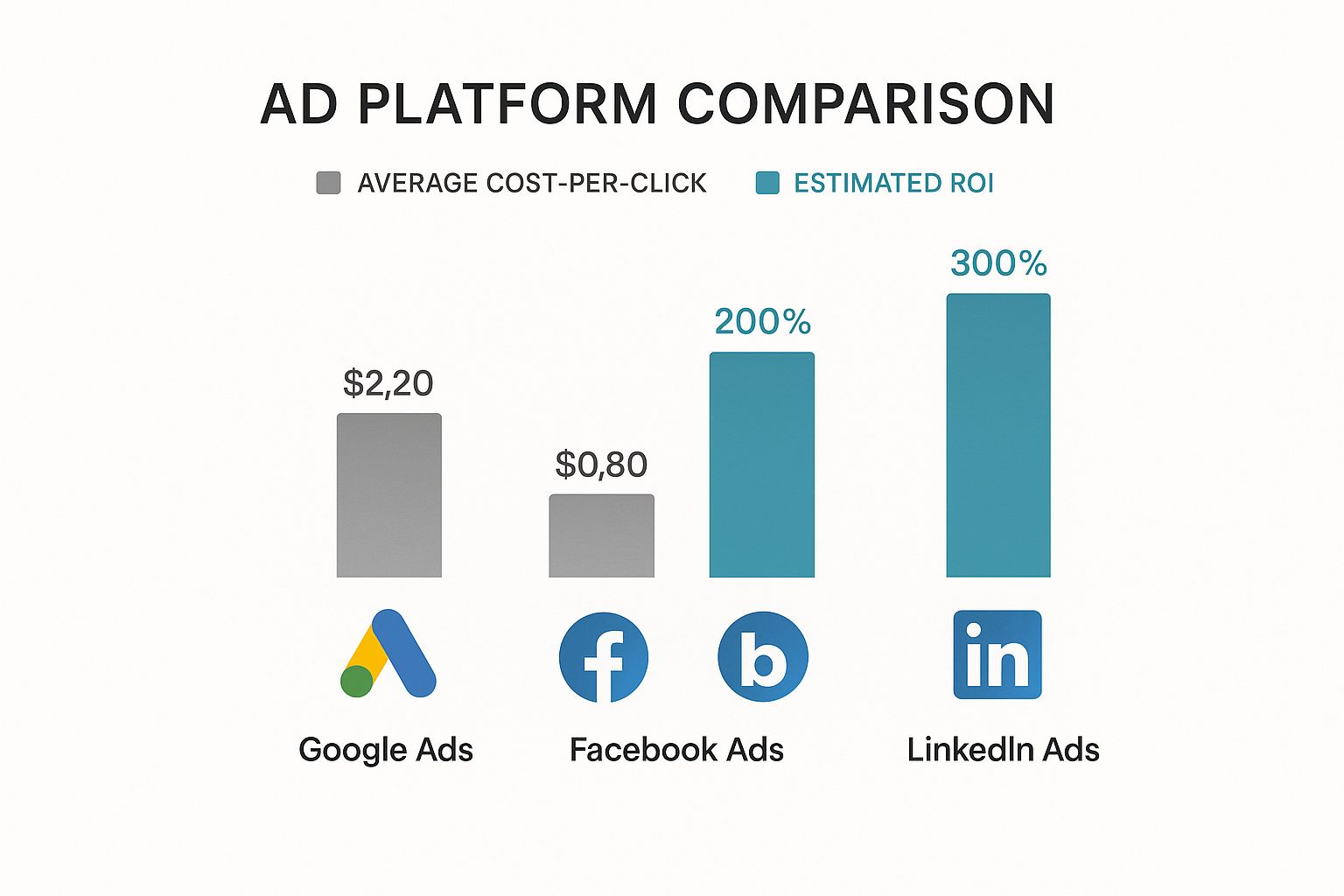
As you can see, a platform like Google Ads might have a higher cost per click, but the user’s intent is often much stronger, leading to a better return. Whichever paid channel you choose, make sure you’re tracking the right digital marketing performance metrics so you know exactly what’s working and what isn’t.
Answering Your Top Traffic Growth Questions
Even when you have a solid plan, a few key questions always seem to pop up on the road to growing your website’s traffic. Let’s dig into some of the most common ones I hear from marketers and business owners.
Think of this as a quick-and-dirty FAQ, tackling the real-world hurdles that can make or break your strategy.
How Long Does It Take to See an Increase in Website Traffic?
This is always the first question, and the only honest answer is: it really depends on the channels you’re using. There’s no magic number here.
SEO is the long game. You’re building an asset, and that takes time. You might start seeing some positive movement in your keyword rankings within 3 to 6 months, but a significant, steady stream of organic traffic? That often takes a solid 6 to 12 months of consistent work. Search engines need time to find your content, understand it, and most importantly, trust it.
Paid advertising, on the other hand, is like flipping a switch. You can have traffic hitting your site the minute your Google Ads or Facebook campaign goes live. The catch? That traffic disappears the second you stop paying the bill.
The smartest approach is often a blend of both. Use paid ads for quick wins and immediate feedback while you patiently build your SEO foundation for sustainable, long-term (and free) traffic.
Should I Focus on SEO or Social Media for Traffic?
This isn’t an “either/or” choice—it’s more of a “both, but for different reasons” situation. SEO and social media play distinct but complementary roles in getting more people to your website.
Think of SEO as your tool for capturing high-intent traffic. These are the people actively typing questions into Google, looking for the exact solutions, products, or services you offer. Someone who lands on your site from a specific search query is often much further along in their buying journey.
Social media is all about brand awareness and community building. It’s where people discover you. You can introduce your brand to new audiences, build real relationships, and create that initial spark of interest that gets people talking.
Here is a practical example of how they can work together:
- Step 1: Publish Your Pillar Content. You write a comprehensive, SEO-optimized guide on a topic your audience cares about.
- Step 2: Promote It on Social. You don’t just drop a link. You create engaging, native posts—maybe a video clip, an infographic, or a poll—that pull out key insights from the article and drive people to learn more.
- Step 3: Earn Social Signals. That buzz on social media can lead to more shares and even backlinks, which indirectly gives your SEO a nice little boost over time.
Can I Increase Website Traffic Without a Budget?
Absolutely. But let’s be clear: “free” doesn’t mean “no work.” Many of the most effective traffic-driving strategies just require an investment of your time and consistent effort. If you have more time than money, you’re in a great position.
SEO is the foundation of any no-budget traffic plan. Period. Creating genuinely helpful content, optimizing it for the right keywords, and earning backlinks will build a reliable stream of organic visitors.
Beyond the basics, a few other “free” tactics are incredibly effective:
- Guest Blogging: Find other respected websites in your niche and offer to write for them. It gets your name and expertise in front of a brand-new, relevant audience and usually nets you a valuable backlink.
- Community Engagement: Become a genuinely helpful voice in online communities. Spend time on Reddit, Quora, or niche industry forums. Answer questions, offer advice, and become a trusted resource—not a spammer.
- Build an Email List: Your email list is a direct line to your biggest fans. It’s a traffic source you completely own and control, immune to the whims of algorithms.
While there’s no invoice to pay, the “cost” is your discipline and elbow grease. The payoff is a diverse and resilient flow of traffic that you don’t have to keep paying for.
How Often Should I Publish New Content to Get More Traffic?
Here’s a hard-won lesson: consistency and quality will always beat sheer frequency. Publishing one deeply researched, incredibly helpful article every week is far more valuable than churning out five short, mediocre posts.
If your website is relatively new, aiming for 1-2 high-quality posts per week is a great starting point. That cadence is aggressive enough to build momentum with search engines and start populating your content library.
For more established sites, the strategy can shift. Sometimes, updating and expanding an existing article that’s already ranking on page two can deliver a much faster SEO win than creating something new from scratch. You’re building on an asset that already has a bit of authority.
The most important thing is to find a realistic publishing schedule you can stick to without letting the quality slide. That consistency is what builds a loyal audience and signals to search engines that your site is a reliable source of fresh information.
Navigating the path to more website traffic involves a mix of technical skill, creative content, and smart promotion. At Galant Studios, we combine over 8 years of experience with data-driven strategies to build a powerful online presence for your business. Let us handle the complexities so you can focus on what you do best. Discover how our expert SEO and website optimization services can drive real growth for your brand.