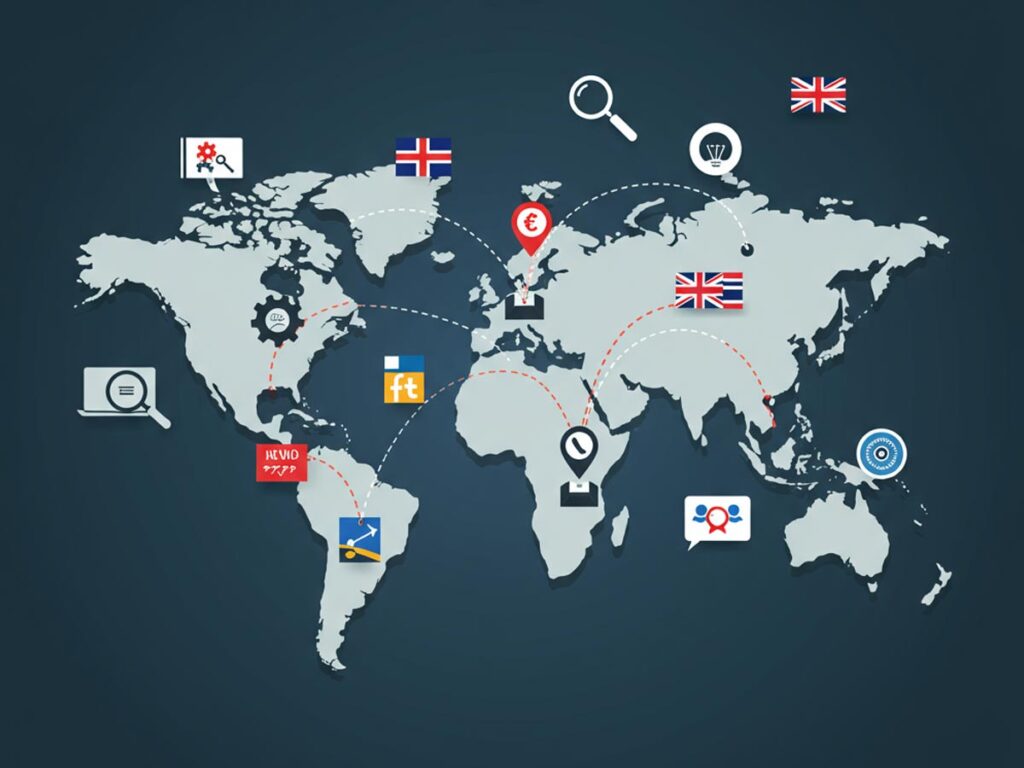
Expanding into international markets presents both tremendous opportunities and unique SEO challenges. Beyond creating content that ranks in your primary market and optimizing for mobile users worldwide, international SEO requires specific strategies to effectively target different countries, languages, and search behaviors.
Our global approach is reflected in our multinational presence, with contact numbers for the US, Spain, and Romania, allowing us to serve clients with true international expertise. This guide outlines a comprehensive framework for expanding your search visibility across borders while maintaining technical excellence and local relevance.
International SEO Planning Framework
Successful international expansion begins with strategic planning:
- Define expansion goals and priorities: Establish clear objectives for each target market
- Assess current international visibility: Analyze existing search presence in target regions
- Identify target countries and languages: Determine specific markets and language requirements
- Evaluate competitive landscape by market: Research market-specific competitors
- Develop market entry sequence: Create phased approach based on opportunity and resources
- Establish measurement framework: Define KPIs for each international market
Strategic planning prevents wasted resources on poorly targeted international efforts. With their 8+ years of experience optimizing websites for 120+ satisfied clients, we understand that methodical planning directly impacts international success.
Market Research Methodology
Thorough market research guides effective international strategy:
- Analyze search volume by market: Determine demand levels in each target country
- Evaluate conversion potential: Assess likelihood of generating business in each market
- Understand local search engines: Research engines beyond Google where relevant
- Identify local search behaviors: Uncover how users search in different markets
- Assess regulatory requirements: Understand privacy, data, and marketing regulations
- Analyze localization needs: Determine cultural adaptation requirements
Market-specific research prevents applying domestic assumptions to international audiences. This approach aligns with our “data-driven tweaks that boost results” methodology, ensuring international expansion decisions are based on market realities.
International Keyword Research
International keywords often differ significantly from domestic terms:
- Avoid direct translation of keywords: Research actual target language search behavior
- Identify market-specific terminology: Understand regional vocabulary differences
- Analyze search intent by market: Recognize how intent varies across cultures
- Research local competitors’ keywords: Discover terms driving traffic in each market
- Consider dialectical variations: Account for language differences across regions
- Quantify opportunity by keyword set: Assess potential traffic value by market
Proper international keyword research prevents the common mistake of assuming direct translations capture actual search behavior. We leverage this approach to help clients build “comprehensive content plans that support your business objectives” across multiple markets.
Technical Implementation Guide
Technical excellence forms the foundation of international SEO:
- Select appropriate URL structure: Choose subdirectories, subdomains, or ccTLDs
- Implement proper hreflang tags: Indicate language and regional targeting correctly
- Configure geotargeting in Search Console: Set appropriate country targeting
- Establish IP delivery protocols: Determine whether to serve content based on location
- Set up international sitemaps: Create language and region-specific XML sitemaps
- Configure proper canonicalization: Prevent duplicate content across language versions
Technical implementation creates the framework for market-specific visibility. We emphasize optimizing “your website’s invisible architecture” as the foundation for successful international expansion.
URL Structure Decision Guide
URL structure significantly impacts international SEO success:
- Subdirectory approach: Use paths like example.com/de/ for lower maintenance but weaker geotargeting
- Subdomain structure: Implement de.example.com for balanced approach
- Country-code TLDs: Utilize example.de for strongest geotargeting but highest maintenance
- Language indicators in URLs: Include clear language identifiers in URL paths
- Avoid automatic redirects: Allow users to select their preferred language/region
- Maintain consistent structure across markets: Use parallel URL patterns for all regions
The right URL structure depends on specific business factors. This strategic approach reflects our focus on creating “a solid SEO framework” customized to each client’s unique international requirements.
Hreflang Implementation
Proper hreflang signals help search engines serve the right content to each user:
- Use correct language and region codes: Follow ISO standards for language and country
- Implement reciprocal hreflang tags: Include all language versions in each page’s tags
- Include self-referencing hreflang: Add tags pointing to the current page itself
- Choose appropriate implementation method: Select HTML, HTTP headers, or sitemap approach
- Verify implementation accuracy: Test for correct syntax and complete coverage
- Monitor for hreflang errors: Check Search Console for implementation issues
Proper hreflang implementation prevents common international ranking problems. With our technical expertise in SEO, we ensure clients implement these critical tags correctly across all international content.
Content Strategy for Global Markets
International content requires balancing global consistency with local relevance:
- Develop core content templates: Create adaptable frameworks for all markets
- Establish market-specific content priorities: Determine unique content needs by region
- Create content production workflows: Build processes for translation and localization
- Define quality assurance protocols: Implement review processes for international content
- Plan content synchronization approach: Determine how to manage updates across versions
- Set publication sequence strategy: Establish whether to launch markets simultaneously or sequentially
Strategic content planning prevents a fragmented international presence. This approach aligns with how we create “compelling content that captivates your audience while strategically driving traffic and conversions” across different markets.
Translation vs. Localization Strategy
The right adaptation approach varies by content and market:
- Identify straight translation opportunities: Determine content suitable for direct translation
- Flag localization requirements: Identify content needing cultural adaptation
- Recognize content requiring creation: Pinpoint topics needing market-specific development
- Select appropriate translation resources: Choose between machine, professional, or native translators
- Implement translation memory tools: Maintain consistency across content pieces
- Establish terminology databases: Create glossaries for consistent term usage
Proper localization significantly impacts both rankings and conversion rates. We help clients determine the appropriate level of adaptation needed for different content types and markets.
Country-Specific SEO Tactics
Local market tactics often differ significantly from domestic approaches:
- Research local search engine preferences: Optimize for Google alternatives where relevant
- Understand local social platforms: Leverage market-specific social networks
- Implement regional schema markup: Add structured data relevant to each market
- Adapt to local user behavior: Adjust to device usage and search patterns by region
- Comply with local regulations: Address privacy, cookie, and marketing requirements
- Leverage local business listings: Optimize for regional directory services
Market-specific tactics strengthen regional relevance and authority. With their experience helping businesses “rank higher on Google” across different markets, we implement approaches tailored to each target region’s unique characteristics.
International Link Building Approach
International link profiles require market-specific strategies:
- Develop region-specific link targets: Identify authoritative sources in each market
- Create localized link-worthy content: Develop assets appealing to regional audiences
- Build relationships with local influencers: Connect with market-specific authorities
- Leverage international brand mentions: Convert unlinked mentions in each market
- Participate in regional industry groups: Engage with market-specific associations
- Monitor international backlink health: Track link quality across all target markets
Strategic international link building strengthens regional authority. This balanced approach reflects our philosophy of creating sustainable SEO improvements through ethical, market-appropriate tactics.
Local Authority Development
Building authority in new markets requires localized approaches:
- Identify market authority signals: Understand what demonstrates credibility in each region
- Develop local partnerships: Build relationships with established regional entities
- Participate in local events: Engage with market-specific industry gatherings
- Contribute to regional publications: Provide content to authoritative local sources
- Leverage existing global authority: Transfer credibility from established markets
- Build regional case studies: Develop market-specific success stories
Local authority directly impacts regional rankings. We leverage these approaches to help clients establish credibility in new markets through strategic, regionally appropriate methods.
International Performance Measurement
Proper measurement ensures global optimization effectiveness:
- Set up country-specific analytics views: Create segmented reporting by market
- Establish regional KPI benchmarks: Define success metrics for each country
- Monitor ranking performance by market: Track positions in local search engines
- Analyze market-specific user behavior: Assess engagement patterns by region
- Track cross-market attribution: Understand how users move between regional versions
- Create international reporting dashboards: Develop comprehensive global visibility reports
Data-driven measurement guides ongoing international optimization. This approach exemplifies our focus on “data-driven tweaks that boost results” across all target markets.
Implementation Strategy
Follow this phased international expansion approach:
- Phase 1: Strategy and Planning (Month 1)
- Conduct international market research
- Define target markets and languages
- Select technical implementation approach
- Phase 2: Technical Foundation (Month 2)
- Implement URL structure
- Configure hreflang tags
- Set up international sitemaps
- Phase 3: Content Development (Months 3-4)
- Create localized core content
- Implement market-specific pages
- Optimize for regional keywords
- Phase 4: Authority Building and Refinement (Ongoing)
- Develop regional backlink profiles
- Analyze market-specific performance
- Refine based on regional data
This methodical approach ensures sustainable international growth. As one satisfied Galant Studios client shared, “We’ve been very happy with their results, which have helped our growth!” This success stems from implementing structured, strategic approaches to international expansion.
International SEO requires balancing global consistency with local relevance and authority. By implementing this comprehensive framework, you’ll create a strong foundation for sustainable global search visibility that drives business growth across borders.
The investment in proper international SEO pays dividends through improved visibility in high-potential markets, preventing the common pitfalls that occur when domestic strategies are applied without appropriate regional adaptation.