Think of your online business listings as your digital storefront. Optimizing them is the process of claiming your space on sites like Google Maps, Yelp, and Apple Maps, then making sure every detail is perfect. This is how you show up when someone nearby searches for what you offer, directly leading to more calls, more foot traffic, and more business.
Why Local Listing Optimization Is a Game Changer
For any local business, your online listing has become your new front door. It’s the first impression, the digital handshake, and often the deciding factor for a potential customer. Getting this right isn’t just a “nice-to-have” anymore; it’s a fundamental strategy for survival when almost every purchase decision starts on a phone.
Let’s look at a practical example: a local pizzeria in Chicago. They might be competing with giants like Domino’s or Pizza Hut. By meticulously optimizing their Google Business Profile with high-quality photos of their deep-dish pizza, responding to every review, and ensuring their hours are always correct, they can dominate high-intent searches like “best deep-dish pizza near Wrigleyville.” A well-managed listing puts them right at the top of the results, pulling in people who are ready to buy right now.
But it’s not just about getting found—it’s about getting chosen. Customers today do their homework. They look at your ratings, read your reviews, and scroll through your photos before they even think about visiting. An incomplete or wrong listing sends a terrible message. It suggests you might be closed, unprofessional, or just don’t care about the customer experience.
Connecting Digital Details to Real-World Results
The link between accurate listings and your bottom line is incredibly direct. Just think about the specific actions you want from a customer:
- More Calls: A correct, clickable phone number makes it effortless for them to reach out. For example, a roofer who lists their emergency line clearly can get a call within minutes of a storm hitting.
- More Bookings: Adding a booking button lets customers schedule appointments without leaving the search results. A hair salon can fill their chairs directly from Google Search.
- More Foot Traffic: An accurate map pin and up-to-date hours guide people straight to you, not to a competitor. A coffee shop that updates its holiday hours prevents a potential customer from showing up to a locked door.
One of the biggest mistakes I see businesses make is treating their listings as a “set it and forget it” task. These are living, breathing profiles of your business. They need constant attention to build trust and authority with both search engines and the people you want to serve.
The Power of Consistency and Trust
The bedrock of local listing optimization is consistency—especially with your Name, Address, and Phone number (NAP). A BrightLocal survey found that a staggering 98% of consumers use the internet to find information on local businesses, and 87% read online reviews before making a decision.
When a customer stumbles upon different addresses or phone numbers for your business, their confidence evaporates instantly. Search engines see this, too, and it can torpedo your rankings. Building a consistent digital footprint is a core part of any successful local SEO strategy for small businesses. That consistency signals that you’re reliable, which is the first step in turning a curious searcher into a loyal customer.
Laying the Groundwork with NAP Consistency
Think of your business’s Name, Address, and Phone number (NAP) as its digital fingerprint. It’s the core identifier that search engines like Google use to verify you’re a real, legitimate business at a specific location.
If that fingerprint gets smudged—with different names, old addresses, or incorrect phone numbers scattered across the web—it creates serious confusion. This confusion doesn’t just frustrate potential customers; it actively hurts your local search rankings.
Perfect NAP consistency is the bedrock of any successful local listing strategy. This means every single mention of your business online, from your Google Business Profile to a tiny niche blog, needs to be absolutely identical. Even the smallest differences can cause search algorithms to see them as separate businesses, creating messy duplicate listings that compete against you.
Why Tiny Errors Cause Massive Headaches
It’s easy to shrug off minor differences, but search engines are incredibly literal. They don’t see typos; they see red flags that might point to an unreliable or even a defunct business. This digital uncertainty is enough to push your listing down in the search results, especially in the cutthroat local map pack.
Let’s look at some real-world examples of how seemingly harmless variations can create chaos:
- Business Name: “Jen’s Bake Shop” vs. “Jens Bake Shop LLC” vs. “Jen’s Bakery”
- Address: “123 Main St.” vs. “123 Main Street” vs. “123 Main Street, Suite #2”
- Phone Number: “(555) 123-4567” vs. “555-123-4567” vs. “+1 (555) 123-4567”
Each one of those variations has the potential to spawn a rogue listing. Imagine a potential customer finding two different addresses for you. They won’t know which is right, and more often than not, they’ll just give up and go to a competitor with clearer information.
This is all about wrestling back control of your online identity.
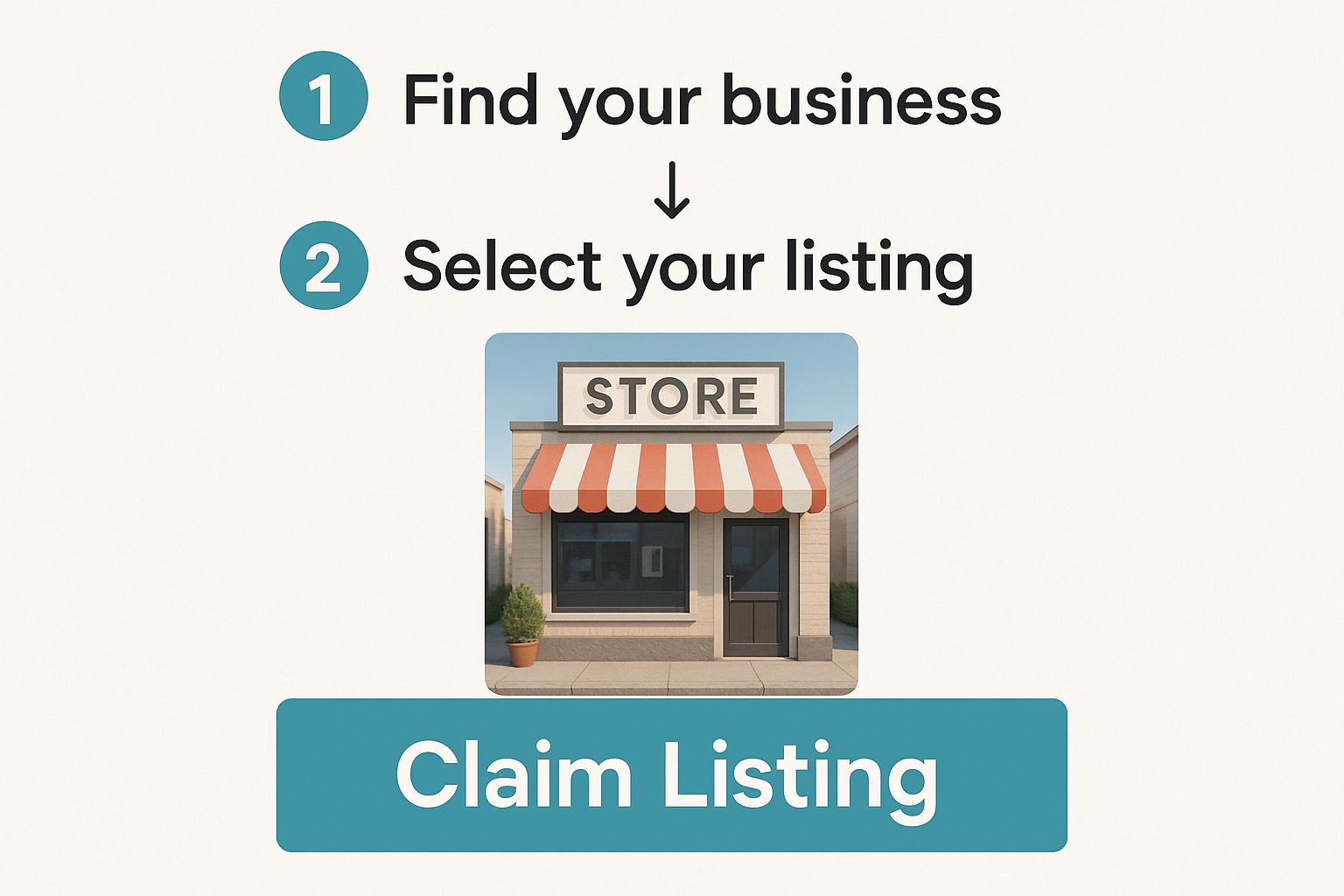
Claiming your primary listings on the major platforms is the first, non-negotiable step to enforcing this consistency across the web.
Time to Conduct Your NAP Audit
Before you can fix anything, you have to understand the full scope of the problem. A proper NAP audit means hunting down every online mention of your business to check it for accuracy. This isn’t just a quick Google search; it takes a bit of digital detective work.
First thing’s first: create a “master NAP” file. A simple spreadsheet is perfect. This document will become your single source of truth, holding the one and only correct version of your business details.
Your master NAP file is your North Star for all local SEO efforts. It needs to detail the exact formatting for your business name, street address, suite number (if you have one), city, state, zip code, and phone number. Every future citation you build or correct must match this file perfectly. No exceptions.
Once your master file is ready, you can start the audit. To uncover hidden or incorrect listings, you need to think like a search engine. Don’t just search for your business name; try different combinations to find all the variations that might be lurking out there.
Smart Search Queries for Your Audit:
"Your Business Name"(always use quotes)"Your Business Name" + "Old Address""Your Business Name" + "Wrong Phone Number""Your Address" - "Your Business Name"(this is a great trick to find other businesses listed at your address)
As you find listings, log everything in your spreadsheet. Note every correct citation, every incorrect one, and any duplicates you find. This methodical approach is the only way to systematically clean up your digital footprint.
You can also use free online tools to get a quick snapshot of your NAP health on major directories. They’re a great starting point, but manual searches are essential for finding mentions on smaller, industry-specific sites or in unstructured citations like blog posts. The best approach is a combination of both. This ensures your audit is truly thorough, giving you a rock-solid foundation. A consistent digital presence, as defined by the concept of a citation, sends a powerful signal to search engines that your business is legitimate, active, and trustworthy.
Mastering Your Google Business Profile
Think of your Google Business Profile (GBP) as more than just an online listing. It’s your digital storefront, your interactive billboard, and for many people, the very first impression they’ll have of your business. Getting the basics set up is a good start, but truly mastering your profile is what separates the businesses that just show up from the ones that completely dominate local search.
This isn’t just a hunch; the data backs it up. A well-oiled GBP is a massive factor in where you land in the local map pack—that prime real estate at the top of the search results. In fact, industry analysis shows that your GBP signals can influence as much as 32% of local pack rankings. Considering that 42% of users click on one of those map pack results, being invisible there means you’re missing out on a huge slice of the pie.
Choosing Categories That Attract Your Ideal Customer
One of the most powerful, and frankly, most overlooked, parts of your GBP is your business category. Google leans heavily on your primary category to understand what you do at your core, giving it the most weight in its ranking algorithm. This one choice has a direct line to the search queries you’ll show up for.
But the real strategy comes into play with your secondary categories. These are your opportunities to snag more specific, high-intent searches.
Here’s a practical example: A plumber’s primary category was just “Plumber.” He was getting calls, but mostly for small, low-margin jobs like leaky faucets. By adding specific secondary categories like “Emergency Plumber,” “Water Heater Repair,” and “Drain Cleaning Service,” he started appearing for those urgent, high-value searches. The shift was immediate, capturing leads from people with a burst pipe at 2 AM, which dramatically increased his profitability.
Pro Tip: Stop guessing what categories to use. A great trick is to simply search for your top services in your area and see which competitors are ranking in the top three. Look at their primary and secondary categories—it’s like getting a cheat sheet for what Google is already rewarding.
Crafting a Description That Converts
You have 750 characters for your business description. Don’t waste them. This is your elevator pitch to every potential customer who finds you. A generic, keyword-stuffed description is a missed connection. You need to write for people first, search engines second.
Here’s a simple framework to make it count:
- Lead with your value proposition. What makes you different? Are you a family-owned auto shop that’s been serving Austin since 1985? Do you offer a 24/7 emergency electrical service? Put your most compelling hook right at the beginning.
- Speak their language. Use the same words and phrases your customers would use. Understanding this is key, and it often involves Mastering Search Query Analysis to see what people are actually typing into Google.
- Weave in your key services. Don’t just list them. For a local coffee shop, you might mention “artisan coffee,” “freshly-baked pastries,” and a “cozy atmosphere with free Wi-Fi.”
This description isn’t just filler text; it sends powerful relevance signals to Google.
Advanced Tactics for Engagement and Visibility
A static profile is an invisible profile. The secret to staying on top is continuous engagement. You have to actively use the tools Google gives you to signal that your business is active, responsive, and relevant today.
1. Keep Things Fresh with Google Posts
Think of Google Posts as free mini-ads that show up right on your profile. They’re perfect for highlighting:
- Promotions and Sales: Announce a “15% off spring cleaning” special.
- New Products or Services: Show off that new seasonal menu item.
- Company News and Events: Share updates about your business or community involvement.
Posts eventually expire, which is Google’s way of encouraging you to keep adding fresh content. This constant activity is a huge positive signal.
2. Take Control of the Q&A Section
The Questions & Answers feature is a potential goldmine… or a minefield. Customers can ask questions, and—here’s the scary part—anyone can answer them. If you’re not paying attention, you could have incorrect information living on your profile.
The best defense is a good offense. Seed your own Q&A by pre-loading it with the questions you get all the time. For instance, a local gym could proactively add and answer questions like: “Do you offer day passes?”, “Is there a designated free weight area?”, and “What are your busiest hours?”. This helps customers and establishes your expertise.
3. Show, Don’t Just Tell, with Geotagged Media
Photos are proof. According to Google, businesses with photos get substantially more requests for driving directions and more clicks to their websites. It’s a no-brainer.

Upload high-quality images of your storefront, your team in action, and your finished work. For an extra SEO boost, geotag your photos before uploading. This embeds location data directly into the image file, giving Google another strong signal that reinforces exactly where you do business.
Google Business Profile Optimization Checklist
To help you stay on track, I’ve put together a checklist that breaks down the most important optimization tasks by their potential impact.
| Optimization Task | Impact Level | Actionable Tip |
|---|---|---|
| Verify Your Listing | Critical | This is non-negotiable. An unverified profile has almost zero visibility. |
| Select Primary & Secondary Categories | High | Research top competitors to see which categories they use for your key services. |
| Ensure 100% NAP Consistency | High | Your Name, Address, and Phone number must be identical everywhere online. |
| Write a Compelling Description | High | Lead with your unique value proposition and naturally include 2-3 main keywords. |
| Upload High-Quality Photos/Videos | High | Add at least 10 photos to start, including exterior, interior, and team shots. Geotag them! |
| Generate & Respond to Reviews | High | Aim for a steady stream of new reviews and reply to every single one (good or bad). |
| Utilize Google Posts Weekly | Medium | Share offers, events, or updates. Use a strong call-to-action in every post. |
| Enable Messaging Feature | Medium | Turn on messaging to allow customers to contact you directly from your profile. |
| Build Out the Q&A Section | Medium | Proactively add and answer at least 5-10 of your most frequently asked questions. |
| Add Products/Services | Medium | Fill out these sections completely with detailed descriptions and pricing if applicable. |
Following this checklist is the most direct path to turning your GBP from a simple listing into a powerful customer acquisition engine. It’s about being thorough and, most importantly, consistent.
Expanding Your Digital Footprint Beyond Google
Look, your Google Business Profile is the undisputed heavyweight champ of local search. We all know that. But if that’s the only place you’re putting your energy, you’re building your house on a single pillar. A truly resilient online presence—one that search engines trust and customers can find—is built across a whole network of platforms.
This is where strategic citation building comes in. A citation is simply any online mention of your business’s Name, Address, and Phone number (NAP). Think of each consistent citation as another “vote of confidence” that tells Google and other search engines you’re a legitimate, established local business. The more of these votes you get from reputable sources, the more trustworthy you look.
This isn’t just about feeding the algorithm, either. It’s about being where your customers actually are. Not everyone’s first stop is Google Maps. Millions of iPhone users ask Siri for directions, pulling data straight from Apple Maps. Others live and die by Yelp reviews before picking a restaurant. If you’re not on these platforms, you’re flat-out invisible to a huge chunk of your potential market.
Identifying the Platforms That Matter Most
The secret to effective citation building is focusing your effort where it counts. Spreading yourself thin across hundreds of junk directories is a massive waste of time. Instead, you need to be strategic and prioritize platforms based on their authority and, just as importantly, their relevance to your business.
Start with the big dogs—the major data aggregators and top-tier directories that power countless other apps and services.
- Apple Maps: The default navigation tool for every single iPhone, iPad, and Mac user. You can’t afford to ignore it.
- Bing Places: This is Microsoft’s answer to GBP. It’s essential for grabbing visibility on the Bing search engine and for anyone using Microsoft devices and services.
- Yelp: A powerhouse for reviews and discovery, especially if you’re in the restaurant, retail, or home services space.
- Facebook: It’s more than social media; it’s one of the first places customers look for your hours, latest updates, and what other people are saying about you.
Once you have those covered, the real magic happens when you drill down into industry-specific directories. These niche platforms carry a ton of weight with search engines because they’re hyper-relevant. For example:
- A law firm absolutely must have a presence on Avvo and FindLaw.
- A home contractor’s profile on Houzz or Angi is non-negotiable.
- For a restaurant or café, a perfectly optimized TripAdvisor profile is crucial.
These niche sites often rank on the first page of Google for relevant searches, giving you another powerful way to get in front of customers who are actively looking for what you do. This multi-platform approach is a core component of mastering local SEO strategies.
Structured vs. Unstructured Citations
It also helps to know the two main types of citations you’ll encounter. Both are valuable for building local authority.
Structured Citations are what most people think of—the neat, organized listings you find in directories like Yelp, Yellow Pages, or those industry-specific sites. Your business information is laid out in a consistent format (Name, Address, Phone, Website, etc.). These are the foundation of your citation profile.
Unstructured Citations are more organic mentions of your business NAP. You might find them in a local newspaper’s article about a community event, a blog post reviewing your services, or on a local forum. While you can’t control them as easily, these mentions are gold because they look incredibly natural and show search engines that your business is a real, active part of the local community.
Don’t underestimate the impact of a broad and accurate citation profile. One analysis found a staggering 91% increase in local search visibility for businesses that got their listings on 10 or more directories. That same study showed that profile completeness led to a 69% increase in website hits, proving this effort pays off in actual customer engagement.
The biggest challenge isn’t always creating new listings. It’s often hunting down and fixing old, incorrect ones. Many directories scrape public data to auto-generate profiles, and that data can be years out of date. Actively claiming these rogue listings is a critical step in controlling your business’s online story and ensuring your NAP is consistent everywhere.
Turning Customer Reviews into a Ranking Superpower
Customer reviews are the lifeblood of your local business listings. They’re so much more than just a little bit of social proof for potential customers. To a search engine, a steady stream of positive feedback is a powerful signal that your business is active, legitimate, and genuinely valued by the community.
Think of each review as a conversation. When someone leaves you feedback, they’re starting a dialogue. How you choose to respond tells everyone—especially Google—just how much you care about your reputation and making customers happy. This isn’t just good customer service; it’s a critical part of optimizing your listings.
Ethically Encouraging a Flow of Feedback
The first hurdle is often just getting more reviews in the first place. The trick is to make it incredibly easy for happy customers to share their thoughts. Whatever you do, never offer incentives or buy reviews. That’s a fast track to getting your listing penalized and violates the terms of service on just about every platform.
Instead, focus on removing any friction in the process.
A fantastic tactic is to create a direct review link from your Google Business Profile. Once you have that, you can weave it into your daily operations so it feels natural, not pushy.
Simple Ways to Ask for Reviews:
- Pop it in your email signature: A quick “Enjoyed our service? Leave us a review!” with the link works wonders.
- Add it to receipts or invoices: Print the link or a QR code that takes customers right to your review page.
- Send a follow-up text or email: After a service is complete, a mechanic could send a text: “Hi Jane, this is Mark from AutoFix. Just confirming your car is all set. If you were happy with our service, a quick review would mean the world to us: [link].”
The goal isn’t to pressure anyone. You’re just opening the door for customers who are already pleased and probably willing to share their experience. This consistent flow is one of the most important local SEO ranking factors you can directly control.
Responding to Every Review—The Good and The Bad
You absolutely have to respond to your reviews. It’s non-negotiable. It shows everyone that you’re an engaged business owner who actually listens to what customers have to say. In fact, research shows that 89% of consumers expect a response after leaving a review. Ignoring them is like leaving a customer standing at your counter with no one to help them.
Responding to a glowing five-star review is the easy part. Thank them by name, maybe mention a specific detail from their review to show you actually read it, and invite them back.
Example Positive Response: “Hi Sarah, thank you so much for the kind words! We’re thrilled to hear you enjoyed the lavender latte and our patio seating. We can’t wait to see you again soon!”
But here’s a pro-tip: your response to a negative review is often far more important. It’s a public stage to show off your professionalism and commitment to service. A thoughtful, calm reply can actually build trust with potential customers who are lurking and watching how you handle criticism.
Turning Negative Feedback into a Positive Signal
When that one-star review inevitably lands, don’t panic or get defensive. I’ve found that a simple framework is the best way to de-escalate the situation and show that you’re taking ownership.
- Acknowledge and Apologize: Start by thanking them for the feedback and apologize that their visit didn’t meet their expectations.
- Take it Offline: Offer to fix the problem directly. Give them a specific name, email, or phone number to contact.
- Keep it Brief and Professional: Avoid getting into a long public back-and-forth. The goal is to demonstrate that you’re responsive, not to win an argument.
Example Negative Response: “Hi Mike, thank you for bringing this to our attention. We’re very sorry to hear that your experience with our delivery service was not up to our usual standards. That’s certainly not the experience we want for our customers. Please contact our manager, Jessica, at [email/phone] so we can learn more and make this right.”
This approach shows potential customers that even when things go wrong, you’re dedicated to finding a solution. It completely transforms a potential liability into a showcase of excellent customer service.
Answering Your Top Local Listing Questions
Even with a solid plan, a few key questions always pop up when businesses start tackling their local listings. I’ve heard them all over the years, so let’s get right into the most common ones.
“How Long Will This Actually Take to Work?”
This is always the first question, and the honest-to-goodness answer is, “it depends.” Some changes can have a near-immediate impact. If you fix a wrong phone number on your Google Business Profile, for example, that could show up in search results in a week or less.
But if you’re talking about making a serious jump in the local map pack rankings, that’s more of a long game. Realistically, you’re looking at 30 to 90 days of consistent work to see significant movement. The timeline really hinges on a few things: how fierce the competition is in your area, how many bad citations you need to clean up across the web, and how consistently you can earn new customer reviews.
Think of it like building a house, not flipping a light switch. The best results—the ones that last—come from steady, ongoing effort, not a one-and-done project.
“Do I Really Need to Care About Anything Besides Google?”
Yes. A thousand times, yes. I get why people ask this—Google is the 800-pound gorilla. But ignoring everything else is a huge strategic blunder. Your customers are spread out across different platforms, and search engines themselves look for proof that your business is legitimate all over the web.
Here’s why you can’t afford to just focus on Google:
- Apple Maps: This is baked into every single iPhone. When someone asks Siri for “pizza near me,” those results are coming straight from Apple Maps, not Google. You’re invisible to millions of potential customers if you’re not there.
- Industry-Specific Sites: Think about platforms like TripAdvisor for a restaurant, Houzz for a home remodeling company, or Avvo for a law firm. These sites carry massive weight in their specific fields. Customers trust them, and so does Google.
- Building Trust: When Google’s crawlers see your business’s NAP (Name, Address, Phone number) listed consistently across dozens of reputable directories, it sends a powerful signal. It screams, “This business is real, it’s established, and you can trust it.” A clean, diverse citation profile is one of the strongest assets you can have.
“What’s the Single Biggest Mistake I Could Make?”
Without a doubt, the most common and damaging mistake is the “set it and forget it” approach. So many business owners go through the initial trouble of claiming their Google Profile, filling in the basics, and then they never log in again. It’s a massive missed opportunity that can quickly turn into a problem.
Your local listings aren’t static pages in an old-school phone book; they’re living, breathing profiles. When a profile sits there neglected, bad things can happen:
- Competitors can actually “suggest an edit” to your listing—and sometimes those edits, like changing your hours or marking you as closed, get approved.
- Customers might upload their own unflattering photos or ask questions that just sit there unanswered, making your business look unresponsive.
- You miss out. Google is always adding new features like Posts, Q&A, and direct messaging. If you’re not using them, you’re falling behind the businesses that are.
The only way to win at this is with active, ongoing management. Regularly adding new photos, responding to every single review (good and bad), and using the features available shows both customers and the search engines that you’re active, engaged, and worthy of that top spot.
Ready to stop guessing and start ranking? Galant Studios has over 8 years of experience helping businesses like yours dominate local search. We build data-driven SEO strategies that turn your online listings into powerful customer acquisition tools. Get in touch with us today!