You can’t prove the value of your SEO efforts without first knowing your starting point. Before you celebrate growth, you need to establish a clear, honest baseline. This initial benchmark is what gives context to every future metric, turning vague efforts into a powerful story of tangible success.
Establishing Your SEO Performance Baseline

You can’t measure growth without a starting line. This foundational step is more than just data collection—it’s about creating the benchmark that gives your entire SEO strategy meaning. Without it, you’re flying blind, unable to prove whether your actions are actually moving the needle and driving real business results.
Think of it as the “before” picture in a transformation story. That initial snapshot is what makes the “after”—your hard-earned results—so much more powerful and persuasive. A solid baseline transforms ambiguous goals like “get more traffic” into measurable objectives you can build a strategy around.
Conducting Your Initial Organic Audit
The first step in building this baseline is a comprehensive audit of your current organic presence. This is a deep dive, capturing a precise snapshot of your website’s performance at this exact moment in time.
This audit will reveal which pages are your current workhorses bringing in traffic, where you stand for your most important keywords, and what your organic conversion rates look like right now. For a more detailed breakdown, our guide on the complete SEO audit process walks you through every stage.
To begin, you’ll need to pull critical data from essential tools like Google Analytics and Google Search Console. Zero in on your top-performing pages and the keywords already driving traffic your way. This initial analysis is brilliant for revealing both your hidden strengths and your most glaring weaknesses.
Benchmarking Key Performance Indicators
Tracking performance effectively hinges on consistent benchmarking. This means collecting key performance indicators (KPIs) at the outset and then comparing them over time—against your own progress, industry standards, and even competitors. This discipline helps you spot performance shifts early, allowing for quick, strategic adjustments instead of reactive fixes.
To give you a clear picture, here are the core metrics you’ll want to gather for your initial baseline audit.
Essential SEO KPIs for Your Baseline Audit
This table summarizes the core Key Performance Indicators (KPIs) to collect when establishing your initial SEO performance baseline. These metrics provide a comprehensive snapshot of your starting point.
| KPI Category | Specific Metric | Why It Matters |
|---|---|---|
| Organic Visibility | Keyword Rankings | Shows your current position for target search terms and market share. |
| User Engagement | Organic Bounce Rate | A high bounce rate can signal a disconnect between user intent and your content. |
| Traffic & Acquisition | Organic Sessions | Measures the total number of visits from search engines, your primary audience. |
| On-Site Performance | Pages per Session | Reveals how deeply users explore your site, indicating content value and site structure. |
| Business Impact | Organic Conversion Rate | Directly links SEO efforts to business goals like leads, sales, and sign-ups. |
Collecting these KPIs gives you a multi-dimensional view of your performance, moving beyond simple traffic numbers to understand how users interact with your site and whether that interaction leads to tangible business outcomes.
A baseline does more than just measure the past; it sets the stage for the future. It allows you to set achievable goals and clearly demonstrate the tangible impact of your SEO work to stakeholders, turning data into a compelling story of growth.
Choosing Metrics That Actually Matter
In the ocean of SEO data, it’s dangerously easy to drown. The real skill is focusing on the metrics that truly signal business success. Without this laser focus, you risk chasing “vanity metrics”—impressive-looking numbers that do little for your bottom line.
The first step is learning to distinguish between what looks good and what actually grows your business. A huge spike in impressions might feel like a win, but if it doesn’t translate into more clicks, traffic, or sales, it’s just noise. Actionable KPIs, on the other hand, are directly tied to tangible business objectives.
Tying SEO to Business Outcomes
The most persuasive metrics are always the ones that demonstrate real-world value. Instead of getting bogged down in day-to-day keyword ranking fluctuations, prioritize metrics that show how your search performance contributes to overall growth.
Here are a few of the primary, business-focused KPIs that should be on every marketer’s dashboard:
- Organic Conversions: This is the ultimate benchmark for SEO success. It tells you exactly how many visitors from search engines are completing a goal, whether that’s making a purchase, submitting a lead form, or signing up for a newsletter.
- Organic-Driven Revenue: For any e-commerce site, this metric is non-negotiable. It calculates the precise revenue generated from customers who found you through organic search, directly connecting your SEO work to the bottom line.
- Keyword Visibility for High-Intent Terms: It’s smart to track your position for keywords that signal a strong intent to buy. For example, a local contractor should obsess over their rank for “emergency plumbing services near me” far more than a broad query like “plumbing tips.”
To truly dial in your selection, it’s worth reviewing best practices for understanding key project tracking metrics. This perspective ensures your SEO dashboard aligns perfectly with business goals, making it much easier to demonstrate ROI to stakeholders.
Interpreting User Engagement Signals
Beyond direct conversions, you need to understand what happens after someone clicks on your search result. User engagement metrics offer a window into your content quality and the overall user experience on your site.
For example, Click-Through Rate (CTR) has always been a core metric. After all, the #1 organic result typically sees a CTR of around 39.8% globally. However, it’s crucial to know that AI-driven search features are starting to shift click patterns, causing CTRs to drop for certain queries as users find answers directly on the search page.
Even with these changes, organic search remains a powerhouse, driving about 53% of all website traffic worldwide. This fact alone underscores why performance tracking is so essential for connecting your SEO efforts to business outcomes.
By focusing on a hand-picked list of actionable KPIs—like organic conversions and key engagement signals—you shift your SEO tracking from a simple reporting task into a strategic tool for growth. These are the metrics that tell the real story of your performance.
Ultimately, your goal is to build a performance dashboard that cuts through the clutter and tells a clear story. When you have a solid grasp of core metrics, you can report on what truly moves the needle for your business with confidence.
Configuring Your SEO Tracking Toolkit
Any successful SEO strategy is built on a bedrock of reliable data. Before you can track performance, you must configure your essential tools correctly. A shoddy setup leads to flawed data, which in turn leads to poor decisions and wasted resources. The heart of your toolkit will almost always be the powerhouse combination of Google Analytics 4 (GA4) and Google Search Console, often rounded out with a dedicated rank tracker.
Think of these platforms as diagnostic instruments, not just data dumps. By linking them and defining your key settings from the start, you ensure every metric you pull is clean, accurate, and tied directly to your goals. This initial groundwork helps you sidestep common setup mistakes that can poison your analysis down the road.
Integrating Google Analytics and Search Console
First things first: you absolutely must link Google Search Console with Google Analytics 4. This is the crucial step that connects your search performance directly to on-site user behavior. It’s what bridges the gap between what happens on a Google search results page and the actions a visitor takes once they arrive.
Once linked, GA4 will begin pulling in valuable Search Console data. You’ll be able to see keyword queries, impressions, and click-through rates right inside your Analytics reports. This unified view is where the real diagnostic work begins. For example, you can spot a page that gets tons of impressions but has a terrible click-through rate, then see in GA4 if that same page also has a high bounce rate. That’s a clear signal of a disconnect between what searchers expect and what your content delivers.
Connecting these two free, powerful tools gives you a much more complete picture of your SEO performance. You stop looking at isolated metrics and start seeing a connected story that reveals not just what is happening, but why.
Defining Conversion Events in GA4
To measure what truly matters to your business, you have to tell GA4 what a “win” looks like. In GA4, these wins are called conversion events. These are specific user actions that align with your business goals—think form submissions, product purchases, or newsletter sign-ups.
Without setting up conversion events, you’re only tracking traffic and engagement, not actual business results. Defining these goals is what transforms GA4 from a simple traffic-counting tool into a machine for measuring ROI. For instance, by creating a “lead_form_submission” event, you can directly attribute leads to your organic search efforts and pinpoint which specific pages or keywords are most valuable. A better user experience often drives more conversions, so it’s also worth understanding how to approach Core Web Vitals optimization.
This is a look at the traffic acquisition report in Google Analytics, where you can start analyzing session data from different channels.
Looking at this data, you can see exactly how your organic search traffic stacks up against other channels in driving both engaged sessions and, most importantly, conversions.
Implementing a Rank Tracker
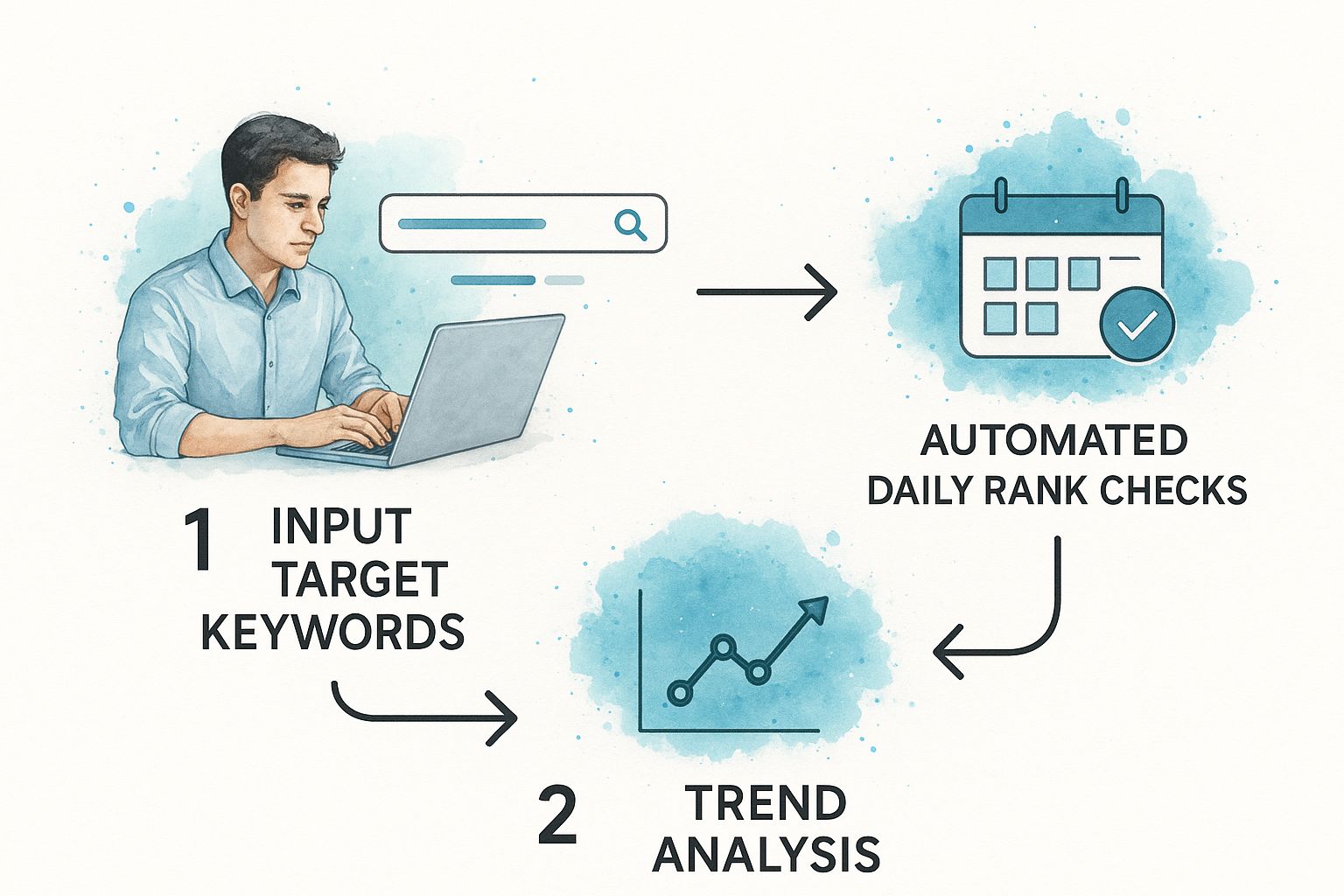
While Google Search Console provides a fantastic amount of keyword data, a dedicated rank tracking tool offers a more immediate and granular view. These tools run automated daily or weekly checks on your most important keywords, giving you a consistent pulse on your visibility. This allows you to quickly spot ranking drops or gains, connect them to specific SEO activities you’ve undertaken, and react much faster.
From Data Overload to Actionable Insights

Raw data from your SEO tools is just noise until you find the story it’s trying to tell. This is where real analysis begins—the process of turning numbers on a screen into a strategic roadmap. It means going beyond just watching metrics and starting to ask why behind every meaningful change.
Interpreting SEO data is all about connecting the dots. Your goal should be to shift from passively reporting numbers to actively solving problems and identifying opportunities. A genuine analysis doesn’t just state that traffic went down; it digs into the likely causes and presents a clear, prioritized list of actions to get things back on track.
Diagnosing Performance Shifts with Real Scenarios
Effective SEO tracking often feels like detective work. When a key metric suddenly moves, you need to cross-reference data from multiple sources to uncover the root cause. This simple practice stops you from making knee-jerk decisions based on an incomplete picture.
Let’s walk through a common and often alarming scenario: a sudden, sharp drop in organic traffic. A junior marketer might panic, but an experienced analyst knows exactly where to start digging. The investigation should always begin by comparing data from Google Search Console and Google Analytics 4.
First, check Google Search Console: Did your keyword rankings or impressions also take a nosedive? If so, the issue is almost certainly a loss of visibility. This could be triggered by a competitor’s surge, a recent Google algorithm update, or even a technical problem like a
noindextag being accidentally added to a key page.Then, analyze user behavior in GA4: What if your rankings and impressions in Search Console look stable, but traffic is still down? The problem is likely your click-through rate (CTR). This tells you people are seeing your site in the search results but aren’t clicking. Maybe a competitor wrote a more compelling title tag, or a new SERP feature like an AI Overview is answering the user’s question right on the results page, removing the need for a click.
By layering these two data sources, you move from a vague problem (“traffic is down”) to a specific, actionable insight (“our CTR for ‘X’ keyword has dropped by 15%, likely due to a new featured snippet”).
The real value in tracking SEO performance isn’t in the data itself, but in the connections you make between different metrics. An analyst’s job is to translate those connections into a clear and logical plan of action.
From Analysis to Prioritized Actions
Once you’ve diagnosed the “why,” the final step is creating a sensible action plan. Simply creating a long list of potential fixes is a recipe for overwhelm and inaction. Instead, you need to prioritize tasks based on their potential impact and the level of effort required to implement them.
For instance, after diagnosing that CTR drop, your prioritized action list might look something like this:
- High-Impact / Low-Effort: Rewrite the title tag and meta description for the affected page. Make it more compelling and ensure it directly addresses user intent.
- Medium-Impact / Medium-Effort: Analyze the content on the top-ranking pages to find gaps in your own article that could be improved to better satisfy what searchers are looking for.
- Lower-Impact / High-Effort: Launch a broader initiative to start earning featured snippets for other related keywords across the site.
This structured approach turns abstract data into tangible tasks that directly address the performance issue. To truly elevate your strategy, you have to master the art of data analysis for marketing success, turning complex metrics into clear next steps. It’s this discipline that separates successful SEO campaigns from those that just spin their wheels.
Creating SEO Reports That Inspire Action
A great SEO report is far more than just a collection of charts and numbers; it’s a story that drives smart business decisions. Without a clear narrative, all that data is just noise. But when crafted well, a report can secure buy-in for your next big project, justify your budget, and give everyone clarity on the path forward.
The real trick is to stop just presenting data and start interpreting it. Your report’s true value comes from connecting your SEO efforts directly to tangible business outcomes. Stakeholders, especially at the executive level, don’t just care about keyword rankings. They want to understand how organic search is bringing in new leads, driving sales, and impacting the bottom line.
Tailoring Your Narrative for Different Audiences
The secret to a report that actually gets read and acted upon is simple: know your audience. The metrics that get your marketing team excited are often worlds away from what a C-level executive needs to see. A one-size-fits-all report almost never lands with impact.
Your marketing colleagues, for instance, will want to dig into the granular details—keyword movements, new backlinks, and technical site health. A CEO, on the other hand, needs the thirty-thousand-foot view. They’re focused on ROI, market share, and how you’re stacking up against the competition. Your job is to translate technical SEO wins into the language of business success.
A report for your marketing team might detail a 30% increase in impressions for a target keyword cluster. For the C-suite, this translates to: “Our increased visibility for key terms has led to a 15% rise in qualified organic leads this quarter, contributing an estimated $50,000 in potential new revenue.”
This distinction is everything. Globally, the SEO industry was valued at approximately $82.3 billion in 2023. Effective reporting is what justifies this spend, showing that the investment is paying off. To get a better grasp on the numbers, you can explore these in-depth SEO statistics that highlight the financial impact of a solid strategy.
To help you frame your reports effectively, it’s useful to think about what each stakeholder truly cares about. Here’s a quick breakdown of how to tailor your reporting focus.
Reporting Focus for Different Stakeholders
| Stakeholder | Primary Focus | Key Metrics to Include |
|---|---|---|
| C-Suite/Executives | Business Impact & ROI | Organic Revenue, Lead Value, Market Share, Competitor Benchmarking |
| Marketing Director | Channel Performance & Growth | Organic Traffic Growth, Conversion Rate, SEO’s Contribution to Overall Goals |
| Marketing Team | Tactical Performance & Insights | Keyword Rankings, Backlink Growth, Top Performing Content, Technical Health Score |
| Sales Team | Lead Quality & Volume | Number of MQLs from Organic, Conversion Rates on Key Landing Pages |
Ultimately, tailoring the data and the story to the audience ensures your message is not only heard but also understood and valued.
Visualizing Data for Maximum Impact
How you present your data is just as important as the data itself. A wall of text or a cluttered spreadsheet will only obscure the insights you’re working so hard to highlight. Instead, lean on clean, simple visuals to make your key points pop.
- Trend Lines Over Time: Line graphs are perfect for showing progress. Plotting organic traffic, conversions, or revenue over several months tells a powerful story of consistent growth at a single glance.
- Pie Charts for Channel Contribution: Want to show SEO’s value? A pie chart illustrating the percentage of website traffic or leads coming from organic search versus other channels makes it instantly clear.
- Bar Charts for Competitive Analysis: Use simple bar charts to compare your keyword visibility or share of voice against your top three competitors. It’s a quick, effective way to provide context for your performance.
Every good report should wrap up with a clear summary of your wins, the challenges you’ve identified, and a prioritized list of what comes next. This final step is what turns your report from a passive update into a strategic document that actively guides the work ahead.
Answering Your Most Common SEO Tracking Questions
Even with the best tools and a solid plan, tracking SEO performance inevitably brings up questions. Knowing how to interpret the data and troubleshoot common issues is what separates seasoned pros from those just starting out. Let’s tackle some of the most frequent and practical questions that arise.
How Often Should I Really Be Checking My SEO Performance?
This is a great question, and the answer is all about finding the right cadence. You want to stay informed without overreacting to every minor dip and spike, which are a normal part of the process.
Here’s a practical rhythm that works for most businesses:
- Weekly or Bi-Weekly Check-in: This is for your big-picture metrics. Take a look at your overall organic traffic and, more importantly, your conversions. This frequency is perfect for spotting meaningful trends without getting lost in daily noise.
- Daily or Weekly Spot-Checks: For your most important, high-intent keywords, a more frequent check makes sense. If you just launched a major piece of content or are in the middle of a campaign, a quick daily check on these specific rankings can give you valuable, immediate feedback.
- Monthly Deep Dive: Set aside time for a thorough health audit in Google Search Console. This is where you’ll look for technical issues like crawling or indexing errors. Catching these problems early can save you from major headaches down the line.
The key isn’t constant monitoring; it’s consistent, scheduled analysis. Sticking to a rhythm helps you build a clean, reliable data history, which is essential for spotting long-term trends and proving sustained growth.
What’s the Single Most Important SEO Metric to Track?
If I had to pick just one, it would be organic conversions. This is the KPI that directly connects all your hard work to what the business actually cares about: sales, leads, or sign-ups. It proves the ROI of your efforts in a way no other metric can.
If you don’t run an e-commerce site, you can simply track goal completions in a tool like Google Analytics. Set up goals for high-value actions such as “contact form submissions,” “demo requests,” or “PDF downloads.”
While metrics like traffic and rankings are crucial leading indicators, conversions are what tell the story of financial impact.
When you shift your focus to organic conversions, you stop reporting on SEO activities and start demonstrating business growth. It’s the metric that finally answers the C-suite’s favorite question: “So, is this SEO thing actually working?”
Help! My Rankings Are High, But My Traffic Is Low. What Gives?
This is a classic SEO puzzle and a frustrating spot to be in, but there’s almost always a logical explanation. If you see high rankings that aren’t translating into clicks, it’s time to play detective.
First, check the search volume. You might be ranking number one for a keyword that almost no one is actually searching for. A quick check in your keyword research tool will confirm if there’s enough demand to justify the effort.
Next, take a hard look at your title tag and meta description in the search results. Are they compelling? Do they give someone a reason to click your link over the others? A low click-through rate (CTR), which you can find in Google Search Console, is a dead giveaway that your SERP snippet isn’t pulling its weight. Try rewriting it to focus on benefits and spark curiosity.
Finally, you might be a victim of Google’s own success. SERP features like featured snippets or the newer AI Overviews can answer a user’s question right on the results page. When that happens, they get what they need without ever having to click through to your site. This is often called a “zero-click search.”
Ready to stop guessing and start growing? Galant Studios combines expert SEO strategies with data-driven insights to ensure your website not only ranks higher but also drives meaningful business results. Let our 8+ years of experience turn your organic traffic into your most valuable asset.