When business owners ask, “how many keywords for SEO” they should use, the answer isn’t a simple number—it’s a fundamental shift in strategy. Forget stuffing your page with dozens of terms. Modern, high-impact SEO is about dedicating each page to one primary keyword and supporting it with a powerful cluster of related secondary keywords to build undeniable topical authority.
The Modern Answer to a Classic SEO Question
The outdated practice of obsessing over keyword density is over. Trying to force a dozen disconnected keywords onto a single page is a surefire way to be ignored by search engines and, more importantly, by your customers. The focus has shifted from an arbitrary count to topical relevance. Your goal isn’t to hit a magic number; it’s to create the most thorough, helpful, and persuasive resource for a user’s search query.
Imagine your page as a detailed consultation with a potential customer. Your primary keyword is the main problem you’re solving. Your secondary and related keywords are the essential talking points that address their concerns, answer their follow-up questions, and guide them toward a solution. This approach ensures your content fully satisfies user intent, which is precisely what Google’s algorithm is designed to reward.
As search engines evolve into sophisticated “answer engines,” this strategic shift is more critical than ever. To see where this is all heading, learning about Answer Engine Optimization services can provide some valuable insight.
Shifting Focus From Quantity to Quality
Ultimately, the most effective SEO strategy is to write for your audience. When your top priority is creating clear, valuable content that solves a real-world problem, you will naturally use the right keywords in the right places. This user-first mentality sends powerful relevance signals to Google without ever risking a penalty for keyword stuffing.
The image below gives a great visual breakdown of how keyword strategy can change based on the purpose of the content.
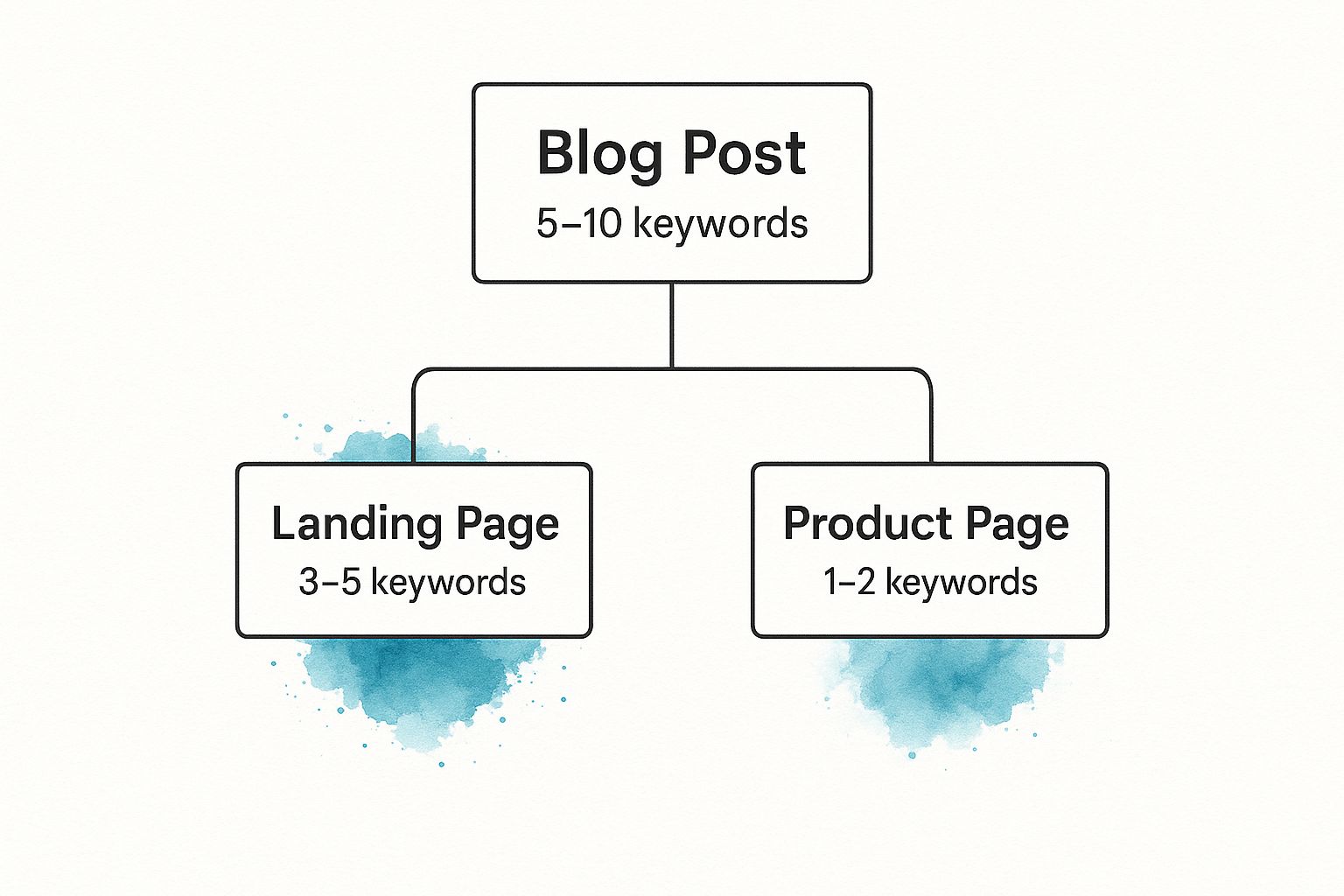
As you can see, a long-form blog post might naturally support 5-10 keywords, whereas a tightly focused product page often performs best with just one or two.
To help clarify this strategic approach, the table below offers a quick summary of how to think about keyword targeting for different types of content on your website.
Keyword Strategy Quick Reference
| Page Type | Primary Keyword Focus | Secondary Keyword Strategy |
|---|---|---|
| Homepage | Broad, brand-level term | Focus on core services or value proposition keywords. |
| Service/Product Page | Specific, transactional term | Use keywords for features, benefits, and use cases. |
| Blog Post | Informational, question-based term | Target long-tail variations, synonyms, and related sub-topics. |
This reference isn’t about rigid rules but about guiding your strategy. The key is to match your keyword intent to the page’s purpose, ensuring every piece of content serves a clear role in your user’s journey.
Building Your Keyword Allocation Framework

It’s easy to get fixated on the question, “how many keywords should I use?” But experienced SEOs know the better question is, “how should I use them?” A powerful SEO strategy isn’t about hitting a random number; it’s about building a structured keyword framework for every page.
Think of your primary keyword as the star of a movie. It’s the headliner, the main character that defines the entire plot and draws the audience in. Your secondary keywords, then, are the crucial supporting cast. They add depth, context, and nuance, making the whole story much more compelling for both your readers and for search engines.
Defining Roles for Your Keywords
Your first action is to assign one single, high-impact primary keyword to each page. This keyword must perfectly match the page’s core topic and the user’s search intent. If you need to sharpen this skill, our complete guide on how to do keyword research is a great place to start.
With that primary keyword locked in, your next move is to build a cluster of related terms around it. These are your secondary keywords—often called LSI (Latent Semantic Indexing) keywords—and they help create a rich web of topical relevance.
Let’s walk through a practical example. Imagine your primary keyword for a service page is “eco-friendly cleaning products.” Your supporting cast of secondary keywords could be:
- Non-toxic surface spray
- Plant-based ingredients for cleaning
- Sustainable household cleaners
- Refillable cleaning solutions
This strategy shifts your goal from trying to rank for a single term to proving you have complete authority on the entire topic. When you cover a subject this comprehensively, you end up naturally weaving in dozens of relevant phrases.
A good rule of thumb is to focus on one to four tightly related keywords per page. The primary keyword takes the spotlight in places like the title and main headings, while the secondary terms fill in the details throughout the body of your content. This approach sends a powerful signal to search engines that you’re an expert on the subject.
Matching Keyword Strategy to Content Type
Not all content is created equal, and your keyword strategy needs to reflect that. The number of keywords that makes sense for your homepage is completely different from what you’d aim for in a detailed, long-form guide. The secret to effective SEO is tailoring your keyword approach to fit the specific purpose of each page.
Your homepage, for example, is your digital storefront. Its main job is to quickly establish who you are and what you offer. For that reason, it should target a small, highly focused group of 3-5 high-level brand and service terms. These are the big-picture keywords that define your core business.
On the other hand, a comprehensive blog post or guide is built to educate and showcase expertise. It’s meant to draw in people who are looking for deep, specific answers. A 2,000-word article can naturally weave in a much larger semantic group of 20-30 keywords, including common questions, long-tail phrases, and related subtopics, without feeling forced.
Actionable Targets for Different Pages
Let’s get practical and break down some keyword targets for the most common types of content. The real key here is matching user intent—whether it’s informational, transactional, or navigational—with the page’s function. This alignment is a cornerstone of any successful content strategy for SEO.
This visual from a Wikipedia article on SEO does a great job of outlining the different components that contribute to a page’s visibility in search results.

As the diagram highlights, on-page SEO is all about the content and keywords within your HTML, which reinforces just how critical it is to customize your approach for every single page.
Here are a few specific recommendations to get you started:
- Product & Service Pages: These pages are designed to drive conversions. They need a tight keyword strategy built around one primary transactional term (like “local SEO services for plumbers”) and maybe 5-7 supporting keywords that highlight features, benefits, or specific use cases.
- Long-Form Guides: When you’re writing a guide, the goal is to become the ultimate authority on a topic. A 3,000-word guide can easily and naturally accommodate 20 or more keywords, targeting a broad spectrum of informational queries to attract readers at every stage of their research.
Ultimately, the length and purpose of your content directly dictate how many keywords you should use. A shorter, 500-word page might feel right with five to seven keywords, while a homepage often performs best by staying focused on just those three to five core terms.
From Keyword Density to Topical Relevance
It’s time to abandon an old SEO habit that holds back great content: the obsession with keyword density. For years, marketers were taught to measure how many times a keyword appeared on a page, but that’s a strategy for a search engine era that no longer exists.
Back in the day, the common wisdom was to make sure your target keyword made up about 1-2% of your total word count. But today’s search algorithms are incredibly sophisticated. They don’t just count words; they understand context, intent, and the relationships between ideas. Forcing a specific keyword count isn’t just unnecessary—it makes your writing sound robotic and unpersuasive. As you can learn more about this shift away from density, the focus has changed dramatically.
The New Goal: Building Topical Authority
So, if we’re not counting keywords, what should we be doing? The answer is building topical relevance. Your goal is to create the single best, most comprehensive resource on the internet for your chosen subject. It’s about demonstrating true expertise, not just repeating a phrase.
When you dive deep into a topic, you’ll naturally use a whole ecosystem of related terms, synonyms, and phrases that people are searching for. This rich, contextual language is what signals to search engines that your page is an authoritative source.
The best advice I can give is this: write for your reader, not for a robot. Concentrate on answering their questions thoroughly and with genuine clarity. If you do that well, the right keywords will naturally fall into place.
Adopting this user-first mindset pays off in several ways:
- You Build Trust: Content that genuinely solves a problem earns a reader’s confidence and encourages them to convert or share.
- Engagement Skyrockets: When a page fully answers someone’s question, they stay longer and interact more—huge positive signals for search engines.
- You Avoid Penalties: By writing naturally, you steer clear of “keyword stuffing,” an old-school tactic that can get your site penalized.
Ultimately, it’s time to stop counting and start creating. A truly valuable resource will always outperform a page that was built just to hit an arbitrary keyword target.
Putting Your Keyword Strategy into Action

Knowing the theory is one thing, but getting results comes down to execution. A winning keyword strategy is all about placing your chosen terms in the right spots—the high-impact locations that signal relevance to both people and search engines. Think of it less like a rigid formula and more like a set of best practices for communicating your page’s purpose clearly.
Your primary keyword is the North Star for your page. It needs to show up in the most prominent places to immediately establish what the content is all about.
High-Impact Placement for Primary Keywords
To give your primary keyword the most weight, you need to work it into a few key areas on the page.
- Title Tag: This is the most important piece of on-page SEO real estate. It’s the blue link people see in search results, so leading with your primary keyword is non-negotiable.
- Meta Description: While it won’t directly boost your rank, a compelling meta description that includes the keyword acts like a tiny ad, convincing searchers to choose your link over competitors.
- H1 Heading: Every page should have one, and only one, H1 tag. Your primary keyword absolutely must be in it to declare the main topic of the page.
- Opening Paragraph: Include your keyword within the first 100 words. This instantly confirms to the reader (and Google) that they’ve landed in the right place to get their answer.
Weaving in Secondary Keywords for Depth
If the primary keyword is the star of the show, secondary keywords are the supporting cast. They add context, build out the topic, and prove to search engines that you have a deep understanding of the subject. The goal here is to let them flow naturally into the content where they feel right, not to stuff them in.
Think of secondary keywords as the supporting details in a well-told story. They add richness and answer the follow-up questions your reader might have, making the entire piece more complete.
You’ll find great opportunities to place these terms in subheadings (like H2s and H3s), image alt text, and sprinkled throughout the body of your text. And since creating great content consistently is the goal, learning to write blog posts faster with an AI-powered workflow can free up time to focus on these strategic details.
Of course, execution is only half the job. Once your keywords are in place, you need a system for tracking your SEO performance to see what’s working and what isn’t. This constant feedback loop of action and analysis is the true engine of long-term SEO success.
Frequently Asked Questions About Keyword Strategy
Even with a solid plan, theory and practice are two different things. When you start applying a keyword strategy, you’re bound to run into some specific questions. Let’s walk through a few of the most common ones to help you move forward with confidence.
Can You Be Penalized for Using Too Many Keywords?
Yes, you absolutely can. This is what we call keyword stuffing, an outdated tactic that search engines now penalize heavily. It’s the practice of jamming a keyword into a page repeatedly in an unnatural way, hoping to trick the algorithm into ranking it higher.
Modern search engines can easily spot this kind of manipulation. When they do, your page will likely be pushed far down in the search results. For a trustworthy definition, the U.S. Federal Trade Commission warns businesses against SEO providers who promise rankings through such tactics.
The best way to avoid this is to stop thinking about keywords and start thinking about your reader. Write for them first. When you focus on creating genuinely helpful, high-quality content, you’ll naturally use the right terms without ever looking spammy.
Should Every Page Target a Different Primary Keyword?
One hundred percent. Each page on your website needs its own unique primary keyword. Think of it as giving every page a specific job to do.
When you don’t do this, you create a problem called keyword cannibalization. This is where two or more of your own pages end up competing for the same search term. It’s a huge headache because it confuses Google. The search engine doesn’t know which page is the real authority on the topic, so it often ends up ranking neither of them very well.
By giving each page a distinct focus, you create a clean, organized site structure that helps your overall SEO, rather than hurting it.
How Do You Find Good Secondary and LSI Keywords?
You don’t need a fancy, expensive tool to get started. In fact, one of the best sources of information is Google itself.
Here are a few actionable places to look right on the search results page:
- “People Also Ask” Boxes: This section literally shows you the questions people are typing into Google related to your topic. These are perfect for creating subheadings or new sections in your article.
- “Related searches” Section: Scroll to the very bottom of the results page. This list gives you a great sense of other topics and phrases that are thematically connected to your main keyword.
- Top-Ranking Competitor Content: Take a look at the top three articles ranking for your primary keyword. What subtopics are they covering? How are their articles structured? You can often find great secondary keyword ideas just by seeing what the top-performing content has in common.
These simple methods give you direct insight into what users are actually looking for, helping you build a more comprehensive and genuinely useful piece of content.
At Galant Studios, we turn these complex SEO concepts into real, measurable growth for businesses. Our team doesn’t just talk about strategy; we build websites optimized from the very beginning to rank higher, pull in more traffic, and turn that traffic into customers. Discover how our data-driven SEO services can elevate your brand today.