
Choosing the best ecommerce platform for SEO isn’t about finding a one-size-fits-all answer; it’s about matching the right tool to your unique business goals. For a founder eager to launch quickly, the streamlined tools of Shopify offer a clear path to market. For a business with unique technical demands, the deep, open-source customization of WooCommerce is a powerful asset. And for ambitious brands poised for rapid growth, BigCommerce provides a robust, built-in feature set designed to scale without the clutter of countless apps.
Your Platform is Your SEO Foundation

Think of your ecommerce platform as the digital foundation of your storefront. It’s more than just a gallery for your products; it’s the technical bedrock that determines how easily search engines like Google can find and recommend you to paying customers. The right platform gives you an immediate competitive advantage, while the wrong one can force you into a constant, uphill battle for visibility.
This guide is designed to move beyond a simple feature list. We’ll dissect the top contenders and give you the actionable insights needed to choose a platform that aligns with your budget, technical comfort, and long-term vision for growth.
Core SEO Features We’ll Evaluate
To deliver a clear, practical comparison, we will assess each platform across four mission-critical areas that directly impact your ability to rank and drive organic traffic.
- Technical SEO Control: Can you easily edit vital files like
robots.txt, set canonical tags to avoid duplicate content, and create clean, keyword-rich URL structures? - On-Page SEO Tools: How intuitive is the process for optimizing the essentials—title tags, meta descriptions, image alt text, and compelling product copy?
- Scalability & Performance: Will the platform keep up as your product catalog expands and organic traffic surges, or will it slow to a crawl under pressure?
- App & Plugin Ecosystem: How strong is the marketplace of third-party tools available to extend functionality and fill any potential SEO gaps?
The stakes are immense. The average ecommerce brand ranks for 1,783 keywords, generating around 9,625 organic visits each month. To buy that same traffic via paid ads would cost an estimated £11,790.58 monthly. This illustrates the massive financial upside of building a strong organic search presence.
The market is dominated by two major players: WooCommerce powers approximately 20.56% of stores, with Shopify following closely at 20.55%. You can explore these ecommerce SEO statistics to understand the competitive landscape you’re entering.
Choosing a platform is a foundational business decision. Migrating an established online store is a monumental task, both technically and financially. It is crucial to select a platform that can support your search visibility and business growth for years to come.
Here’s a high-level snapshot of how our main contenders stack up before we dive into the granular details.
| Feature | Shopify | WooCommerce | BigCommerce |
|---|---|---|---|
| Ease of Use | High | Medium (Requires WordPress) | High |
| Customization | Medium | High (Open-Source) | Medium |
| Hosting | Included (Managed) | Self-Hosted | Included (Managed) |
| SEO Tools | Strong (Built-in + Apps) | Excellent (via Plugins) | Strong (Built-in) |
Evaluating Core SEO Capabilities Across Platforms
Before we compare platforms side-by-side, let’s define what truly makes an ecommerce platform “good” for SEO. The reality is, they are not created equal. Your choice will either become a powerful engine for organic growth or a source of persistent technical friction. These core features are the non-negotiables for any merchant serious about winning in search.
The core objective is simple: make it effortless for Google to find, understand, and rank your product and category pages. A platform with powerful, intuitive SEO tools built-in saves you countless hours and prevents common technical errors from undermining your marketing efforts. Without these, you’re competing with one hand tied behind your back.
The Anatomy of an SEO-Friendly Platform
A truly effective platform gives you precise control over how search engines perceive your store. It all starts with clean, customizable URLs. For example, a logical URL like /collections/running-gear/mens-performance-shorts clearly communicates context to both shoppers and search engine crawlers, reinforcing your target keywords.
In contrast, a platform that generates messy, parameter-driven URLs like /products?cat=4&id=987 creates confusion and can significantly dilute your SEO authority. The ability to craft a logical site architecture with clean URLs isn’t just a “nice-to-have”—it’s a fundamental requirement for success.
Beyond URLs, several other elements are absolutely vital:
- Editable Title Tags and Meta Descriptions: You must have the freedom to write compelling, keyword-rich titles and descriptions for every product, category, and blog post.
- Automated XML Sitemaps: Your platform should automatically generate and update a sitemap. This file acts as a roadmap, guiding search engines to discover all your important pages efficiently.
- Simple Canonical Tag Implementation: Duplicate content is a chronic issue in ecommerce. Your platform must offer a straightforward way to manage
rel="canonical"tags, telling Google which version of a page is the definitive one.
The best ecommerce platform for SEO doesn’t just offer these features; it makes managing them intuitive. Your time should be invested in strategy and marketing, not in wrestling with basic technical settings.
Auditing and Advanced Control
A key part of maintaining an optimized store is conducting regular e-commerce SEO audits. This process helps you assess your platform’s core functions and identify opportunities. This includes examining more advanced features. For instance, can you easily edit your robots.txt file? This simple text file gives search engine bots direct instructions on which pages to crawl and which to ignore.
You also need to evaluate the platform’s handling of structured data, or Schema markup. This is the behind-the-scenes code that helps search engines understand the specific details of your page content, which in turn powers eye-catching rich snippets—like star ratings and pricing—directly in the search results. While some platforms offer this natively, others depend on third-party apps. This is where a platform like WooCommerce excels; being built on WordPress, it leverages a vast plugin ecosystem for unmatched flexibility. We explore this further in our guide to using WordPress for e-commerce.
Ultimately, a platform’s SEO prowess is measured by the degree of control it gives you. Without direct access to these foundational elements, even the most brilliant content strategy will struggle to gain traction. With these benchmarks established, let’s see how Shopify, WooCommerce, and BigCommerce truly compare.
A Head-to-Head SEO Platform Comparison
When selecting an ecommerce platform, it’s easy to get sidetracked by flashy features. But for SEO, the decisive factors are often buried in the technical details. While most platforms handle the basics, their approach to advanced challenges like file access, structured data, and site speed can be the difference between ranking on page one and being lost in the noise.
This isn’t about crowning a single “best” platform. The goal is to dissect how Shopify, WooCommerce, and BigCommerce perform under the hood, empowering you to choose the right tool for your specific business needs and technical comfort level.
Technical Control Over Your SEO Foundation
The level of control you have over core technical files is a major point of difference. Access to your robots.txt file, for example, is fundamental. It’s your direct line of communication with search engine crawlers, telling them which parts of your site to explore and which to ignore, thereby preventing the indexing of duplicate content or low-value pages.
WooCommerce: As an open-source plugin for WordPress, WooCommerce hands you the keys to the entire kingdom. You gain complete, unrestricted access to all core files. You can directly edit
robots.txt, modify.htaccessto implement complex redirect rules, and execute virtually any technical SEO task imaginable. This is the ideal scenario for businesses with dedicated technical expertise.BigCommerce: This platform offers a powerful middle ground. BigCommerce allows you to edit your robots.txt file directly from the store dashboard—a significant advantage over more restrictive systems. This provides critical crawl management capabilities without requiring server-level access.
Shopify: Shopify’s approach prioritizes security and ease of use. Consequently, it does not permit direct editing of the robots.txt file. While it generates a well-optimized file automatically, this can become a limitation for stores with complex requirements, such as blocking specific third-party app scripts from being crawled.
This visual comparison offers a quick look at how these platforms approach core SEO functionalities.
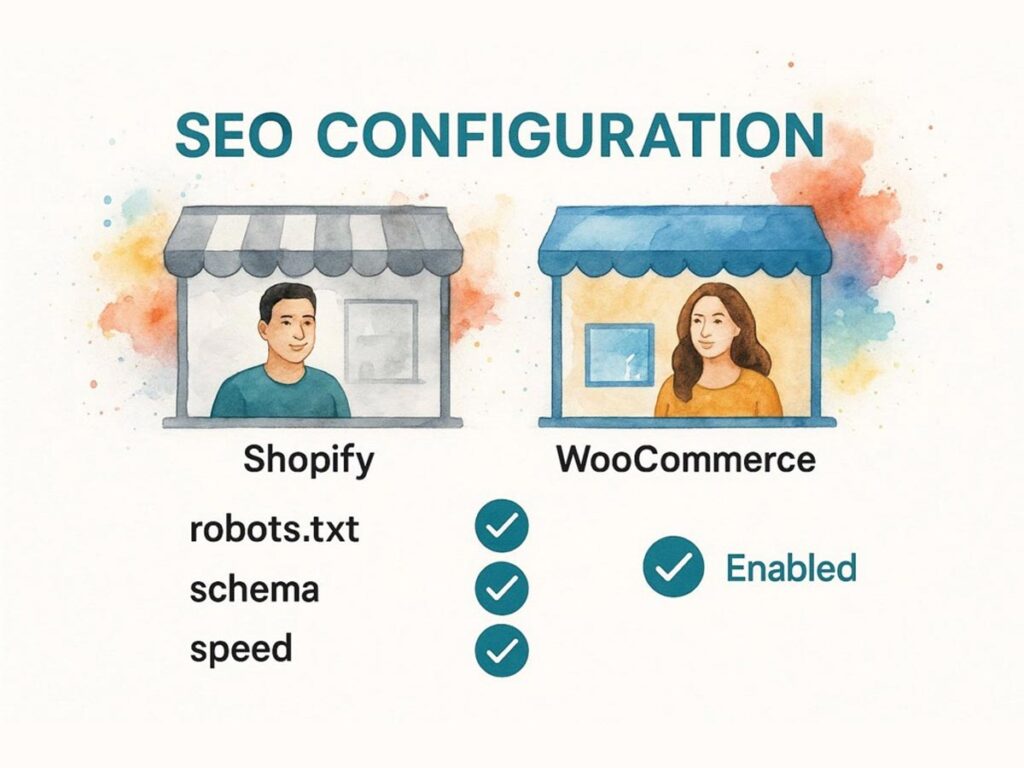
As the infographic illustrates, WooCommerce delivers deep, direct control over technical SEO, whereas Shopify streamlines these elements for user convenience.
Native Structured Data Implementation
Structured data (Schema markup) is the vocabulary that helps search engines deeply understand your content. It’s the driving force behind the rich snippets you see in search results—like star ratings, prices, and stock levels—that significantly boost click-through rates. The official standards are developed collaboratively, and you can dive into the technical specifications at Schema.org.
With plugins like Yoast SEO or Rank Math, WooCommerce provides exceptional control over Schema. You can fine-tune every detail for products, articles, and local business data, ensuring your pages are perfectly primed for rich results.
Key Differentiator: The real difference is customization. WooCommerce, via its vast plugin ecosystem, offers nearly limitless Schema flexibility. Shopify and BigCommerce provide excellent native implementations, but they are more standardized and less granular.
Both Shopify and BigCommerce come with powerful product Schema built-in. Your product pages are automatically marked up with the necessary code for price, availability, and brand. However, if you need to customize this markup for unique product types or add more detail, you’ll likely need to edit theme files or install a third-party app.
Optimizing For Site Speed And Performance
Site speed is a confirmed Google ranking factor and is crucial for a positive user experience. A slow-loading site is a conversion killer, especially on mobile. With mobile commerce projected to account for 59% of total ecommerce sales by 2025, a lightning-fast mobile experience is non-negotiable.
Managed vs. Self-Hosted Environments
Shopify & BigCommerce (Managed): As fully hosted solutions, these platforms manage all server infrastructure on your behalf—a massive advantage for merchants without a dedicated IT team. They leverage global Content Delivery Networks (CDNs) and optimized server configurations to deliver consistently fast load times, even during high-traffic events like Black Friday.
WooCommerce (Self-Hosted): With WooCommerce, you are in complete control of performance. Your site’s speed is a direct reflection of your chosen hosting provider, theme, and the quantity (and quality) of your plugins. This creates the potential for incredible speed with a premium host and diligent optimization, but a poorly configured setup can just as easily lead to a slow, frustrating experience for shoppers.
The following table breaks down how each platform approaches these advanced SEO functionalities, offering a clear side-by-side view.
Advanced SEO Feature Comparison of Top Ecommerce Platforms
This table provides a detailed comparison of Shopify, WooCommerce, and BigCommerce across critical advanced SEO functionalities, highlighting their implementation nuances.
| SEO Feature | Shopify | WooCommerce | BigCommerce |
|---|---|---|---|
| Robots.txt Access | No direct access; the file is auto-generated. | Full access and direct editing capabilities. | Direct edit access is available within store settings. |
| Native Schema Markup | Strong out-of-the-box product schema; customization requires apps or code edits. | Relies heavily on plugins (e.g., Yoast) for comprehensive and customizable schema. | Strong native support for product and review schema; customization is more straightforward. |
| Speed Optimization | Managed hosting with a global CDN ensures consistently high performance. | Performance is variable; it depends entirely on your hosting, theme, and plugin choices. | Managed hosting with a focus on speed and performance, similar to Shopify. |
| Faceted Navigation | Management of filter pages typically requires third-party apps. | Relies on plugins to control indexing and canonicalization of filtered URLs. | Strong, native control to prevent duplicate content from faceted search. |
This comparison shows that the “best” platform truly depends on your specific needs, technical resources, and the complexity of your product catalog.
Handling Complex Product Catalogs
For stores with large and varied inventories, faceted navigation—the filters for size, color, brand, etc.—can become an SEO nightmare. If not managed correctly, these filters can generate thousands of low-value, duplicate pages that dilute your ranking authority and waste your crawl budget.
This is an area where BigCommerce truly excels. It offers powerful, built-in controls for faceted navigation, letting you specify which filter combinations should be indexed and which should have a canonical tag pointing back to the main category page. This proactive approach helps you prevent duplicate content issues without needing to rely on another app.
In contrast, Shopify and WooCommerce typically depend on apps and plugins to solve this challenge. While effective solutions exist, they introduce another layer of complexity and potential cost. For a large retailer with thousands of SKUs, BigCommerce’s native functionality provides a cleaner, more integrated solution for maintaining technical SEO health at scale.
Mastering Content and On-Page SEO

If technical SEO is the foundation of your house, content is the persuasive copy and stunning interior design that turns visitors into buyers. A platform’s ability to support a rich content strategy—from compelling product descriptions to expert blog posts—is what ultimately fuels organic visibility and drives conversions.
This is where your marketing strategy comes to life. How easily can you create content that resonates with both search engines and the customer who is seconds away from clicking “add to cart”? The answer lies in the platform’s native toolset and its app ecosystem.
Optimizing Product and Category Pages
The product page is the conversion engine of your store, making its optimization a top priority. This goes far beyond a title and a few photos. A great platform enables you to easily edit meta titles, write unique descriptions, and add high-quality, keyword-rich copy without fighting a clunky interface.
Shopify: Offers a clean, intuitive interface for editing key SEO elements like titles and meta descriptions directly on the product page. Its true power, however, is unlocked through its vast app marketplace. Adding an app like Judge.me or Yotpo seamlessly integrates customer reviews and user-generated content, which automatically injects the structured data required for rich snippets.
WooCommerce: Built on WordPress, its content capabilities are virtually limitless. You can leverage powerful page builders like Elementor to design visually stunning, highly customized product layouts that function like dedicated landing pages. This is a massive advantage for brands selling complex or luxury items that demand deeper storytelling.
Crucial Insight: A staggering 90% of underperforming ecommerce sites share a common flaw: thin content on their product and category pages. Your platform must empower you to build out detailed, valuable content that answers customer questions and differentiates you from the competition.
User-generated content is a powerful lever. With organic search driving 43% of all traffic to retail sites, it’s vital to note that product pages with customer reviews can attract 18% more traffic than those without. Even simple optimizations to meta titles and descriptions have been shown to boost organic sales by as much as 32%.
Blogging and Content Marketing Capabilities
Blogging is one of the most effective strategies for capturing top-of-funnel traffic, establishing your brand’s authority, and targeting the long-tail keywords that product pages often miss. A top-tier ecommerce platform must either have powerful native blogging tools or integrate flawlessly with a leading content management system (CMS).
In this arena, WooCommerce is the undisputed leader. As a plugin for WordPress, it inherits the world’s most powerful blogging platform. This means you can build a comprehensive content hub with sophisticated category structures, author archives, and any content format imaginable—all deeply integrated with your product catalog. For example, you can create an in-depth “How to Choose the Right Hiking Boot” guide that links directly to the specific products you sell.
BigCommerce and Shopify both provide solid, built-in blogging functions that are sufficient for most businesses. They offer a simple editor for writing articles, managing comments, and handling basic on-page SEO. However, they lack the sheer flexibility and plugin support of WordPress, which could be a deciding factor for brands executing an aggressive, content-first marketing strategy. For a deeper dive, explore our complete guide to ecommerce SEO best practices.
Solving Technical SEO and User Experience Challenges
Technical SEO is the invisible engine that powers both user experience and your store’s search rankings. A slow, cumbersome website not only frustrates potential buyers but also signals to Google that your site is of low quality. Conversely, a fast, intuitive experience can significantly boost conversions and organic visibility.
This is where the architectural philosophies of platforms like Shopify, WooCommerce, and BigCommerce become clear. Each takes a distinct approach to handling core technical challenges such as site speed, mobile-first design, and structured data. Making the right choice means aligning a platform’s strengths with your team’s technical capabilities and business objectives.
Navigating Site Speed and Hosting Environments
Site speed is non-negotiable. It’s a confirmed ranking factor and a cornerstone of a great user experience. Shopify and BigCommerce simplify this challenge by offering a managed hosting environment. They handle the technical heavy lifting—using global Content Delivery Networks (CDNs) and optimized server configurations—to ensure your store loads quickly. This is a major benefit for business owners who want to focus on marketing, not server management.
WooCommerce, in contrast, offers complete control and, therefore, complete responsibility. As a self-hosted solution, your store’s performance depends entirely on your hosting provider, theme efficiency, and plugin load. A finely-tuned setup on a high-performance host can be incredibly fast, but a poorly configured one can easily result in a slow user experience. For a deeper dive, our guide on website performance optimization techniques offers actionable strategies for any platform.
The Power of Structured Data and Rich Results
Structured data, implemented via Schema markup, is your key to earning rich results in search. These are the enhanced listings that display star ratings, pricing, and stock availability directly on the search results page, making your products stand out from the competition.
The impact of structured data on user behavior is significant. Product listings that feature review stars and other schema-powered enhancements can achieve a click-through rate up to 35% higher than plain blue links. This makes robust schema implementation a vital feature when choosing the best ecommerce platform for SEO.
This is especially critical for mobile shoppers. Smartphones now account for 77% of retail website visits and approximately 68% of all online orders. To capture this enormous audience, you need every competitive advantage available. To learn more, you can explore the latest SEO statistics and their impact.
Both Shopify and BigCommerce provide strong, built-in product schema. WooCommerce achieves unparalleled customization through powerful plugins like Yoast SEO. Your choice here depends on whether you prioritize out-of-the-box simplicity or require granular control over every data point.
Making The Final Decision For Your Business
Choosing the best ecommerce platform for SEO is not about finding a universal winner; it’s about selecting the right strategic partner for your business’s journey. The ideal choice balances your immediate needs, long-term growth ambitions, and available technical resources.
To help you make a confident decision, we’ve distilled our findings into clear, actionable recommendations based on common business profiles, highlighting where each platform’s strengths will serve you best.
Recommendations For Specific Business Needs
Align your primary business objectives with the platform best suited to help you achieve them.
For Speed-to-Market and Simplicity: Shopify
If your top priority is to get online quickly with minimal technical friction, Shopify is the clear frontrunner. It is perfectly suited for entrepreneurs and brands that value a reliable, hands-off technical environment. Its managed hosting and intuitive dashboard let you focus on marketing and sales, confident that the core technical SEO is expertly handled.For Unmatched Customization and Control: WooCommerce
For businesses that demand absolute command over every aspect of their online store, WooCommerce is the definitive choice. Its open-source nature, combined with the power of WordPress, delivers limitless customization. This path is ideal if you have in-house technical talent or the development resources to manage a self-hosted solution.For Scalable, Feature-Rich Enterprises: BigCommerce
Large and rapidly growing businesses that need powerful native features—without becoming overly reliant on third-party apps—will find BigCommerce an exceptional fit. It provides advanced, out-of-the-box functionality for managing complex inventories and sophisticated faceted navigation, making it a powerful all-in-one solution built for scale.
Ultimately, your chosen platform should empower your SEO strategy, not obstruct it. A platform that aligns with your operational style becomes a solid foundation, helping you attract high-intent organic traffic and build sustainable growth. Carefully assess your business goals, technical comfort, and scalability requirements to make a decision that will pay dividends for years to come.
Frequently Asked Questions
Selecting the right ecommerce platform for your SEO goals is a foundational decision that impacts long-term growth. Let’s address some of the most common questions merchants face to help you build your online store on solid ground.
Which Platform Is Best For SEO Beginners?
For those new to SEO, Shopify typically offers the most accessible entry point. As a managed platform, it handles complex technical details like hosting, security, and server configuration for you.
This allows you to focus on the SEO fundamentals that drive results: writing persuasive product descriptions, crafting keyword-rich page titles, and adding descriptive alt text to your images. Shopify’s user-friendly interface makes these crucial on-page SEO tasks straightforward and easy to learn.
Can I Migrate My Store To A Different Platform Later?
While it is technically possible, migrating an established ecommerce store is a high-stakes, complex project that should be avoided if possible. It is far more than a simple data transfer.
A successful migration requires a meticulous plan to redirect thousands of URLs, preserve your hard-earned domain authority, and move all customer and product data without any errors. The risks of lost traffic and revenue are significant, and the costs can be substantial. It is almost always more cost-effective to invest the time upfront to choose the right platform from day one.
Migrating an established ecommerce store is not a simple “export/import” task. It demands a sophisticated SEO strategy to prevent a catastrophic drop in rankings and sales. This is a project that typically requires specialized expertise to execute flawlessly.
Is An Open-Source Platform like WooCommerce Cheaper?
At first glance, WooCommerce can appear to be the most budget-friendly option since the core software itself is free. However, it’s crucial to consider the total cost of ownership.
With WooCommerce, you are responsible for all associated costs, which include:
- High-quality web hosting
- Premium plugins for essential SEO and marketing features
- Security solutions and SSL certificates
- Developer fees for maintenance, updates, and custom development
These expenses can add up quickly. It’s important to understand that “open source,” as defined by organizations like the Open Source Initiative, means freedom to modify the code, not freedom from cost. In contrast, managed platforms like Shopify or BigCommerce bundle these operational necessities into a single, predictable monthly subscription.
Ready to build an SEO foundation that drives real results? Galant Studios specializes in creating high-performance websites optimized to dominate search rankings and attract more customers. Contact us today to build your online presence.