At its heart, search engine optimization (SEO) is the art and science of making your website more attractive to search engines like Google. When you master it, your site doesn’t just climb higher in the search results—it puts you directly in front of customers who are actively searching for the solutions you provide. This isn’t just about traffic; it’s about driving profitable growth for your business.
What Is Search Engine Optimization

Imagine the internet is a colossal, ever-expanding library. Search engines are the librarians, and your website is one of countless books on the shelves. SEO is the strategic process of ensuring your book is not only easy for the librarian to find and understand but is the one they recommend first when someone asks about its topic.
This isn’t about tricking Google. It’s a methodical approach to proving your website’s relevance and authority to both search engines and, more importantly, the people using them. It’s the discipline of earning organic traffic—visitors who find you because you offer the best solution, not because you paid for an ad. SEO has been around since the mid-1990s, evolving from a niche tactic into a non-negotiable business strategy, with the global SEO services industry valued at over $86.8 billion as of 2025.
For another excellent perspective, this guide on what is search engine optimization for business is a great resource.
The Three Core Functions of Search Engines
To truly leverage SEO for your business, you first need to grasp how search engines work. They are constantly performing three critical jobs.
Crawling: Search engines dispatch automated bots (known as “crawlers” or “spiders”) to scour the web. These bots follow links to discover new pages, updated content, images, and videos. For example, when you publish a new blog post and link to it from your homepage, a crawler will follow that link to find and read your new content.
Indexing: Once a bot finds your content, the search engine analyzes it and stores a copy in a massive digital database called an index. Think of it as the library’s master catalog, where everything is sorted and categorized. A well-structured page with clear headings helps the search engine index your content correctly.
Ranking: When you type a search query, the engine pulls the most relevant results from its index. It then uses a sophisticated algorithm with hundreds of factors to rank those pages, aiming to deliver the most helpful answer right at the top.
To give you a clearer picture, this table breaks down how search engines work and where your SEO efforts directly influence each step.
Core SEO Concepts at a Glance
| Search Engine Process | What It Means | How Your SEO Efforts Influence It |
|---|---|---|
| Crawling | Automated bots discover content by following links. | Actionable Insight: Technical SEO ensures your site is easy for bots to find, with a clear sitemap and no broken links. |
| Indexing | Content is analyzed and stored in a massive database. | Actionable Insight: On-page SEO, like using specific keywords, helps search engines categorize your content accurately. |
| Ranking | The search engine sorts indexed content to answer a user’s query. | Actionable Insight: All SEO efforts signal that your content is the most trustworthy and complete answer. |
This process reveals a powerful truth: effective SEO aligns your website with every single part of how a search engine operates. A well-optimized site is easier for bots to crawl, more likely to be indexed correctly, and far more likely to rank for the searches that generate customers for your business.
Key Takeaway: SEO isn’t about “gaming the system.” It’s about strategically aligning your website’s content and structure with what your customers are looking for, making you the obvious choice for both them and the search engines.
Why SEO Is Your Most Valuable Business Asset
Knowing the definition of SEO is one thing, but truly understanding why it’s a powerful engine for business growth is another. SEO is far more than a marketing channel; it’s a direct investment in your company’s long-term visibility, credibility, and profitability. It’s the engine that brings interested, high-intent customers directly to your door, 24/7.
The persuasive power of SEO lies in its timing. Unlike a billboard that interrupts someone’s drive, SEO connects with them at the exact moment they are actively looking for a solution you provide. When someone searches “emergency plumber near me,” they have an urgent need. Being the first result means you’re not just a marketer; you’re a problem-solver, connecting with an audience that is ready to convert.
Building Trust That Paid Ads Can’t Buy
There’s a reason savvy searchers often scroll past the ads at the top of a results page. Organic rankings carry an inherent authority that paid placements simply can’t replicate. Users instinctively trust the websites Google recommends organically, viewing them as more relevant and credible. A top ranking is a powerful endorsement from the world’s most trusted information source. It signals to potential customers that you are a leader in your field.
This trust directly impacts your bottom line. When a customer finds you through an organic search, they see your brand as a genuine expert, not just another company trying to sell them something. It’s a powerful way to build brand equity, foster stronger customer relationships, and fortify your reputation for years to come.
The infographic below helps visualize how SEO drives value by attracting this high-intent traffic and building that crucial user trust.
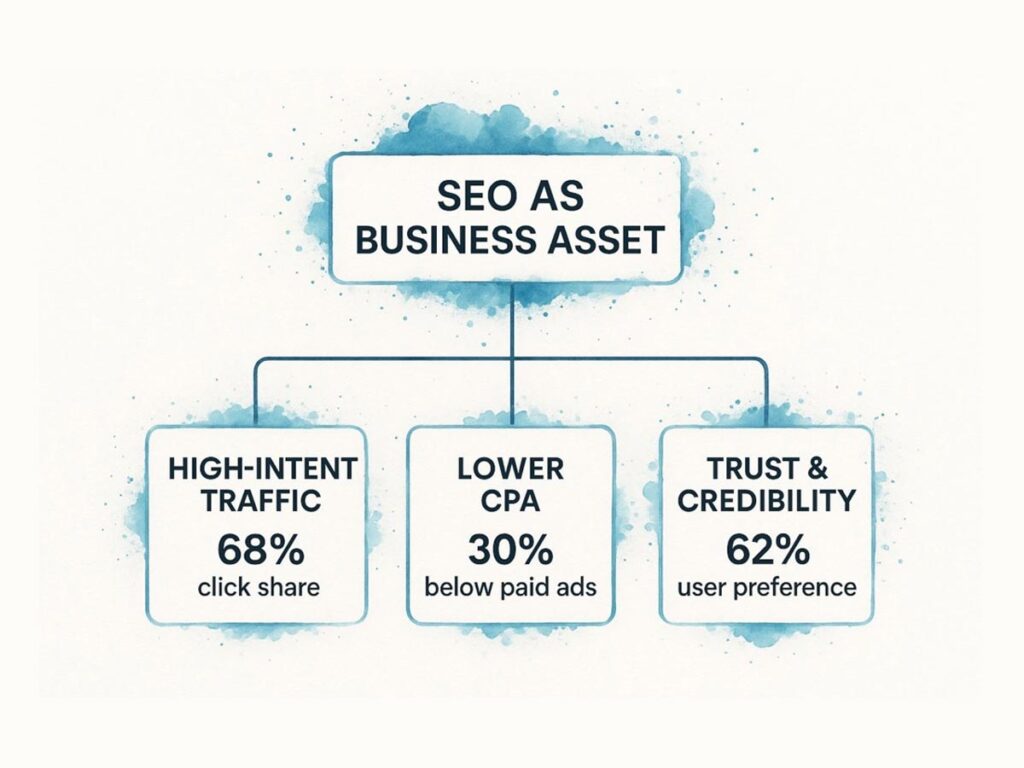
As you can see, users don’t just prefer organic results—these results also deliver a far more efficient cost per acquisition when compared to paid channels.
A Superior Return on Investment
From a financial perspective, a smart SEO strategy delivers results that are both significant and sustainable. Paid advertising demands a constant flow of cash to stay visible—the moment you stop paying, your traffic vanishes. SEO is different. The results compound. The work you put in today creating valuable content and earning authority continues to pay dividends for years, delivering an exceptional return on your initial investment.
By focusing on organic growth, you are building a durable business asset. Each piece of optimized content and every earned backlink adds to your website’s equity, creating a competitive advantage that is difficult for others to replicate quickly.
The data confirms this decisively. A staggering 68% of all online experiences begin with a search engine, and studies show that SEO drives over 1000% more traffic than paid advertising. These figures highlight just how essential a solid grasp of SEO is for any business that wants to compete online. You can dive deeper into the data by exploring current industry research on MarTech Zone. When you combine this massive traffic potential with lower long-term costs, it becomes clear that SEO is one of the most profitable investments a business can make.
The Three Pillars of a Strong SEO Strategy

To transform the concept of SEO into a concrete plan, it helps to break it down. Every successful SEO strategy is built on three interconnected pillars. To achieve high rankings and generate a steady stream of organic traffic, you must master each one.
Think of it like building a house. You can’t have a valuable home without a solid foundation, well-designed rooms, and a strong reputation in the neighborhood. SEO works the same way, requiring a careful balance of technical integrity, quality content, and external authority.
Each pillar addresses a different aspect of how search engines evaluate your website. If one crumbles, it inevitably weakens the others—a beautifully decorated house is worthless if it’s sitting on a cracked foundation. Let’s look at what each of these pillars does.
Pillar 1: Technical SEO – The Foundation
Technical SEO is the concrete foundation of your digital presence. It covers all the behind-the-scenes optimizations that make your site easy for search engine crawlers to find, understand, and index. If this foundation has cracks, everything you build on top of it is at risk.
This part of SEO isn’t about the words on the page but about the website’s structural health. It’s about ensuring your site is fast, secure, and works perfectly on any device. For instance, with more than half of all web traffic now coming from mobile devices, a mobile-friendly experience isn’t just a bonus; it’s an absolute requirement for technical health. According to Wikipedia, this trend has been accelerating for years, making mobile optimization a top priority.
Practical Example: A user trying to book a restaurant on their phone will abandon a site that loads slowly or requires them to pinch and zoom. Google knows this and prioritizes fast, mobile-friendly sites in its rankings.
Pillar 2: On-Page SEO – The Interior Design
If technical SEO is the foundation, then on-page SEO is the interior design—it’s the content and structure of every page on your site. This includes everything you do on your website’s pages to signal to both users and search engines what they’re about and why they’re valuable.
This is where you directly answer your customer’s query. It involves creating high-quality, informative content that solves their problems. It also means strategically optimizing elements like page titles, headings, and images to make your content as clear and engaging as possible.
Practical Example: A company selling running shoes should create a page for “best trail running shoes for beginners.” The content would include shoe recommendations, discuss key features like grip and cushioning, and use headings like “What to Look For in a Trail Shoe” to guide the reader.
A critical piece of this puzzle is identifying the exact terms your audience uses. Learning how to conduct keyword research is fundamental to any real SEO strategy. For a more detailed breakdown, our guide on how to do keyword research walks you through the entire process.
Pillar 3: Off-Page SEO – The Neighborhood Reputation
Finally, off-page SEO is your website’s reputation across the internet. This refers to all the actions taken outside of your own website to build its authority and trustworthiness. While on-page SEO is what you say about yourself, off-page SEO is what everyone else says about you.
The most significant factor here is building backlinks. A backlink is a link from another website to yours. In the eyes of a search engine, a high-quality backlink is a vote of confidence.
Practical Example: If a major publication like Forbes or an influential industry blog links to your company’s latest research report, it sends a powerful signal to Google that your website is a credible and valuable resource.
Key Takeaway: A winning SEO strategy is about balance. A technically flawless website (foundation) filled with exceptional content (interior design) and endorsed by a strong external reputation (neighborhood credibility) is perfectly positioned to dominate the search results.
Mastering On-Page SEO to Win Rankings
While technical SEO lays the groundwork and off-page efforts build your authority, on-page SEO is where you have the most direct, hands-on control over your search rankings. This is the art of optimizing individual web pages to attract high-intent traffic from search engines.
It all comes down to the elements you can edit on the page itself—your content, headlines, images, and internal links. The goal is to make it crystal clear to both people and search engine algorithms what your page is about and why it delivers value.
Think of each page as a targeted sales pitch. On-page SEO ensures that pitch is compelling, easy to understand, and perfectly aligned with what your audience is searching for. It’s not about stuffing keywords; it’s about creating a genuinely helpful experience that speaks your customer’s language. When you get this right, you satisfy user intent, which is Google’s top priority.
Crafting Content Around User Intent
The bedrock of great on-page SEO is high-quality content that solves a searcher’s problem. Before you write a single word, you must identify the primary keyword or phrase that page should rank for. This keyword is your North Star—it keeps your content focused and relevant.
Practical Example: A local bakery wants to attract customers looking for “gluten-free birthday cakes.” Their page content should focus on cake designs, flavors, pricing, and how to place an order. It shouldn’t be a deep dive into the history of gluten-free flour, because the searcher’s intent is transactional; they want to buy a cake, not read a scientific journal.
To go deeper on optimizing your pages, our comprehensive guide on what is on-page SEO offers a complete playbook.
A classic mistake is creating content based on what you think your audience wants. On-page SEO must be driven by keyword research data that tells you the exact words and questions real customers are using.
Optimizing Critical Page Elements
Once your keyword and content strategy are locked in, the next step is to place that keyword in a few mission-critical spots within the page’s HTML code. These elements are like signposts for search engines, helping them instantly grasp your page’s purpose.
Here are the most important on-page elements to get right:
- Title Tags: This is your headline in the search results. It must be compelling and include your main keyword. A strong title for our bakery could be: “Custom Gluten-Free Birthday Cakes in [City Name] | Order Online.”
- Meta Descriptions: Think of this as your 160-character ad in the search results. While it doesn’t directly impact rankings, a persuasive meta description convinces users to click on your link instead of a competitor’s.
- Headings (H1, H2, H3): Headings give your content structure and make it scannable. Your page title should always be wrapped in an H1 tag with your primary keyword, while subheadings (H2s, H3s) should break up the content and feature related terms.
The Power of Internal Linking and Multimedia
A well-optimized page is never an island. Internal links—links from one page on your site to another—are crucial for building a logical site architecture. They guide search engines to discover all your content and understand how different topics are related.
For instance, linking from a blog post on “cake decorating ideas” back to your “gluten-free birthday cakes” product page creates a helpful path for users and passes ranking authority between pages.
Finally, don’t forget visuals. Adding images and videos makes your content far more engaging. When you optimize the file names and alt text of your images with relevant keywords, you give search engines even more context. More importantly, this keeps people on your page longer, sending a strong positive signal to Google that your content is valuable. By getting these on-page factors right, you are firmly in the driver’s seat of your SEO performance.
Building Authority with Off-Page and Technical SEO
Even a website with brilliant content and a stunning design will fail if search engines can’t find it or don’t trust it. This is where the work beyond your content becomes critical. Off-page signals build your site’s credibility, while a strong technical foundation ensures search engines can efficiently do their job.
Think of these two elements as working in tandem to transform your website from a simple online brochure into an authoritative resource that search engines are eager to recommend.
Earning Trust Beyond Your Website’s Borders
Off-page SEO encompasses everything you do away from your website to bolster its reputation. At its core, this is all about building trust, and in the world of search, the most valuable currency of trust is the backlink—a link pointing from another website to yours.
Each quality backlink acts as a vote of confidence. When a reputable, well-established website links to your content, it’s signaling to Google, “This is a credible source of information.” But it’s a game of quality, not quantity. A single backlink from an authoritative industry publication is worth far more than hundreds of low-quality links from irrelevant sites.
Smart Strategies for Off-Page SEO
A strong backlink profile isn’t built on tricks; it’s earned by creating assets so valuable that other people genuinely want to share them.
This means focusing on relationship-based strategies that have real-world value:
- Create “Link-Worthy” Assets: Actionable Insight: Develop original research, in-depth guides, or compelling infographics that offer something new. A marketing agency could publish a report on “The State of Small Business Advertising,” which other blogs would naturally link to as a data source.
- Contribute as a Guest Expert: Writing articles for other respected websites in your niche is a classic for a reason. It not only earns you a relevant backlink but also introduces your brand to a new, highly targeted audience.
- Engage in Digital PR: Connect with journalists and bloggers. Offer your expertise or unique data for a story they are writing. When they cite you as a source, you gain a powerful, authoritative link.
This focus on quality and genuine relationships shows how far SEO has come. The early days of keyword stuffing and manipulation are long gone, replaced by a much stronger emphasis on user experience and real authority. You can see how dramatically the field has changed in this look at how SEO has evolved from the Stone Age to the AI Revolution.
The Invisible Foundation: Technical SEO
While off-page SEO builds your external reputation, technical SEO ensures your internal structure is solid. It’s the invisible foundation that dictates whether search engine crawlers can efficiently find, understand, and index your content.
If your technical SEO is a mess, even the most amazing content and the strongest backlinks won’t be enough to rank.
A technically sound website gives both search engine bots and human visitors a smooth, seamless experience. This involves optimizing several areas that are non-negotiable in today’s search environment.
Key Takeaway: Technical SEO isn’t just for developers. It directly impacts the user experience, which is a massive ranking factor. A site that’s slow, insecure, or confusing to navigate will always struggle to rank, no matter how great its content is.
One of the most critical components is a logical and efficient site structure, often called site architecture. Organizing your pages and content flows properly helps both users and search engines find what they’re looking for without getting lost. For a much deeper dive, our guide on improving your SEO site architecture provides practical, actionable steps.
Comparing Off-Page and Technical SEO Focus Areas
While both are essential, it’s important to understand that off-page and technical SEO tackle very different parts of the overall puzzle. The table below helps clarify their distinct yet complementary roles.
| Aspect | Off-Page SEO Focus | Technical SEO Focus |
|---|---|---|
| Primary Goal | Build authority, credibility, and trust through external signals. | Ensure the website is fast, secure, and easily crawlable for search engines. |
| Key Activities | Acquiring high-quality backlinks, managing brand mentions, social signals. | Optimizing site speed, ensuring mobile-friendliness, implementing HTTPS, managing sitemaps. |
| Analogy | Building a strong reputation and earning endorsements in your community. | Constructing a solid, accessible, and well-organized building foundation. |
Ultimately, you need both a strong external reputation and a solid internal structure to succeed. One simply can’t function at its best without the other.
Common SEO Questions Answered
To help pull all these concepts together, let’s walk through some of the questions I hear most often from business owners and marketers. Getting clear, straightforward answers to these can make the difference between feeling overwhelmed and having a practical plan for moving forward.
How Long Does It Take to See Results from SEO?
This is the big one, and the honest answer is: SEO is a marathon, not a sprint. While some technical fixes might produce a small bump in weeks, you should expect to see significant, meaningful gains in traffic and rankings in about 4 to 12 months.
This timeline depends on your starting point, industry competitiveness, and the consistency of your efforts. Think of it less like a quick campaign and more like building a valuable business asset. The effort you invest today creates a foundation that delivers steady, reliable growth for years.
Can I Do SEO Myself or Should I Hire an Expert?
You absolutely can. Many business owners successfully learn the basics of SEO. Starting with on-page optimizations like improving title tags and ensuring your local business profiles are accurate is a fantastic place to begin and can yield real results.
However, as your needs grow, so does the complexity. Hiring an expert becomes the right move when you need to conduct a deep technical audit, reverse-engineer competitor strategies, or build a serious backlink campaign. Many businesses find a hybrid model works best—handling content creation in-house and bringing in an expert for high-level strategy and technical challenges.
What Is the Difference Between SEO and SEM?
This question causes a lot of confusion, but the relationship is simple. Think of Search Engine Marketing (SEM) as the entire umbrella of promoting a business on search engines. Search Engine Optimization (SEO) is a critical discipline that falls under that umbrella. The U.S. Small Business Administration defines SEM as all activities designed to make a business visible on search result pages.
SEM is the whole pie—it includes both paid search ads (like Google Ads, often called PPC) and organic search (SEO). The key difference is that PPC buys you immediate visibility, while SEO earns you sustainable, trusted visibility over time. A smart digital marketing strategy almost always uses a mix of both.
Which SEO Ranking Factors Matter Most Today?
Google’s algorithm considers hundreds of signals, but the factors that carry the most weight consistently come back to one thing: the user’s experience.
If you focus on mastering these key areas, you’ll be on the right track:
- High-Quality, Relevant Content: Your content must be the best answer to the searcher’s question. There are no shortcuts.
- Authoritative Backlinks: Links from credible, relevant websites are a massive vote of confidence in Google’s eyes.
- Mobile-Friendliness and Site Speed: Your site must be fast and seamless on any device, especially on a phone.
- Technical Health: A clean, organized site structure that search engines can easily crawl is a non-negotiable prerequisite.
Beyond these, Google is placing a heavy emphasis on signals of Expertise, Authoritativeness, and Trustworthiness (often called E-A-T). Proving you’re a legitimate authority in your field has never been more important.
Ready to transform your online presence and drive real business growth? The team at Galant Studios specializes in crafting expert SEO strategies that deliver measurable results. Contact us today to see how we can help you climb the rankings and connect with more customers.