On-page SEO is the art and science of optimizing the elements on your website to earn higher rankings in search results and attract more relevant traffic. It’s about crafting each page—from the visible content to the underlying code—to be perfectly clear to both search engines and your ideal customers. This is the foundation you build upon, distinct from off-page SEO, which involves external signals like backlinks from other sites.
Your Website’s First Impression on Google

Imagine your website is a new bookstore. For customers to find the book they need, you wouldn’t just toss everything into random piles. You’d create clear sections, give each book a compelling title on its spine, and write a helpful summary on the back cover.
On-page SEO is that same organizational system, but for the digital world. It’s how you give each page a clear, enticing title (Title Tags), organize its content logically (Header Tags), and ensure the information itself is genuinely valuable (Content Quality). Without this structure, search engines like Google are left guessing what your pages are about, making it nearly impossible for your target audience to find you.
Why You Can’t Afford to Ignore On-Page SEO
Mastering on-page SEO isn’t just a technical task; it’s a critical driver of business growth. Organic search remains the dominant force in web traffic, responsible for over 53% of all visitors online. The rewards for reaching the top are immense: the #1 organic result on Google captures an average of 27.6% of all clicks. And since less than 1% of searchers ever venture to the second page, being on page one isn’t just a goal—it’s a necessity.
When executed correctly, on-page SEO delivers tangible business outcomes:
- Higher Visibility: You’re essentially handing search engines a perfect map of your content, making it easy for them to rank you for valuable keywords.
- Better Qualified Traffic: By focusing on what your audience actually wants, you attract visitors who are actively looking for the solutions you provide, leading to better leads and sales.
- An Exceptional User Experience: On-page elements like fast load times and mobile-friendly design don’t just impress Google—they delight human visitors, encouraging them to stay longer and convert.
By optimizing the elements you directly control, you lay the foundation for search engines and users to find, understand, and value your content above your competitors.
To give you a clear roadmap, here’s a quick look at the core elements we’ll cover.
Core On-Page SEO Elements at a Glance
| Element | Primary Function | Impact on SEO |
|---|---|---|
| Title Tags | Defines the title of a web page for search results | High – a primary factor for relevance and click-through rate |
| Meta Descriptions | Summarizes a page’s content in search results | Medium – influences clicks but not a direct ranking factor |
| Content Quality | Provides valuable, relevant information to the user | High – foundational to satisfying user intent and ranking |
| Internal Links | Connects pages within your own website | Medium – distributes page authority and helps with navigation |
| Page Speed | Measures how quickly a page’s content loads | High – a confirmed ranking factor and crucial for user experience |
| Mobile Optimization | Ensures a seamless experience on mobile devices | High – essential for a majority of users and rankings |
Each of these components plays a vital role in your website’s performance.
This guide will walk you through the essentials, but if you’re ready for the next level, our post on advanced https://galantstudios.com/on-page-seo-optimization-techniques-that-drive-rankings-in-2025/ is a great next step. And while we’re zeroed in on on-page tactics here, understanding general SEO strategies will give you a more complete picture of your digital marketing efforts.
Mastering Content and Search Intent
If on-page SEO is a car, then high-quality content is its engine. But just writing a “good” article isn’t enough. The secret to ranking is aligning your content perfectly with search intent—the “why” behind a user’s search query. Your job is to become a digital detective and figure out exactly what they hope to accomplish.
Are they looking for information (“what is a 401k?”), comparing options (“roth IRA vs. 401k”), or ready to take action (“open a retirement account”)? Misunderstanding this intent is like showing up to a casual coffee meeting in a tuxedo. The content might be high-quality, but it’s completely wrong for the situation. This mismatch leads to high bounce rates, telling Google your page isn’t the right answer and causing your rankings to plummet.
Identifying and Matching Search Intent
How do you decode search intent? The most direct method is to look at what’s already ranking. Google has invested billions in understanding what users want, so the top-ranking pages for your target keyword are your cheat sheet.
- Informational Intent: Search for “how to bake sourdough bread,” and you’ll find blog posts, step-by-step guides, and video tutorials.
- Commercial Intent: Search for “best running shoes for beginners,” and the results will be filled with product reviews, comparison articles, and “top 10” lists.
- Transactional Intent: Search for “buy iPhone 15 pro,” and you’ll be met with product pages from Apple, wireless carriers, and major retailers.
Practical Example: Let’s say you want to rank for “choosing a digital camera.” A quick search reveals that the top results are comprehensive buying guides and articles explaining camera types—not individual product pages. This tells you the intent is primarily informational with a strong commercial leaning. Trying to rank a single camera’s product page here would be an uphill battle, but a detailed guide is perfectly positioned to win.
Structuring Content for Users and Search Engines
Once you’ve nailed the intent, structure your content to be the ultimate resource—the last click a user needs to make. This means anticipating their follow-up questions and answering them proactively.
For our “choosing a digital camera” guide, a winning structure would look like this:
- H1 Title: How to Choose the Perfect Digital Camera: A 2025 Buyer’s Guide
- H2 Subheading: First, Understand the Main Camera Types (DSLR vs. Mirrorless vs. Point-and-Shoot)
- H2 Subheading: 5 Key Features You Can’t Ignore (Megapixels, Sensor Size, etc.)
- H2 Subheading: How to Set Your Budget and Find the Best Value
- H2 Subheading: Our Top Camera Picks for Beginners This Year
This clear hierarchy makes the article scannable for readers and easy for search engines to comprehend. This logical flow should also be reflected in your URL. For more guidance, explore our guide on how to create SEO-friendly URLs.
Crafting content that addresses user intent isn’t just about answering a question. It’s about creating the definitive resource that satisfies their curiosity completely, establishing your page as an authority on the topic.
This approach delivers measurable results. Research has shown that longer-form content (over 3,000 words) often generates significantly more traffic and backlinks. This confirms that modern on-page SEO rewards a deep commitment to quality, depth, and user satisfaction. To gain a competitive edge, use free competitor analysis tools to see what’s working for others and identify gaps you can fill.
Optimizing Key Page Elements for Clicks
Beyond your main content, several HTML elements act as your page’s “advertisement” in search results. They are the first impression that convinces a user to click your link instead of a competitor’s. Mastering these elements is a non-negotiable part of on-page SEO.
These components—your title tag, meta description, and header tags—serve a dual purpose: they provide clear signals to search engine crawlers while simultaneously persuading human searchers that you have the answer they need.
Crafting the Perfect Title Tag
If you could only optimize one on-page element, it should be the title tag. This is the clickable blue headline in Google’s search results and the text in your browser tab. Its job is to tell both people and search engines what your page is about in a compelling, concise way.
An effective title tag strikes a balance between keywords and persuasion. Place your primary keyword near the beginning, keep the total length under 60 characters to avoid it being cut off, and often include your brand name at the end for recognition.
- Before:
Our Products - After:
Shop Handcrafted Leather Wallets | Your Brand | Free Shipping
The “After” version is specific, includes a keyword, and presents a clear benefit to entice a click.
Writing Meta Descriptions That Drive Action
While Google confirms the meta description is not a direct ranking factor, its impact on your click-through rate (CTR) is immense. This is the short summary (under 160 characters) that appears below your title in search results. It’s your elevator pitch—your one shot to convince a user your page is worth their time.
A great meta description expands on the promise of the title tag. It should include your keyword naturally and end with a compelling call-to-action. Learn the nuances in our guide on how to write meta descriptions that convert searchers into visitors.
Think of your meta description as the movie trailer that makes someone choose your film. A persuasive one can dramatically boost clicks, even if you aren’t ranked #1.
Here’s a practical example of this in action:
- Before:
This page is about our accounting services. We offer various services for businesses. - After:
Expert accounting services for small businesses. Get reliable bookkeeping, payroll & tax prep to save you time and money. Request your free quote today!
The second version uses active language, focuses on benefits, and tells the user exactly what to do next.
Structuring Content with Header Tags
Header tags (H1, H2, H3, etc.) create the logical skeleton of your content. They break up your text, making it easy for people to scan and for search engines to understand the page’s hierarchy.
Your H1 tag is the main on-page headline and should be used only once per page. It should closely align with your title tag and feature your primary keyword.
H2 tags function as the main sections of your article, like chapters in a book. H3 tags then act as sub-points within those chapters. This organization not only improves the user experience but also signals the depth and relevance of your content to search engines.
Building a Powerful Internal Linking Structure
Internal links are the hidden roadways of your website, guiding visitors and search engine crawlers from one page to another. A strategic internal linking plan connects your content into a cohesive, authoritative network.
Think of your website as a city. Your homepage and core service pages are major landmarks, while individual blog posts are distinct neighborhoods. Internal links are the roads connecting them. Without these roads, visitors get lost, and search engine bots miss out on discovering some of your most valuable content. This is a crucial concept to master when you’re learning what is on page seo.
The map below illustrates how a central “pillar” page can distribute authority and provide context to related pages.
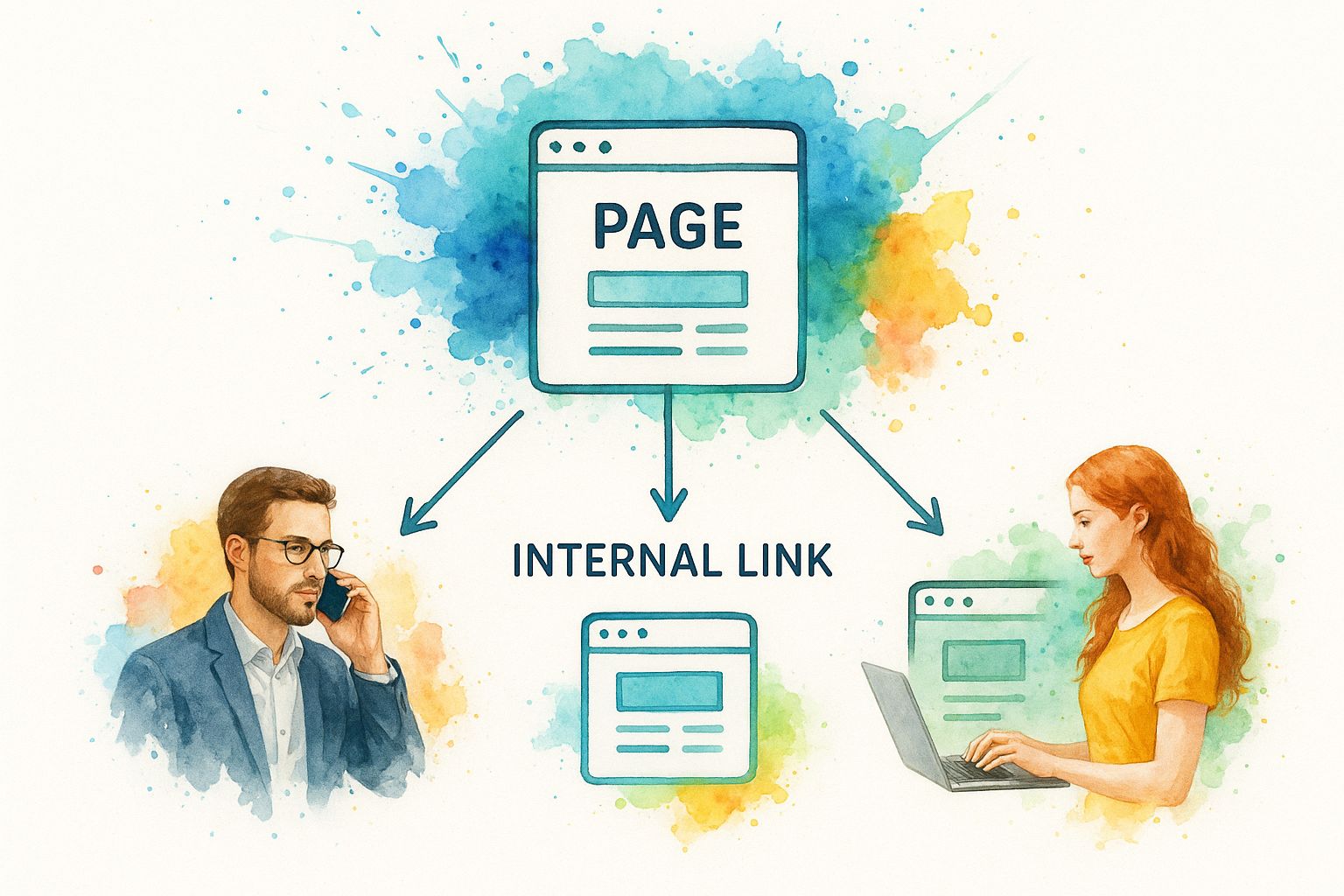
As you can see, this isn’t about random linking. It’s a deliberate strategy to build a web of related content that reinforces your expertise on a topic.
The Role of Link Equity and Anchor Text
In SEO, the “traffic” flowing through these internal roads is called link equity (or “link juice”). Your most authoritative pages, like your homepage, have the most equity. When you link from these power pages to other pages on your site, you pass some of that authority, giving the destination page a ranking boost.
The clickable text you use for the link—the anchor text—is equally important. It acts as a signpost, telling users and search engines what the linked page is about.
- Weak Anchor Text: “click here,” “read more”
- Strong Anchor Text: “our complete on-page SEO checklist”
Using descriptive, keyword-rich anchor text sends a powerful signal. For example, consistently linking to a page with the anchor text “local SEO services” reinforces to Google that this page is an authority on that specific topic. To understand the theory behind how search engines value links, you can explore the concepts behind historical page rank algorithms.
A thoughtful internal linking strategy creates a logical content hierarchy, distributes ranking power across your site, and helps search engines understand the contextual relationship between your pages.
A Practical Internal Linking Example
Let’s put this into action. Imagine you just published a detailed blog post: “10 Actionable Ways to Attract More Local Customers.” Your goal is to not only rank this post but also to use it to strengthen your primary “Local SEO Services” page.
Here’s a simple, 3-step process:
- Link from the New Post to Your Cornerstone Page: Within the new blog post, find a natural place to link to your service page. A sentence like, “For businesses serious about growth, investing in professional local SEO services is one of the most effective strategies,” creates a perfect, context-rich link.
- Link from Your Cornerstone Page to the New Post: Go to your “Local SEO Services” page and add a link back. You could add a section like, “For practical tips you can implement today, read our new guide on how to attract more local customers.”
- Link from Other Relevant Posts: Identify 2-3 older, related blog posts that already perform well. Edit them to include a link to your new article where it adds value for the reader.
This creates a powerful, interconnected content hub. Your new post gets an authority boost from an established page, your service page is reinforced with fresh, relevant content, and your visitors are guided deeper into your site.
How Technical SEO Shapes User Experience
On-page SEO extends beyond visible content; it’s deeply rooted in your website’s technical foundation. These behind-the-scenes factors directly impact user experience—a critical element that Google watches closely.
Imagine your website is a beautiful restaurant. It doesn’t matter how amazing the food is if the door is stuck or the tables are wobbly. Customers will simply leave. Your site’s loading speed and mobile experience are the digital equivalents of that smooth, welcoming environment. Two of the most critical technical factors are page speed and mobile-friendliness.
The Critical Need for Speed
In an era of instant gratification, a slow website is a conversion killer. Page speed is a confirmed Google ranking factor. A delay of just a few seconds can cause your bounce rate to skyrocket, signaling to Google that your site offers a poor user experience.
To diagnose your site’s performance, start with Google’s PageSpeed Insights. This free tool scores your site for both mobile and desktop and provides a prioritized list of actionable recommendations for improvement.
Common culprits for slow speeds include:
- Unoptimized Images: Large image files are often the biggest offender. Use tools to compress images without sacrificing visible quality.
- No Browser Caching: Caching allows a returning visitor’s browser to load saved parts of your site (like your logo and stylesheet) instantly, rather than re-downloading them.
- Bloated Code: Minifying HTML, CSS, and JavaScript removes unnecessary characters and spaces from the code, making the files smaller and faster to load.
If your site is on a specific platform, look for platform-specific guidance, such as these tips for optimizing your Sitecore performance.
Mobile-Friendliness in a Mobile-First World
Google now uses mobile-first indexing, meaning it primarily evaluates the mobile version of your site to determine its rankings—for all searches. If your site is difficult to use on a phone, your rankings will suffer everywhere.
Today, responsive design is the industry standard. It enables your website’s layout to automatically adjust to any screen size, providing a seamless experience from desktop to smartphone. With 92.3% of internet users accessing the web via a mobile phone, this is non-negotiable.
A website that isn’t mobile-friendly is the digital equivalent of asking customers to read your restaurant menu through a keyhole. It’s frustrating, impractical, and will send them straight to your competitors.
True mobile optimization goes beyond just fitting content on a screen. Consider this checklist:
- Is text readable without zooming?
- Are buttons and links large enough and spaced apart for easy tapping?
- Do pop-ups block content and are they easy to close?
- Is navigation simple and intuitive?
By mastering these technical elements, you build a site that is both easy for search engines to crawl and a pleasure for people to use—a winning combination for long-term growth.
Measuring the Business Impact of On-Page SEO
On-page optimization is more than a marketing tactic; it’s a sustainable engine for business growth. When done right, its impact extends far beyond traffic metrics, translating directly into better leads, higher conversions, and increased revenue.
Think of your website as your top-performing salesperson, working 24/7. On-page SEO is how you train that salesperson. By aligning your content with what your customers are searching for, you attract qualified prospects who are actively seeking the solutions you provide. You aren’t interrupting them with an ad; you’re providing a solution at the exact moment they need it.
From Traffic Metrics to Revenue Growth
The true power of on-page SEO is realized when you connect your efforts to your bottom line. More traffic is good, but qualified traffic is what drives conversions. Searchers arrive with a specific need, making them far more likely to convert than someone who stumbles upon an ad.
The data backs this up: SEO leads have a close rate of 14.6%, dwarfing the 1.7% close rate from outbound methods like cold calling. That means a single, well-optimized page can be nearly 8.5 times more effective at generating business. You can find more insights about SEO’s impact on business growth across various industry reports.
Unlocking New Markets and Opportunities
A sophisticated on-page SEO strategy can also be your gateway to new markets and revenue streams. By applying specific tactics, you can target and capture previously untapped audiences.
Here’s how this works in practice:
Localized Keywords: A local bakery can create content targeting “best birthday cakes in Brooklyn” or “artisan sourdough near me.” This is a direct line to hungry customers in their neighborhood, driving foot traffic that converts into sales.
Hreflang Tags: An e-commerce brand expanding globally can use
hreflangtags to tell search engines which regional version of a page to show. A user in France sees the French site, while a user in Spain sees the Spanish one, creating a seamless international experience.Targeted Content Hubs: A B2B software company could build a resource hub around “small business tax preparation.” By creating in-depth articles, checklists, and tools covering the topic from every angle, they establish themselves as the definitive authority, attracting their ideal customers and guiding them toward a product demo.
These examples demonstrate that understanding what on-page SEO is goes far beyond technical tweaks. It’s about using content and optimization to achieve tangible business goals, whether that’s dominating your local area or launching successfully worldwide.
Answering Your On-Page SEO Questions
As you dive into optimizing your site, a few key questions often come up. Let’s address them directly to provide clarity and confidence as you move forward.
What’s the Real Difference Between On-Page and Off-Page SEO?
Think of your website as a physical store. On-page SEO is everything you do inside the store to make it welcoming and easy to navigate. This includes organizing your products (site structure), writing clear descriptions (content), creating an attractive window display (title tags), and ensuring the aisles are clear (internal links). You have 100% control over these elements.
Off-page SEO is your store’s reputation around town. It’s the positive reviews in the local paper, referrals from other business owners, and general word-of-mouth. In the digital world, this primarily means earning high-quality backlinks from other websites. These act as votes of confidence, telling Google that your site is a trustworthy authority. You need both on-page and off-page SEO to succeed.
How Long Until I Actually See Results from This?
This is the most common question, and the honest answer is: it depends, but it takes time. While you might see a small boost from a title tag update in a few weeks, a comprehensive on-page SEO strategy typically shows meaningful results in 3 to 6 months.
Search engines need time to recrawl your pages, process the improvements, and evaluate how your content compares to competitors. Factors like your industry’s competitiveness, your website’s history, and the consistency of your efforts all play a role. SEO is not a quick fix; it’s a long-term investment in building a sustainable asset for your business.
On-page SEO is a marathon, not a sprint. Consistent, high-quality optimization efforts build lasting authority that pays dividends over time, driving sustainable organic growth for your business.
Can I Really Do On-Page SEO Myself?
Absolutely. While advanced technical SEO might require an expert, you can master the fundamentals yourself.
Many of the most impactful on-page tasks are about content and clarity. If you can write a compelling headline, structure an article logically, and understand what your customers are asking for, you’re already well on your way. Tools and plugins can guide you through the more technical aspects like title tags and meta descriptions. Mastering the basics is one of the most powerful investments you can make in your website’s success.
Ready to transform your website’s visibility and drive measurable growth? The team at Galant Studios specializes in expert SEO services that get your business noticed. We build fast, mobile-friendly websites with optimization at their core, ensuring you rank higher and attract more customers. Take the first step toward dominating your market today.