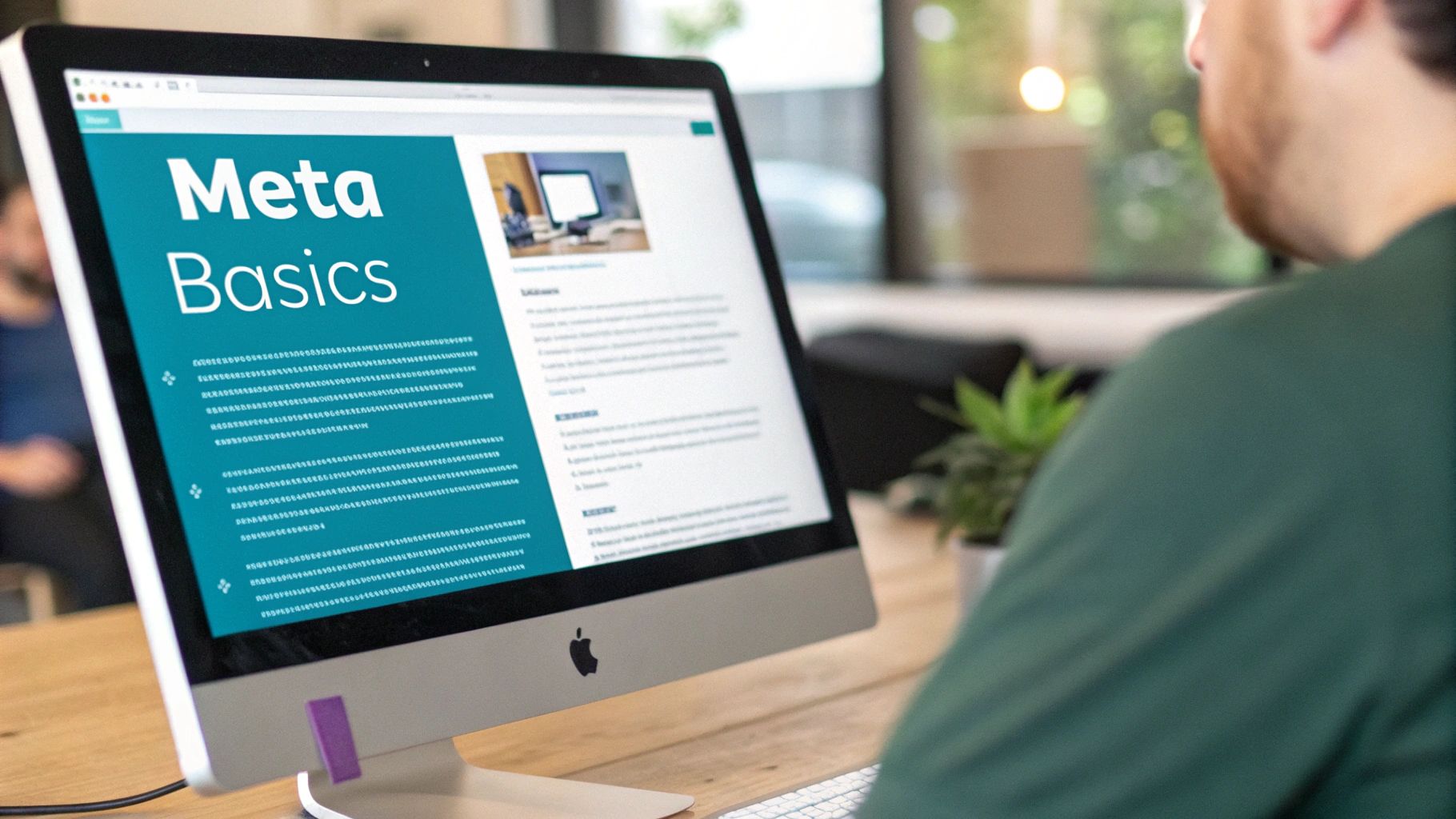
It’s easy to overcomplicate meta descriptions, but their job is simple: create a short, compelling summary of about 155 characters that speaks directly to what a searcher wants. Think of it as ad copy for your content, your one shot in the search results to convince someone to click.
What Meta Descriptions Are (and Why They Still Matter)
I always tell clients to imagine a meta description as the blurb on the back of a book. It’s not actually part of the story, but it’s your best and only chance to convince someone to open the cover. In SEO terms, it’s that little snippet of text that shows up right under your page’s title in the search results.
You see them every time you use Google. Here’s a perfect example of how they appear on a search engine results page (SERP):
Every result is using that small space to pitch its content, trying to persuade you that their page has the best answer. Now, it’s true that meta descriptions are not a direct ranking factor that Google’s algorithm uses to order results. But don’t let that fool you—their influence on user behavior is huge.
The Power of a Great First Impression
A well-written meta description is your ad copy for the SERPs. It’s your first and often only opportunity to connect with a potential visitor and make a strong case for why your page is worth their time. This is where you can directly influence your click-through rate (CTR)—the percentage of people who see your result and actually click on it.
When more people click your link, it sends a powerful signal to Google that users find your result highly relevant for that specific search. This kind of positive user engagement is a fantastic way to indirectly support your overall SEO performance over time.
A well-crafted meta description bridges the gap between a search query and a page visit. It turns a passive impression into an active click by clearly communicating value and relevance before the user even lands on your site.
Boosting Clicks with Better Copy
We have a lot of data that shows while meta descriptions don’t directly feed into ranking algorithms, their impact on getting people to your site is massive. I’ve seen well-written descriptions improve click-through rates by as much as 10–20%. That’s a significant jump in traffic without having to climb any higher in the rankings.
To help you get started, here’s a quick breakdown of the core elements that make a meta description effective.
Core Elements of an Effective Meta Description
| Element | Best Practice | Actionable Insight |
|---|---|---|
| Length | Keep it around 150–160 characters. | Ensures your full message is visible on both desktop and mobile without getting cut off. |
| Primary Keyword | Include your main target keyword naturally. | Google often bolds matching keywords in search results. Placing it early signals immediate relevance. |
| User Intent | Address the “why” behind the search query. | If someone searches “quick weeknight dinner,” your description should promise speed and simplicity. |
| Clear Value | Explain what the user will gain from your page. | Answers the “What’s in it for me?” question, providing a compelling reason to click. |
| Call-to-Action (CTA) | Use a gentle nudge like “Learn more,” “Find out,” or “Shop now.” | Encourages the user to take the next step and click through to your website. |
Getting these elements right is the foundation of turning search impressions into valuable website traffic.
If you’re looking to really dive deep and get a competitive edge, this guide on how to write meta descriptions that boost clicks is one of the best I’ve come across.
A Practical Framework for Writing Meta Descriptions
Let’s move from theory to action. Writing a great meta description always starts with one thing: understanding user intent. You need to get inside the searcher’s head and figure out the real problem they’re trying to solve. What’s the question behind their query? Nailing this is the foundation for writing copy that actually gets clicked.
Once you know the why, your next move is to work your primary keyword into the first sentence. The key here is to make it feel natural, not forced. This isn’t about keyword stuffing. It’s about signaling to the user, “Yes, this page has exactly what you’re looking for.” Google often bolds the search terms in the results, which makes your snippet pop and grabs the user’s attention instantly.
Write Active, Benefit-Driven Copy
I’ve found the most effective descriptions always use an active voice and zero in on the benefits, not just the features. Don’t just tell them what your page is; show them what it does for them. It’s a subtle but powerful shift that turns a bland summary into a compelling reason to click.
Thinking in “before and after” terms can really help lock this in.
Blog Post Example:
- Before: This blog post is about SEO content writing and its different aspects.
- After: Discover 5 actionable SEO content writing tips to boost your traffic and climb the rankings. Learn the strategies that create content people actually want to read.
Service Page Example:
- Before: We offer website design services for small businesses, including mockups and development.
- After: Get a professional, blazing-fast website that turns visitors into customers. Explore our custom design packages and see how we help businesses grow.
This approach makes a promise in the search results that your on-page content has to deliver on. It’s all about building trust from that very first impression. You can see how we apply this ourselves; our internal pages, like this one on SEO content writing, are built to provide clear value and answer user questions directly.
A powerful meta description doesn’t just summarize content—it solves a problem. It answers the searcher’s unspoken question: “Why is this the best result for me?”
The whole process connects directly to performance. Crafting compelling descriptions leads to better click-through rates, which ultimately helps your overall SEO. This image breaks it down perfectly.
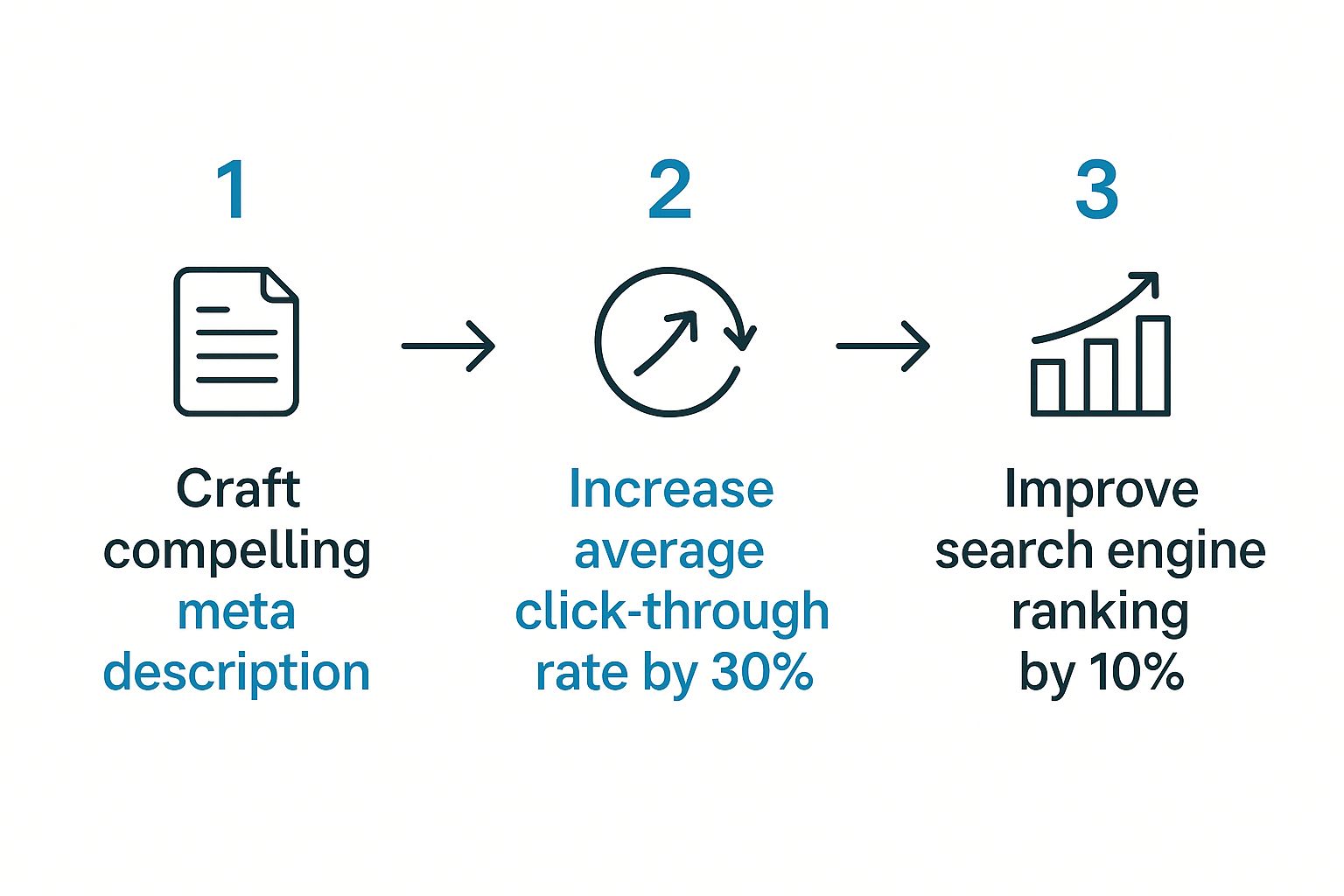
Think of your meta description as a catalyst. It’s a small piece of copy that can have a surprisingly big impact, kicking off a positive feedback loop that can improve your rankings over time.
Key Rules for Writing High-Impact Descriptions

When it comes to writing a meta description that actually gets clicked, there are a few foundational rules you just can’t ignore. Think of them less as strict guidelines and more as the core principles that separate a great description from one that just sits there on the page.
First up, let’s talk length. Google will chop off anything too long, so you have to be concise. I always aim for the 155–160 character sweet spot. This is usually enough to get your point across without getting cut off on desktop or mobile search results. It’s your tiny piece of ad real estate—make every character count.
Ensure Every Description Is Unique
I see this mistake all the time: people get lazy and duplicate descriptions across similar pages. Don’t do it. Every single page on your site needs its own completely unique meta description.
Why? For one, it helps you avoid looking like you have duplicate content. But more importantly, it lets you give a highly specific preview of what’s on that specific page. If all your product pages say the same thing, they just blend into a generic mess in the search results. Taking a few extra minutes to write something unique is one of the most effective on-page SEO optimization techniques that drive rankings in 2025.
Drive Action with a Clear Call-to-Action
A good description doesn’t just describe; it persuades. You need to give the searcher a clear next step. A simple, compelling call-to-action (CTA) can make a huge difference in your click-through rate.
Here are a few practical examples:
- For a blog post: “Discover the secrets,” “Learn how to,” or “Read our complete guide.”
- For a product: “Shop the collection now,” “Explore all features,” or “Grab yours today.”
- For a service: “Get a free quote,” “See our portfolio,” or “Book your consultation.”
This small tweak turns your summary from a passive statement into an active invitation.
The best meta descriptions act as a compelling pitch. They align with user intent, clearly state the page’s value, and end with an irresistible nudge to click, turning a search impression into a website visit.
Ultimately, your description has to feel authentic. It should sound like your brand and speak directly to the person you’re trying to reach. Ditch the robotic, keyword-stuffed language and just focus on being helpful and engaging. Many of the same fundamentals apply; you can even brush up on general strategies for writing good summaries to sharpen your skills.
How to Adapt to Modern SEO and AI Changes
The world of SEO is always on the move, and how search engines treat meta descriptions is a perfect example of that. You can spend hours crafting what you think is the perfect snippet, only to see Google completely rewrite it.
Don’t panic—this isn’t a penalty. It’s actually a clue. It tells you that Google is laser-focused on matching a user’s specific search query, and it thinks a different piece of text from your page does a better job. This makes the clarity of your on-page content more critical than ever before.
Looking ahead through 2024 and into 2025, the game is less about stuffing keywords and more about deeply understanding user intent. This shift is happening because search engine AI has gotten incredibly good at understanding context.
Your main goal should be to write for human questions, not just for keywords. When your content clearly answers what a user is asking, Google is far more likely to either use your intended description or generate a really good one on its own.
Stand Out with Structured Data
So, how can you regain some control and make your snippets more compelling? One of the best ways is by using structured data, often called Schema markup. Think of it as a way to “spoon-feed” search engines key information about your page in a language they understand perfectly.
When you add structured data, Google can pull that information to create “rich snippets,” which add eye-catching details right into your search result. These can include things like:
- Star Ratings: Perfect for showing off customer reviews.
- Pricing Information: Displays the cost of a product instantly.
- Event Dates: Highlights key dates for workshops or webinars.
- Recipe Cook Times: Gives users the quick info they’re looking for.
These little additions make your listing pop on the search results page, giving users more reasons to click on your link instead of a competitor’s. Implementing Schema is a core part of any forward-thinking SEO strategy. If you need help with the technical side, an expert SEO service can make sure it’s all set up correctly.
And when you’re feeling stuck for ideas, turning to the best AI tools for brainstorming can be a huge help. They can spark new angles for user-focused descriptions that really resonate with today’s searchers.
Common Meta Description Mistakes and How to Fix Them
I’ve seen the same mistakes pop up time and time again over the years. Here’s a quick table to help you spot and fix some of the most common issues that might be holding your click-through rates back.
| Common Mistake | Example of Mistake | How to Fix It (Actionable Solution) |
|---|---|---|
| Keyword Stuffing | “Best running shoes, cheap running shoes, buy running shoes online. Our running shoes are the best.” | “Discover our top-rated running shoes, designed for comfort and performance. Find your perfect pair today and enjoy free shipping.” |
| Being Too Vague | “This is a webpage about our company. We offer a variety of services to our customers.” | “At Galant Studios, we offer expert SEO services to boost your rankings. Learn about our proven strategies for driving organic traffic.” |
| Ignoring the Call-to-Action | “Our guide covers the top 10 tips for digital marketing in 2024.” | “Ready to grow your business? Read our guide to the top 10 digital marketing tips for 2024 and start implementing them today!” |
| Duplicate Descriptions | Using the same meta description across multiple product or service pages. | Action: For each page, identify its unique value proposition. A page for “trail running shoes” should highlight durability, while a page for “marathon shoes” should mention lightweight design. |
Avoiding these simple traps can make a huge difference in how your pages perform in search results. Remember, the goal is to be helpful, clear, and compelling.
Tools to Test and Sharpen Your Descriptions
You’ve written what you think is a killer meta description, but the job isn’t done. The real magic happens when you start testing and tweaking. After all, if you aren’t measuring performance, you’re just guessing.
The best place to start is your most powerful (and free) tool: Google Search Console.
Actionable Insight: Jump into the “Performance” report in GSC. This is where you can see the click-through rate (CTR) for every single one of your pages. Look for the outliers—pages with tons of impressions but a depressingly low CTR. These are your golden opportunities, the pages practically begging for a better meta description.
Get a Sneak Peek Before Going Live
Never push a new meta description live without seeing what it looks like first. A simple SERP snippet preview tool is your best friend here. Just copy and paste your title tag and new description, and it’ll show you exactly how it will appear in the wild.
This quick check is a lifesaver. It helps you instantly spot common problems:
- Is it too long? You’ll see immediately if Google is going to chop off your brilliant closing line.
- Does it look right? Is it scannable, appealing, and easy to digest?
- Is the message clear? Does your value proposition hit the reader right away?
Think of a preview tool as the fitting room for your content. It lets you see how your snippet “wears” before you take it out in public, ensuring it makes the best possible first impression.
A Straightforward A/B Testing Method
For your most critical pages—the ones that drive revenue or leads—it’s worth running a simple A/B test. The concept, which Wikipedia explains as a way to compare user responses to two variants, is simple.
Actionable Plan:
- Come up with two distinct versions of your meta description (e.g., one focused on a benefit, one on a feature).
- Run Version A for a few weeks, carefully recording the page’s CTR in Google Search Console.
- Swap it out for Version B and let it run for the same amount of time.
- Compare the data. The version with the higher CTR is your winner.
By comparing the data, you take all the guesswork out of it. You’ll know for sure which message actually gets people to click.
Common Questions About Meta Descriptions
Even after you get the hang of writing meta descriptions, a few questions always seem to come up. Let’s tackle them head-on so you can move forward with confidence.
What Happens If I Don’t Write One?
It’s a common misconception that leaving the meta description blank means nothing will show up. That’s not quite right. If you don’t provide one, Google will scan your page and pull a snippet it thinks best matches the user’s search query.
The problem is, Google’s choice is often a jumbled, out-of-context sentence that does a poor job of selling your content. Taking a minute to write your own description gives you full control over your message, letting you craft a compelling pitch designed to earn that click.
Should My Brand Name Be in the Description?
Generally, no. You only have about 155 characters to work with, and that space is far too valuable to waste on your brand name—which is already prominent in your page title and URL.
The only real exception here is your homepage. It makes perfect sense to include your brand name there since the description serves as a summary of your entire business. For every other page, like blog posts or product pages, focus squarely on what that specific page offers the user.
A meta description is your chance to speak directly to the searcher’s needs. Use every character to answer their “What’s in it for me?” question, not to repeat brand information they already see.
How Often Should I Update My Descriptions?
You definitely don’t need to be tweaking your meta descriptions every week. A more strategic approach is to review them for your most important pages—the ones driving the most traffic and conversions—every quarter or so.
It’s time for an update in a few specific situations:
- You’ve made significant changes to the page’s content or purpose.
- You spot a declining click-through rate for the page in Google Search Console.
- You want to align the description with a new marketing campaign or a seasonal promotion.
Ready to stop guessing and start ranking? Galant Studios offers expert SEO services that turn your website into a powerful growth engine. Get your free SEO audit today!