
Think of local citation building as creating a trail of digital breadcrumbs for Google. It’s the simple act of getting your business’s Name, Address, and Phone number (NAP) listed on websites across the internet. Every time a search engine like Google finds one of these mentions—or citations—it’s like another vote of confidence, verifying that your business is real, located where you say it is, and ultimately, a legitimate local operation. The more consistent and authoritative these digital breadcrumbs are, the more Google trusts you, which directly fuels your climb up the local search rankings.
Why Citations Are the Bedrock of Your Local SEO Success

If potential customers can’t find you online, you’re practically invisible. In the competitive world of local search, visibility isn’t just a goal; it’s the entire game. Local citation building isn’t just a “nice-to-have” tactic; it’s the foundational strategy that ensures your business shows up when and where it matters most—right when a customer is ready to buy.
Consider each citation an independent verification of your business’s existence. When Google’s web crawlers find your exact NAP information on dozens of credible sources—from major directories like Yelp to hyper-local blogs—it cements the idea that your business is a legitimate entity at its claimed location. This builds the trust you need to rank.
The Critical Importance of Consistency
Imagine a new coffee shop opens downtown. Its Google Business Profile says “123 Main St,” but Yelp lists it as “123 Main Street,” and a local blog review mentions it as “123 Main St., Suite A.” To a human, these are the same place. To a search engine, they are confusing, conflicting signals that dilute trust and sabotage your ranking potential.
Perfect consistency, on the other hand, is a powerful signal of authority. For a deeper dive into the mechanics of citations, it’s worth reading this ultimate guide to local search citations.
This consistency isn’t just about appeasing an algorithm; it’s about building a trustworthy digital identity. Search engines want to confidently recommend businesses to their users, and a clean, consistent citation profile is one of the strongest indicators of that trustworthiness.
Turning Digital Mentions into Real Foot Traffic
What’s the direct payoff of a strong citation profile? Winning the “near me” searches. When a homeowner urgently searches for a “plumber near me,” Google’s algorithm instantly scans for local businesses it deems both prominent and legitimate.
A business with dozens of accurate, consistent citations will always appear more prominent than a competitor with only a few mismatched listings. That perceived authority translates directly into higher rankings in the coveted local map pack and organic search results. While citations are just one piece of the puzzle, they are a critical component among many local search ranking factors that determine your visibility.
Ultimately, the goal of effective local citation building is simple but powerful: it transforms digital mentions into real-world customers walking through your door. It’s the foundational work that makes all your other local SEO efforts exponentially more effective.
How to Conduct a Thorough Citation Audit

Before building anything new, you must inspect the foundation you’re already standing on. A full audit of your current digital footprint isn’t just a suggestion—it’s the non-negotiable first step. This is how you uncover the digital gremlins holding you back: the old addresses, wrong phone numbers, and inconsistent business names that are actively hurting your local SEO.
Think of it as a health check-up for your business’s online identity. You are systematically hunting down every single mention of your business to ensure your core details—your Name, Address, and Phone number (NAP) —are perfectly aligned everywhere. Any inconsistency, no matter how small, confuses search engines and erodes the trust of potential customers.
Step 1: Uncover Every Existing Listing
Your mission is to find every citation tied to your business—the good, the bad, and the ugly. The most effective way to get a complete picture is by combining manual detective work with the power of specialized SEO tools.
Start with a few advanced Google search operators. These simple commands help you zero in on specific variations of your business information. Try searching for these:
"Your Business Name" + "Your Old Address""Your Business Name" + "An Old Phone Number""Common Misspelling of Your Name" + "Your City""Your Phone Number"
You’ll be shocked at what these queries unearth. They often surface rogue listings on obscure directories or mentions in old blog posts that automated tools might miss. As you find them, document every URL and note the exact NAP information listed.
Step 2: Organize Your Findings for Action
As your list of citations grows, you must keep it organized. A simple spreadsheet is your most valuable tool here. It transforms a messy pile of links into a clear, actionable roadmap for cleanup.
An organized audit turns chaotic data into a strategic weapon. It allows you to prioritize your cleanup efforts, focusing on the most authoritative directories first to ensure your work delivers the greatest immediate impact on your local rankings.
Set up a spreadsheet with columns that will help you track your progress and create a master inventory of your entire citation profile.
| Directory/URL | Status | Correct NAP? | Notes | Action Needed |
|---|---|---|---|---|
| Yelp.com/biz/your-business | Claimed | Yes | Logo is from 2018. | Update logo. |
| Yellowpages.com/biz/your-biz | Unclaimed | No | Lists old phone number. | Claim and correct listing. |
| localblog.com/feature | N/A | No | Mentions incorrect suite #. | Contact site owner. |
This methodical approach ensures no incorrect listing slips through the cracks. By meticulously documenting everything, you build a precise to-do list for repairing your digital presence—the essential groundwork for any citation-building campaign that actually gets results.
Identifying and Prioritizing High-Value Citation Opportunities
With your existing digital footprint clean, it’s time to shift from fixing errors to building strategically. The truth is, not all citations are created equal. A mention on a respected, industry-specific blog is leagues more valuable than a listing on a random, generic directory. The goal is to find and secure listings on platforms that deliver the biggest return on your effort.
This isn’t about blasting your business information across the web. Success comes from prioritizing platforms Google already trusts and, just as importantly, the ones your potential customers actually use. For example, a local law firm gets a massive authority boost from being listed on Avvo or FindLaw, whereas a restaurant needs to be on TripAdvisor and OpenTable.
Categorizing Your Citation Sources
To build a powerful citation profile, think about your sources in a few key categories. Each plays a distinct but vital role in signaling your business’s legitimacy and prominence to search engines.
- Core Data Aggregators: These are the data wholesalers—like Foursquare and Data Axle—that feed business information to hundreds of other online directories, apps, and mapping services. Getting your NAP right here is the fastest way to ensure widespread consistency.
- Primary Structured Directories: This group includes the household names people use daily. We’re talking about platforms like Google Business Profile, Apple Maps, Bing Places, and Yelp. Being accurately listed here is non-negotiable.
- Niche-Specific Directories: These are the platforms dedicated to your industry. A contractor should be on Houzz or Angi, while a doctor would focus on a site like Healthgrades. These sites send powerful relevance signals to Google.
This infographic breaks down a solid process for finding and prioritizing these valuable opportunities.
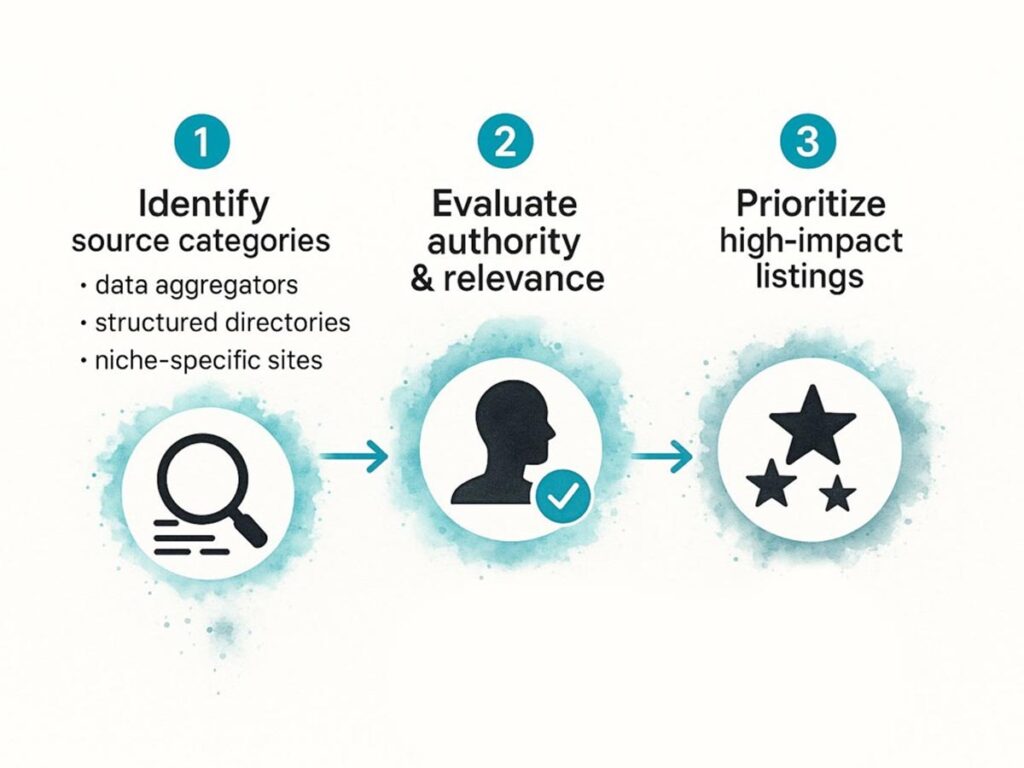
As you can see, the process moves from a broad identification of source types to creating a refined list of high-impact platforms perfectly suited to your business.
Evaluating Authority and Relevance
Local search has become a strategic, data-driven discipline. With 46% of all Google searches having local intent, the need for accurate business information is paramount. The data tells a compelling story: business websites make up 47% of first-page local results, while directories and other third-party mentions account for another 47%. This perfectly illustrates just how critical it is to be present on trusted external sites.
When evaluating a potential citation site, ask two simple questions:
- Does this site have high authority? Use free SEO tools to check a site’s Domain Authority (DA). A higher score indicates a trustworthy and valuable platform.
- Is this site relevant to my business or my city? A listing on your local Chamber of Commerce website is almost always more valuable than one on a generic national directory with no local connection.
Focusing your energy on a curated list of high-authority, relevant sites will always outperform a scattershot approach. In modern local SEO, quality soundly defeats quantity.
While citations are fantastic for building trust, they pack the biggest punch when paired with a solid backlink strategy. To learn more, check out our guide on local link building to see how backlinks can add another powerful layer of authority. By prioritizing high-value opportunities, you ensure your time is invested where it will make the most significant impact on your rankings.
Ensuring Ironclad Consistency in Every Submission

If there is one golden rule in local SEO, it’s this: accuracy is non-negotiable. When building citations, every single submission must be a perfect mirror of your core business information. I’ve seen businesses torpedo their own efforts over something as trivial as listing “St.” on one directory and “Street” on another. These tiny variations create conflicting signals that confuse search engines and dilute your local authority.
Look at it from Google’s perspective. If ten different sources provide ten slightly different addresses, Google can’t be certain which is correct. That uncertainty makes it less likely to recommend you in local search results, directly impacting your ability to attract customers.
Your Pre-Submission Accuracy Checklist
Before submitting to a single directory, you must establish a single source of truth for your NAP data—your Name, Address, and Phone number. This master file will be your guide, ensuring every listing you create is a carbon copy of the last.
I recommend keeping this in a simple spreadsheet or document that your whole team can access. This simple step prevents the accidental typos and variations that can destroy a campaign.
Here’s what to lock down:
- Business Name: Is it “Smith & Sons Plumbing, Inc.” or just “Smith & Sons Plumbing”? Use your exact legal or doing-business-as (DBA) name and stick with it.
- Street Address: Standardize every component according to your country’s postal service. For instance, the U.S. Postal Service has specific abbreviations (e.g., ‘STE’ for Suite, ‘AVE’ for Avenue). Pick one format and never deviate.
- Phone Number: Always use your primary local business line, including the area code. Avoid using tracking numbers in general citations, as they can cause inconsistencies.
- Website URL: Use the final, canonical version of your URL. Pay close attention to
https://vs.http://and whether you includewww.or not.
The goal is to make it incredibly easy for search engines to connect the dots across the web. When your business information is identical everywhere, it removes all doubt and builds the trust needed for higher local rankings.
Manual Submissions vs. Automated Services
With your master NAP in hand, you have two primary paths for building citations: doing it manually or using an automated service. The right strategy often involves a bit of both.
Businesses with complete and accurate listings across the most important platforms can see up to 25% higher visibility in local search. This isn’t just a vanity metric; it’s a direct result of Google’s algorithm rewarding the consistency that’s crucial for ranking in those valuable “near me” searches.
Let’s break down the pros and cons of each method to help you decide which path is right for you.
Citation Building Approaches
| Feature | Manual Submission | Automated Service |
|---|---|---|
| Control | 100% control over every detail. | Limited control; relies on the service’s API and data mapping. |
| Accuracy | Guarantees perfect NAP consistency if done carefully. | High, but occasional errors can still occur. |
| Speed | Slow and time-consuming. | Extremely fast; distributes to hundreds of sites at once. |
| Cost | “Free” in money, but requires a significant time investment. | Typically an annual subscription (e.g., Yext, BrightLocal). |
| Best For | Core foundational directories and high-authority niche sites. | Scaling your presence across a broad range of general directories. |
In my experience, a hybrid approach yields the best results. Start by manually claiming and meticulously optimizing your listings on the titans of local search—Google Business Profile, Bing Places, Apple Maps, and top-tier industry directories. These are too important to leave to automation.
Once that foundation is solid, you can leverage an automated service to efficiently distribute your information to a wider net of secondary directories. For a deeper dive, our guide on local business listing optimization outlines more advanced strategies. This balanced method gives you the quality of manual control and the quantity needed for broad visibility.
Keeping Your Citations Healthy for the Long Haul
Think of your local citations as a garden, not a brick wall. It’s not a one-and-done project. A “set it and forget it” mindset is a fast track to outdated information spreading across the web, which completely undermines the authority you’ve worked so hard to build.
To protect your investment in local SEO, you must be a vigilant steward of your business information. This means having a plan for consistent upkeep. As your business evolves—a new address, a different phone number, or a full rebrand—your digital footprint must change with it, accurately and everywhere. If you neglect this, old data will linger online, creating messy duplicate listings and conflicting information that will damage your local rankings.
Set Up a Proactive Monitoring System
A solid maintenance plan is built on catching problems before they spiral. Thankfully, you don’t have to spend your days manually checking dozens of directories. Modern SEO tools can act as your early-warning system, alerting you whenever your business name appears somewhere new or when an existing listing is changed without your permission.
This shifts your strategy from constantly playing catch-up to proactively defending your data’s integrity. When you get an alert about a new, inaccurate citation scraped by a data aggregator, you can resolve it immediately. This prevents the error from spreading across the web and saves you from a massive cleanup project down the road.
A manageable maintenance strategy is all about consistency. A simple quarterly audit is usually all it takes to find duplicates, fix inaccuracies, and ensure your most important listings on high-authority sites are still perfect.
This simple routine prevents small data discrepancies from becoming major ranking issues.
How to Handle Common Business Changes
Change is a constant in business, but it doesn’t have to sabotage your local SEO. All you need is a methodical approach to updating your information.
- You’re Moving to a New Address: Start the update process before you move. Update the new address on your website and your Google Business Profile first. Once the move is complete, systematically work through your list of top-tier directories, double-checking that the new address is published correctly.
- You’re Changing Your Phone Number: Just like with an address change, update your most critical platforms first. Your website, GBP, and the primary data aggregators should be at the top of your list to push the new number into the ecosystem quickly.
- You’re Rebranding: This is the most complex change. You must update your new business name everywhere while also managing mentions of the old one to prevent Google from seeing them as two separate, competing entities.
The explosion of mobile search has made this accuracy more critical than ever. Mobile searches with local intent have skyrocketed by over 900% in recent years, and users depend on that data to be correct. Consider that 60% of mobile users have used a “click-to-call” feature directly from a listing—an accurate phone number isn’t just a detail, it’s a direct line to new customers. You can find more insights on this in a detailed analysis on local citation providers.
By putting a simple monitoring and audit schedule in place, you build a sustainable framework for your local SEO. This ensures your citation profile remains a powerful, accurate asset that supports your business’s growth for years to come.
Common Questions About Local Citation Building
As you dive into local citation building, questions are bound to surface. That’s normal. Getting these details right is what separates a strategy that works from one that just spins its wheels. Let’s tackle some of the most common questions business owners ask.
Structured vs. Unstructured Citations: What’s the Difference?
This concept sounds technical, but it’s quite simple.
A structured citation is a formal business listing on a site like Yelp or your Google Business Profile. Your business’s Name, Address, and Phone number (your NAP) are entered into specific, labeled fields. It’s clean, organized, and easy for search engines to parse.
An unstructured citation is a more casual mention. Imagine a local food blogger writing about your restaurant or a news site covering a community event you sponsored. When they mention your business name and maybe your address in the body of an article, that’s an unstructured citation. Both types are valuable signals to search engines that your business is a legitimate, active part of the local community.
How Quickly Can I Expect to See Results?
This is the million-dollar question, and the honest answer is: it takes time. Local citation building is not an overnight fix. While a new listing might go live on some directories within days, others can take weeks to review and publish your submission.
Realistically, you should expect to see initial movement in your local search visibility within one to three months of a consistent and focused effort. However, the real payoff—stable, high-ranking positions that drive consistent traffic—builds over a much longer period. Think of it as a long-term investment in your business’s digital foundation, not a quick-win tactic.
Do I Really Need to Include My Suite Number?
Yes. Absolutely, one hundred percent, yes. This might seem like a minuscule detail, but it’s one of the most critical components of NAP consistency.
Your address must be an exact match everywhere. If your official business address registered with the U.S. Postal Service includes a suite or unit number, you must use it on every single citation.
Dropping “Suite 200” from one listing while including it on another sends a confusing signal to Google. That ambiguity can directly harm your local rankings. Decide on one standard format—whether it’s ‘Suite 200’, ‘Ste. 200’, or ‘#200’—and use it religiously.
How Do Citations Actually Help My Google Business Profile?
Citations are a core pillar supporting your Google Business Profile (GBP) ranking. Think of Google’s algorithm as a detective constantly looking for clues across the web to verify the information on your GBP.
When it finds dozens of high-quality, consistent citations that match your GBP, it confirms your business’s existence, location, and legitimacy. This builds immense “trust” and authority for your profile. That trust is what fuels higher rankings in the local map pack, putting you in front of more customers actively searching for what you offer.
Ready to stop worrying about inconsistencies and start dominating local search? Galant Studios specializes in expert local SEO strategies that build a powerful and consistent online presence for your business. Let our 8+ years of experience drive your growth. Get in touch with us today to see how we can boost your visibility and attract more customers.