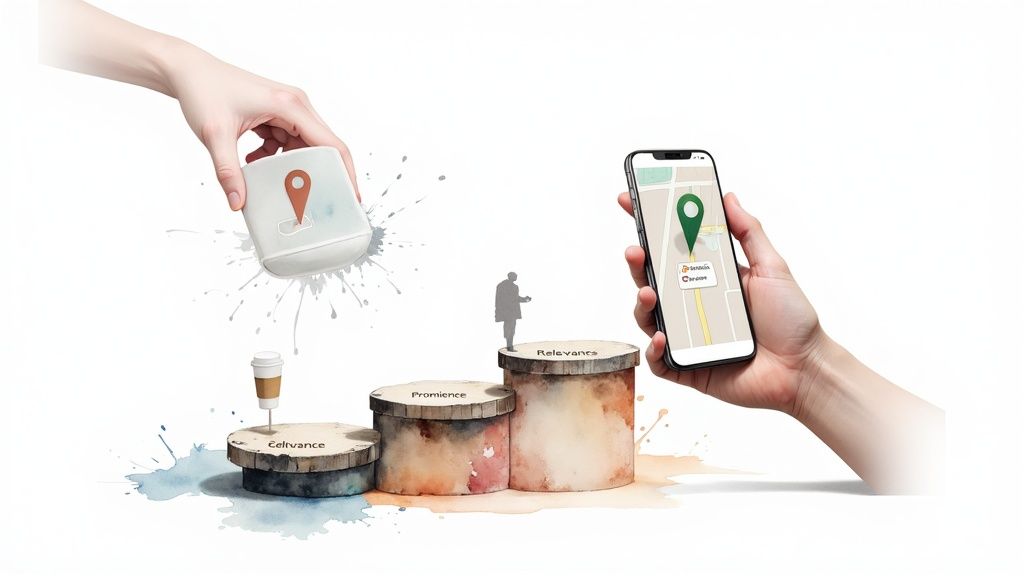
Local search ranking factors are the signals Google’s algorithm weighs to decide which local businesses to show at the top of its results. The entire system is built on three core concepts: relevance, proximity, and prominence. A successful local strategy comes down to optimizing for these pillars, making sure your business is the best possible answer for a potential customer nearby.
The Blueprint for Local Search Visibility
Think of it this way: general search engine optimization (SEO) is like getting your business listed in a massive, global directory. It’s helpful, but you’re competing against everyone. Local SEO, on the other hand, is about becoming the go-to spot everyone in the neighborhood knows and recommends. It’s about being visible to the people just around the corner.
This targeted approach is absolutely essential because so many searches today have local intent. When someone pulls out their phone and types in “best pizza near me,” they aren’t looking for a theoretical answer—they’re hungry and want immediate, trustworthy results. Google’s local algorithm is fine-tuned to deliver just that, often through the highly visible “Map Pack” that sits at the top of the search results page.
Understanding Google’s Core Pillars
So, how does Google decide who gets those prime Map Pack spots? Its algorithm evaluates businesses against three foundational pillars. If you want to build a winning local SEO strategy, you have to master these first.
- Relevance: This is all about how well your business profile aligns with what a person is looking for. If someone searches for an “emergency plumber,” Google scours its index for businesses clearly categorized as plumbers that also list emergency repairs as a service. It’s a direct matchmaking process.
- Proximity: This one is straightforward—it measures the physical distance between your business and the user’s location (or the location they specified in their search). You can’t just pick up and move your shop, but you can make absolutely certain that Google knows precisely where you are and the specific areas you serve.
- Prominence: This pillar gauges how well-known and respected your business is in the real world, as reflected online. Google looks at signals like the quantity and quality of your online reviews, the number of reputable websites linking back to you, and how often you’re mentioned in trusted online directories.
To help you visualize how these components work together, here’s a quick overview of the strategic goals for each pillar.
The Core Pillars of Local Ranking
This table summarizes the primary categories that influence your local search ranking and their strategic goals.
| Pillar | Core Components | Primary Goal |
|---|---|---|
| Relevance | Google Business Profile categories, on-page content, keyword optimization. | Align your digital presence directly with customer search queries. |
| Proximity | Physical address, service area definitions, location-specific keywords. | Ensure Google understands your exact location and the geographic areas you serve. |
| Prominence | Online reviews, backlinks from local sites, directory citations. | Build a strong online reputation that signals authority and trustworthiness. |
By consistently working on these three areas, you create a comprehensive and authoritative digital footprint that search engines can easily understand and trust.
The real secret to local SEO isn’t finding one magic bullet to rank higher. It’s about meticulously building a holistic and trustworthy digital presence that sends strong, consistent signals of quality and authority to Google.
This image from a Whitespark study breaks down the most influential ranking factors, showing you exactly where to concentrate your efforts for the biggest impact.
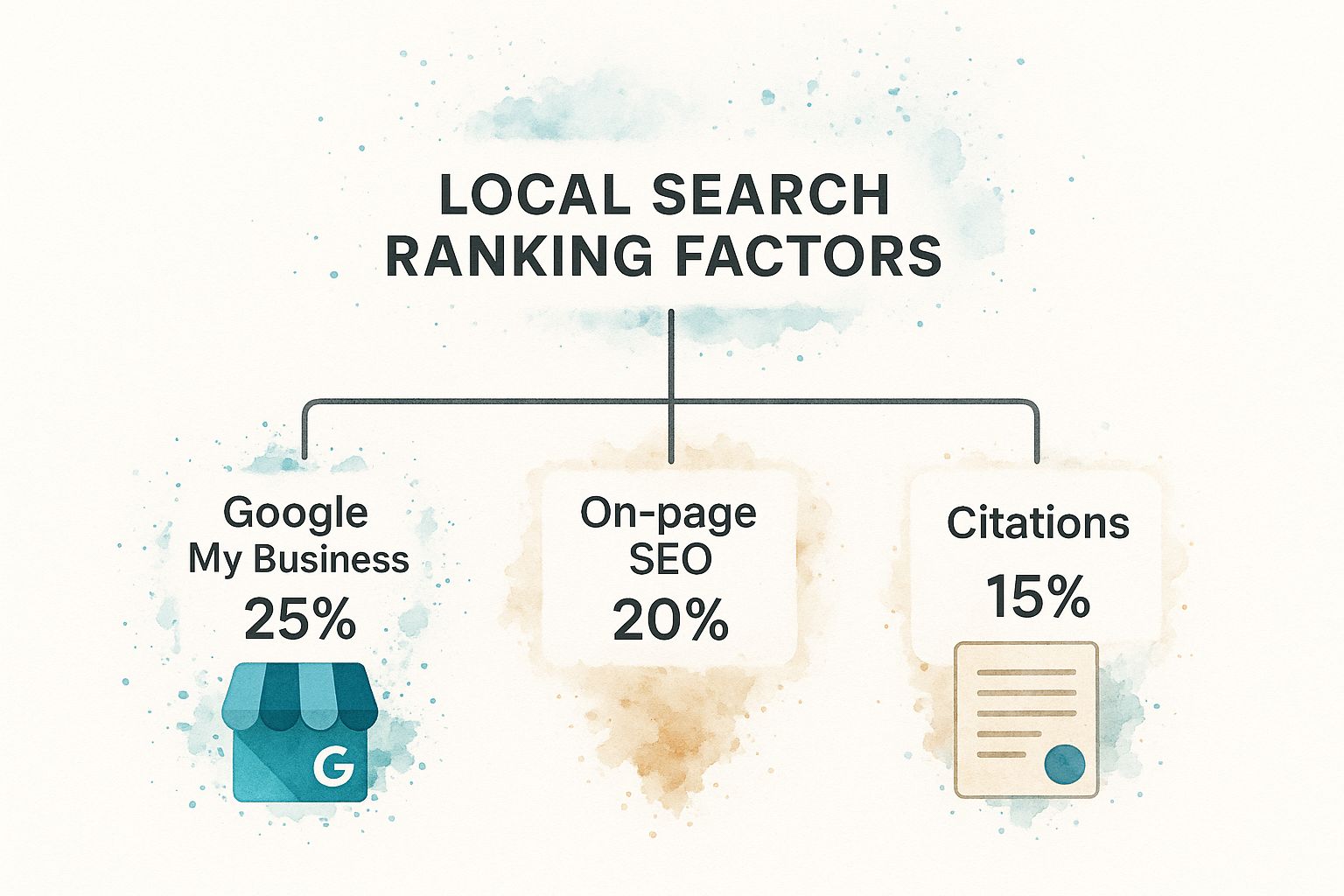
As you can see, your Google Business Profile, on-page signals from your website, and your backlink profile carry the most weight. These are the cornerstones of local search visibility, and in the following sections, we’ll dive into actionable strategies to optimize each of these critical areas.
Optimizing Your Google Business Profile for Dominance
Think of your Google Business Profile (GBP) as your digital storefront. For local businesses, it’s not just important; it’s the single most critical driver for showing up in local search results.
In fact, a complete and actively managed GBP can account for up to 32% of the ranking influence in the coveted Google Maps pack results. Read the full research about GBP impact. That’s a massive piece of the pie you can’t afford to ignore.
Let’s break down how to build a profile that works for you.
Choosing The Right Categories
Everything starts with telling Google exactly what you do. The first step, and one of the most crucial, is selecting precise business categories. This is how you match what you offer with what people are searching for.
Your primary category should be the one that best describes your core business. From there, you can add a few secondary categories to cover more specific services. For instance, a bakery’s primary category would be “Bakery,” but they might also add “Wedding Cake Supplier” to capture that specific audience.
- Accuracy Over Quantity: Don’t stuff your profile with irrelevant categories. Google values precision and trust.
- User Intent Matching: The right categories help you appear for highly relevant, purchase-ready searches.
Crafting A Compelling Description
Your business description is your chance to tell a story. In a few concise sentences, you need to highlight what makes you unique and why a customer should choose you.
This is also the perfect place to naturally include local keywords, like city names or well-known neighborhoods. Doing this helps you show up when someone searches for a service in your specific area.
Here’s a look at the Google Business homepage setup interface where you’ll manage these details:

This dashboard is your command center for entering categories, business hours, contact information, and more.
Uploading Geo-Tagged Photos
They say a picture is worth a thousand words, and on your GBP, it’s also a powerful signal to Google. High-resolution images of your storefront, your team in action, and your products build trust and boost engagement.
But here’s a pro tip: geo-tag your photos before uploading them. This embeds location data into the image file, which sends another strong signal to Google’s algorithm that your business is exactly where you say it is.
- Name your image files with location-based keywords, like ‘Main-Street-Cafe-Anytown.jpg’.
- Always include alt text that describes the image and mentions your business and location.
Leveraging Google Posts
Google Posts are like mini-billboards right on your listing, allowing you to share updates, events, and special offers directly with searchers.
Consistent posting is key. It shows Google that your profile is active and keeps your listing fresh and relevant.
- Post about limited-time promotions to create a sense of urgency.
- Share recent customer reviews or testimonials to build social proof.
Try to publish at least one new post every week to maintain your momentum.
Using The Q&A Feature
The Q&A section is a goldmine. You can proactively answer common questions before potential customers even have to ask them.
This simple tactic positions you as an authority and removes potential friction from the decision-making process. Think about what people always ask you.
- What is your turnaround time for custom orders?
- Do you offer free estimates on weekends?
By answering each question thoroughly, you can also start to capture more of those valuable long-tail searches.
Adding Specific Services
Don’t just rely on your categories. The “Services” section of your GBP dashboard lets you detail every single service you offer, complete with its own title and description.
This is how you expand your reach into more niche searches and signal deep expertise in your field.
- A Service Name like ‘Emergency AC Repair’ immediately attracts customers with urgent needs.
- The Service Description can then mention your service area and key benefits, further strengthening your local relevance.
Think of the services section as a detailed mini-directory for your business, right within your profile.
A fully optimized GBP sends strong signals of activity, authority, and relevance directly to Google.
To keep everything in top shape, you need to perform regular audits to ensure your information is always current and complete.
For a deeper dive, check out our guide on how to optimize your Google Business Profile for more detailed instructions and advanced tips.
A consistent maintenance schedule is the best way to stay on top.
| Step | Frequency | Benefit |
|---|---|---|
| Category Review | Quarterly | Better relevance |
| Photo Upload | Bi-weekly | Improved engagement |
| Post Updates | Weekly | Signals activity |
| Q&A Audit | Monthly | Reduces friction |
| Service Addition | As needed | Niche reach |
Follow this plan and keep a close eye on your GBP performance. This isn’t a one-and-done task; it’s an ongoing process. Regular improvements are what lead to long-term visibility, higher rankings, and ultimately, more customers walking through your door.
Honing Your On-Page Local SEO Signals
While your Google Business Profile is the star player for getting into the Map Pack, your website is the bedrock. It’s the foundation that proves your authority to Google for all the other local search results. This is where you get to tell your story, build trust, and demonstrate why you’re the local expert. Skipping this part is like setting up a beautiful storefront but forgetting to hang a sign out front.
On-page SEO is all about optimizing the content and code of your website to send strong, clear signals about your local relevance. It’s a huge piece of the puzzle. While SEO experts might debate the exact order of importance, a major industry survey found that 36% of them believe on-page signals are the single most important factor for ranking in organic local search.

Mastering Local Keyword Research
First things first: you need to speak your customers’ language. Real local keyword research isn’t about guessing what people might search for; it’s about uncovering the exact phrases they type into Google when they need what you offer. You have to think beyond a generic term like “plumber.”
Your potential customers have specific, often urgent, problems. Someone in Texas isn’t just looking for a “plumber.” They’re far more likely to search for “emergency plumber in Austin” or “24-hour pipe repair near downtown Dallas.” These longer, more detailed phrases are what we call long-tail keywords. They signal someone is ready to buy and are usually less competitive, making them gold for a local business.
The goal is to build a solid list of these terms to shape your entire content strategy. You can use tools like Google Keyword Planner, but honestly, one of the best ways is to just start typing queries into Google and see what it suggests. Those autocomplete options come directly from real user searches.
Strategic Keyword Integration
Once you have your target keywords, the next step is to weave them naturally into the fabric of your website. Doing this properly tells search engines what each page is about and, crucially, which geographic areas you serve. Think of it as placing helpful signposts all over your site that guide both your visitors and Google’s crawlers.
Here are the most important places to get your local keywords integrated:
- Title Tags: This is the headline that shows up in the browser tab and on the search results page. Keep it concise, but make sure it includes your main service and location (e.g., “Expert AC Repair Services in Phoenix, AZ”).
- Meta Descriptions: This doesn’t directly influence rankings, but a well-written description that includes your keyword and location can be the difference between someone clicking your link or your competitor’s.
- Header Tags (H1, H2, H3): Your main keyword should be in the H1 tag, which is the main title on the page itself. Use related keywords in your H2 and H3 subheadings to give the page a clear, logical structure.
- Body Content: Sprinkle your keywords and location-based phrases throughout your content, making sure it reads naturally. It’s particularly important to get them into the first 100 words or so.
For a deeper dive into these on-page elements, our dedicated guide explains what is on-page SEO in much more detail.
Ensuring Flawless NAP Consistency
One of the most fundamental rules in local SEO is maintaining the consistency of your business’s Name, Address, and Phone number (NAP). This information has to be absolutely identical on every single page of your website, usually placed in the footer or on a dedicated contact page.
Any inconsistency, no matter how tiny—like using “St.” on one page and “Street” on another—can create confusion for search engines. That confusion erodes the trust Google has in your location data, which can directly tank your local rankings.
Think of your NAP as your business’s digital fingerprint. It needs to be perfectly clean and consistent everywhere it appears online, and that starts with your own website. This reinforces your legitimacy and makes it a no-brainer for Google to verify your physical location.
Implementing Local Business Schema Markup
Finally, you can give search engines a direct, crystal-clear explanation of who you are by implementing local business schema markup. Schema is a special vocabulary of code that you add to your website’s backend. While it doesn’t change what visitors see on the front end, it explicitly tells search engines what your content actually means.
This code clearly labels key pieces of information, such as:
- Your official business name
- Your precise address and even geo-coordinates
- Your phone number and hours of operation
- Your average customer review ratings
By serving this data up on a silver platter, you remove all the guesswork for Google. This can help you earn “rich results” in the search listings, like those eye-catching star ratings or event details, which can seriously boost your click-through rate and make your business stand out from the crowd.
Building Trust Through Reviews and Citations
In local search, trust is everything. While your Google Business Profile and website set the stage, it’s your public reputation that truly makes the difference. Two of the most powerful signals you can send are through customer reviews and business citations. These tell both potential customers and search engines that you’re a legitimate, respected, and active part of the local community.
Think of it from Google’s perspective. Its goal is to provide the best, most reliable answer to a searcher’s query. A business with a steady flow of recent, glowing reviews and consistent information across the web looks far more trustworthy than one that’s a ghost online or has conflicting details scattered about.
The Power of Online Reviews
Online reviews are the new word-of-mouth. They are the social proof that people rely on before they decide to spend their money. For any local business, having a strong collection of reviews isn’t just a nice bonus; it’s a core driver of visibility and real-world sales.
This is especially true in the Google Map Pack, where star ratings are displayed right next to your business name. This is prime real estate. In fact, research shows that around 42% of users click on results in this highly visible section. A high star rating here can be the deciding factor. It’s no surprise that 90% of marketers agree that positive reviews and active review management directly boost local search rankings.
Strategies for Generating Consistent Reviews
You can’t just sit back and hope for reviews to trickle in. That’s a recipe for a weak online reputation. The key is to build a simple, proactive system that makes it easy for happy customers to share their experiences.
Here are a few proven, ethical tactics that work:
- Email Follow-Ups: A few days after a purchase or service, send a polite, automated email asking for feedback on Google. Timing is key here—you want the experience to still be fresh in their mind.
- In-Store Prompts: Use QR codes on receipts, table tents, or flyers that link directly to your Google review page. This removes all friction.
- Personal Requests: For service businesses, train your staff to ask satisfied customers for a review right after a successful job. A simple, “If you were happy with the service, we’d love it if you could share your experience on Google” can work wonders.
Beyond just getting more reviews, employing effective strategies for collecting customer feedback can give you invaluable insights while simultaneously bolstering your local reputation.
It is absolutely critical to respond to every single review—the good, the bad, and the neutral. A thoughtful response to a negative review often wins over more future customers than a dozen positive ones, as it shows you are accountable and genuinely care.
Demystifying Business Citations
If reviews build your reputation with people, citations build your credibility with search engines. A citation is just a mention of your business’s core information—Name, Address, and Phone number (NAP)—on another website. You’ll find them on online business directories, industry-specific sites, and local community pages.
Think of each consistent citation as a vote of confidence. When Google’s crawlers find your exact NAP information on dozens of reputable platforms like Yelp, the Better Business Bureau, or the local Chamber of Commerce site, it confirms that you are who you say you are and you’re located where you say you are. This consistency is a cornerstone of building local prominence.
The reverse is also true. Inconsistent or outdated information creates digital confusion, eroding Google’s trust and hurting your rankings. That’s why auditing and cleaning up your citations is an essential, ongoing task.
To dig deeper into this, you can read our detailed guide on https://galantstudios.com/local-business-listing-optimization/. The process of ensuring NAP consistency across the web is fundamental to building a strong local presence.
To stay on top of these crucial off-page factors, it helps to follow a structured routine. This checklist outlines the key tasks to perform each month to keep your online reputation in top shape.
Essential Review and Citation Management Checklist
| Task | Frequency | Primary Tool/Method |
|---|---|---|
| Monitor and Respond to All Reviews | Daily/Weekly | Google Business Profile Dashboard, Review Management Software |
| Actively Request New Reviews | Weekly | Email/SMS Automation, In-Person Requests, QR Codes |
| Audit for New NAP Mentions | Monthly | Google Alerts, Brand Monitoring Tools |
| Check Top Directories for Accuracy | Monthly | Manual Check, Yext, Moz Local |
| Identify and Build New Citation Opportunities | Monthly | Industry/Local Directory Research |
Following a simple schedule like this ensures you’re not just reacting to your online reputation, but actively building it. Consistency in these efforts is what separates businesses that just show up online from those that truly dominate their local market.
4. Understanding Behavioral and Technical SEO Signals
Beyond the content you write and the links you build, Google pays close attention to two other vital areas: how people actually interact with your business online and the overall technical health of your website.
Think of it like this: your other SEO work gets a customer to your digital front door. Behavioral signals tell Google if they liked what they saw when they peered through the window, and technical SEO ensures the door opens smoothly without getting stuck. Mastering both gives you a serious competitive edge.
Gauging User Intent with Behavioral Signals
Behavioral signals are essentially the digital footprints users leave behind, and Google’s algorithm interprets these actions as votes of confidence. When people engage with your listing, it suggests your business is a popular and relevant choice for what they were searching for.
These signals are so influential because they directly reflect real-world interest. If lots of people are taking positive actions on your listing, it’s a clear message to Google that you’re a trusted local authority.
Key behavioral signals to watch include:
- Click-Through Rate (CTR): This is simply the percentage of people who click on your listing after it appears in their search results. A high CTR tells Google your listing is compelling and highly relevant to the search.
- Mobile Clicks-to-Call: This metric tracks how many users tap the “call” button directly from your Google Business Profile on their phone. It’s a powerful sign of immediate intent to connect.
- Driving Directions Requests: When someone requests driving directions to your physical store, it sends one of the strongest possible local signals to Google. They aren’t just browsing; they intend to visit.
To get a better handle on what drives these actions, exploring the broader principles of customer behavior analytics can offer some fantastic insights.
A listing that consistently earns clicks, calls, and direction requests is effectively telling Google, “I am the best answer for this local need.” This kind of user validation is a direct line to higher local rankings.
Building a Strong Technical Foundation
While behavioral signals measure how much users like you, technical SEO makes sure your website doesn’t actively push them away. A slow, confusing, or insecure site can sabotage all your other efforts in an instant.
The technical health of your website is foundational for all modern SEO, but it’s especially critical for local search, where your audience is frequently on a mobile device and short on patience.
Here are the technical elements you absolutely have to get right:
- Mobile-Friendliness: The vast majority of local searches happen on smartphones. Your website must provide a seamless experience on small screens. Google uses mobile-first indexing, which means it primarily judges your site based on its mobile version.
- Page Speed: Users expect websites to load in the blink of an eye. A site that takes more than a few seconds to appear will have users bouncing away, signaling a poor experience to Google.
- HTTPS Security: A secure website (the “https” in your URL) is a confirmed ranking factor, even if a small one. More importantly, it builds trust. Users are rightly hesitant to share information or engage with a site that their browser flags as “not secure.”
Ultimately, these technical and behavioral factors are two sides of the same coin. A technically sound website encourages positive user behavior, which sends strong signals to Google. This creates a powerful feedback loop that works to continuously boost your visibility in local search results.
Your Questions on Local Search Factors Answered

Diving into local search can feel like you’re trying to solve a puzzle with a thousand moving pieces. It’s only natural to have questions. This section cuts through the noise and answers some of the most common things business owners ask, giving you clear, straightforward guidance to help you focus your efforts where they’ll have the biggest impact.
Let’s skip the jargon and get right to what works, what to avoid, and how to build a smart strategy that gets you real, tangible results.
How Long Does It Take to See Local SEO Results?
This is the big one, isn’t it? The honest answer is: it depends. Local SEO isn’t a quick fix; think of it as a long-term investment in your business’s visibility. Generally, you should start seeing some positive movement in your rankings within three to six months of consistent work.
Several things can speed up or slow down that timeline:
- Competition Level: If you’re in a crowded market full of established businesses, it’s going to take more time to climb the ranks. A niche business in a smaller town, on the other hand, might see progress much faster.
- Starting Point: A business with a brand-new, unoptimized Google Business Profile has a longer road ahead than one that’s already got the basics covered and just needs some fine-tuning.
- Consistency: This is key. Regularly updating your GBP, earning new reviews, and building citations every single month will dramatically accelerate your progress.
I often tell clients to think of it like tending a garden. You can’t plant seeds and expect a full bloom the next day. But with steady watering and care, you’ll cultivate a strong, healthy presence that lasts.
Which Single Factor Is Most Important?
Everyone wants to find that one magic bullet, but the truth is that local search is a holistic system where everything works together. If I had to pick just one thing, though, it would be the Google Business Profile (GBP). It is hands-down the most powerful component, especially for getting into that all-important Map Pack.
Your GBP is the central hub where Google gathers most of its information about your business. It’s the primary driver behind your relevance, proximity, and prominence signals.
An incomplete or neglected Google Business Profile is the single biggest obstacle to local search success. Prioritizing its full optimization—from accurate categories to consistent posts and active review management—provides the highest return on your time and effort.
Do I Need a Physical Address to Rank Locally?
For most local search features, yes, a verifiable physical address is non-negotiable. The whole idea behind local search is based on proximity—Google needs to confirm your physical location to show you in “near me” searches. The address on your GBP has to be a place where you can actually meet customers.
But what about businesses that go to their customers? There are options for what are known as Service Area Businesses (SABs).
- For Plumbers, Electricians, and Landscapers: You can set up your GBP as an SAB. This allows you to define the specific cities, counties, or zip codes you serve.
- Hiding Your Address: During setup, you’ll get the option to hide your street address from the public. You still provide Google with a verifiable location, but it won’t show up on your public profile.
This setup allows mobile businesses to appear in relevant local searches without having to display a home or private office address. For the official rules, it’s always a good idea to review the guidelines for representing your business on Google.
How Do Negative Reviews Affect My Ranking?
Getting a negative review stings, but it won’t automatically sink your rankings. In fact, the way you respond can send incredibly positive signals to both Google and potential customers. Think about it: a profile with nothing but glowing five-star reviews can sometimes look less authentic than one with a realistic mix.
What really matters is your response. When you reply to a negative review promptly and professionally, you show that you’re accountable and committed to customer satisfaction. This builds trust. It shows everyone else looking at your profile that you take feedback seriously, which can often win over more new customers than the bad review might have lost.
Optimizing for local search is an ongoing process of building authority and earning trust. If you’re ready to stop guessing and start implementing a strategy that drives real growth, Galant Studios can help. Our expert team combines data-driven SEO with compelling design to ensure your business stands out.