A content marketing strategy is your documented blueprint for winning customers. It details how you’ll use valuable, relevant content to attract, engage, and persuade a specific audience to take action. It’s the critical bridge connecting your ambitious business goals to the real-world content you create every day.
This plan is what separates thoughtful, profitable marketing from just making noise online.
What a Content Marketing Strategy Really Is (And Isn’t)

It’s tempting to jump right into creating—writing a blog post here, a social media update there. But without a strategy, you’re just throwing darts in the dark and hoping one hits the bullseye. A formal content marketing strategy turns that expensive guesswork into a deliberate, repeatable process for growth.
Think of it this way: you wouldn’t set out on a cross-country road trip without a map or GPS. Your content strategy is that map. It tells you exactly where you’re going (your goal), the best routes to take (your channels), and what milestones to look for to ensure you’re on the fastest path to your destination.
Moving From Random Acts to a Cohesive System
A documented strategy provides a clear framework for every content decision you make. It ensures each article, video, or email newsletter is a calculated step toward a much larger objective. For a deeper dive into this foundational concept, you can explore this resource on What Is Content Marketing Strategy?
This structured approach forces you to answer the tough, essential questions before you create anything:
- Who are we really talking to? Go beyond simple demographics. What keeps your ideal customer up at night? What are their biggest challenges and secret aspirations?
- What do we want to achieve? Do we need to build brand awareness, generate a pipeline of sales-qualified leads, or improve customer loyalty? Be specific.
- How does our content actually solve a problem? What unique perspective or tangible solution can we provide that no one else is offering?
- How will we know if it’s working? What specific key performance indicators (KPIs) will track our success and hold us accountable to a tangible ROI?
Answering these questions gives your entire team a North Star. It aligns every effort, prevents wasted resources, and ensures your content consistently builds trust and authority with the people most likely to buy from you.
The table below highlights the night-and-day difference between working with a plan versus winging it.
Strategic Content vs. Ad-Hoc Content Creation
| Attribute | With a Content Strategy | Without a Strategy |
|---|---|---|
| Purpose | Every piece of content has a clear, defined goal tied to business objectives. | Content is created reactively, often based on trends or gut feelings. |
| Audience | Content is precisely targeted to a well-researched audience persona, solving their specific problems. | Content is generic, trying to appeal to everyone and ultimately resonating with no one. |
| Consistency | Brand voice, messaging, and quality are consistent across all channels, building brand recognition. | Messaging is disjointed and brand identity is weak or confusing. |
| Measurement | Success is measured with specific KPIs, allowing for data-driven adjustments and proving ROI. | ROI is difficult or impossible to measure; success is purely anecdotal. |
| Efficiency | Resources (time, budget) are allocated effectively to high-impact activities. | Efforts are scattered, leading to wasted time and budget on low-return tasks. |
| Outcomes | Builds long-term brand authority, audience trust, and a predictable lead pipeline. | Generates sporadic traffic spikes but fails to build sustainable growth or customer loyalty. |
As you can see, the difference isn’t just procedural—it directly impacts your bottom line.
Get In Touch
The Core of Strategic Content
Ultimately, a content marketing strategy boils down to one powerful idea: intentionality.
It’s about making deliberate choices to achieve specific business results. It’s about planning not just what you’ll create, but why you’re creating it, who it’s for, and exactly how it will contribute to revenue.
This mindset is what elevates you from being just another content publisher to becoming a go-to, trusted resource in your industry. It’s how you stop chasing quantity and start creating quality that builds a sustainable engine for growth.
Why a Content Strategy Is a Non-Negotiable Asset
In a marketplace that’s noisier than ever, creating content without a plan is just shouting into the void. A documented content marketing strategy is what turns that shout into a clear, persuasive message—one that reaches the right people and inspires them to act. It’s what transforms your marketing from a cost center into a predictable engine for growth.
Without that strategic roadmap, you’re just creating stuff. You end up with inconsistent content that’s completely disconnected from what the business needs to achieve. The result? Wasted time, a drained budget, and a pile of digital assets that don’t build any real momentum. A strategy gives you the framework to be intentional.
Building a Competitive Moat with Content
A well-executed strategy is one of the most powerful competitive advantages you can build. While your competitors are busy chasing shiny objects or publishing random blog posts, you’ll be systematically building a library of genuinely helpful resources. That library becomes a durable asset that attracts, educates, and nurtures potential customers 24/7.
This asset-building approach pays off with compounding returns. A single, deeply researched article can bring in qualified organic traffic for years, slowly but surely cementing your brand as the trusted authority. This kind of authority is what builds real customer loyalty and makes you the obvious choice when it’s time to buy.
A content strategy shifts your focus from running short-term campaigns to building long-term relationships. It’s the difference between renting an audience with ads and owning an audience built on trust.
This isn’t just a nice idea; it’s backed by powerful market trends. Content marketing has matured from a niche tactic into a massive global industry. Researchers valued the market at roughly $413.2 billion in 2022, and they’re projecting it could rocket toward $2.0 trillion by 2032. That growth is reflected in how companies are spending, too—36% of them now dedicate between 10% and 29% of their total marketing budgets just to content. You can explore more data on these industry trends to see just how significant this shift is.
Get In Touch
Fueling a Sustainable Lead Pipeline
One of the most direct business outcomes of a strong content strategy is a steady, sustainable flow of leads. When you consistently publish content that speaks directly to the problems and questions of your target audience, you pull qualified prospects right to your digital doorstep.
This works so well because it mirrors how people actually buy things today. Modern buyers are researchers. Before they even think about making a purchase, they head to Google to find answers, compare options, and get validation for their choices. A solid strategy ensures your content is there waiting for them, right when they need it most.
Here’s a practical example of how a strategy fuels your pipeline:
- Improves Search Engine Visibility: By focusing on the exact keywords your audience is searching for, your content climbs the search rankings and drives a consistent stream of organic traffic from people looking for your solution.
- Attracts Qualified Prospects: Your content acts like a magnet for the right people—individuals genuinely interested in what you have to say. For instance, a B2B software company writing about “how to improve team productivity” will attract managers, not hobbyists.
- Nurtures Leads Effectively: A strategy maps out content for every stage of the buyer’s journey, so you’re always delivering the right information at the right time to guide people toward a decision.
Ultimately, investing in a content marketing strategy isn’t just about making better blog posts. It’s a core business decision that builds lasting brand equity, secures your relevance in the market for years, and delivers a return you can actually measure.
The Building Blocks of an Effective Content Strategy
A powerful content marketing strategy isn’t a single document; it’s a living system built from several critical, interconnected parts. Each one supports the others, creating a stable foundation for every piece of content you publish. Without these pillars, your efforts are aimless, making it nearly impossible to see real business results.
Think of it like assembling a high-performance engine. You need the right pistons, camshaft, and fuel injectors all working in perfect harmony. In content strategy, these essential components are your audience personas, your business goals, and your content topics.
Defining Your Ideal Audience with Personas
Before you write a single word, you have to know—truly know—who you’re creating it for. This goes so much deeper than basic demographics like age or location. An effective strategy is built on detailed audience personas, which are carefully researched, semi-fictional profiles of your ideal customers.
These personas need to capture the human elements that drive decisions. What are their goals? What daily frustrations are they trying to solve? What motivates them to look for a solution like yours in the first place? Answering these questions lets you create content that connects on a much more personal level. It’s the difference between shouting a generic message into a crowd and having a real conversation with one person.
To bring these profiles to life, you must uncover their pain points and motivations. For a complete walkthrough on this vital step, you can learn more about how to create buyer personas that will genuinely guide your content.
A well-crafted persona is your north star for content creation. Every topic idea, headline, and call-to-action should be filtered through a simple question: “Would this genuinely help our persona, ‘Marketing Mary,’ solve her biggest challenge this week?”
This sharp focus ensures every article, video, or post you produce is relevant, empathetic, and valuable to the people you most want to reach.
Get In Touch
Setting SMART Goals for Measurable Success
Once you have a clear picture of your audience, the next building block is defining what you actually want to achieve. Vague goals like “increase traffic” or “get more followers” won’t cut it. A solid content strategy is anchored by SMART goals—goals that are Specific, Measurable, Achievable, Relevant, and Time-bound.
This framework turns ambiguous wishes into concrete, actionable targets. Instead of “increase traffic,” a SMART goal sounds like this: “Increase organic blog traffic from new users by 15% over the next quarter by publishing eight search-optimized articles targeting long-tail keywords.”
Here’s a practical breakdown of how each part works:
- Specific: State exactly what you want to accomplish. Who is involved? What are the details?
- Measurable: Define the precise metrics you will use to track progress and know when you’ve succeeded.
- Achievable: Set a goal that is challenging but still realistic given your team’s resources and timeline.
- Relevant: Make sure the goal connects directly to bigger business objectives, like revenue growth or lead generation.
- Time-bound: Establish a clear deadline to create urgency and a schedule for checking in.
This disciplined approach ensures your content efforts are tied to real business outcomes, not just vanity metrics. It gives you a clear benchmark for success and holds everyone accountable for delivering results.
This diagram shows how these foundational efforts ultimately fuel key business objectives.
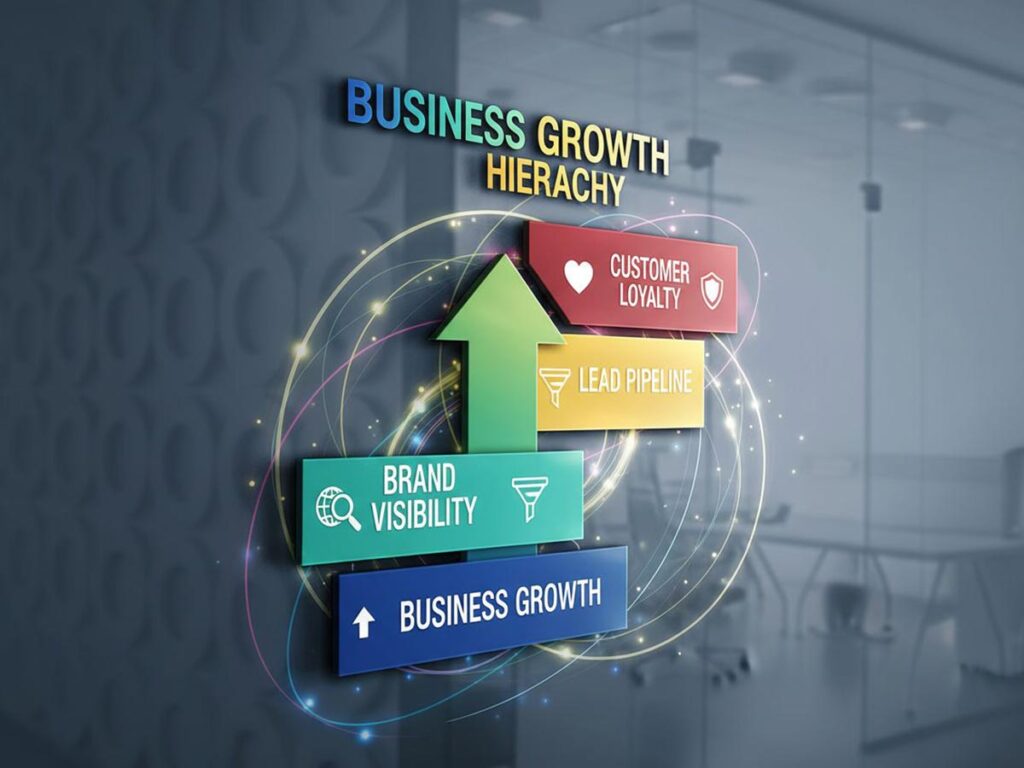
As the hierarchy shows, strategic content directly supports the core pillars of business growth by improving visibility, filling the lead pipeline, and building lasting loyalty.
Uncovering Topics Through Keyword Research
The final core component is deciding what your content will actually be about. This can’t be based on guesswork or what you think your audience wants. The most successful strategies are built on a solid foundation of thorough keyword research and topic ideation.
Keyword research is the process of finding the specific words and phrases your audience is typing into search engines like Google. By understanding their search habits, you can create content that directly answers their questions, positioning your brand as a helpful authority at the exact moment they need you most.
But this process is about more than just finding high-volume terms. It’s about getting to the heart of search intent—the underlying why behind a user’s query. Are they looking for information (“what is…”), comparing solutions (“best…for…”), or ready to buy (“…near me”)? Aligning your content with that intent is crucial for attracting qualified traffic that is much more likely to become a customer.
By grounding your strategy in detailed personas, SMART goals, and data-driven topic research, you build a resilient and purposeful plan. Each element informs the next, creating a cohesive system where every single piece of content has a clear “why” behind it.
Essential Tools for Your Content Strategy Stack
Of course, a great plan needs the right tools for execution. To bring these components together, you’ll need a technology stack that helps you research, create, distribute, and measure your content’s performance. Here are some of the go-to tools that professionals rely on.
| Tool Category | Example Tools | Primary Function |
|---|---|---|
| Keyword Research | Ahrefs, Semrush | Uncovering search terms, analyzing competitors, and identifying topic opportunities. |
| Content Management | WordPress, HubSpot | Creating, managing, and publishing content on your website or blog. |
| Analytics & Reporting | Google Analytics | Tracking website traffic, user behavior, and goal conversions. |
| Social Media Mgmt. | Buffer, Hootsuite | Scheduling and distributing content across social channels. |
| Email Marketing | Mailchimp, ConvertKit | Nurturing your audience and promoting content via email newsletters. |
This isn’t an exhaustive list, but it provides a solid starting point for building a stack that empowers your team to work efficiently and make data-informed decisions.
Turning Your Strategy Into Action
With a solid blueprint in hand, it’s time to move from theory to reality. A strategy, no matter how brilliant, is just a document until you translate its goals and audience insights into real content that people can see, read, and experience. This is the moment your plan becomes a living, breathing part of your day-to-day marketing.
The bridge between planning and doing is built on practical tools and clear processes. It’s where you shift from the “why” and “who” to the “what, where, and when.” Your big ideas are about to become blog posts, videos, and social media updates that actually connect with your audience.
Building Your Content Calendar
A content calendar is the operational heart of your entire strategy. Think of it as a detailed schedule that dictates exactly what you’ll publish, on which channels, and at what time. This tool is your best friend for maintaining consistency and managing the production workflow without feeling completely overwhelmed.
Imagine it as an air traffic control system for your content. It prevents collisions, keeps a steady flow of material going out, and gives your team a bird’s-eye view of everything in the pipeline. A well-organized calendar is absolutely essential for keeping your efforts aligned with your goals over the long haul.
A great calendar should map out:
- Publication Dates: Clear deadlines for when each piece goes live.
- Content Titles: The specific headlines or topics for every asset.
- Format: The type of content, like a blog post, video, infographic, or email.
- Target Keywords: The main SEO keywords each piece is designed to rank for.
- Target Audience: The specific persona the content is built to attract.
- Status: The current stage of production (e.g., Drafting, In Review, Scheduled).
If you’re just getting started, seeing a real-world example can be a huge help. You can check out this detailed content marketing strategy template to see how all these pieces fit together in a practical document.
Choosing the Right Content Formats
Your strategy should point you toward the formats that best match your audience’s habits and your business goals. Not all content is created equal; a video might be perfect for a product demo, while a deep-dive article is far better for explaining a complex, nuanced topic.
Content marketing is now a standard practice, and the data shows it. Recent surveys reveal that 86% of marketers use blog posts in their strategies, while 67% rely on email. Video and social content have also exploded, with platforms like YouTube reporting massive audience growth year after year. It’s also worth noting the rise of AI, with over 80% of marketers now using it in some capacity. You can discover more insights about these content marketing statistics to get a feel for the current landscape.
The screenshot below from Wikipedia visualizes how different channels fit into a broader distribution framework.
This diagram clearly shows the three core types of media—owned, paid, and earned—which are the pillars of any smart distribution plan.
Get In Touch
Mastering Smart Content Distribution
Creating outstanding content is only half the job. If nobody sees it, it simply can’t get results. A thoughtful distribution plan is what ensures your hard work actually reaches your target audience through the right mix of channels.
A great piece of content without a distribution plan is like a billboard in the desert. It might be brilliant, but its impact is lost if it’s not placed where people can see it.
Smart distribution requires a multi-channel approach that blends different media types:
- Owned Media: These are the channels you control completely, like your website, blog, and email list. This is your home base—the foundation for building direct, lasting relationships with your audience.
- Earned Media: This is the organic attention you get through word-of-mouth, social media shares, press mentions, or backlinks from other sites. Earned media is incredibly valuable because it works like a third-party endorsement, building powerful trust and authority.
- Paid Media: This involves paying to promote your content through social media ads, search engine marketing (SEM), or sponsored posts. Paid channels are fantastic for amplifying your reach quickly and targeting very specific groups of people.
Maximizing Impact Through Content Repurposing
To get the most mileage out of every piece of content, you don’t always need to start from scratch. Content repurposing is the clever practice of taking one core asset and transforming it into multiple new formats. This squeezes every last drop of value from your initial effort and extends its reach across different platforms and audiences.
For instance, a single in-depth blog post can be masterfully repurposed into:
- An engaging infographic that visualizes the key data.
- A series of short social media videos discussing each main point.
- A slide deck for a webinar presentation.
- A key segment in your weekly email newsletter.
- The script for a new podcast episode.
By turning your strategy into a well-oiled operational machine, you ensure every piece of content is created with purpose, shared effectively, and used to its fullest potential. This is how you build sustainable momentum and drive real, measurable growth for your business.
Measuring Performance and Optimizing for Growth

A brilliant strategy is just a hopeful guess until you start measuring its results. To turn your content marketing plan into a genuine growth engine, you need a solid system for tracking performance, making sense of the data, and constantly refining your approach.
Without this feedback loop, you’re flying blind. You can’t prove the value of your work or make smart decisions to get better results. This commitment to measurement is what separates a content program that stalls from one that builds momentum over time. It’s how you discover what truly clicks with your audience and where to put your resources for the biggest impact.
Identifying Your Key Performance Indicators
The first step is picking the right Key Performance Indicators (KPIs). These are the specific, measurable numbers that tell you if you’re hitting your SMART goals. The KPIs you choose have to tie directly back to the business objectives you set at the very beginning.
For instance, if your main goal is to build brand awareness, your metrics should reflect reach and attention.
- Organic Traffic: How many people are finding your site through search engines?
- Social Media Reach: How many unique individuals saw your posts?
- Brand Mentions: Where is your brand being talked about online?
On the other hand, if your goal is generating leads, you’ll focus on metrics that track specific actions.
- Conversion Rate: What percentage of visitors took the action you wanted, like filling out a form?
- Cost Per Lead (CPL): How much did it cost to acquire each new lead?
- Email Subscribers: How many new people opted into your mailing list?
The goal is to sidestep “vanity metrics”—numbers like social media likes that look good on paper but don’t actually contribute to business growth. A successful content marketing strategy is ultimately measured by its impact on the bottom line.
Essential Tools for Tracking and Analysis
To keep an eye on these KPIs, you need analytics tools that can collect and organize the data for you. Fortunately, there are plenty of powerful platforms out there to give you deep insights into your content’s performance.
The cornerstone for most is Google Analytics, a free and incredibly comprehensive tool for understanding your website traffic. It shows you where visitors come from, what they look at, and whether they complete your goals. Getting comfortable with this tool is non-negotiable for any serious content marketer.
But to get the full picture, you’ll need a few more tools in your belt:
- SEO Platforms: Tools like Ahrefs or Semrush are essential for tracking keyword rankings, backlink profiles, and what your competitors are up to.
- Social Media Analytics: Every platform—from LinkedIn to Instagram—has its own native analytics to measure engagement and growth.
- Email Marketing Platforms: Services like Mailchimp or ConvertKit provide the critical data on open rates, click-throughs, and list health.
Keeping a close watch on these various digital marketing performance metrics gives you a complete, 360-degree view of how your strategy is performing across every channel.
The Power of the Content Audit
One of the most valuable actions you can take for long-term growth is a content audit. This is a systematic review of every single piece of content on your website to figure out what’s working, what isn’t, and what to do about it. It helps you find your hidden gems, weak links, and new opportunities.
The process usually starts with a comprehensive spreadsheet, listing all your content URLs alongside key metrics like page views, time on page, conversions, and backlinks.
With that data in hand, you can assign an action to every piece of content:
- Keep: This is your high-performing content. It’s relevant, drives results, and should be promoted regularly.
- Update/Optimize: Solid content that could be even better. Maybe it needs a data refresh, better SEO, or new visuals to make it more engaging.
- Consolidate: If you have several articles on a similar topic, combining them into one definitive guide can boost both user experience and search rankings.
- Remove/Redirect: Content that’s irrelevant, low-quality, or gets zero traffic. Pruning this dead weight can actually improve your site’s overall authority with search engines.
By conducting a content audit regularly, you ensure your content library stays lean and effective. It becomes a hard-working asset that serves both your audience and your business, fueling sustainable growth for years to come.
Get In Touch
Answering Your Content Strategy Questions
Even the most well-crafted plan runs into questions once you start putting it into practice. Getting these common uncertainties cleared up from the start is the best way to keep your team aligned and moving forward with confidence.
Let’s dive into some of the most frequent questions we hear from marketers and business owners.
How Long Does It Take to See Results?
This is the big one. The honest answer is, “it depends.” Content marketing isn’t like flipping a switch on a paid ad campaign where you see traffic minutes later. It’s a long-term play, an investment that compounds over time.
Generally, you can expect to see the first signs of life—like a bump in organic traffic or improvements in keyword rankings—within 3 to 6 months. But for the kind of significant results that really move the needle, like a reliable stream of qualified leads, you’re typically looking at 9 to 12 months of consistent, high-quality work.
Think of your content marketing strategy as building a valuable asset. The goal isn’t a temporary traffic spike. You’re systematically creating brand authority and audience trust that will pay dividends for years. Patience and consistency are everything.
Of course, a few things can speed up or slow down your timeline:
- Your Industry’s Competitiveness: Trying to rank for “mortgage loans”? That’s a tougher climb than ranking for “artisanal dog sweaters” and will naturally take more time.
- Your Content’s Quality and Frequency: Publishing truly excellent, helpful content on a regular schedule will always accelerate your results.
- Your Promotion and Distribution Efforts: Creating great content is only half the battle. You have to get it in front of people.
What’s the Difference Between Content Strategy and Content Marketing?
These two get mixed up all the time, but the distinction is crucial. Getting it right is key to ensuring your efforts actually work.
Let’s use a simple analogy: building a house.
Content strategy is the architect’s blueprint. It’s the high-level plan that answers all the critical questions before you ever break ground. Who is this house for (your audience)? Why are we building it (your business goals)? What materials will we use (content formats)? And where will we build it (distribution channels)?
Content marketing, then, is the actual construction. It’s the team on the ground mixing the concrete, framing the walls, and painting the rooms. This is the hands-on work of writing the blog posts, shooting the videos, and publishing the social media updates that the blueprint called for. One is the plan; the other is the execution.
How Much Should We Budget for Content Marketing?
There’s no single-size-fits-all number here. Your budget will depend entirely on your goals, your industry, and the resources you already have. That said, a common starting point is to allocate somewhere between 10% and 30% of your overall marketing budget to content.
If you’re a small business or just starting out, your biggest investment might be time, not cash, especially if you can handle the writing or design work yourself. For larger companies with aggressive growth targets, the budget needs to be more robust to cover things like:
- Talent: Salaries for your in-house team or fees for skilled freelance writers, designers, and video producers.
- Tools: Subscriptions for essential software like Ahrefs or Semrush, analytics platforms, and project management tools.
- Promotion: A dedicated budget for paid distribution to amplify your content’s reach through channels like social media ads or sponsored placements.
The smartest way to approach it is to start with a budget you’re comfortable with. Track your key metrics closely, and once you can show a clear return on that investment, you’ll have a rock-solid case for increasing it.
At Galant Studios, we live and breathe this stuff. We specialize in building and executing content strategies that create real brand authority and drive sustainable growth. If you’re ready to turn your content from an expense into a predictable engine for new business, we should talk.
See how our expert SEO and content services can elevate your brand’s visibility by visiting us at https://galantstudios.com.