A content marketing strategy template isn’t just another document; it’s the reusable blueprint that steers every single thing you create, publish, and promote. It’s what ensures a simple social media update is just as aligned with your core business objectives as a major cornerstone blog post. Think of it as your strategic roadmap for planning, executing, and actually measuring what works.
Building Your Foundational Content Framework
Before you even think about writing a single word, you need to lay the groundwork. It’s a classic mistake: businesses get excited and jump straight into creating content without stopping to define what success even looks like. This almost always leads to wasted resources and underwhelming results.
A solid foundation means that every article, video, and social post you produce serves a distinct, measurable purpose.
This is the point where you must get specific. Forget vague goals like “increase traffic.” We’re talking about a fundamental shift in thinking. Instead of just aiming for more visitors, your objective becomes something concrete and persuasive, like “generating 20% more qualified leads from organic search within the next quarter.” Moving from just doing things to creating real impact is the secret sauce of any effective content strategy.
Define Your Content Mission
Your content mission statement is your North Star. It’s a short, powerful declaration that spells out who you’re talking to, what you’re giving them, and how it benefits your business. It’s the single best tool for keeping your team aligned and focused on what truly matters.
For example, a B2B software company might craft a mission like this:
“To provide small business owners with actionable, data-driven marketing guides that help them grow their revenue, establishing our brand as a trusted authority in the marketing technology space.”
See how clear that is? It defines the audience (small business owners), the deliverable (actionable guides), and the business goal (becoming a trusted authority).
Establish a Unique Value Proposition
Let’s be honest: your audience is drowning in content. What makes yours different? Your unique value proposition (UVP) is the answer. It’s the specific promise you make that no one else is delivering in quite the same way. In a noisy world, a sharp UVP is how you cut through.
To craft a persuasive UVP, consider these angles:
- Expertise: Do you have access to proprietary data or insights? According to the U.S. Bureau of Labor Statistics, nearly 40% of workers receive formal company training. Can you share insights from your internal experts?
- Perspective: Can you bring a fresh, or even contrarian, viewpoint to well-worn topics?
- Format: Are you known for creating incredibly detailed tutorials, visually stunning content, or hyper-practical templates?
Practical Example: An e-commerce brand selling sustainable products could build its UVP around providing transparent, scientifically-backed information on eco-friendly living. This goes far deeper than the generic lifestyle tips their competitors are pushing out.
Translate Business Goals into Content KPIs
This is where the rubber meets the road. Your high-level company objectives must be broken down into tangible content KPIs. If you can’t connect your content to business outcomes, you’ll never be able to prove its value. This translation is a non-negotiable step for your content marketing strategy template.
A broad business goal like “increase customer retention” is too fuzzy. Let’s make it actionable.
| Business Objective | Content KPI | Actionable Content Idea |
|---|---|---|
| Increase Customer Retention | Reduce support ticket volume by 15% | Create a comprehensive video tutorial series for new users. |
| Generate More Leads | Increase marketing qualified leads (MQLs) by 25% | Develop a downloadable “Ultimate Checklist” gated by an email form. |
| Improve Brand Awareness | Grow organic search visibility for key topics by 30% | Publish a cornerstone “Pillar Page” on a core industry topic. |
Going through this process ensures your content is never just an expense line. It becomes a direct, measurable contributor to the company’s bottom line. By establishing this foundational framework—complete with a mission, a unique value prop, and crystal-clear KPIs—you create a strategic filter for every single content decision. Every piece will have a purpose, moving you closer to achieving real business goals.
How to Truly Understand Your Target Audience
If you want your content to convert, it needs to feel like it was written specifically for one person. The only way to achieve that is by moving past generic assumptions and building a genuine, deep understanding of who you’re talking to.
This is where detailed buyer personas come in. A solid persona isn’t just a list of demographics; it’s a living portrait of your ideal customer, built from real data and honest market research. Think of it as giving a face and a story to your analytics, which helps your entire team create content that actually resonates and persuades.
Moving from Data to Actionable Insights
Gathering information is the easy part. The real work—and where the value lies—is in digging through that data to find the human element. What are their real frustrations? What truly motivates them? What does success actually look like in their world?
To get these critical insights, you’ll need to roll up your sleeves and do some research:
- Customer Interviews: There is simply no substitute for a direct conversation. Talk to your current customers and ask open-ended questions like, “Walk me through the day you realized you needed a solution like ours. What was happening?”
- Surveys: When you need to gather information at scale, tools like SurveyMonkey or Google Forms are your best friend. Use them to ask about professional responsibilities, preferred content formats, and where they turn for industry news.
- Analytics Review: Your own website and social media data are a goldmine. Look at which pages get the most traffic, what content drives conversions, and what search terms people are using to find you. Their behavior tells a story.
This research phase is the bedrock of your entire content marketing strategy template. With roughly 90% of organizations using content marketing, standing out requires a sharp focus on the audience. In fact, for almost half of all businesses, a deep understanding of their audience is a top driver of success. You can explore more content marketing statistics to see just how critical these data-driven insights have become.
Mapping the Customer Journey
Once you know who you’re talking to, you need to understand when and where to talk to them. This is where a customer journey map becomes essential. It’s a visual representation of every interaction a person has with your brand, from the first time they hear your name to the point they become a loyal advocate.
Mapping this out allows you to pinpoint the exact moments where your content can provide the most value and gently nudge them toward a conversion.
Actionable Insight: By aligning your content to specific stages of the journey, you create a natural, supportive experience that guides people toward your solution. It’s about giving them the right answer at the exact moment they’re asking the question.
Building a Practical Persona Example
Let’s make this real. Imagine a B2B SaaS company selling project management software. A key persona for them might be “Marketing Manager Mary.” By synthesizing data from interviews and surveys, they can build a character that feels real and gives their content creation a clear, conversion-focused direction.
Here’s a snapshot of what that persona could look like.
B2B Audience Persona Example ‘Marketing Manager Mary’
| Attribute | Description |
|---|---|
| Demographics | Age 35-45, lives in a major metropolitan area, holds a master’s degree in marketing. |
| Job Role | Manages a team of five marketers, responsible for campaign execution and reporting to the Director of Marketing. |
| Goals | To prove the ROI of her team’s marketing campaigns and improve team efficiency without increasing headcount. |
| Challenges | Struggles with tracking multiple project timelines, lacks a centralized location for creative assets, and finds it difficult to provide clear, concise progress reports to leadership. |
| Motivations | Is motivated by data-driven results, professional growth, and recognition for her team’s contributions to revenue. |
| Content Preferences | Prefers in-depth case studies, actionable templates, and short video tutorials. Consumes content on LinkedIn and industry-specific blogs. |
This profile for “Marketing Manager Mary” is so much more than a simple description. It becomes the team’s North Star. Now, when they’re brainstorming ideas, they can ask themselves, “Would this template actually help Mary solve her reporting problem and make her look good to her boss?” or “Is this video short and practical enough for her packed schedule?”
This level of focus is what separates content that gets ignored from content that gets results. It ensures every piece you create is genuinely useful and directly speaks to the real-world needs of your audience.
Auditing Your Content to Find Hidden Opportunities

Before you write a single new word, you must get a handle on what you’ve already got. Your existing content is a goldmine of data—a living record of what resonates with your audience and what falls flat. A proper content audit turns that raw data into an actionable, conversion-focused strategy.
Think of it as a systematic inventory of every blog post, case study, and white paper you’ve ever published. The goal isn’t just to make a list; it’s to create an objective, data-backed picture of what’s working, what needs a tune-up, and where the real gaps in your strategy are hiding.
Without this step, you’re flying blind. You’d be guessing what your audience wants instead of analyzing what they’ve already told you with their clicks and conversions. This audit is the foundation of a content marketing strategy template that’s grounded in reality, not just wishful thinking.
Cataloging Your Content Assets
First, round everything up. The easiest way to do this is with a simple spreadsheet—this will become your home base for the entire audit. For now, don’t worry about analysis; just focus on gathering the facts.
Your job is to log every single piece of content you’ve published. For each one, you’ll want to track a few key details:
- URL: The direct link to the asset.
- Content Type: Is it a blog post, video, case study?
- Publication Date: How old is this piece?
- Key Metrics: Pull initial performance data. Focus on conversion-oriented metrics like lead generation or goal completions, alongside page views and time on page.
This inventory gives you the raw material for the real work ahead. It’s a complete map of your content footprint, essential for spotting the patterns and opportunities that are waiting to be found.
Evaluating Performance and Identifying Gaps
With your inventory assembled, it’s time to put on your analyst hat. This is where you connect the dots between your content’s performance, your business goals, and those audience personas you worked so hard on.
Pro Tip: A great content audit isn’t just about finding your most popular articles. It’s about digging into the why behind the numbers so you can build a smarter path forward.
Practical Example: You might discover that your case studies have a fantastic conversion rate but almost no traffic. That’s a distribution problem. On the flip side, a blog post with tons of traffic but a 95% bounce rate is failing to do its job. It might be targeting the wrong search intent, or the copy might not be persuasive enough.
As you evaluate, you’ll likely sort your content into a few main action buckets:
- Keep: This is your top-tier content. It’s performing well, it’s still relevant, and it’s hitting your goals.
- Update: The piece has good bones but it’s gotten stale. It’s a prime candidate for a refresh with new data, better examples, or a stronger call-to-action.
- Consolidate: You have three different articles that all touch on the same topic. Combining them into one comprehensive, authoritative guide can work wonders for your SEO and provide a much better user experience.
- Remove: Some content is just dead weight. It might be wildly outdated, irrelevant, or so low-quality that it’s actually hurting your brand. Pruning this content can sometimes give your overall site authority a boost.
This process inevitably shines a light on what’s missing. You’ll clearly see the gaps. Maybe you’re great at top-of-funnel content but have nothing to help prospects who are ready to make a decision. To dive deeper on that front, you might find our guide on conducting a competitor analysis for digital marketing useful.
Finding these holes in your strategy gives you a clear, data-driven roadmap for your editorial calendar. You’ll know exactly what to create next to fill the gaps in your customer’s journey and drive more conversions.
Developing a Practical Editorial Plan
Now that you have a solid grasp of your audience and what content you already have, it’s time to create an actionable roadmap. This is where strategy meets execution. An editorial plan is far more than a simple list of publish dates; it’s the operational heart of your entire content machine, ensuring every single piece is created with a clear purpose and gets into the right hands at the right time.
Without this crucial step, even the most brilliant content ideas can get lost in the day-to-day chaos. You end up with an inconsistent publishing schedule and a collection of content that doesn’t hit your strategic goals.
From Pillars to Practical Topics
The backbone of a strong editorial plan is your set of content pillars. These are the major, overarching themes your brand has genuine authority to speak on. For an agency like ours, a core pillar might be “SEO Services for Small Businesses.” From that single, broad theme, we can then branch out into specific topic clusters.
Topic clusters are groups of related articles that all link back to a central, foundational pillar page. This structure is a game-changer for two reasons. First, it creates a fantastic user experience by giving your audience a deep resource on a subject they care about. Second, it’s incredibly effective for SEO, signaling to search engines that you have serious expertise in a particular area.
Let’s make this practical:
- Pillar: SEO for Small Businesses
- Cluster Topics: “Local SEO Checklist,” “How to Choose SEO Keywords,” “Measuring SEO ROI,” “Technical SEO Basics”
Brainstorming this way forces you to think systematically about how to cover a subject from all angles. You move away from creating random, disconnected posts and ensure all your effort is focused and builds upon itself. Any good content marketing strategy template will have a dedicated section for mapping out these pillar-and-cluster relationships.
The process of turning these high-level themes into a real schedule is what makes the strategy come alive.
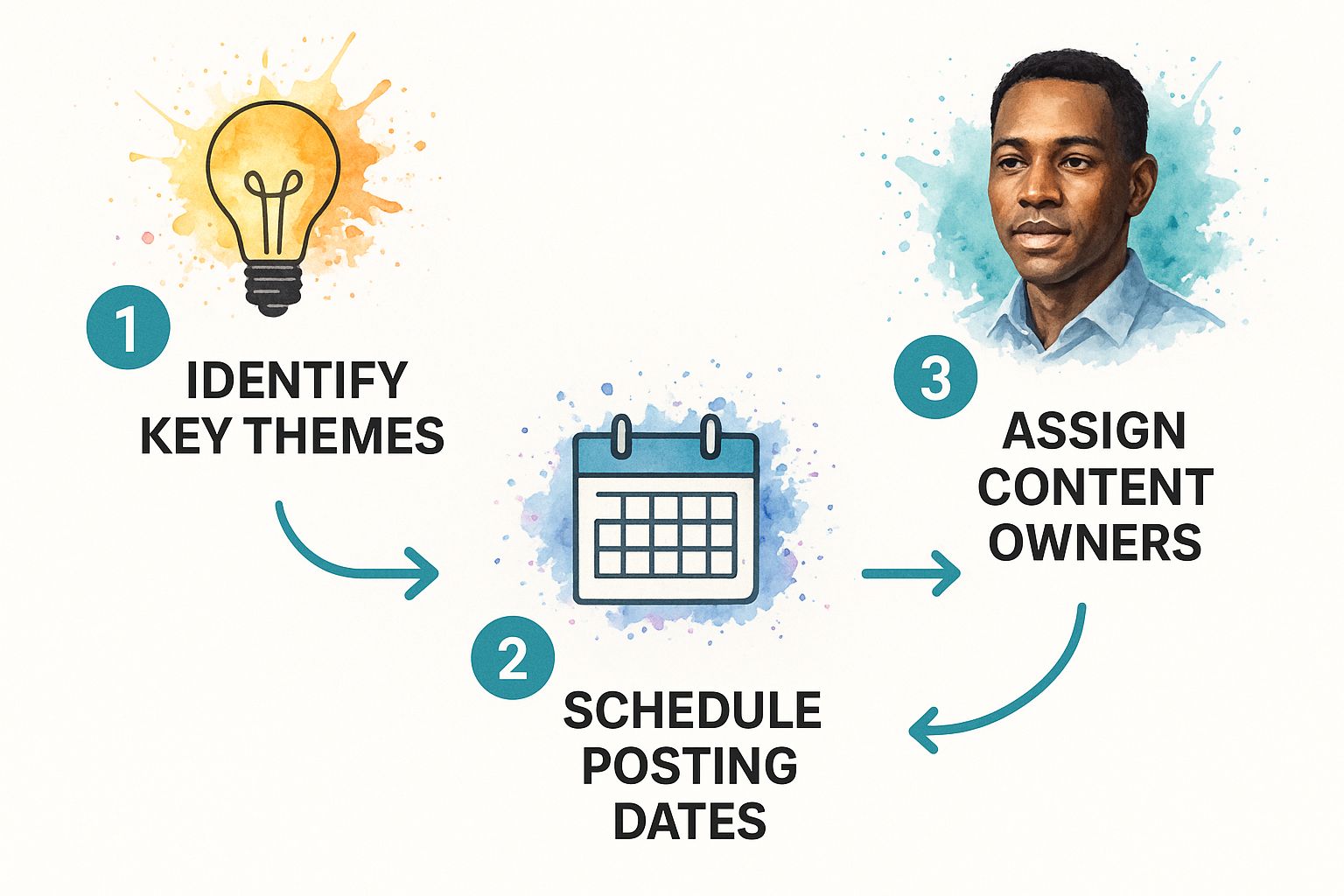
This visual shows the simple, powerful flow from broad ideas to specific, assigned tasks. It’s what keeps your entire content production process organized and everyone accountable.
Structuring Your Editorial Calendar
Your editorial calendar is the tactical tool that puts your plan into motion. Honestly, a well-organized spreadsheet can work wonders, though project management tools like Asana or Trello can offer more advanced features. Whatever you choose, it must track key pieces of information for every asset.
At a minimum, an effective calendar should include columns for:
- Publication Date: The target go-live date.
- Content Title/Topic: The working title or a clear description.
- Content Format: Is it a blog post, video, case study, or infographic?
- Content Pillar: Which core theme does this piece support?
- Author/Owner: Who is responsible for getting it done?
- Status: Where is it in the pipeline? (e.g., Outline, In-Progress, Review, Scheduled).
This structure brings immediate clarity and accountability to the team. It helps you see if you’re leaning too heavily on one format and gives you a bird’s-eye view of your publishing cadence.
Having a documented strategy is a crucial first step, but execution is what separates successful brands from the rest. The editorial calendar is your primary tool for managing that execution.
Of course, just having a plan isn’t a guarantee of success. Research consistently shows that while most marketers have a content strategy, only 29% feel it’s highly effective. A major culprit? A lack of clear goals, which plagues 42% of marketers with less-than-stellar strategies. Other common hurdles include content that doesn’t align with the customer journey and not using data to make decisions.
Balancing Quality, Quantity, and Deadlines
One of the biggest struggles in content marketing is navigating the constant tension between producing a high volume of content and maintaining exceptional quality. Your editorial calendar forces you to be realistic about what your team can actually handle.
Instead of pulling a goal out of thin air, like “we’ll publish three blog posts a week,” work backward from your available resources. Figure out how long it really takes to produce one high-quality piece of content, from initial research and writing all the way through design and promotion.
This grounded-in-reality approach helps you set deadlines that are challenging but achievable, and it puts the focus squarely on quality. A single, deeply-researched, and beautifully executed cornerstone article will almost always outperform five mediocre posts that were rushed out the door. Your editorial plan is the tool that lets you make those strategic trade-offs, turning your content efforts into a predictable and powerful engine for growth.
Integrating AI and Modern Tools into Your Workflow

Any modern content marketing strategy template that doesn’t account for technology is already outdated. We’ve moved past the point where smart tools, especially AI, are just a nice-to-have. Today, they form the core of any competitive and efficient content engine.
The idea isn’t to have machines replace human creativity. It’s about augmenting it. By letting technology handle the repetitive, data-heavy tasks, you free up your team to focus on the high-level strategic thinking that truly sets your brand apart.
From brainstorming all the way to analyzing performance, technology can be a powerful partner. And the industry is catching on fast. Projections show that by 2025, over 80% of marketers will be using AI tools in some capacity. This isn’t just a trend; it’s a direct response to challenges like content inconsistency and inefficiency. You can explore the research on global AI adoption in marketing to see just how widespread this shift has become.
Automating Ideation and Optimization
One of the first places you’ll feel the impact of AI is in the early stages of creation. AI-powered tools can sift through immense amounts of data—from search trends to your competitors’ top articles—and generate relevant topic ideas in minutes. What once took hours of manual research can now be done before your morning coffee is finished.
Actionable Insight: This data-driven approach takes the guesswork out of SEO. You’re no longer just hoping you’ve hit the right notes; you’re starting with a blueprint that’s already aligned with what both search engines and your audience want to see.
Enhancing Content Creation and Distribution
Once you have your plan, modern tools can help with the actual writing. I’m not suggesting you let AI write a finished article from scratch. But it can produce a solid first draft, summarize dense research, or suggest different persuasive angles for a topic. This lets your writers do what they do best: add their unique voice, industry insights, and storytelling flair.
And it’s not just about text. Technology opens up entirely new content formats. You can improve accessibility and reach a wider audience by using advanced Text-to-Speech API solutions to turn your articles into audio versions. It’s a simple way to repurpose existing work for people who prefer to listen during their commute or workout.
Here are a few practical ways teams effectively use these tools:
- Content Generation: Use AI to spin up initial drafts for blog posts, social media captions, or email campaigns that a human can then refine and polish.
- Performance Analysis: Lean on platforms that use machine learning to analyze what’s working (and what’s not) and give you clear recommendations for optimization.
- Personalization: Implement tools that can dynamically change the content on your website based on a visitor’s behavior, making the experience feel far more relevant and persuasive.
When you strategically weave these tools into your workflow, you build a content operation that is more adaptive, efficient, and ultimately, more impactful. Your team ends up producing better content, faster, with data to back up every move you make.
Measuring Success and Optimizing Your Strategy
Building your content strategy template is a huge step forward, but let’s be honest—it’s just the starting point. A strategy that sits on a shelf, unmeasured and untouched, quickly becomes irrelevant. The real work, the part that separates the pros from the amateurs, is creating a disciplined process for tracking what’s working and what isn’t.
This is how you turn a static document into a living, breathing part of your business. Without data, you’re just making educated guesses. With it, you can double down on your wins, fix the weak spots, and invest your time and money where they’ll actually make a difference.
Defining Your Key Performance Indicators
First things first, we must move past vanity metrics. Page views and social likes feel good, but they don’t pay the bills. The goal is to focus on Key Performance Indicators (KPIs) that tie directly back to your core business objectives. Your KPIs should tell a complete story, connecting the dots from that first click all the way to a sale.
A good set of KPIs gives you a 360-degree view of how your content is performing across the entire customer journey. I recommend tracking a mix of indicators:
- Traffic and Reach: Think organic traffic, keyword rankings, and social media reach. This tells you how well you’re pulling your target audience into your world.
- Engagement: Are people sticking around? Metrics like time on page, bounce rate, and social shares show you if your content is actually hitting the mark.
- Conversion: This is where the rubber meets the road. Track lead conversion rates, newsletter sign-ups, and downloads for gated content like ebooks or checklists.
- Revenue Impact: The ultimate test. Can you connect your content directly to things like customer acquisition cost (CAC) and overall content marketing ROI?
These aren’t just numbers; they’re diagnostic tools. Seeing tons of traffic but almost no conversions? That’s a classic sign of a mismatch between your content and the audience it’s attracting. Having a solid grasp of these digital marketing performance metrics is non-negotiable for making smart decisions.
Building an Effective Reporting Dashboard
All the data in the world is useless if you can’t easily see what it means. A simple, clean reporting dashboard brings your most important KPIs together in one place, so you can spot trends and track progress against your goals in seconds. You don’t need a complicated setup; a tool like Google Analytics paired with a well-organized spreadsheet can be incredibly effective.
Your dashboard should be built around your specific goals, but here’s a solid foundation to start with:
| Metric Category | Example KPI | What It Tells You |
|---|---|---|
| Audience Growth | New Organic Users | Your ability to attract a fresh audience via search. |
| Content Engagement | Average Session Duration | How compelling and valuable your content is. |
| Lead Generation | MQL Conversion Rate | The effectiveness of your content in generating qualified leads. |
| Business Impact | Content-Sourced Revenue | The direct financial return from your content efforts. |
Make a habit of reviewing this dashboard regularly—whether it’s every Monday morning or the first of the month. This simple routine turns measurement from a chore into a powerful strategic habit.
From Data to Decisive Action
Now for the final piece: turning those insights into action. This continuous loop of optimization is what truly sets high-performing content programs apart. Your data will give you clear signals about what to do next.
A great content strategy is never truly “finished.” It is a living document that is constantly being tested, challenged, and improved based on real-world performance data.
Is a specific article generating a ton of organic leads? That’s your green light to go all-in. Create a whole cluster of content around that topic, maybe spinning it off into a webinar or an in-depth guide. On the flip side, if a blog series gets plenty of traffic but nobody sticks around, it’s time to investigate. Are you targeting the wrong keywords? Is the format just plain boring?
This iterative process—measure, interpret, act, repeat—is what keeps your strategy sharp and effective. It gives you the confidence to pivot when you need to, amplify what’s already working, and consistently drive better results from your content marketing investment.
At Galant Studios, we build data-driven SEO and content strategies that deliver measurable results. If you’re ready to transform your content into a powerful growth engine, let’s talk. Learn more about our approach at https://galantstudios.com.