
Competitor analysis in digital marketing means digging into what your rivals are doing—where they’re focusing their budgets, which messages click with their audience, and what search terms they own. It’s about swapping assumptions for real data so your campaigns hit the mark every time.
Why Competitor Analysis Is Your Strategic Advantage

Let’s drop the textbook speak. Picture competitor analysis as your navigation system in a crowded market. You’re not just listing rival brands—you’re uncovering the motivations behind their wins and missteps.
This kind of research shines a light on where they’re channeling their ad spend, which blog posts or videos get the most traction, and the keywords they dominate. And because it’s grounded in data, it turns observations into actionable insights.
Uncover Opportunities And Mitigate Risks
When you track competitors consistently, you’re one step ahead of market changes. For instance, if a rival B2B software company suddenly pivots to a heavy video strategy on LinkedIn, that shift hints at evolving audience tastes you can tap into. Your next move could be to launch a short-form video series answering common customer questions, meeting the market where it’s headed.
At the same time, you steer clear of pitfalls they’ve already hit—think product launch flops or poorly timed campaigns. That foresight saves budget and protects your brand reputation.
A proper competitor analysis isn’t a research task; it’s the foundation of a resilient digital marketing strategy that adapts, anticipates, and ultimately wins.
Moreover, the appetite for competitive intelligence tools among SMBs is on the rise. The CI software market is projected to jump from $2.56 billion in 2023 to $6.02 billion by 2030, signaling a shift from basic tracking to a panoramic view of industry dynamics.
The Real-World Impact
A robust competitor analysis digital marketing plan delivers:
- Strategic Benchmarking: Sets a clear performance baseline against top players.
- Identifying Gaps: Spots rivals’ weak points—like slow site speed or lackluster customer support—and turns them into your competitive edge.
- Informed Strategy: Feeds your SEO keywords, ad creatives, and content calendar with evidence-based choices.
Ultimately, this process isn’t about snooping—it’s about arming your team with the intelligence to build smarter campaigns and drive lasting growth.
How to Pinpoint Your Real Digital Competitors
First things first: your biggest rival in the real world probably isn’t your biggest threat online. In the digital space, the companies fighting for your audience’s attention often look surprisingly different from the ones you’d normally name. A truly effective competitor analysis hinges on identifying who you’re really up against online.
To do this, you have to shift your thinking. Stop asking, “Who sells the same thing I do?” and start asking, “Who is solving the same problem for my customer?” This simple change in perspective uncovers the true competitive picture.
Learning to Spot Your Different Rivals
Not all competitors are the same, and trying to track all of them equally is a recipe for disaster. The trick is to categorize them so you know who to watch like a hawk and who just needs a casual glance now and then.
You’ll generally run into three types of competitors online:
- Direct Competitors: These are the obvious ones. They offer a very similar product or service to the same people you do. If you sell high-end running shoes online, another e-commerce store specializing in premium running shoes is your direct competitor. No surprises there.
- Indirect Competitors: These businesses solve the same core customer problem, just with a completely different solution. For a company selling project management software, an indirect competitor could be a firm offering freelance project managers. Both solve the “how do I manage this project?” problem.
- Search Competitors: This is the group most people miss. These are the websites, blogs, or publications that don’t sell what you do but consistently outrank you for your most important keywords. A popular tech blog that owns the top spot for “best project management software” is a search competitor, siphoning off traffic that should be yours.
It’s so important to get this right. If you ignore your search competitors, you’re missing a huge piece of the puzzle—you’re letting them steal your traffic and you’re overlooking a goldmine of information about what kind of content actually grabs your audience’s attention.
A Simple Framework for Finding Your Competitors
So, where do you start building this list? It’s really just a mix of smart searching and using the tools you already have. Kick things off by brainstorming the main keywords for your product or service—think about the exact terms a customer would type into Google to find a solution like yours.
Now, plug those keywords into Google. Don’t just glance at the top three results; dig into the entire first page. The “People also ask” and “Related searches” sections at the bottom are particularly useful for uncovering new keywords and the competitors who are ranking for them.
Let’s walk through a real-world example.
Imagine you run a local meal delivery service that provides healthy, plant-based lunches in Austin, Texas.
- Start with the Obvious: Your first search would be something like “healthy meal delivery Austin.” Jot down the top 5 companies that pop up. These are almost certainly your direct competitors.
- Think Outside the Box: What’s the alternative to getting meals delivered? Someone might search for “quick healthy lunch recipes” or “healthy cafes in Austin.” The recipe blogs and local cafes that show up are your indirect and search competitors. They’re capturing the mindshare of your ideal customer, even if they aren’t selling the same thing.
- Get a Little Fancy: Try using a few advanced Google search operators. A search like
related:yourwebsite.comcan show you sites Google considers similar to yours. Another good one is"your keyword" inurl:blog, which helps uncover blogs and other content-heavy sites that are competing for your informational keywords, giving you a longer list of search competitors.
Once you’ve gone through these steps, you’ll have a clear, organized list. You’ll know who to watch for product innovation (your direct competitors), who to monitor for clever marketing angles (your indirect competitors), and who to learn from for your content strategy (your search competitors). This groundwork makes the rest of your analysis infinitely more focused and valuable.
Building Your Competitive Intelligence Toolkit
You can’t win the game if you don’t know who you’re playing against. And in digital marketing, that means having the right tools to see what your competitors are doing. But let’s be clear: this isn’t about buying the most expensive software. It’s about building a smart, balanced toolkit that mixes powerful paid platforms with scrappy, free resources to give you the full picture.
Knowing a tool exists is one thing; knowing how to squeeze every drop of strategic value out of it is another. A well-chosen set of tools empowers you to see exactly what your rivals are up to, how it’s working for them, and where you can carve out an advantage.
Curating Your Paid and Free Tool Stack
The best approach is a hybrid one. You pair a heavy-hitting, all-in-one paid platform with a handful of nimble, free tools that handle specific jobs. The paid stuff gives you depth and efficiency, while the free tools offer that on-the-ground intelligence that big platforms sometimes miss.
Here’s a practical breakdown of how to use these tools for actionable insights:
For Deep SEO and Content Insights (Paid): Tools like Ahrefs or Semrush are the industry standard for a reason. Practical Example: Use Ahrefs’ “Top Pages” report on a competitor’s domain. You might discover their most visited page is a long-form guide to “choosing the right CRM.” This is an actionable insight. Your team can now create a more comprehensive, up-to-date guide with better visuals and an interactive quiz to outrank them.
For Traffic and Audience Analysis (Paid & Freemium): Similarweb provides a quick but surprisingly accurate snapshot of a competitor’s website traffic. More importantly, it shows you where that traffic comes from. Practical Example: You see that a competitor gets 40% of their traffic from referral sites, specifically from a list of industry blogs. This is a ready-made list of potential partners for your own outreach and guest-posting campaigns.
For Content and Social Buzz (Paid): Before I write a single word, I often turn to a tool like BuzzSumo. You can drop in a competitor’s domain and instantly see which articles or blog posts got the most social shares. Practical Example: You find that your rival’s posts about “remote work productivity hacks” consistently go viral on LinkedIn. This validates the topic’s appeal, giving you the confidence to invest in creating your own series of videos or infographics on the same theme, tailored for LinkedIn.
This simple comparison shows what you can learn by putting a few key metrics side-by-side.
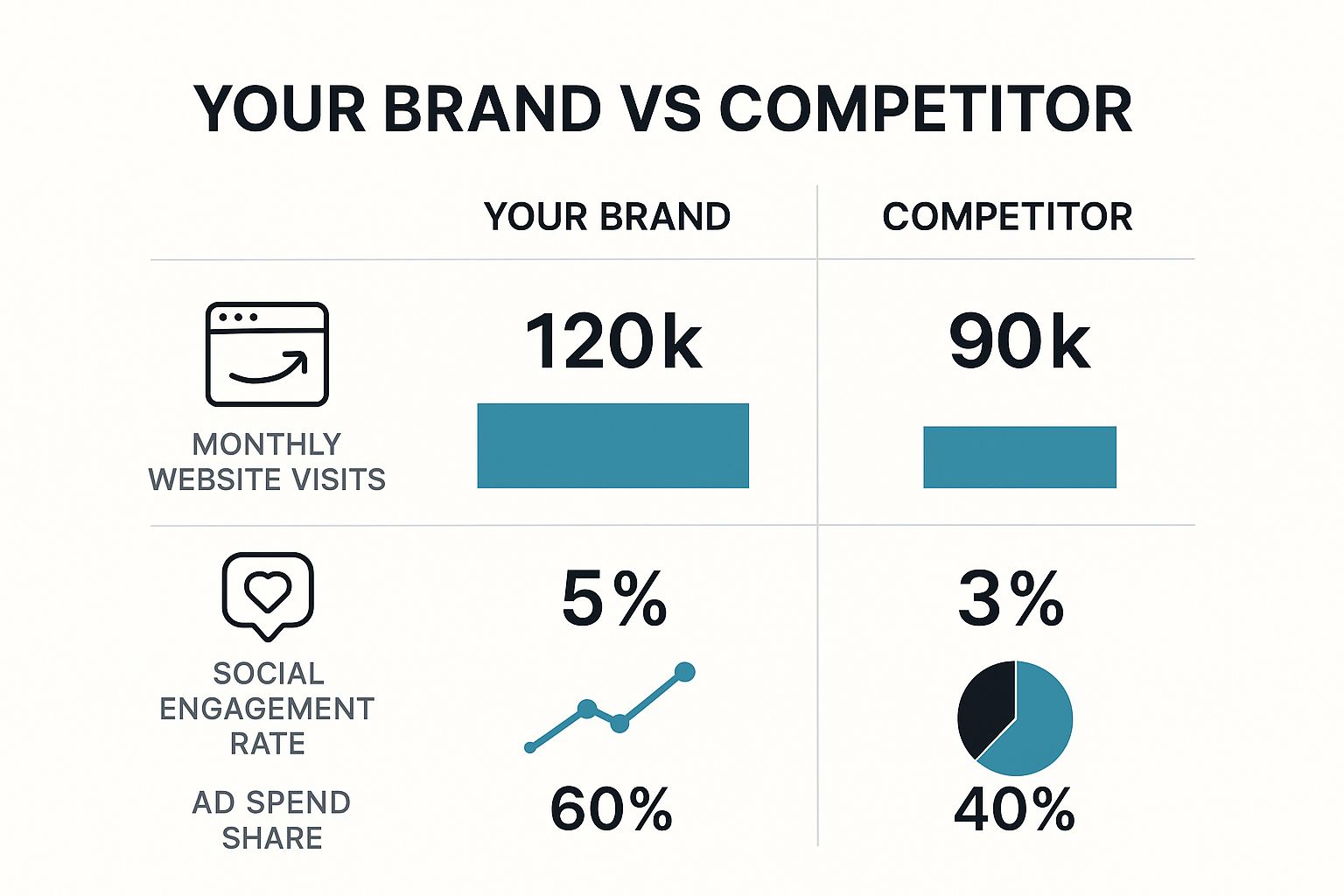
Looking at this, you can see that while our brand has higher monthly visits and ad spend, our competitor is getting way more social engagement. That’s a huge red flag and an actionable insight. It suggests they have a much stronger community or their content is resonating on a level ours isn’t. An immediate action item is to analyze their top-performing social posts to understand their content strategy.
Digital Marketing Competitor Analysis Tool Comparison
To help you build out your own intelligence stack, here’s a quick breakdown of popular tools, what they’re best for, and how they’re typically priced.
| Tool Category | Example Tools | Primary Use Case | Pricing Model |
|---|---|---|---|
| All-in-One SEO/Marketing | Semrush, Ahrefs, Moz Pro | Keyword research, backlink analysis, rank tracking, site audits. | Subscription (Monthly/Annual) |
| Website Traffic Analysis | Similarweb, Alexa | Estimating traffic volume, sources, and audience demographics. | Freemium, Subscription |
| Content & Social Analysis | BuzzSumo, Socialbakers | Identifying popular content, tracking social shares and engagement. | Subscription |
| PPC & Ad Intelligence | SpyFu, iSpionage | Uncovering competitor ad copy, keywords, and ad spend estimates. | Freemium, Subscription |
| Free Monitoring | Google Alerts, Facebook Ad Library | Real-time brand mentions, tracking competitor ad campaigns. | Free |
This isn’t an exhaustive list, of course, but it’s a solid foundation. The goal is to pick one or two primary tools and supplement them with others as needed, rather than trying to use everything at once.
Leveraging Free Intelligence Sources
Never underestimate the power of free. Some of the most valuable insights come from sources that cost nothing but a little bit of time. They’re perfect for ongoing monitoring and picking up on the qualitative details that paid tools often miss.
- Google Alerts: This is your personal spy. Set up alerts for your competitors’ brand names, their flagship products, and even their CEO’s name. You’ll get an email every time they’re mentioned in the news, on a blog, or in a press release. It’s real-time intel, delivered right to your inbox.
- Social Media Itself: Go beyond just looking at their follower counts. Dig into the comments on their Instagram to see what customers are complaining about. Check their LinkedIn page to see if they’re on a hiring spree (a great indicator of growth or a new strategic push). And my personal favorite: the Facebook Ad Library. It’s a free-to-use goldmine that lets you see every single ad a competitor is currently running.
- Their Own Marketing: Subscribe to their newsletter. Sign up for their webinars. Follow their blog. This is the ultimate insider look. Newsletters often announce new features or sales before they go public, and webinars reveal their core sales pitch and the exact questions their prospects are asking.
The most powerful toolkit combines the hard, quantitative data from paid platforms with the qualitative, real-world context you get from free sources. One tells you what is happening; the other helps you understand why.
The tools you choose should ultimately feed your strategy and help you measure what matters. Understanding which numbers to watch is crucial, and you can learn more about the most important digital marketing performance metrics in our complete guide.
By pulling together information from these different sources, you’re not just collecting data anymore. You’re building a living, breathing intelligence system that lets you make smarter, faster decisions. To put all of this into a broader strategic context, check out this excellent resource on how to conduct competitive analysis that wins.
Decoding Competitor Strategies Channel By Channel

Alright, this is where the real detective work begins. You’ve identified your key competitors and have your toolkit ready. Now it’s time to roll up your sleeves and systematically pull apart their digital marketing strategies, channel by channel. We’re not just taking a quick peek; we’re going for a deep dive to figure out what makes their engine run.
Think of each marketing channel as a different chapter in their playbook. By looking at them one by one, you can piece together their grand plan, see what they’re truly good at, and, more importantly, spot the cracks you can exploit.
Mastering Their SEO and Content Game
For most businesses, organic search is the bedrock of sustainable traffic. Getting a handle on a competitor’s SEO and content strategy shows you exactly how they’re winning over search engines to attract, engage, and convert their audience.
Start with their keyword footprint. Tools like Ahrefs or Semrush will give you a quick rundown of their top-ranking keywords. Then, dig into the type of content that’s working for them. Is it massive, in-depth blog posts? Quick-start guides? Video tutorials? Pinpointing their most successful formats helps you understand what really clicks with your shared audience.
Don’t just look at what they rank for—look at how they rank. A high-quality backlink profile is often the secret sauce. Analyze who is linking to them and why. This alone can uncover a goldmine of potential link-building opportunities for your own site.
Here’s a practical, actionable checklist:
- Find the Keyword Gaps: Use a tool to find valuable keywords they rank for that you don’t. This creates an immediate to-do list for your content team. Actionable Insight: Your competitor ranks #3 for “vegan protein powder for beginners,” a keyword you don’t target at all. Your next blog post should be a comprehensive guide on this exact topic.
- Analyze Their Top Pages: Identify the specific pages pulling in the most organic traffic. Deconstruct these pages—look at their structure, the depth of the content, and their on-page SEO tactics.
- Gauge Backlink Quality: It’s not about the number of backlinks, but their quality and relevance. A handful of links from respected industry authorities is worth far more than hundreds of links from spammy sites.
Deconstructing Their Paid Advertising Funnels
If you want the most direct look into a competitor’s budget and conversion strategy, look at their paid ads. When a company puts money behind an ad, they’re placing a bet on which audiences and messages they think will bring in the most cash.
Your analysis here should zero in on their ad copy, creative assets, and landing pages. Use free resources like the Facebook Ad Library to see their social ads. For search ads, a tool like SpyFu can show you their ad copy, likely spending, and the exact keywords they’re bidding on.
Here’s what to look for to gain actionable insights:
- Ad Copy & Messaging: What pain points are they hitting? What emotional language are they using? Their copy tells you exactly what they believe their core value proposition is.
- Visuals & Creative: Are they using static images, slick videos, or user-generated content? The style gives you clues about how they’re trying to grab attention.
- The Landing Page Experience: Click their ads. The landing page reveals their call-to-action (CTA), their offer, and their entire conversion process.
Practical Example: You run an e-commerce store selling eco-friendly cleaning supplies. You see your top competitor is running Instagram video ads full of user-generated content—real customers using their products. The ad sends you to a landing page offering a 15% discount for first-time buyers who sign up with their email. Actionable Insight: Their strategy is built on social proof and lead capture. You can now test a similar campaign, perhaps by running a contest to gather user-generated content and offering a slightly better first-time buyer discount.
Assessing Social Media Engagement and Community Building
A competitor’s social media feed is a direct window into their brand’s personality and how they treat their customers. You need to look past vanity metrics like follower count and focus on what truly matters: engagement.
Check out their activity on the platforms most important in your industry. Pay close attention to:
- Engagement Rate: Calculate their average likes, comments, and shares per post as a percentage of their follower count. It’s a direct measure of how well their content is landing.
- Content Pillars: Look for recurring themes or topics in their posts. Are they all about education? Entertainment? Fostering a community?
- Community Management: How do they handle comments and questions? A brand that actively engages with its community is building serious loyalty.
Practical Example: A B2B software competitor is killing it on LinkedIn by posting short video tutorials of their product’s features. You, on the other hand, have only been posting text updates. Actionable Insight: Your audience on LinkedIn prefers visual, educational content. The clear next step is to start producing your own video tutorials to compete effectively.
The digital marketing landscape evolves rapidly. Brands are now using AI-powered tools to monitor competitor ad creative and keyword targets in real time. For more on this, check out this resource on how competitive analysis is shaping the future of marketing.
Turning Competitive Insights Into Action
Alright, you’ve done the heavy lifting. You’ve gathered piles of data, but raw data doesn’t drive growth. Action does. This is the moment where your analysis transforms from a research project into a strategic weapon.
Organizing Your Findings With a SWOT Framework
A classic SWOT analysis (Strengths, Weaknesses, Opportunities, Threats) is a fantastic tool for this, but we’re going to give it a digital-first spin. Frame every point through the lens of your competitive research. This shifts the exercise from a simple internal audit to a powerful market assessment.
Here’s how to frame it:
- Strengths: What are we demonstrably doing better than our competitors? (e.g., “Our blog content generates 20% more organic traffic than our top three rivals combined.”)
- Weaknesses: Where are we consistently getting beaten by the competition? (e.g., “Our website’s mobile page speed is significantly slower than our competitors’, leading to a higher bounce rate.”)
- Opportunities: What gaps did we find in the market or in a competitor’s strategy? (e.g., “Nobody is creating compelling video content for the ‘eco-friendly pet supplies’ niche. It’s wide open.”)
- Threats: What is a competitor doing that could seriously hurt our performance? (e.g., “Competitor X just started bidding aggressively on our core branded keywords.”)
This framework helps you organize a mountain of data into four clear, actionable buckets.
The following table provides a practical structure for applying this framework.
Digital SWOT Analysis Framework
| SWOT Quadrant | Guiding Question | Digital Marketing Example |
|---|---|---|
| Strengths | Where do we currently outperform our competitors? | Our email newsletter has a 35% open rate, while the industry average (and our competitors’) hovers around 20%. |
| Weaknesses | In which digital areas are we lagging behind? | Our top competitor has 50k Instagram followers with high engagement, while our account is stagnant at 5k. |
| Opportunities | What untapped market needs or competitor blind spots can we exploit? | No competitor offers a free online tool or calculator, which could be a powerful lead-generation asset for us. |
| Threats | What external or competitive actions could negatively impact us? | A new, well-funded startup just entered our niche and is pouring money into Google Ads, driving up our CPC. |
By filling this out, you’re building the foundation of your new strategic plan.
From Weakness to Opportunity: A Real-World Example
Let’s make this tangible. Imagine your analysis uncovers that your main competitor, “Brand X,” has a clunky, slow-loading website. On the surface, that’s just a technical detail. But when you look at it through your SWOT framework, it becomes a goldmine.
A competitor’s weakness is your opportunity. Their slow website isn’t just a technical flaw; it’s an open invitation for you to deliver a superior user experience and capture their frustrated audience.
In this scenario, their Weakness (terrible site performance) directly creates your Opportunity. The action plan practically writes itself: invest heavily in optimizing your own site’s speed and user experience. This single move can lead to better search rankings, lower bounce rates, and higher conversions—all because you spotted and acted on a competitor’s glaring flaw. This is a core tactic when you learn how to increase website traffic by simply being better where it counts.
Prioritizing Actions with an Impact vs. Effort Matrix
You’re probably buzzing with ideas by now. The challenge is, you can’t do everything at once. A simple but incredibly effective way to prioritize is by plotting each potential action on an Impact vs. Effort Matrix.
This visual tool helps you immediately see where your focus should be.
- High Impact, Low Effort (Quick Wins): Do them now. Practical Example: Creating a landing page targeting a high-intent keyword your competitor is ignoring.
- High Impact, High Effort (Major Projects): These are your big, strategic bets. Practical Example: Launching that comprehensive video series to fill the content gap you identified.
- Low Impact, Low Effort (Fill-ins): Tackle these when you have downtime. Practical Example: A/B testing a headline on a low-traffic blog post.
- Low Impact, High Effort (Time Sinks): Avoid these. Practical Example: Trying to outrank a massive authority like Wikipedia for a very broad, informational search term.
This matrix turns a messy to-do list into a focused, strategic roadmap, ensuring you put your limited time and budget where they’ll make the biggest difference.
Setting Specific and Measurable Goals
The final piece of the puzzle is turning your prioritized actions into concrete goals. Vague aspirations like “get better at SEO” are useless. Your goals must be specific, measurable, and born directly from your competitive analysis.
Using our running examples, your goals might look like this:
- The SEO Goal: Outrank Competitor X for the keyword “organic dog food delivery” and capture a top-three position within six months.
- The Content Goal: Launch a five-part YouTube series targeting the “eco-friendly pet supplies” audience by the end of Q3, with a target of 10,000 views on the first video.
- The UX Goal: Decrease our average mobile page load time by 40% in the next 60 days to capitalize on our competitor’s slow site and improve our conversion rate.
See the difference? These goals are sharp, time-bound, and directly tied to the insights you worked so hard to uncover. This is how a competitor analysis digital marketing plan stops being an academic exercise and becomes the engine that drives your business forward.
Common Questions About Competitor Analysis

Even with a clear roadmap, diving into a full-blown competitor analysis can bring up a few questions. Let’s walk through some of the most common ones to help you sidestep any roadblocks.
How Often Should I Analyze Competitors?
For a really deep, comprehensive analysis, I recommend doing it quarterly. This timing is the sweet spot—it gives you enough data to see real trends and strategic shifts without getting lost in the day-to-day fluctuations.
But digital marketing moves fast. You can’t just set it and forget it. So, you’ll want to keep a closer pulse on a few things more frequently.
- Monthly Checks: Do monthly check-ins on major content pushes, big jumps (or drops) in their keyword rankings, and any new services they’re rolling out.
- Weekly Glances: A quick, weekly look at their social media ads or paid search campaigns can tell you where their promotional dollars are going right now.
This mix of a quarterly deep-dive and more frequent monitoring keeps you informed without being overwhelmed.
Is This Possible With a Small Budget?
Yes, 100%. A tight budget should not stop you. While expensive tools are great for aggregating data quickly, you can uncover a ton of valuable intel for free if you’re willing to do a bit of detective work.
The best insights often come from sharp observation, not pricey software. It’s about being resourceful and knowing where to find the clues your competitors leave behind.
You can start with the basics right away. Set up Google Alerts for their brand names. Follow their social accounts and, more importantly, subscribe to their email newsletters. These free steps give you a front-row seat to their marketing messaging, sales funnels, and customer engagement tactics. The strategic value you get is immense.
What Is the Most Important Metric to Track?
There’s no single “magic metric.” The most important metric depends entirely on your specific goals. The real power comes from looking at a collection of metrics across their entire digital presence, which helps you connect the dots between what they’re doing and the results they’re getting.
Practical Example: If your primary goal is to improve SEO, you might track their backlink velocity. A steady climb shows they’re serious about building authority. You can learn more by exploring this guide on what is a link building strategy. If your focus is on paid acquisition, you’d be more interested in their ad copy variations and landing page offers. Each metric reveals a different piece of their overall competitor analysis digital marketing puzzle.
Ready to turn competitive insights into a winning strategy? Galant Studios specializes in data-driven SEO and website optimization that gives your business a decisive edge.