
When a pipe bursts under a kitchen sink, the first thing a frantic homeowner does is grab their phone and search for help. Local SEO is the art and science of making sure your plumbing business is the first name they see. It’s a targeted strategy to optimize your entire online presence—from your website to your Google Business Profile—so you show up for those critical "plumber near me" searches.
Your Blueprint for Local SEO Success
If your phone isn’t ringing as often as you'd like, the problem probably isn't your workmanship; it's your online visibility. Standard, nationwide SEO tactics are useless for a plumber. A website visitor from another state can't hire you. You need to connect with the person whose basement is flooding just a few miles down the road.
This guide is your practical blueprint for turning your online presence into a real, lead-generating asset. We're skipping the fluff and getting straight to the actionable strategies that work for plumbers. We’ll cover how to make your Google Business Profile your best salesperson, uncover the exact phrases customers type in an emergency, and build the kind of local trust that gets Google’s attention.
The goal is simple: dominate your local market. When a potential customer in your town searches for a plumber, we want your business to be the obvious first choice.
The Core Process of Plumbing SEO
A solid local SEO strategy isn’t a one-time fix; it’s a continuous cycle focused on visibility, connection, and growth. Think of it as a journey that takes you from being an unknown option to the go-to plumber in your area.
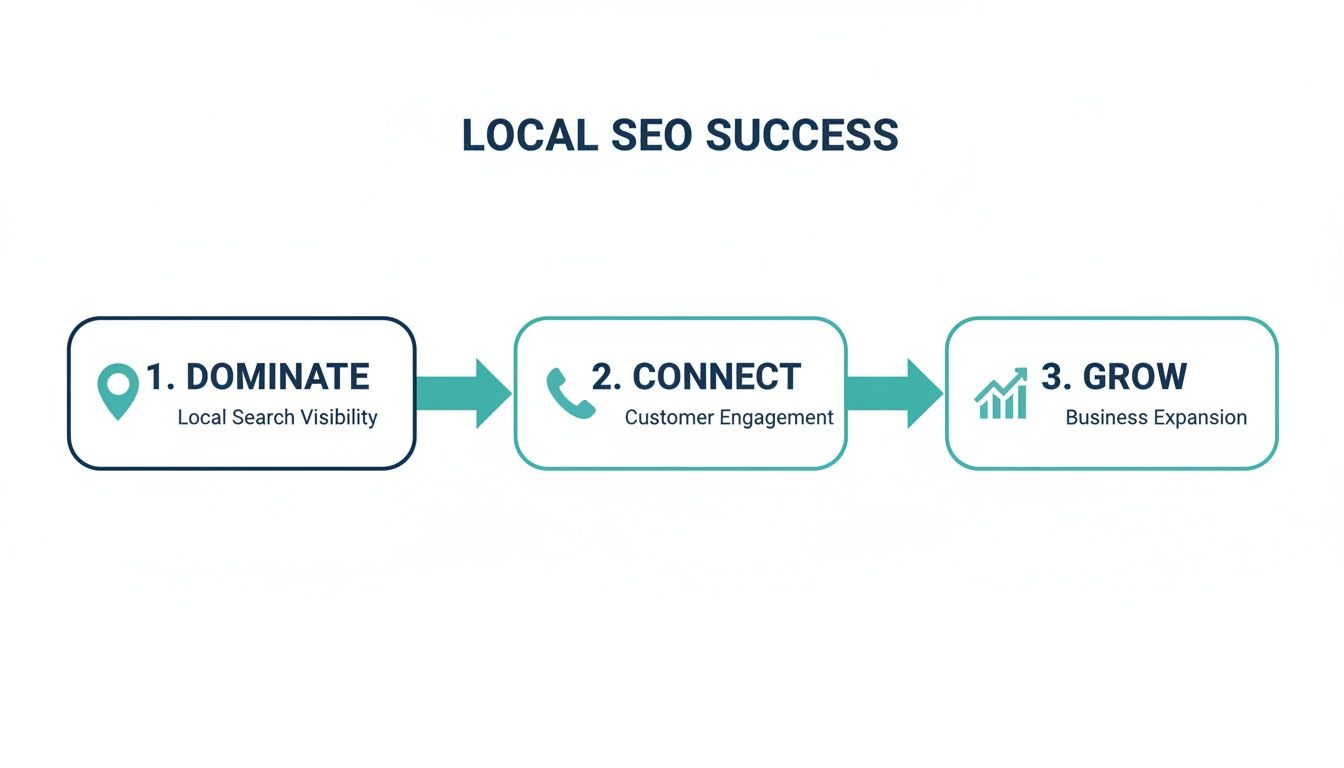
What this shows is that each step naturally leads to the next. When you dominate local search results, you inevitably connect with more customers, and that connection is what fuels real, sustainable growth for your business.
Why Generic Marketing Fails Plumbers
Most marketing advice is far too broad for a local service business. A plumber’s success hinges entirely on being relevant to a customer's immediate location. With over 129,000 plumbing businesses in the U.S. alone, according to the Bureau of Labor Statistics, the competition in any single city is fierce.
This hyper-local battlefield demands a specialized game plan. For plumbers, effective local SEO boils down to mastering three key areas:
- Proximity Signals: This is about proving to Google that your shop is the closest and most convenient option for someone in a specific neighborhood.
- Trust Signals: You build trust and credibility through consistent business information online, a steady stream of positive customer reviews, and local mentions.
- Relevance Signals: This means aligning your website content and online profiles with the exact terms people are searching for, whether it's "leak detection" or "water heater installation."
The difference between a thriving plumbing business and one that’s just getting by is often its visibility in those moments of urgent need. When a pipe bursts at 2 AM, the company that shows up first in a Google search is the one that gets the job.
This guide gives you the framework to get these signals right. If you're looking for more marketing ideas specifically for trade professionals, this Ultimate Guide to Marketing for Tradies: Winning More Local Jobs is an excellent resource. Getting these elements right isn't just about ranking; it's about becoming the undeniable choice for local customers who need you now.
Mastering Your Google Business Profile for the Local 3-Pack
If there's one tool that can single-handedly transform your local plumbing business, it's your Google Business Profile (GBP). Think of it as your digital storefront. It’s often the very first impression a potential customer has of your company, and getting it right is the secret to landing a spot in the coveted Google Local 3-Pack.
Appearing in that top-three block on Google Maps isn't just a vanity metric; it's a massive driver of real, paying jobs. In fact, the Local 3-Pack captures a staggering 44% of all clicks. That means nearly half the people searching for a plumber in your area will click on one of those three businesses. It completely blows standard organic results out of the water, which is why optimizing your GBP should be your number one priority.
Get Your Business Categories Right
The first place most plumbers go wrong is with their business categories. This one setting has a huge influence on which search terms Google shows your profile for.
- Primary Category: This is non-negotiable. It has to be "Plumber." Anything else will confuse Google about the core of your business and hurt your rankings. This is your most powerful signal to Google.
- Secondary Categories: This is where you can get specific. Think about the high-value services you want more calls for. Do you specialize in "Drain Cleaning Service," "Water Heater Installation Service," or "Sewer Contractor" work? Add them here. These additional categories help you show up for more specific, high-intent searches from customers who know exactly what they need.
Actionable Insight: Don't get carried away. Adding a category for a service you only perform occasionally (like "Gasfitter") will dilute your profile's authority for the core services that drive your revenue. Stick to what you're known for.
Write a Business Description That Sells
You have 750 characters to make your case. Your business description is your elevator pitch, and it needs to speak to potential customers while also signaling your relevance to Google.
Forget generic fluff like "We offer great plumbing services." That tells nobody anything useful. Instead, weave a narrative that builds trust and includes your key terms.
Practical Example:
As a family-owned, licensed, and insured plumber serving the [Your City] area for over 15 years, we specialize in 24/7 emergency services for homes and businesses. From burst pipe repair in [Neighborhood 1] to water heater installation in [Neighboring Town], our expert team provides fast, reliable solutions. We offer upfront pricing and a 100% satisfaction guarantee.
This example works because it hits all the right notes: it mentions keywords ("licensed plumber," "24/7 emergency services"), lists specific services, and even names local areas to reinforce its geographic relevance. For a more detailed walkthrough, check out our complete guide on how to optimize Google Business Profile.
Use Every Feature Google Gives You
An incomplete profile looks abandoned. A fully built-out profile signals to both Google and customers that you're active, engaged, and ready for business. The more you use the tools Google provides, the more they'll reward you with visibility.
Take a look at what your customers see when they search on Google Maps.
This is where all your hard work pays off, directly influencing whether a customer calls you or the other guy.
- Google Posts: Treat this like a mini-blog for your business. Share updates, run a special, or highlight a seasonal service. Example: A post about "Emergency Winter Pipe Protection" or a "10% Discount on Water Heater Inspections" can grab attention. These expire, so publish a new one weekly to stay fresh.
- Q&A Section: Don't wait for customers to ask questions—answer them ahead of time. Add your own common questions like, "Do you offer 24/7 emergency service?" or "Are your plumbers licensed and insured?" and then provide the answers. This lets you control the narrative and address customer concerns upfront.
- Services List: This is a goldmine that many plumbers ignore. List out every single service you provide, from "Faucet Repair" and "Toilet Installation" to "Sump Pump Services" and "Gas Line Repair." Each service you add is another keyword that Google can use to match you with a customer's search.
- Geo-tagged Photos: High-quality, real-world photos are incredibly powerful. Post pictures of your team on job sites in different neighborhoods, your branded vans parked in front of local landmarks, and compelling before-and-after shots. Crucially, make sure the location data (geo-tag) is turned on in your phone's camera. This gives Google visual proof of where you work, reinforcing your service area and helping you dominate the local map.
Finding Keywords and Optimizing Your Website
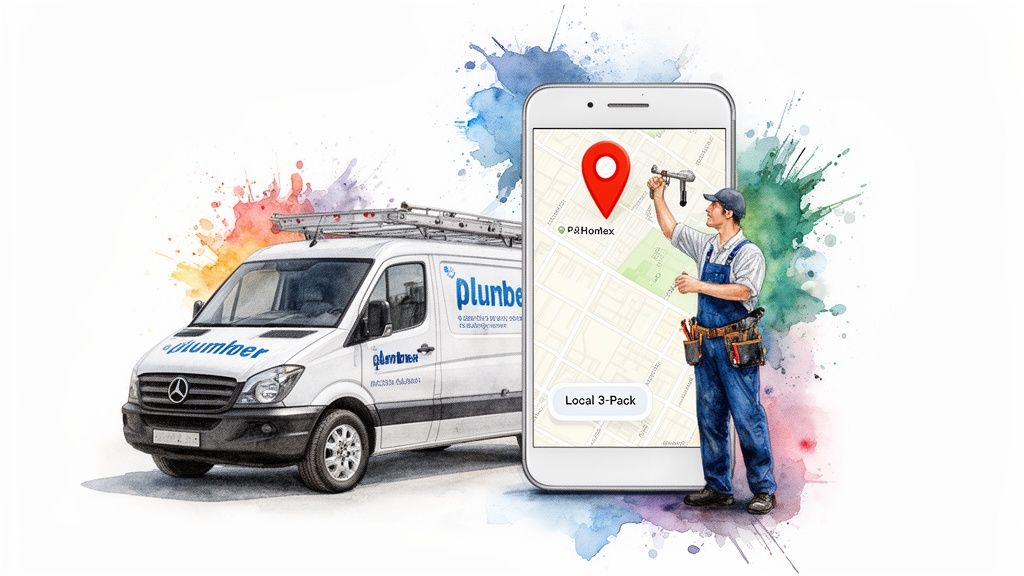
While your Google Business Profile is your digital storefront, your website is the foundation where real business happens. It's your chance to prove your expertise, build trust, and rank for all the different services and towns you cover. That all starts with understanding exactly what a customer types into Google when they're in a panic.
When a pipe bursts at 2 AM, no one is searching for "hydronic system maintenance." They’re frantically typing in "emergency plumber near me" or "24-hour plumber [Their Town]." This is the heart of keyword research for plumbers: finding those high-intent phrases that signal someone needs your help, right now.
Uncovering High-Intent Local Keywords
Good keyword research means putting yourself in your customer's shoes. The goal is to find searches that combine a specific service with a geographic area. The way people find plumbers has completely changed with smartphones. A staggering 70% of mobile local searches result in someone clicking on the map results.
Think about that. When people search on their phones—which is often during an emergency—they're looking at the map, not scrolling through pages of blue links. And since 46% of all Google searches have local intent, a location-first strategy isn't optional; it's essential.
To start building your keyword list, you'll want to brainstorm your core services and then attach location-based terms to them.
- Core Services: List everything you do, from the everyday to the specialized. Think "water heater repair," "drain cleaning," "sewer line inspection," and "sump pump installation."
- Intent Modifiers: These are words that signal urgency or a desire to hire someone. Words like "emergency," "24/7," "repair," "cost," and "service" are perfect examples.
- Location Modifiers: This is what makes your keywords local. Use the cities, towns, counties, and even specific neighborhoods you want to work in, like "[Your City]," "[Your County]," or even "[Neighborhood Name]."
When you put these together, you get powerful, high-conversion keywords like "emergency sewer line repair in [Your City]" or "sump pump installation cost in [Neighborhood Name]." For a more detailed walkthrough, you can check out our complete guide on how to do keyword research.
To help you get started, here’s a quick breakdown of how to combine these elements.
Local Keyword Modifiers For Plumbers
| Keyword Type | Example Modifiers | Full Keyword Example |
|---|---|---|
| Core Service | drain cleaning | clogged drain service in Chicago |
| Emergency Service | emergency plumber | 24/7 emergency plumber Brooklyn |
| Installation Service | water heater installation | tankless water heater installation cost Austin |
| Repair Service | leak repair | slab leak repair near Dallas |
| Hyperlocal Targeting | sewer inspection | sewer inspection Lincoln Park |
This table shows just how specific you can get. The more you tailor your keywords to your actual services and service area, the better your chances of attracting the right kind of customers.
Building Your Website Around Services and Locations
With your keywords in hand, you need a website structure that puts them to work. The biggest mistake plumbers make is lumping all their services together on one generic "Services" page. This completely kills your ability to rank for anything specific.
Instead, every single core service you offer needs its own dedicated page.
A separate, dedicated page for "Water Heater Installation" sends a powerful signal to Google that you are an authority on that specific topic. This creates a highly relevant destination for that search, massively boosting your odds of ranking for it.
Your site structure should be organized logically, something like this:
- Homepage: An overview of your business, top services, and service area.
- Service Pages: A unique page for each service (e.g., Drain Cleaning, Leak Detection, Bathroom Remodeling).
- Location Pages: If you cover multiple cities, create a specific page for each major town you target.
This structure lets you optimize each page with incredible focus. Your "Drain Cleaning" page will be all about drain cleaning, targeting keywords like "clogged drain service" and "hydro jetting in [Your City]."
Optimizing Your Service Pages for Conversions
Just creating the pages isn't enough; they have to be optimized to convince both Google and potential customers that you're the right choice. Each service page is a digital sales pitch.
Here's a simple, effective framework for every service page:
- Clear Title Tag & H1 Heading: Make them direct and keyword-focused. For example, a Title Tag could be "Expert Water Heater Repair in [Your City] | 24/7 Service," with the H1 Heading being "Fast, Reliable Water Heater Repair Services."
- Hook Them Immediately: Start by addressing their problem. Connect with their pain point: "Is your water heater leaking or just not making hot water? A broken water heater can ruin your whole day."
- Explain Your Solution: Detail your process, the types of problems you solve, and what makes you the best plumber for the job. Weave your keywords in naturally. Use subheadings like "Signs You Need Water Heater Repair" to make the page easy to scan.
- Strong Call to Action (CTA): Make it impossible to miss. Use big, bold buttons and clickable phone numbers. Phrases like "Schedule Your Repair Now" or "Call for a Free Estimate" tell people exactly what to do next.
By building out this network of specific, optimized pages, your website goes from being a simple online brochure to a powerful lead-generation machine that attracts qualified customers from every corner of your service area.
Building Trust with Citations and Online Reviews

In local search, trust is everything. When a homeowner has a burst pipe at 2 a.m., they need to know the plumber they call is legitimate, reliable, and respected in their community. The two most powerful tools you have to build this kind of digital trust are citations and online reviews.
Think of these as digital handshakes and referrals. Citations prove to Google that your business is a real, established local entity. Reviews prove to potential customers that you actually deliver on your promises. If you're serious about ranking locally, mastering both is non-negotiable.
The Power of Consistent NAP and Citations
So, what exactly is a citation? It’s simply any online mention of your business’s Name, Address, and Phone number—what we in the industry call your NAP. Google’s bots crawl the web looking for these mentions to verify that your business is who and where you say you are.
When Google finds your NAP listed identically across dozens of reputable websites, it’s like getting a chorus of endorsements. This consistency is absolutely critical. Even a small discrepancy—like "Smith Plumbing" on one site and "Smith Plumbing Inc." on another, or "St" versus "Street"—can create confusion and dilute your authority in Google's eyes.
The only solution is to lock down one official NAP and use it perfectly everywhere. Start by auditing your presence on the directories that matter most.
- Top-Tier General Directories: These are the big ones. Make sure your business profile is claimed, complete, and 100% accurate on Yelp, Bing Places, Apple Maps, and the Better Business Bureau.
- Industry-Specific Platforms: For plumbers, a listing on a home services site is gold. Prioritize getting your NAP correct on Angi, HomeAdvisor, Thumbtack, and Houzz.
- Local Directories: Never underestimate the power of hyper-local signals. A listing with your city’s Chamber of Commerce or a local business association tells Google you're a genuine part of the community.
A consistent NAP across high-authority directories is a foundational signal for local SEO. It proves you're a stable, legitimate local business that search engines can confidently recommend.
Turning Happy Customers into a 5-Star Reputation
Online reviews are the new word-of-mouth, plain and simple. An impressive collection of recent, positive reviews is often the single most persuasive factor for a customer choosing between you and a competitor. In fact, research consistently shows that over 90% of consumers read online reviews before making a local service decision.
Don't leave this to chance. You need a simple, proactive system for encouraging feedback. The absolute best time to ask is right after you've successfully finished a job and the customer is happy with the work. A quick text or email while the positive experience is fresh in their mind works wonders.
Practical Example: Review Request Template (Email/Text)
"Hi [Customer Name], this is [Your Name] from [Your Plumbing Company]. Thanks again for trusting us with your [service performed] today. We’d be grateful if you could take 30 seconds to share your experience on Google. Your feedback helps our small business grow. Here's a direct link: [Link to Google Review Page]"
This approach is personal, direct, and makes it incredibly easy for them to follow through.
Responding to Every Review—Good and Bad
Getting reviews is only half the battle; responding to them is just as important. Your replies are public, and they show everyone—including future customers—that you value feedback and are committed to great service.
For a glowing 5-star review, a simple "thank you" is good, but a personalized response is much better. Address the customer by name and mention a specific detail from their review. It proves you're actually reading what they write.
Negative reviews are frustrating, but they're also a golden opportunity to demonstrate your professionalism.
- Acknowledge and Apologize: Start by validating their feelings. Apologize that their experience didn't live up to expectations.
- Take It Offline: Never get into a public back-and-forth. Provide a direct phone number or email for a manager to contact them and resolve the issue privately.
- Show You Care: Your professional response shows potential customers that even when things don't go perfectly, you are committed to making it right.
This public display of accountability can sometimes be more powerful than a dozen positive reviews. It builds trust by showing you stand behind your work, no matter what. For more guidance on managing your business’s public information, the U.S. Small Business Administration offers excellent resources.
Building Local Backlinks to Cement Your Authority
While your on-site content and Google Business Profile are fundamental, some of the most impactful ranking signals for local SEO are built off your website. I'm talking about local backlinks. Think of a backlink as a vote of confidence from another website. When a respected local business links to your site, it's a powerful signal to Google that you're a trusted, authoritative player in the community.
Forget about complicated, overly technical link-building schemes. For a plumbing business, the most effective strategies are grounded in real-world community relationships. It's about weaving your business into the local fabric, both online and off, to create a competitive advantage that’s hard to replicate.
Partner with Other Local Businesses
One of the most authentic ways to earn powerful backlinks is by forging relationships with other non-competing businesses that serve the same local homeowners you do. These symbiotic partnerships can quickly become a fantastic referral network.
Start thinking about who else is working in your clients' homes. Potential partners include:
- Restoration Companies: After they handle the water damage cleanup, they'll need a plumber to fix the underlying problem.
- Real Estate Agents: Agents are always looking for reliable plumbers, either for pre-sale inspections or for new homeowners.
- General Contractors and Remodelers: Kitchen and bathroom projects nearly always involve significant plumbing work.
- Property Managers: They have an ongoing need for a dependable plumber to handle maintenance and emergencies across multiple units.
Reach out and propose a simple referral partnership. To bring this online, you could create a "Preferred Partners" or "Local Resources" page on your website where you link to them. Then, ask if they'd be willing to do the same. A link from a local realtor's blog post titled "Our Most Trusted Home Service Pros in [Your Town]" is an incredible local signal for Google.
Get Involved in Your Local Community
Google loves to see businesses that are genuinely part of their local community. Getting involved isn't just good for your brand's reputation; it's also a goldmine for high-quality, local backlinks. This is where your offline efforts can directly boost your online authority.
Actionable Insight: Sponsoring a local Little League team will almost always get you a link from the league's "Our Sponsors" page. Participating in a local charity 5K run or a town festival can produce similar results. These links are incredibly valuable because they often come from trusted, location-specific domains (like .org or even .gov sites) that search engines highly respect.
A backlink from your local Chamber of Commerce or the website for a well-known community event is one of the strongest authority signals you can get. It anchors your business to your service area in a way few other SEO tactics can.
These actions prove you're more than just a name on a van—you're an active, contributing member of the community.
Create Genuinely Useful Local Content
Another powerful strategy is to create content on your own website that other local organizations will actually want to link to. This means going beyond your standard service pages and positioning yourself as a true local resource. The goal is to create "linkable assets" that provide real value.
Here are a few practical ideas a plumbing business could run with:
- A Guide to Local Water Quality: Write a detailed post about your city's specific water hardness levels or common contaminants, and explain what homeowners can do about it. A local news outlet or a community blogger would see this as a great resource to share.
- A Homeowner's Guide to Plumbing Codes: Develop a simplified guide to your town's specific plumbing codes for common DIY projects. A local hardware store's website could find this incredibly valuable to share with their customers.
- Seasonal Maintenance Checklists: Put together a comprehensive "Winter Plumbing Checklist for [Your City] Homes" that covers local issues, like how to prevent frozen pipes in your specific climate.
By producing this type of hyper-local, helpful content, you give other websites a compelling reason to link back to you. This approach to local seo for plumbers is all about earning links naturally. For a more thorough look at these tactics, check out our guide on local link building.
Frequently Asked Questions About Plumbing SEO
Jumping into online marketing for your plumbing business is bound to bring up some questions. I've worked with countless plumbers over the years, and a few key questions always come up. Let's tackle them head-on with some straight, practical answers.
How Long Does Local SEO Take to Work for a Plumber?
I get this question all the time. Everyone wants to know when the phone will start ringing. While you might see some early movement from a well-optimized Google Business Profile within a few weeks, a solid local SEO for plumbers strategy is a long game. Realistically, you should plan on seeing significant, measurable growth in your rankings and lead volume within 3 to 6 months.
Why so long? Well, the timeline really depends on how tough your local competition is and how consistently you work at it. Building high-quality citations, getting a steady stream of positive reviews, and earning legitimate local backlinks—these things don't happen overnight. They build on each other, creating a powerful foundation that pays off for years.
Think of it less like a quick fix and more like building a valuable asset for your business.
What Is More Important: My Website or My Google Business Profile?
This is a classic "chicken or egg" question, but the answer is pretty clear for plumbers. If you're looking for immediate local calls for emergency jobs, your Google Business Profile (GBP) is absolutely critical. It’s what gets you into the Google Maps 3-Pack, which is prime real estate for customers who need a plumber right now.
But don't discount your website. Your website is the bedrock of your online authority. It’s the professional, optimized site that helps your GBP rank higher in the first place. It gives potential customers the detailed information, photos, and testimonials they need to feel confident hiring you. Plus, your website can rank for a much broader set of specific service and location keywords than your GBP ever could on its own.
They work together as a powerful team. Your Google Business Profile is the billboard that grabs a driver's attention, and your website is the showroom that closes the deal. You need both to be top-notch for any kind of lasting success.
Can I Do Local SEO Myself, or Should I Hire an Agency?
You can definitely handle some of the basics yourself if you're motivated. Tasks like setting up your Google Business Profile, making sure your business name and phone number are consistent online, and asking customers for reviews are all manageable in-house.
However, running a full-blown strategy is a serious time commitment. It requires specialized knowledge that's always changing as Google updates its algorithms. Things like technical on-page SEO, strategic local link building, and deep competitor analysis really need an expert touch to be effective.
For most plumbing business owners, it boils down to a simple trade-off:
- Time vs. Money: Do you honestly have several hours a week to dedicate to learning and doing SEO?
- Expertise vs. Opportunity Cost: Is your time better spent managing your crew and serving your customers?
Hiring a specialized agency can speed things up dramatically, keep you from making costly mistakes, and let you focus on what you do best. When you look at the ROI from new, high-value jobs, professional SEO often pays for itself many times over.
How Much Should a Plumber Budget for Local SEO?
There’s no one-size-fits-all price. The right budget depends entirely on how competitive your city is, what your growth goals are, and what's included in the service.
A very basic plan focused on just Google Business Profile management and citation cleanup might start in the low hundreds per month. That's a decent starting point, but it likely won't be enough to make a dent in a crowded urban market.
On the other hand, a comprehensive strategy designed to dominate a competitive area typically runs from $1,500 to $5,000+ per month. For that kind of investment, you should expect:
- Deep keyword research and strategic planning
- Ongoing website optimization (on-page and technical)
- Consistent creation of local content (new service pages, blog posts)
- Proactive local link building and outreach
- Reputation management and review generation systems
- Detailed monthly reporting that shows what's working
The key is to stop thinking of it as a "cost" and see it as an investment in a powerful customer acquisition channel. The right local SEO for plumbers strategy will bring in high-value jobs that far exceed the monthly expense.
Ready to stop missing out on local calls and start dominating your service area? At Galant Studios, we specialize in creating powerful local SEO strategies that turn your online presence into a lead-generation machine. We have the experience to put your plumbing business at the top of Google's results, ensuring you get the call when customers need you most.
Learn how our expert SEO services can grow your plumbing business today.