
When it comes to BigCommerce, unlocking explosive organic growth isn't about finding a secret trick. It's about mastering the powerful SEO features already built into the platform. A winning strategy combines clean URL structures, persuasive meta tags, and smart technical settings to create an unstoppable engine for attracting qualified customers.
Building Your SEO Foundation on BigCommerce
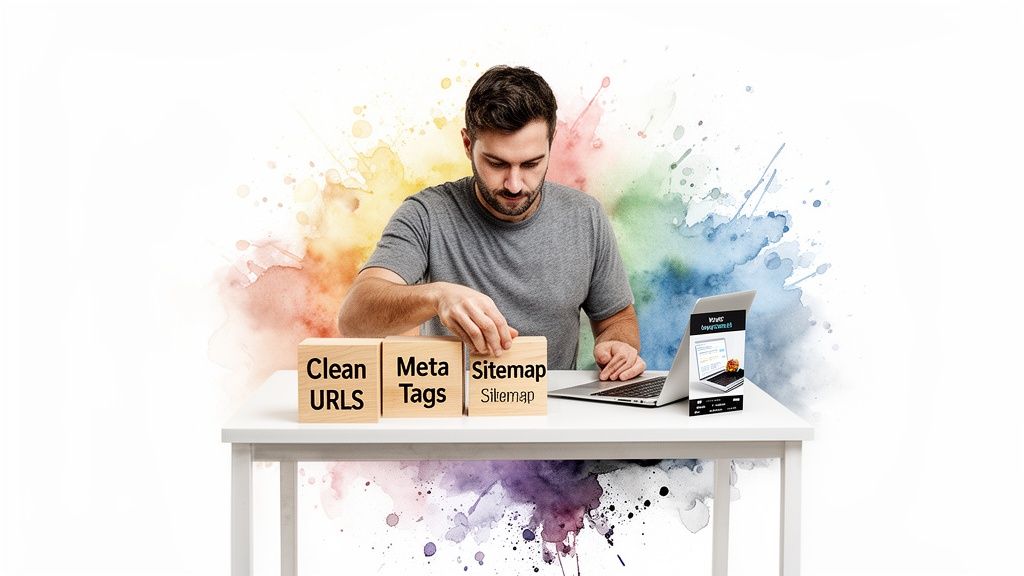
It’s a common misconception that choosing a powerful platform like BigCommerce automatically handles all your SEO. While it gives you an incredible head start, it’s not a magic bullet. Think of it like this: BigCommerce provides a professional-grade workshop full of powerful tools, but you’re the craftsman who needs to wield them effectively to build a successful business.
The real competitive advantage of BigCommerce SEO optimization comes from mastering these native features. Many other platforms force you to install a half-dozen apps just to get basic control, but BigCommerce puts the most important SEO levers right at your fingertips from day one.
Why BigCommerce is a Powerhouse for Organic Growth
From the ground up, BigCommerce was engineered with SEO in mind. It solves many of the technical headaches that can sink an e-commerce site, giving you an immediate competitive edge right out of the box.
The table below breaks down the most crucial native features and, more importantly, why they are your secret weapons for climbing the search rankings.
Core BigCommerce SEO Features and Their Impact
| BigCommerce Feature | What It Does | Why It Matters for SEO |
|---|---|---|
| Customizable URLs | Allows complete control over the URL slugs for all pages. | Creates clean, keyword-rich links that are easy for both shoppers and search engines to understand, boosting page relevance. |
| Built-in Meta Tag Control | Lets you directly edit meta titles and descriptions on product, category, and content pages. | Gives you direct influence over your search result "advertisement," which is crucial for earning clicks from qualified buyers. |
| Automatic Sitemaps | Generates and automatically updates your XML sitemap as your store changes. | Ensures search engines can efficiently find, crawl, and index all your important pages without you lifting a finger. |
| Mobile-Responsive Themes | Provides a library of themes designed to work flawlessly on all devices. | Directly addresses Google's mobile-first indexing, a critical ranking factor that prioritizes the experience of users on their phones. |
These features aren't just minor conveniences; they are the bedrock of a high-performing SEO strategy. For instance, a clear URL like /womens-shoes/running-sneakers is infinitely more persuasive and understandable than a messy, system-generated one like /cat/?id=45&prod=129. This seemingly small detail has a massive impact on how search engines value your pages. You can dive deeper into how these elements work together by learning more about crafting a logical site architecture and SEO.
The Tangible Impact of a Strong SEO Foundation
Investing in BigCommerce SEO optimization isn't just a technical task—it's a core business decision that directly fuels your revenue. In the hyper-competitive e-commerce landscape, organic search is a dominant force, responsible for a staggering 43% of all traffic to online stores, according to data from Statista.
Practical Example: Just look at TheBattery.com. The company went from minimal sales to $1 million in revenue in only 10 months. An incredible 77% of those sales came directly from organic traffic, a testament to the power of BigCommerce's SEO-friendly architecture.
This case study is powerful proof that a well-executed strategy delivers real, measurable returns. By focusing on the fundamental features BigCommerce offers, you’re not just tweaking settings; you’re building a sustainable engine for growth that brings a steady stream of customers actively searching for your products—long after your paid ad campaigns have ended.
Mastering On-Page SEO for Products and Categories

Your product and category pages are the commercial heart of your BigCommerce store. While a solid technical foundation is vital, it’s the on-page optimization of these key pages that converts search intent into sales. This is where sharp keyword selection and persuasive copywriting work together to create a powerful engine for organic growth.
The hard truth is that 75% of users never scroll past the first page of Google. For a BigCommerce store, this makes top rankings non-negotiable. Our internal data shows that retailers who properly optimize their meta titles and descriptions see, on average, a 32% increase in organic sales. It's a direct and powerful lever for your business.
On top of that, leads generated from SEO close at an impressive 14.6% rate, completely blowing away the 1.7% from outbound marketing. The effort pays for itself.
Fine-Tuning Your Keyword Research for Products
General keyword research is a start, but e-commerce demands laser focus. You must target keywords with clear transactional intent—the exact phrases people type when they are ready to make a purchase, not just browsing for information.
Think beyond the obvious. A search for "shoes" is purely informational. A search for "women's size 8 waterproof hiking boots" is someone with their credit card in hand. Your goal is to pinpoint and target these specific, long-tail keywords for every product you sell.
Here are actionable strategies that work every time:
- Spy on Competitor Keywords: Use an SEO tool to see which specific product keywords are already driving revenue for your direct competitors. This gives you a proven list of terms that are working right now in your niche.
- Mine Amazon's Search Bar: Amazon is a goldmine for buyer-intent keywords. Start typing a core product term into its search bar and study the autocomplete suggestions. These are real phrases from real customers telling you exactly what they're looking for.
- Add Powerful Modifiers: Enhance your core keywords with transactional or descriptive words like "buy," "sale," "review," "lightweight," or "100% cotton" to capture highly qualified traffic.
Crafting Meta Titles and Descriptions That Earn Clicks
In the search results, your meta title and description are your digital storefront. Their one job is to be compelling enough to make someone click your link instead of the nine others on the page. Thankfully, BigCommerce gives you full control over these on every product and category page.
A lazy title like "Red T-Shirt" is a massive wasted opportunity. You need a clear, repeatable formula that satisfies both your potential customers and Google.
Pro Tip: Structure your product page titles like this for maximum impact: Primary Keyword | Key Feature or Benefit | Brand Name. This format is scannable, information-rich, and naturally packed with relevant keywords.
Let's see this in action. We'll transform that generic title into a high-performer.
Before Optimization:
- Meta Title: Red T-Shirt
- Meta Description: A red t-shirt available in several sizes.
After Optimization:
- Meta Title: Men’s Crimson Red Crewneck T-Shirt | 100% Cotton | YourBrand
- Meta Description: Discover our premium Crimson Red Crewneck T-Shirt. Made from ultra-soft, breathable 100% cotton for all-day comfort. Shop now for free shipping!
The optimized version instantly tells the shopper what they’re getting. It includes the primary keyword, key features (crewneck, 100% cotton), a clear benefit (comfort), and a compelling call-to-action (free shipping). It's infinitely more likely to attract a qualified buyer.
Writing Product Descriptions That Convert
Your product descriptions must pull double duty: they need to be optimized for search engine algorithms and persuade a human to make a purchase. Too many store owners fall into the trap of copying manufacturer descriptions, which creates a massive duplicate content problem that can torpedo your rankings.
You must write unique, benefit-driven copy for every single product. Don't just list specs; explain how those features solve a problem or improve the customer's life. Each element on the page, from the URL slug to the image alt text, is another opportunity to reinforce the page's relevance to your target keywords.
The Power of Clean URLs and Internal Linking
Clean, descriptive URLs are another cornerstone of on-page SEO. BigCommerce excels by letting you customize the URL for every page. A well-structured URL should be readable by a human and include your primary keyword.
For example, a URL like /mens-crimson-red-crewneck-tshirt is far more effective and user-friendly than /product-id-789123. For a more detailed walkthrough, check out this guide on how to create SEO-friendly URLs.
Finally, don’t neglect internal links. Use them strategically to guide both users and search engine crawlers through your site. From category pages, link to your best-selling products. Within product descriptions, link to related items or accessories. This not only improves the user experience but also spreads "link equity" throughout your store, helping to lift the rankings of many pages at once.
Advanced Technical SEO for Peak Performance
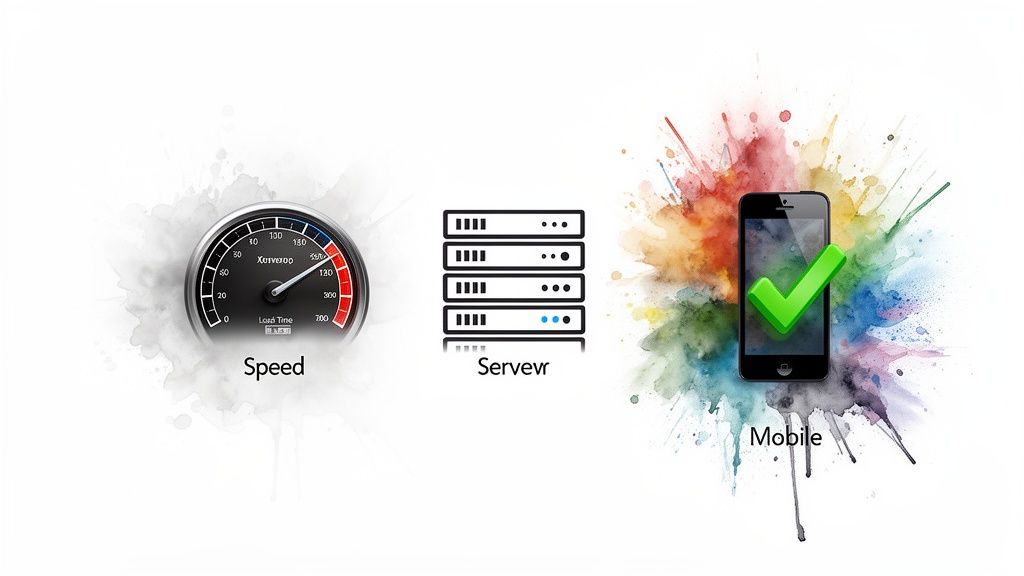
While on-page SEO is what your customers see, technical SEO is the invisible foundation holding everything up. It’s the "under-the-hood" work that enables search engines to crawl, index, and understand your store efficiently. Get this right, and you'll be rewarded with higher rankings and a superior customer experience.
Ignoring your site's technical health is like building a gorgeous showroom on a shaky foundation—it's only a matter of time before things crumble. For any BigCommerce store, a solid technical base is directly tied to revenue. The platform's impressive load times, which often clock in under 2.4 seconds, can boost conversions by a staggering 8.4% for every second you shave off.
Consider that in a market like the US, where e-commerce SEO drives nearly 23.6% of all sales, that speed is a serious competitive advantage. Just look at Chair King Backyard Store. After moving to BigCommerce, they saw 42% more users, 47% more sessions, and a 28% revenue jump, all by leveraging the platform's technical strengths. You can see more details about what’s possible with these BigCommerce performance statistics.
Prioritizing Website Speed and Performance
In e-commerce, speed isn't just a feature; it's a fundamental requirement. Nothing sends a potential customer clicking the "back" button faster than a slow-loading website. Google has also been crystal clear that page speed is a major ranking factor for both desktop and mobile.
BigCommerce gives you a great head start with its solid infrastructure and responsive themes, but you can't just set it and forget it. You must proactively manage performance.
Here are the most critical actions you can take to keep your store running at top speed:
- Optimize Your Images: This is the number one culprit. Large, uncompressed product photos are the primary cause of slow load times. Before uploading, use a tool to compress your images, shrinking their file size without sacrificing quality. Also, make a habit of using modern formats like WebP whenever possible.
- Limit App Overload: The BigCommerce app marketplace is fantastic, but every app adds code to your site, which can slow it down. Regularly audit your apps and remove anything that isn't providing significant, measurable value.
- Leverage a Content Delivery Network (CDN): BigCommerce has a CDN built right in—a huge benefit. It stores copies of your site's files on servers across the globe, ensuring your pages load quickly for customers no matter where they are.
For an even deeper dive, our guide on website performance optimization techniques offers more strategies to get your load times as low as possible.
Managing Duplicate Content with Canonical Tags
E-commerce stores are notorious for creating duplicate content. This happens when the same (or very similar) content appears on multiple URLs, confusing search engines about which page they should rank. Common culprits include product variants (like different colors or sizes) and faceted navigation that creates messy, filtered URLs.
This is where the canonical tag becomes your best friend. It’s a simple piece of HTML code that points search engines to the one "master" version of a page you want them to index.
Key Takeaway: By using canonical tags correctly, you consolidate all your ranking power—like backlinks and user engagement—onto a single, preferred URL. This prevents you from accidentally splitting your SEO authority across a dozen duplicate pages.
BigCommerce handles much of this for you automatically, especially for product variants. Still, it's a best practice to run an SEO crawler on your site periodically to ensure your canonicals are set up correctly everywhere, particularly after making significant changes to your store’s structure.
Winning Rich Snippets with Structured Data
Structured data, typically implemented with Schema markup, is like spoon-feeding information to search engines. You add it to your site’s code to provide context. Instead of Google just seeing a number like "$49.99," structured data tells it, "This is the price for this specific product."
Why does this matter so much for BigCommerce SEO optimization? Because it makes your store eligible for rich snippets in the search results. These are the eye-catching listings that show extra details like:
- Product Ratings: Those gold stars that build instant trust and social proof.
- Pricing and Availability: Information that tells shoppers you have what they're looking for, right now.
- FAQs: Direct answers to common questions, appearing right in the search results.
These enhanced snippets make your listings pop, which can dramatically increase your click-through rate. Most BigCommerce themes come with basic product schema already built-in, but you can take it a step further. Using apps or custom development, you can add more detailed markup for reviews and FAQs to truly stand out from the competition.
Driving Authority with Content and Link Building
A technically perfect store is a fantastic foundation, but it's just that—a foundation. Your BigCommerce SEO efforts truly compound when you start building authority. This is all about reputation, and you build it with a smart content strategy and high-quality links pointing back to your site.
Think of it this way: a solid technical setup gets you in the game, but content and links are how you win. You're showing Google and potential customers that you're a trustworthy, go-to resource in your industry, not just another online shop.
Building a Purpose-Driven Content Strategy
Content marketing for e-commerce can't be a shot in the dark. Every article, guide, or video you create needs a specific job. What is the goal? Are you trying to attract someone at the beginning of their research, or are you hoping to nudge a shopper comparing final options over the finish line?
Your aim is to meet customers with helpful, relevant content at every stage of their journey. Doing this consistently builds immense trust. When they're finally ready to make a purchase, your brand will be top of mind.
Don't underestimate the long-term impact. Organic search consistently delivers over 1000% more visitors to websites than social media, making it a dominant and sustainable traffic source. This is especially true for the BigCommerce ecosystem. In Q3 2023 alone, the platform saw its active store count grow 27% year-over-year, with 45,768 stores actively using SEO to drive that growth. You can dig into more of this data and find other essential BigCommerce SEO tips to see the full picture.
To make this actionable, let's map out how different content formats can serve specific business goals. A clear plan ensures your content marketing isn't just creating noise but is actively building your business.
Connecting Content Ideas to Business Goals
| Content Type | Primary Business Goal | Example Topic |
|---|---|---|
| Buying Guide | Attract Top-of-Funnel Traffic | The Definitive Guide to Choosing Kitchen Knives |
| Comparison Article | Capture High-Intent Shoppers | Wüsthof vs. Zwilling Chef's Knives: A Head-to-Head Comparison |
| How-To Blog Post | Address Customer Pain Points | How to Properly Sharpen and Maintain Your Knives |
| Inspirational Post | Build Community & Drive Engagement | 5 Stunning Kitchen Setups for the Modern Home Chef |
This table illustrates that every piece of content can be a strategic asset, moving customers closer to a purchase while simultaneously boosting your SEO.
Earning Backlinks with Valuable Content
Backlinks—links from other websites pointing to yours—are still one of Google's most significant ranking factors. They are essentially votes of confidence from around the web. When another reputable site links to you, they're vouching for your content and telling search engines that you're a credible source.
But here’s the secret: you don't really build links anymore. You earn them by creating content so valuable that other sites feel compelled to link to it.
Your in-depth guides, original research, and detailed comparison articles become "linkable assets." When you create the single best resource on a topic, people in your industry—bloggers, journalists, and even manufacturers—will naturally reference it in their own work.
Let’s go back to our home goods store example. Imagine you publish "The Definitive Guide to Choosing Kitchen Knives." It’s not just a blog post; it's a 3,000-word masterpiece with custom graphics, expert quotes, and embedded videos.
Suddenly, that one piece of content becomes a backlink-generating machine:
- A top food blogger writing about essential kitchen tools links to your guide because it's the most thorough resource available.
- A kitchen supply review site includes your guide in their latest knife roundup.
- An influencer you sent a product to shares the guide with their audience, leading to a cascade of social shares and more organic links.
Key Takeaway: Stop thinking of link building as a separate, tedious chore. Weave it directly into your content strategy. Focus on creating exceptional, problem-solving content, and high-quality backlinks will follow as a natural byproduct.
This approach transforms your blog from a simple marketing channel into an asset that continuously grows your store’s domain authority. As your authority rises, it lifts the rankings for all your pages—including your most valuable product and category pages—driving a steady, sustainable increase in organic traffic and sales.
Measuring and Refining Your SEO Strategy
SEO isn't a "set it and forget it" task. It's a dynamic, ongoing process that requires constant attention. To see real, lasting results from your BigCommerce SEO optimization, you must get into a rhythm of executing, measuring, and refining your approach based on what the data tells you.
Throwing optimizations at the wall and hoping something sticks is a surefire way to waste time and money. The secret to success is building a feedback loop. You need to let performance data from the right tools inform every decision you make, turning guesswork into a repeatable process for driving sustainable organic growth.
Setting Up Your Analytics Foundation
Before you can measure anything, you need to get the basics right. This means connecting your BigCommerce store to the two most essential (and free) tools in the SEO world: Google Analytics and Google Search Console. Think of these as the dashboard for your SEO efforts, giving you a direct line of sight into your traffic, user behavior, and overall search visibility.
BigCommerce makes this connection straightforward. You can typically find the integration options under a "Web Analytics" or "Data Solutions" section in your store's backend. Once linked, they'll start gathering the data that will become the bedrock of your measurement strategy, showing you exactly how people are finding and interacting with your store.
Identifying and Monitoring Key Performance Indicators
With your tools connected, it's time to focus on the numbers that actually matter for an e-commerce business. It's easy to get distracted by vanity metrics, but what you really need are the key performance indicators (KPIs) that connect directly to your bottom line.
A well-oiled SEO strategy can deliver a massive ROI—some studies show it can be as high as 317%. But that doesn't happen by accident. It comes from a deliberate process of building authority, which typically moves from creating genuinely helpful content to proactive outreach and, finally, earning high-quality links.
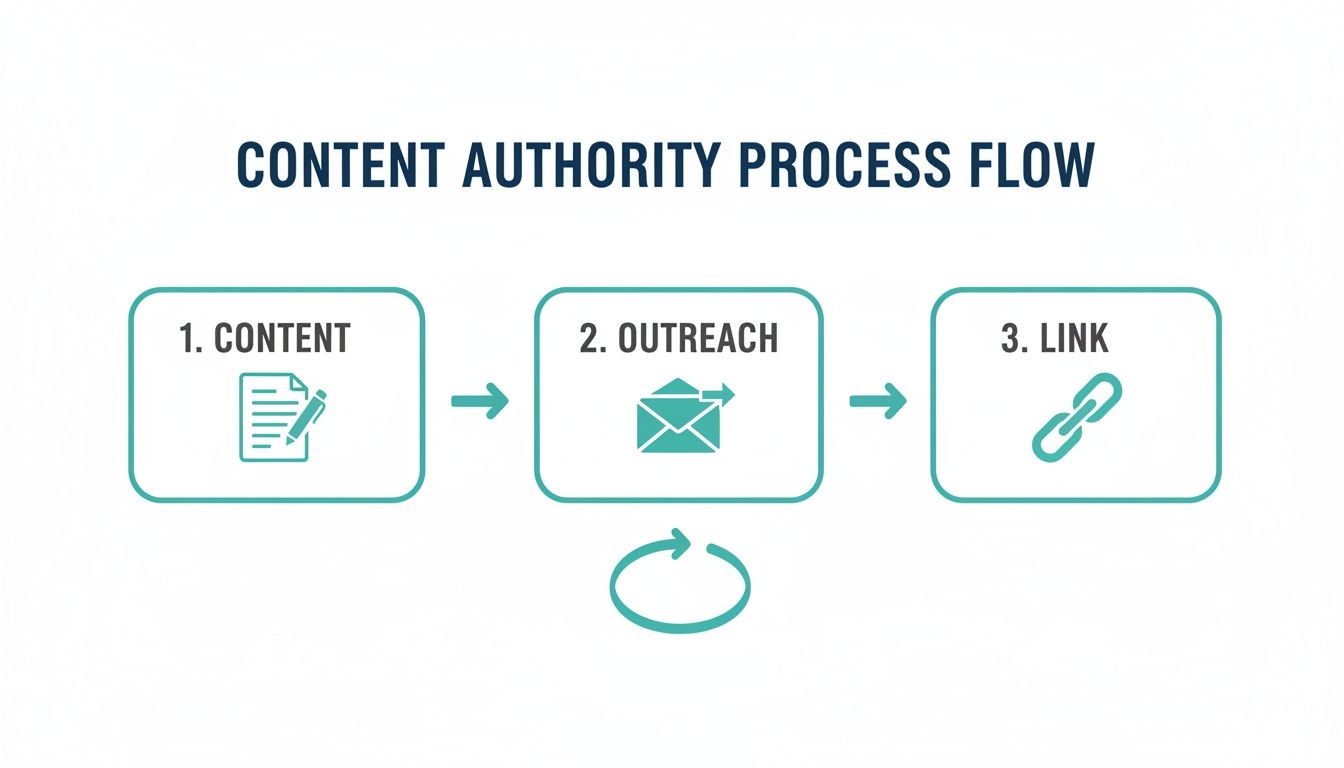
As you can see, great content is the starting point for earning the trust signals that Google rewards. You can learn more about a continuous SEO improvement from these findings.
Here are the core KPIs you should be watching like a hawk:
- Organic Traffic: How many visitors are you getting from non-paid search results? Monitor this weekly and monthly to spot trends early.
- Keyword Rankings: Where do you stand for your most critical, money-making keywords? A steady climb in the rankings is a clear sign your strategy is working.
- Organic Conversion Rate: This is the most important one. What percentage of your organic visitors actually make a purchase? This metric tells you if your SEO efforts are truly impacting revenue.
- Click-Through Rate (CTR): Found in Google Search Console, this shows the percentage of people who click your site after seeing it in search results. A low CTR could mean your page titles and meta descriptions aren't persuasive enough.
Expert Insight: Don't just track overall organic traffic. Dive deeper. Segment your data by product category or even specific blog posts. This granular view will reveal which parts of your store are performing best and where your biggest opportunities for growth lie.
Conducting Monthly SEO Health Checks
To stay ahead, you need to schedule regular SEO reviews. I recommend setting aside a few hours each month for a systematic "health check." This is your chance to catch problems before they grow, uncover new opportunities, and make intelligent adjustments to your strategy.
A solid monthly review framework should cover these bases:
- Review Top Performing Pages: Look at your analytics to see which product pages, categories, and blog posts are bringing in the most organic traffic and sales. What are they doing right? How can you replicate that success elsewhere?
- Analyze Keyword Performance: Which keywords are climbing the ranks? Have you lost ground on any important terms? This is where you can identify both wins and potential issues to address.
- Check for Technical Issues: Log into Google Search Console and check for any new crawl errors, mobile usability warnings, or security flags. These technical hiccups can quietly sabotage your performance if left unchecked.
This disciplined, monthly routine is what separates the pros from the amateurs. It transforms your BigCommerce SEO optimization from a one-off checklist into a dynamic engine that consistently drives business growth.
Frequently Asked Questions About BigCommerce SEO
Even with a comprehensive guide, specific questions are bound to pop up as you dig into your store's SEO. Let's tackle some of the most common ones to clear up confusion and help you move forward with confidence.
Is BigCommerce Better Than Shopify for SEO?
This is the classic debate, and the honest answer is: it depends on your priorities. Both are excellent platforms, but they approach SEO from different philosophies.
BigCommerce shines with its powerful, out-of-the-box features. For example, it gives you complete control over your URL structures for every page—something that often requires workarounds or apps on other platforms. If you value granular, technical SEO control without needing extra add-ons, BigCommerce has a distinct advantage.
Shopify is renowned for its simplicity, but achieving the same level of advanced SEO capability often means relying on its vast app ecosystem. The right choice depends on your technical comfort level and how much direct control you want over your site's SEO from day one. For a deeper analysis, check out this comparison of BigCommerce and other platforms.
How Long Does It Take to See SEO Results?
I'll be upfront: SEO is a marathon, not a sprint. While you might see small wins from initial on-page optimizations within a few weeks, don't expect to hit page one for competitive keywords overnight. Real, meaningful results that impact your bottom line typically take four to 12 months of consistent, focused effort.
This timeline can vary based on your market's competitiveness, your domain's existing authority, and the consistency of your efforts. The magic happens with a sustained commitment to creating valuable content, maintaining technical health, and earning quality backlinks over the long haul.
A common mistake is giving up after just a couple of months. True SEO momentum is built through persistence. The most significant rewards go to those who stay the course.
What Is the Most Important SEO Task for a New Store?
If you're launching a new BigCommerce store, your absolute first priority is a combination of deep keyword research and meticulous on-page optimization. Nothing else matters more at the start. You must understand the exact phrases your ideal customers type into Google when they're ready to buy your products.
Once you have that list of high-intent keywords, the foundational work begins. You need to strategically weave them into your most important pages: your homepage, category pages, and every single product page. Optimizing your titles, meta descriptions, and product details tells Google exactly who you are and what you offer, setting the stage for all future success.
Ready to elevate your store's visibility and drive sustainable organic growth? Galant Studios specializes in expert SEO services that turn traffic into revenue. Let our experience work for you. Get started with us today.