
That sinking feeling when you see a sudden, steep drop in your website traffic is unmistakable. It’s almost always triggered by one of a few common culprits: a Google algorithm update, a critical technical SEO error like an indexing problem, or a manual penalty from Google. The first rule? Don’t panic. The second is to start a methodical diagnosis using your analytics and Google Search Console to find the root cause before you change a single thing.
Understanding the Sudden Drop in Website Traffic
Seeing your analytics graph take a nosedive is a gut-wrenching experience. One day your metrics are humming along, and the next, your numbers have fallen off a cliff. While unnerving, this is almost always a solvable problem. The trick is to trade that initial panic for a structured, diagnostic approach. Before jumping to conclusions, you need to understand what typically causes these sudden shifts.
A logical investigation starts with a clear framework. The flowchart below maps out the exact decision-making process for diagnosing why website traffic has dropped, starting with initial checks in your analytics platform.
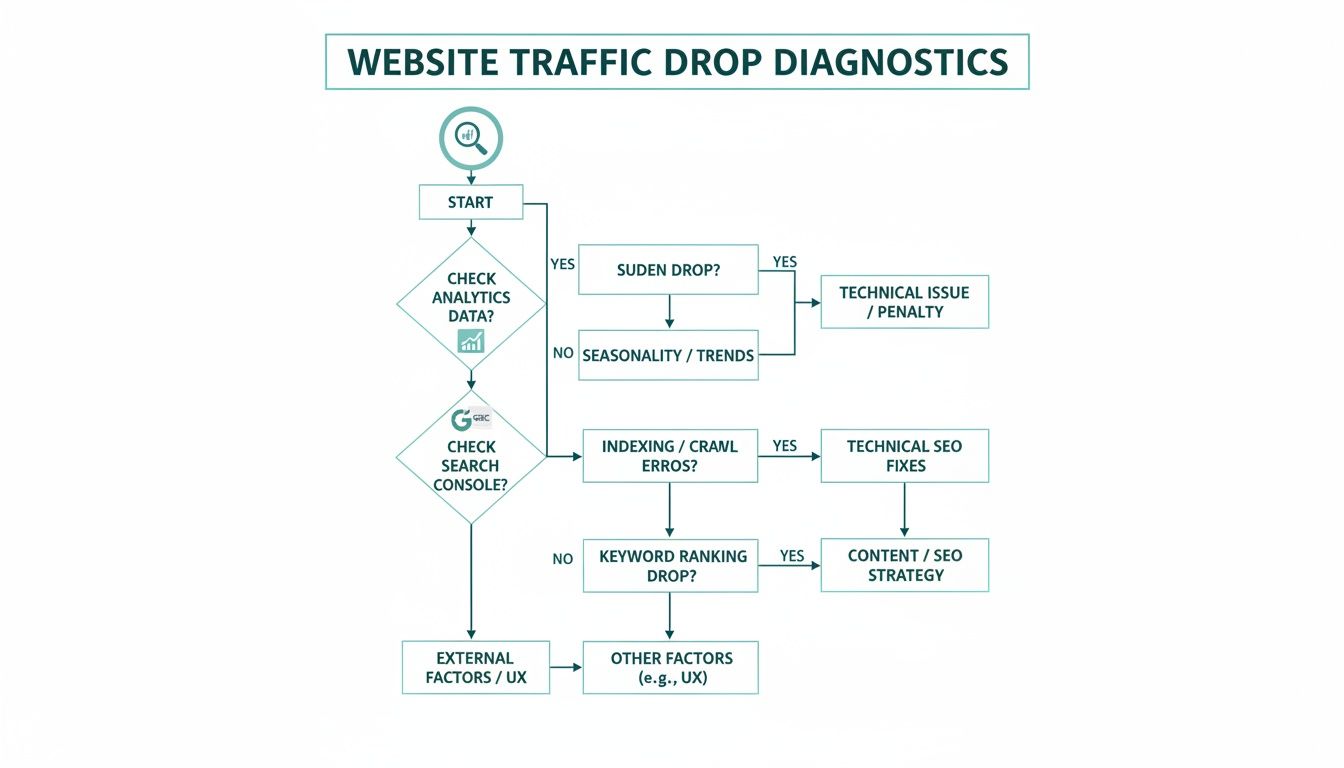
This visual guide helps you move methodically from reviewing the data to pinpointing the specific problem. It’s all about a calm, evidence-based investigation, not a reactive scramble.
To help you get started quickly, this checklist covers the most likely suspects and where to look first.
Quick Diagnostic Checklist for Sudden Traffic Drops
| Potential Cause | Primary Diagnostic Tool | Key Indicator to Check |
|---|---|---|
| Google Algorithm Update | SEO News Outlets & GSC | Performance report for widespread ranking drops across many keywords. |
| Technical Indexing Issue | Google Search Console | Coverage report for a spike in “Excluded” or “Error” pages. |
| Manual Action (Penalty) | Google Search Console | “Manual Actions” report for any listed violations. |
| Lost High-Value Backlinks | Ahrefs or SEMrush | Referring Domains report for a sudden drop in authoritative links. |
| Server or Hosting Errors | Google Search Console | Coverage report for a surge in server errors (5xx). |
| Analytics Tracking Failure | Google Analytics | Real-Time report to see if any current visitors are being tracked. |
This table isn’t exhaustive, but it will help you quickly narrow down the possibilities so you can focus your investigation where it matters most.
Common Causes Behind Traffic Loss
Sudden traffic drops feel more common these days because the search landscape is more dynamic than ever. Constant algorithm tweaks and new technologies mean things can change fast. Understanding these factors gives you the context you need for your investigation.
Several underlying issues can trigger a significant drop, ranging from external factors completely out of your control to internal technical glitches that might have been brewing for a while. Finding the right cause is the most critical step toward recovery.
- Google Algorithm Updates: Google is always refining its ranking algorithms. A major update can re-evaluate your site’s content quality or backlink profile overnight, leading to a dramatic shift in your rankings.
- Technical SEO Issues: Simple things can have a huge impact. An incorrect
robots.txtrule, accidentally applying ‘noindex’ tags sitewide, or persistent server errors can stop Google from crawling and indexing your pages. - Manual Actions: If your site is found to be in violation of Google’s webmaster guidelines—now known as spam policies—it can receive a manual penalty that directly tanks your visibility in search results. For example, the U.S. Federal Trade Commission has strict rules on deceptive practices, which Google’s policies often mirror.
- Lost Backlinks: High-authority backlinks are a major ranking signal. If you suddenly lose several important links, it can hurt your site’s perceived authority and, consequently, your rankings.
The most effective response to a traffic drop is a systematic one. Start by gathering data, form a hypothesis based on the evidence, and only then begin implementing solutions. A rushed approach often leads to more problems.
The Growing Impact of AI in Search
The introduction of AI-driven search features is fundamentally changing user behavior and our traffic patterns. Imagine logging into your analytics to see your traffic has plummeted overnight. That’s what happened to HubSpot, a marketing giant that saw its monthly organic visits crash from 13.5 million to under 7 million in weeks, eventually hitting a low of 6 million—a staggering 70-80% decline.
This wasn’t an isolated incident. It was part of a broader “Great Decoupling” in organic search as AI Overviews began appearing in 13% of queries, slashing click-through rates (CTR) by a massive 47%. Publishers were left scrambling. You can read a full breakdown in this analysis of the 2025 organic traffic crisis.
This new reality means that even if you maintain high rankings, your site might get far fewer clicks because users are getting their answers directly on the search results page. A balanced and comprehensive SEO strategy is more important than ever. By approaching any traffic problem methodically, you can turn anxiety into an actionable recovery plan.
Your Essential Diagnostic Toolkit
Before you can build a recovery plan, you need to play detective. Solving the mystery of a sudden traffic drop requires the right set of diagnostic tools. This is your command center, walking you through the essential platforms you’ll need to pinpoint the source of the loss. Instead of a frantic search for answers, think of this as a methodical investigation to uncover the precise ‘what,’ ‘where,’ and ‘when’ of the decline.
Your primary instruments for this investigation will be Google Analytics (GA4) and Google Search Console (GSC). These are Google’s own platforms, giving you the most direct, unfiltered view of your website’s search performance and user interactions. They are the absolute bedrock of any traffic analysis.
Mastering Google Search Console for Core Insights
Google Search Console is your direct line to Google, so it should always be your first stop. It’s packed with crucial data on your site’s health and search performance, and it can often reveal the root cause of a traffic drop in just a few clicks.
Start by heading straight to the Performance report. This is where you’ll spend most of your initial time. The key is to set the date range to compare the period after the drop with an equivalent period before it. This side-by-side comparison immediately puts the scale of the problem into perspective.
From there, start slicing the data to narrow down the issue:
- Queries: Did traffic disappear for a handful of high-volume keywords, or is the loss spread thinly across many terms? A drop tied to specific keywords could mean a competitor has overtaken you or that search intent has shifted. For example, if your traffic for “best laptops 2023” vanished in early 2024, it’s likely a natural shift in user search behavior.
- Pages: Is the traffic loss isolated to one page, a cluster of related pages (like a blog category), or is it a site-wide problem? A site-wide drop often points to a technical issue or a broad algorithm update.
- Devices: Did your mobile traffic plummet while desktop traffic held steady? This is a huge red flag for a mobile usability problem, which needs immediate attention since Google uses mobile-first indexing.
A critical mistake I see people make is assuming the problem is incredibly complex. Before you start a deep technical audit, always check the “Manual Actions” and “Security Issues” tabs in GSC. An overlooked penalty or malware warning is a common, and thankfully obvious, cause of a traffic catastrophe.
Leveraging Google Analytics to Understand User Behavior
While GSC shows you what’s happening in the search results, Google Analytics (GA4) reveals what happens once visitors land on your site. When you experience a sudden traffic drop, GA4 helps you understand the impact on a much more granular level.
Go to the Traffic Acquisition report. This report quickly tells you which channels are bleeding traffic. Did the drop come from organic search, direct traffic, social media, or referrals? If the loss is isolated to organic search, you can be fairly confident it’s an SEO issue. But if multiple channels dropped at once, the problem might be a site-wide tracking error or a broader issue with your brand’s visibility. This data provides the crucial context you need to focus your recovery efforts.
Expanding Your Toolkit with Third-Party Platforms
Google’s tools are non-negotiable, but third-party platforms like Semrush and Ahrefs provide competitive and historical context that you just can’t get elsewhere. They allow you to look beyond your own data and see what’s happening in the wider market.
One of the most powerful features of these tools is backlink analysis. Did you recently lose a few high-authority backlinks? A sudden dip in your link profile can absolutely damage your site’s authority and, consequently, its rankings. Use these platforms to monitor for lost links and figure out why they disappeared.
You should also use these platforms to spy on your competitors. Did a competitor’s traffic spike right around the time yours fell? Analyzing their top pages, recent content, and new backlinks can reveal strategic moves they made to capture your audience. Performing comprehensive digital marketing audits is a crucial part of this process, helping you pinpoint these external causes and create a blueprint for recovery.
By combining the hard data from Google with the competitive intelligence from third-party tools, you build a complete picture of the situation. This empowers you to move from diagnosis to decisive action.
Uncovering Hidden Technical SEO Failures
Sometimes, a catastrophic traffic drop isn’t from a massive Google update. It’s often a single, subtle technical error hiding in plain sight. These issues can essentially cloak your pages from search engines, and if you don’t know where to look, they can go unnoticed for weeks. This is precisely why a hands-on technical SEO audit is your best friend in a crisis.
The investigation always starts where search visibility is born: indexing. If Google can’t find and index your pages, they simply don’t exist in the search results. Your first port of call should be Google Search Console, specifically the ‘Pages’ report.
Confirming Your Pages Are Indexed
This report is your direct line to Google, showing you exactly which URLs it has indexed and which it has ignored. A sudden spike in the “Excluded” or “Error” counts is a glaring red flag. You need to look for pages that were previously indexed but are now flagged as “Crawled – currently not indexed” or, even more concerning, “Discovered – currently not indexed.”
These statuses mean Google knows your pages exist but has decided against including them in search results. The reasons can range from perceived low quality and duplicate content to technical issues preventing a proper evaluation.
A common mistake is assuming a page is fine just because it’s live. I once worked with a client whose traffic to their most profitable service pages vanished overnight. The culprit? A single ‘noindex’ tag accidentally added during a plugin update, telling Google to ignore an entire directory. It’s a simple error with catastrophic consequences.
Inspecting Your Robots.txt File
Your robots.txt file is a tiny text file with immense power. It tells search engine crawlers which parts of your site they can and cannot access. One wrong move here can be devastating. For a deep dive into the technical side of things, it’s worth checking out a master framework for technical SEO audits.
Scan the file for Disallow directives that are too aggressive. For example, a rule like Disallow: /blog/ would block crawlers from your entire blog. This often happens during a site migration when a developer blocks a staging area and forgets to remove the rule before launching the site.
Here are a few red flags to watch for in your robots.txt:
Disallow: /: This is the nuclear option. It blocks every crawler from your entire site.User-agent: Googlebotfollowed byDisallow: /: This specifically tells Google to stay out while letting other bots in—a surefire way to kill your organic traffic.- Blocking CSS or JavaScript files: Modern search engines render pages like a browser to understand them fully. Blocking these resources can cripple their ability to index and rank your content properly.
Hunting for Sitemap Errors and Rogue Tags
Think of your XML sitemap as a roadmap you hand directly to search engines. It guides them to all your important content. Inside Google Search Console, check the ‘Sitemaps’ report for any errors. Google will tell you if it’s having trouble fetching the sitemap or if it contains broken URLs.
Beyond the sitemap, you need to hunt for rogue ‘noindex’ meta tags. This small snippet of HTML (<meta name="robots" content="noindex">) is an explicit command to search engines to not index a page. You can use a crawler like Screaming Frog or simply use your browser’s “View Page Source” function on your most important pages to check for this tag. It can be added by SEO plugins or custom code, often by mistake.
The Overlooked Impact of Site Speed and Mobile Experience
Technical SEO isn’t just about crawlability and indexing; it’s also about the user’s experience. With Google’s mobile-first indexing, the performance of your site on a phone is paramount. Slow load times are a major ranking inhibitor and a direct cause of traffic loss.
More than half of mobile users will leave a site if it takes longer than 3 seconds to load. That bounce rate skyrockets to 87% with just a two-second delay. These are avoidable problems that a thorough audit can uncover.
Check your key pages with Google’s PageSpeed Insights. It provides a performance score and, more importantly, a list of actionable recommendations. The fixes are often surprisingly simple, like compressing images or minifying code. Implementing these website performance optimization techniques can not only help you recover lost traffic but also boost conversions down the line. Never underestimate how a single, unoptimized image on a landing page can drag down its performance and cause it to disappear from the rankings.
Investigating Content Quality and Algorithm Shifts
If your technical audit gives you a clean bill of health, it’s time to shift your focus. The investigation moves away from your site’s code and structure to two far more dynamic elements: your content and the search engine environment itself. A sudden traffic drop is very often a direct reaction to a major change in how search engines define and reward quality.
The trick is to connect the date of your traffic decline with known industry-wide events. Search engines like Google are constantly tweaking their ranking systems, and a significant update can completely reshuffle the results overnight. If your traffic graph shows a steep cliff, an algorithm update is the most likely culprit.
Correlating Your Traffic Drop with Google Algorithm Updates
Your first job is to play detective and check the timelines. Luckily, you don’t have to guess. Google actually maintains an official log of its ranking updates, giving you a reliable calendar to cross-reference with your own analytics.
You can find the official list of updates here, which shows major changes in chronological order. For example, a search engine might release a “Helpful Content Update” aimed at demoting content that seems written for search engines instead of people. If your traffic dropped on the same day, you have your primary suspect.
This resource is your best friend for confirming whether your traffic drop lines up with a documented algorithm event.
By comparing the date your traffic plummeted in Google Analytics with this timeline, you can build a solid hypothesis. For instance, if your traffic nosedived on March 5th and Google announced a “Core Update” that same day, you have a very clear place to start your analysis. Understanding what that specific update targeted—whether it was helpful content, link quality, or site authority—gives you a precise roadmap for recovery.
Conducting a Content Audit to Find Internal Issues
Once you’ve identified a likely algorithm update, the next logical step is to look inward with a critical content audit. These updates don’t penalize sites randomly; they re-evaluate them against a new or more refined set of quality standards. It’s possible your content simply no longer makes the grade.
Begin with the highest-traffic pages that experienced the sharpest declines. Be honest and ask yourself some tough questions:
- Does this page truly satisfy the user’s search intent? If someone is looking for “best running shoes for beginners,” does your page deliver a detailed, unbiased comparison with clear pros and cons? Or is it just a thin article loaded with affiliate links?
- Is the information accurate and up-to-date? Outdated stats, broken links, or claims without evidence can seriously damage a page’s credibility over time, making it an easy target during a quality-focused update.
- Does the content demonstrate real expertise? Google’s quality guidelines increasingly favor content that shows first-hand experience. A generic summary just can’t compete with a guide written by someone who genuinely knows the topic inside and out.
A classic mistake is to focus only on the pages that lost traffic. You also need to analyze the pages that held steady or even grew. These pages are your internal blueprint for what Google currently likes about your site.
The Impact of Site Changes and Zero-Click Searches
Sometimes, the problem is closer to home. Did you recently unpublish a popular article, overhaul your site navigation, or change your URL structure? These kinds of actions can have an immediate and severe impact on traffic. Even a seemingly small change, like removing a link to a key category from your main menu, can dilute its internal link equity and cause its rankings to slide.
Beyond your own site, the entire search landscape is shifting. The rise of AI-powered search is a huge factor that can cause a traffic drop even if your rankings haven’t changed. We’ve seen retailers, publishers, and agencies experience traffic drops of 20-40% as AI chatbots and other “zero-click” features answer user questions directly on the results page. This means fewer people need to click through to your website.
This is a fundamental change in user behavior, and it requires evolving your SEO approach. You can get more insights on adapting to this shift with an AI-friendly strategy and its impact on web traffic.
By methodically looking at algorithm updates, auditing your content for weaknesses, and accounting for your own site changes, you can assemble a complete picture of why your traffic dropped. This diagnosis is the critical first step before you can build a recovery plan that actually works.
Building a Resilient Long-Term Traffic Strategy
Getting your traffic back on track is the immediate goal, of course. But this entire ordeal holds a far more valuable lesson: putting all your eggs in one basket is a massive business risk. The real win isn’t just recovering lost visitors; it’s about shifting from reactive panic to a proactive strategy built on diversification and a strong brand. That’s how you build a digital presence that can weather any storm.
Think of it this way. Relying only on organic search is like building a house on a single pillar. When that pillar gets shaky, the whole structure is in danger. A diversified strategy gives you multiple pillars of support, so if one channel takes a hit, your business remains stable.
Diversifying Your Traffic Streams
A truly resilient strategy is all about cultivating several independent streams of visitors. If your website traffic dropped suddenly, it was likely because one source dried up. By establishing a presence across multiple platforms, you create a safety net that softens the blow of any single algorithm update or market shift.
I always advise clients to start with channels they have direct control over.
- Email Marketing: This is your number one owned asset. Your email list is a direct line to your most engaged audience, completely independent of Google’s or Meta’s latest whims. Focus on growing that list with real incentives and then nurture it with high-value content. That’s how you build loyalty and drive consistent, repeat traffic.
- Social Media Communities: Stop just blasting out links. Instead, build a real community on the platforms where your ideal customers actually hang out. This creates a following that comes to your site because they trust your voice, not just because they stumbled upon you in a search result.
- Paid Channels: When used smartly, paid advertising like Google Ads or social media ads can be a predictable, scalable traffic source. It’s perfect for supplementing organic efforts, giving a boost to your most important content, or filling the gap during a recovery period.
A truly resilient brand doesn’t just wait for traffic to show up. It actively builds relationships across multiple channels. The goal is to build an audience that seeks you out, no matter how they first found you.
Building Brand Equity as Your Ultimate Defense
Your best defense against traffic volatility is a brand people recognize and trust. When customers start searching for you by name, you’ve hit a major milestone. This “branded search” traffic is incredibly stable and high-converting, making you far less vulnerable to broad algorithm updates.
Achieving this kind of brand equity requires a unified approach. The digital world is noisier than ever. For example, recent data shows search ad impressions dropped a surprising 14% year-over-year in one quarter, while AI bots accounted for 4.2% of web requests, skewing raw traffic numbers. Yet, during that same time, click-through rates in some sectors bounced back, showing a clear preference for quality. You can see more details on these trends in the full report on DataReportal.
This just proves how critical it is for every part of your strategy to work together to build your reputation.
Your content needs to be top-notch, your user experience has to be seamless, and your customer service must be unforgettable. When you consistently deliver value at every touchpoint, you turn casual visitors into loyal advocates. This is the bedrock of sustainable growth and a core part of how we help clients figure out how to increase organic search traffic.
By diversifying your traffic and investing in your brand, you can turn this crisis into an opportunity. You won’t just recover from the drop—you’ll build a stronger, more antifragile business that’s ready for whatever comes next.
Frequently Asked Questions

When your traffic suddenly vanishes, a flood of questions and anxieties comes with it. I’ve been there, and I know the feeling. This section tackles the most common questions I hear, providing straightforward answers to help you get your bearings and start moving forward.
How Long Does It Take to Recover from a Sudden Traffic Drop?
Honestly, it depends entirely on what caused the drop in the first place. There’s no single timeline.
If it’s a simple technical glitch—like an accidental robots.txt block—you could see things bounce back within a few days once search engines re-crawl your site. I’ve seen quick fixes like that restore traffic almost overnight.
However, if a major Google algorithm update is the culprit, you’re looking at a longer journey. This usually means Google has re-evaluated your site’s quality, and you’ll need to put in some serious work. Improving content and rebuilding authority can take several months. A manual action from Google also requires time; you have to fix the specific violation and then wait for your reconsideration request to be reviewed.
Could a Traffic Drop Be Seasonal?
Absolutely. Seasonality is one of the first things you should check, especially for businesses tied to holidays, weather, or specific times of the year. It’s a common and often overlooked reason for a traffic dip.
Before you dive into a complex technical audit, pop open your Google Analytics and compare your traffic to the same period last year. A similar downward curve is a good sign it’s just a predictable seasonal lull. For instance, a ski resort should expect much lower traffic in July than in January. But if this year’s drop is much steeper or happens at an unusual time, that’s your signal to start digging deeper for a more serious problem.
My Competitor’s Traffic Increased When Mine Dropped. What’s Going On?
This is a classic sign of a Google algorithm update. When you see a competitor’s traffic spike right as yours plummets, it’s a massive clue that the update favored their approach over yours. Don’t panic; think of this as a gift. You now have a live case study of what’s working.
It’s time for some serious competitive analysis. Use your favorite SEO tools to dissect what they’re doing right:
- Backlinks: Are they earning links from more authoritative sites than you are?
- Content: Is their content more in-depth? Does it better match what users are actually searching for?
- User Experience: Check their site speed and mobile-friendliness. Is it a smoother experience than yours?
This analysis gives you a clear roadmap for recovery. It shows you exactly where your strategy is falling short and what you need to do to catch up and regain your footing.
The search landscape is in constant flux; what worked yesterday is not guaranteed to work tomorrow. The goal of recovery is not just to reclaim old rankings but to build a more robust, resilient website that is better prepared for future changes.
Will I Get My Old Rankings Back After Fixing the Issue?
While a full recovery is the goal, getting back to your exact previous rankings isn’t always a guarantee. The web is a dynamic place—competitors are constantly improving their sites, and algorithms never stop evolving.
The best strategy is to focus on fixing the core problem while also embracing modern best practices for site health and performance. Many websites I’ve worked on have actually emerged from a traffic drop stronger than before. The ultimate aim should be to build sustainable, high-quality traffic, which might result in a different, but often more valuable, set of rankings in the long run.
When your Galant Studios website is optimized from the ground up, you build a powerful defense against unexpected traffic drops. We integrate expert SEO and performance strategies into every aspect of your site to ensure it’s built to last. Learn how our services can help you build a resilient online presence.