
If you’re ready to build a reliable engine for sustainable growth, organic search is your fuel. Forget one-off tactics that fade over time. The real secret lies in a coordinated strategy that masterfully blends high-quality content, rock-solid technical SEO, and genuine authority building. This guide isn’t just theory; it’s an actionable roadmap to transform your website from a digital brochure into a lead-generating powerhouse.
Unlocking Your Website’s Growth Potential

Too many businesses treat their website like a passive brochure, hoping customers will stumble upon it. A winning website, however, is an active growth engine, purposefully engineered with search engine optimization (SEO) at its core. Your mission is to become the most relevant, helpful, and authoritative answer to the questions your ideal customers are typing into search engines every single day.
The prize for getting this right is immense. Organic search isn’t just one channel; it’s the channel, driving over 53% of all website traffic worldwide. That figure completely dwarfs paid search (a mere 5%) and social media (4%). Learning how to increase organic search traffic isn’t just a marketing tactic—it’s a fundamental requirement for modern business survival.
Why Organic Traffic Is an Asset You Own
Think about it this way: paid advertising is like renting an audience. The second you turn off the ads, the traffic vanishes. Organic traffic, however, is an asset you build and own. A single, well-optimized article can continue to attract qualified visitors for months, or even years, delivering compounding returns long after you’ve hit “publish.” You’re not just buying clicks; you’re building a foundation for future growth.
If you’re just getting your bearings, understanding the core principles is your first step. A great starting point is this guide on SEO optimization for beginners.
This guide, however, goes deeper to provide a concrete, step-by-step plan. We’ll show you exactly how to:
- Master search intent to attract the right audience at the perfect moment.
- Build a complete content ecosystem that earns trust from both users and Google.
- Fortify your site’s technical foundation to guarantee peak performance.
Understanding the ‘why’ behind effective SEO is what separates fleeting tactics from a strategy that delivers lasting results. It’s time to stop waiting for visitors and start building a reliable growth engine.
Mastering Keywords and Search Intent
Any serious effort to grow organic search traffic begins with a deep understanding of what your audience is actually searching for. The old days of stuffing pages with high-volume keywords are long gone. Today, the real wins come from uncovering the “why” behind every search—what we call search intent.
When you nail search intent, you create content that doesn’t just rank; it genuinely solves a problem for the searcher. This perfect alignment builds trust, keeps people on your site, and sends powerful positive signals to Google. It’s the critical difference between a visitor who bounces in seconds and one who becomes a loyal customer.
Decoding the Three Types of Search Intent
To build a content plan that converts, you must first understand the different motivations behind a search query. Each one signals a different stage in the buyer’s journey and demands a completely different type of content from you.
Informational Intent: This is the discovery phase. People are looking for answers, definitions, or how-to guides. Their queries often start with “what is,” “how to,” or “why.”
- Practical Example: A search for “how to do keyword research” signals a user who wants to learn a skill, not buy a tool. Your content should be a step-by-step tutorial. For a deeper dive, check out this comprehensive guide on how to do keyword research.
Commercial Intent: Here, the user is in evaluation mode, weighing their options before making a decision. You’ll see searches including words like “best,” “review,” “vs,” or “comparison.”
- Practical Example: Someone searching “best SEO tools for small business” is clearly comparing products. The ideal content is a detailed comparison article or a list of top-rated tools.
Transactional Intent: This is the finish line. The user is ready to buy, sign up, or take action. These keywords are direct, often including terms like “buy,” “price,” “discount,” or a specific brand name.
- Practical Example: A search for “buy Ahrefs subscription” is an unmistakable signal of purchase intent. This query should lead directly to a pricing or product page.
Getting this right is everything. When you match your content to the user’s intent, you meet them exactly where they are in their journey. This is how you turn a simple search into a real business opportunity.
Consider the sheer scale of this opportunity. Google now processes over 8.5 billion searches per day. That’s roughly 99,000 searches every single second. Each one is a chance for you to connect, but only if you’ve done the work to understand what the searcher truly needs.
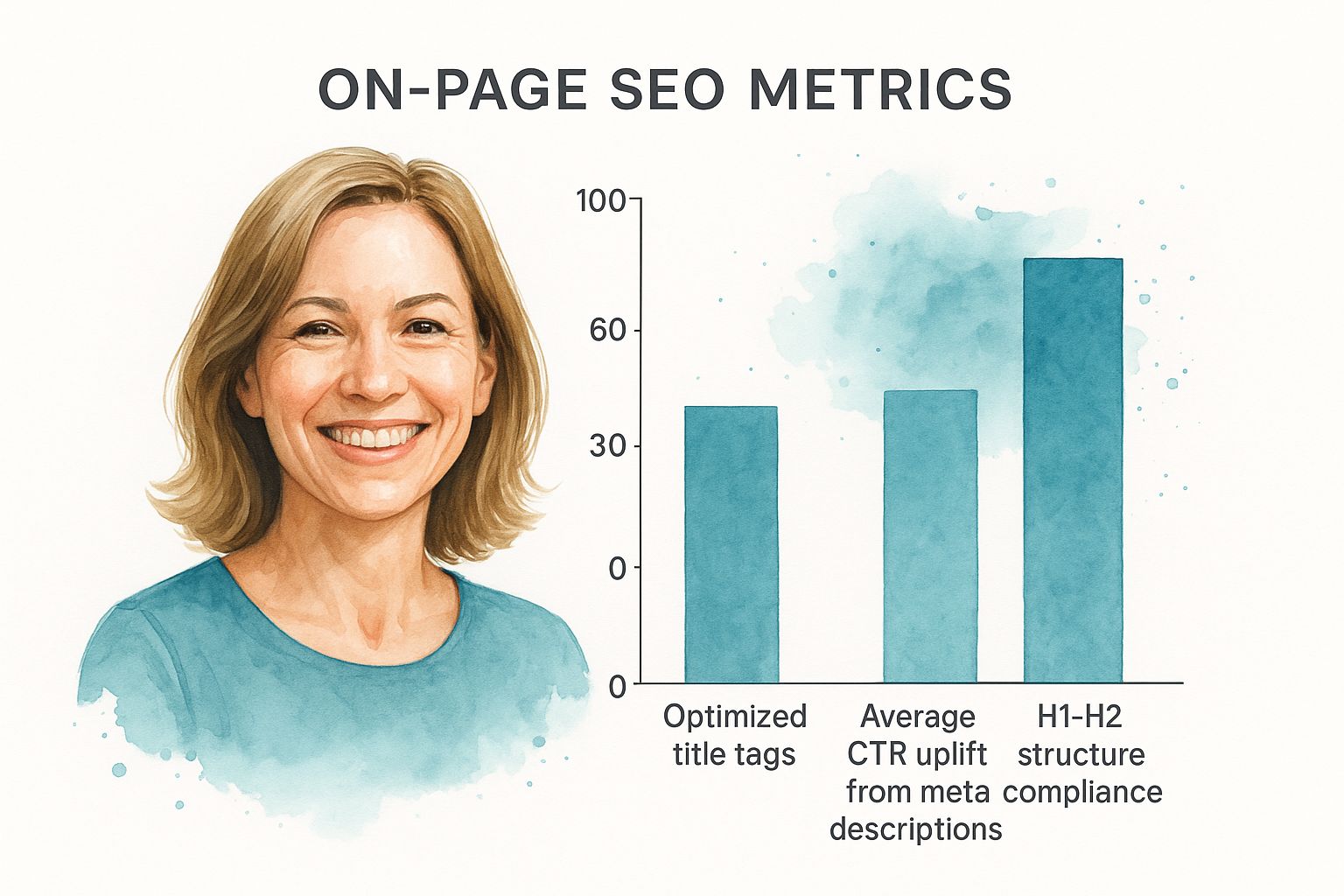
The image above highlights a common missed opportunity: while most sites get the basic structure of H1s and H2s right, they fail to fine-tune title tags and meta descriptions to perfectly match user intent, leaving valuable clicks on the table.
Building a Keyword Map That Drives Results
With a firm grasp of search intent, your next move is to organize your findings into a practical keyword map. This isn’t just a list of terms; it’s a strategic blueprint that connects specific keywords to specific pages on your website, ensuring every piece of content has a clear, conversion-focused purpose.
This framework translates different user needs into a concrete content strategy.
Keyword Intent Mapping Framework
| Search Intent Type | User Goal | Ideal Content Format | Business Objective |
|---|---|---|---|
| Informational | “I need to learn something.” | Blog posts, how-to guides, tutorials | Build authority, capture top-of-funnel traffic |
| Commercial | “I need help choosing.” | Comparison articles, product reviews, alternatives lists | Guide consideration, assist in decision-making |
| Transactional | “I’m ready to buy.” | Product pages, pricing pages, demo sign-ups | Drive conversions and direct sales |
A structured approach like this prevents “keyword cannibalization”—where multiple pages on your site accidentally compete for the same terms. More importantly, it creates a clear, logical path that guides a user from their first question all the way to a final purchase.
Creating Content That Consistently Ranks

With your strategic keyword map complete, it’s time to create the content that brings it to life. Let’s be blunt: high-quality content is the single most important vehicle for your entire SEO effort. It’s how you prove your expertise, solve real problems for your audience, and ultimately persuade search engines that you deserve a top ranking.
Simply churning out articles won’t work. The goal is to build an organized library of content that becomes a lasting asset—one that consistently attracts new visitors and cements your authority. This is how you shift from seeing random traffic spikes to building a predictable, sustainable stream of organic leads.
Adopting the Topic Cluster Model
One of the most powerful frameworks for structuring content is the topic cluster model. This approach organizes your content around a central, comprehensive “pillar” page covering a broad topic. This pillar page then links out to several “cluster” articles, each diving deep into a specific subtopic.
Practical Example: Imagine you run a digital marketing agency.
- Pillar Page: “The Ultimate Guide to Digital Marketing” – a broad overview covering all major channels.
- Cluster Articles: From that pillar, you would create and link to more focused articles like:
- “A Beginner’s Guide to SEO Fundamentals”
- “How to Build Your First Email Marketing Campaign”
- “A Step-by-Step Social Media Strategy for Small Businesses”
This model is a game-changer for two reasons. First, it creates a seamless user experience, allowing visitors to navigate from a general overview to the specific details they crave. Second, it builds a clean site architecture that signals topical expertise to Google, helping your entire cluster of pages rank better together.
Mastering Essential On-Page SEO Techniques
Once your content is written, you must nail the on-page fundamentals. These technical elements are direct signals that help search engines understand what your page is about and how relevant it is to a searcher’s query.
Your title tags and meta descriptions are your first—and sometimes only—chance to make an impression in the search results. They are the ad copy for your content. A well-written one can dramatically increase your click-through rate (CTR).
A great page title is clear, compelling, includes your primary keyword, and stays under 60 characters. While the meta description isn’t a direct ranking factor, it’s your opportunity to persuade someone to click your link instead of a competitor’s. To get a structured start on this, you can use a content marketing strategy template.
A powerful title tag and meta description can be the difference between a user scrolling past your result and clicking through to your site. This is your first and best chance to win their attention.
The importance of earning that click cannot be overstated. Data consistently shows the top-ranking result on Google earns an average click-through rate between 27% and 39%. Even more telling, just moving up a single position in the search results can boost your CTR by over 30%—proving just how valuable those top spots really are.
The Strategic Power of Internal Linking
Internal linking is simply the act of linking from one page on your website to another. It sounds basic, but it’s a profoundly effective SEO technique when done right. A thoughtful internal linking strategy helps search engines discover new content, understand the relationships between your pages, and spread authority across your entire site.
Think of it as weaving a web of connections that reinforces your expertise. Whenever you publish a new article, actively look for opportunities to link to other relevant pages on your site. For example, in an article about “email marketing best practices,” it’s a natural fit to link back to your “Ultimate Guide to Digital Marketing” pillar page.
Here are a few actionable tips for internal linking:
- Use Descriptive Anchor Text: Avoid generic phrases like “click here.” Instead, use anchor text that clearly describes the linked page, such as “our guide to SEO fundamentals.” This provides valuable context for both users and search engines.
- Link to Your Most Important Pages: Identify your high-priority “money” pages—your core service or product pages—and ensure you link to them from relevant blog posts. This channels authority where it matters most, helping them rank for competitive commercial terms.
- Create a Logical Flow: Your internal links should feel natural and genuinely helpful, guiding the reader toward more information and enriching their experience on your site.
Building a Strong Technical SEO Foundation
While great content and smart keyword research are crucial, they’re only half the story. If search engines can’t efficiently find, crawl, and understand your website, even the most brilliant content will go unnoticed. This is where technical SEO comes in—it’s the solid bedrock upon which all your other traffic-driving efforts are built.
Think of your website as a library. Your content is the collection of books, but technical SEO is the cataloging system, the clear signage, and the structural integrity of the building itself. Without it, visitors (and search engine crawlers) would get lost, frustrated, and leave before finding what they need.
Optimizing for Speed and Mobile Users
In today’s fast-paced digital world, a slow website is a dead website. Two of the most critical technical factors that Google scrutinizes are site speed and mobile-friendliness.
Site speed—how quickly your pages load—has a massive impact on user experience. A delay of just a few seconds can cause a shocking number of potential customers to abandon your site. Google quantifies this with metrics called Core Web Vitals. If your scores are poor, your rankings will suffer. It’s that simple.
Equally important is how your site performs on a phone. Google now operates on a mobile-first indexing model, which means it primarily evaluates your mobile site to determine your rankings. A clunky, slow, or hard-to-navigate mobile experience is a major red flag for Google, and it will hurt your visibility on all devices.
A fast, seamless experience isn’t just a bonus feature; it’s a fundamental expectation. If you’re going to focus your technical efforts anywhere, start with site speed and mobile optimization. The payoff is huge.
Conducting a Basic Technical Audit
You don’t need to be a developer to spot and fix common technical issues. Your most powerful ally is Google Search Console, a free tool that gives you a direct look at how Google sees your site. It is an absolute must-have.
Once set up, you can perform a quick health check by reviewing these key reports:
- Indexing Report: This shows you which pages Google has successfully added to its index and, more importantly, which ones it couldn’t. Check for errors that might be preventing your best content from appearing in search results.
- Core Web Vitals Report: Here, you’ll see a performance grade for your pages. It will flag any URLs that are “Poor” or “Need improvement,” giving you a clear to-do list for optimization.
- Mobile Usability Report: This report identifies pages with mobile-specific issues, like text that’s too small to read or buttons that are too close together. Fixing these is often straightforward and makes a big difference.
Getting into the habit of checking these reports monthly is a proactive way to catch technical issues before they do real damage to your organic traffic.
When you’re starting out, it’s easy to get overwhelmed. The key is to focus on what actually moves the needle. This priority checklist can help.
Technical SEO Priority Checklist
| Priority Level | Task | Impact on Organic Traffic | Tools to Use |
|---|---|---|---|
| High | Fix Core Web Vitals issues | High | Google Search Console, PageSpeed Insights |
| High | Ensure mobile-friendliness | High | Google Search Console, Mobile-Friendly Test |
| High | Submit an XML Sitemap | Medium to High | Google Search Console, Yoast SEO, Rank Math |
| Medium | Implement basic Schema markup (e.g., Article, FAQ) | Medium | Schema Markup Generator, Google Search Console |
| Medium | Find and fix broken links (404 errors) | Medium | Screaming Frog, Ahrefs |
| Low | Clean up URL parameters | Low | Google Search Console |
| Low | Optimize your robots.txt file | Low (unless misconfigured) | Google Search Console, any text editor |
Stick to the high-priority items first. They deliver the biggest return on your effort and build a solid foundation you can refine over time.
The Role of an XML Sitemap
An XML sitemap is a map of your website created specifically for search engines. It’s a simple file that lists all your important pages, making it much easier for crawlers to discover and index your content. While search engines can find pages by following links, a sitemap removes all guesswork and ensures they know about every single page you want them to see.
This official screenshot from Google’s documentation illustrates its clean, simple structure—it’s just a machine-readable list of your URLs.
Its function is to make Google’s job easier, which is always a good idea.
Submitting your sitemap through Google Search Console is a non-negotiable step. It tells Google, “Here is my complete library of content,” and can significantly speed up how quickly your new pages or recent updates get indexed.
Using Structured Data to Enhance Visibility
Structured data, commonly implemented with Schema markup, is code you add to your site to give search engines more explicit details about your content. It helps Google move beyond keywords to truly understand the context of your page.
For instance, with Schema, you can explicitly tell Google that a page contains:
- A recipe with ingredients and a 30-minute cook time.
- An article written by Jane Doe and published yesterday.
- A product that costs $49.99, has a 4.8-star rating, and is in stock.
- An FAQ section with specific questions and answers.
This extra context is what qualifies your pages for “rich results” in search—like the star ratings, review snippets, or FAQ dropdowns you see on the results page. These enhanced listings are more eye-catching, take up more screen real estate, and can dramatically boost your click-through rate. It’s a powerful way to make your existing rankings work harder for you.
Earning Authority with Strategic Link Building

While on-page and technical SEO set the stage, true authority in Google’s eyes is earned, not declared. This is where link building comes in. Think of every high-quality backlink as a vote of confidence from another reputable website, signaling to search engines that your content is credible, valuable, and trustworthy.
A strong backlink profile is one of the most powerful ranking factors, period. But this is a game of quality, not quantity. A single link from a well-respected industry journal is worth more than a hundred links from low-quality, spammy sites. The goal is to build a natural, authoritative link profile that not only improves your rankings but also sends referral traffic from audiences genuinely interested in what you do.
Guest Blogging on Authoritative Sites
One of the most time-tested methods for earning powerful backlinks is guest blogging. This isn’t about blasting articles across the web; it’s about strategically placing your best content on other respected websites in your niche.
Your target publications should meet these criteria:
- They have an established readership that mirrors your ideal customer profile.
- They are a trusted, authoritative voice in your industry.
- They maintain high editorial standards, so your content is in good company.
When you contribute a genuinely helpful article to a site like this, you gain more than just a link. You get brand exposure to a new audience and position yourself as an expert. The strategy is about building relationships and providing real value—the backlink is the natural byproduct. To get a better handle on the basics, explore this detailed overview of what a link building strategy is.
Create Link-Worthy Assets
Instead of constantly asking for links, a far more powerful strategy is to create content that people naturally want to link to. These “linkable assets” are built from the ground up to be valuable resources for your industry.
Pour your effort into creating content like this:
- Original Research and Data: Conduct your own surveys or analyze unique data. When you become the primary source for a key statistic—like “45% of small businesses struggle with SEO”—others will cite and link to you whenever they discuss that topic.
- In-Depth Guides and Tutorials: A truly definitive guide on a complex topic becomes the go-to resource that other writers will reference when they need to explain that subject to their audience.
- Free Tools and Calculators: A simple tool that solves a common problem (e.g., a “Marketing Budget Calculator”) can become a passive link-building machine, attracting backlinks for years to come.
This approach flips the script from outreach to attraction. When you create the absolute best resource on a given topic, the links tend to follow.
The most sustainable way to build links is to create something worth linking to. Focus on being a primary source of information, not just another voice commenting on it.
Analyze Your Competitors’ Backlinks
Want a ready-made roadmap for link-building opportunities? Look at where your top-ranking competitors are getting their best links. By analyzing their backlink profiles, you can identify the authoritative sites in your niche that are already linking to content just like yours.
Using an SEO tool, you can pull a list of every domain linking to a competitor’s high-performing page. Then, play detective to figure out why they earned that link.
- Did they publish a unique statistic?
- Were they featured in an expert roundup?
- Is their guide simply more comprehensive than anything else?
Once you understand the context, your mission is to create something even better—a resource that’s more current, more detailed, or offers a fresh perspective. Then, reach out to those same websites, introduce your superior asset, and show them why it would be a valuable addition for their readers. This method provides a proven, systematic way to find and earn high-quality links.
Common Questions About Increasing Organic Traffic
As you implement these strategies, a few key questions almost always come up. Let’s tackle the most common ones to provide clarity and set you on the right path.
How Long Does This SEO Stuff Actually Take?
This is the big one. The honest answer is: it depends, but it’s never instant. SEO is a long-term investment. While you might see some small wins within the first couple of months, you should plan for 4 to 12 months to see significant, lasting results.
Think of it like planting a tree, not flipping a switch. Several factors influence how quickly you see growth:
- Your Website’s Age and Authority: An established site with years of content has a head start. A brand-new domain is starting from scratch and needs time to build trust with search engines.
- The Competitive Landscape: Trying to rank for “personal injury lawyer” is a different ballgame than “artisan dog treats in Boise.” The more intense the competition, the longer the journey.
- Your Commitment: SEO rewards consistency. Regularly publishing great content, fixing technical issues, and building quality links will compound your results over time. Sporadic efforts simply don’t build momentum.
“SEO is a marathon, not a sprint. The strategies that deliver lasting organic growth are built on a foundation of consistent effort and a commitment to providing genuine value over many months, not just a few weeks.”
On-Page vs. Off-Page SEO: What’s the Difference?
Understanding this distinction is crucial because a successful strategy requires both. They are two sides of the same optimization coin.
On-page SEO is everything you do on your own website to improve its rankings. This includes the quality of your content, your title tags and headings, your internal linking strategy, and image alt text. It’s all about making your content clear, relevant, and easy for both users and search engines to understand.
Off-page SEO covers all the actions you take away from your website to build its authority. The biggest piece of this puzzle by far is link building—earning links from other reputable sites. Think of these backlinks as votes of confidence. The more high-quality “votes” you have, the more search engines view your site as a trustworthy authority.
You can’t have one without the other. Perfect on-page SEO won’t get you far without the authority from off-page signals, and tons of backlinks pointing to a messy, poorly optimized site is a waste of effort.
Should I Go After High-Volume or Long-Tail Keywords?
This is a classic strategy question, and the answer isn’t “one or the other.” A smart approach targets both, but for different purposes.
High-volume keywords (like “digital marketing”) attract a huge number of searches. They are tempting but also intensely competitive. These are best suited for your core homepage or main service pages.
Long-tail keywords are longer, more specific phrases (like “how to increase organic search traffic for a local business”). Each one gets fewer searches, but here’s the magic: they often have a much higher conversion rate because the searcher knows exactly what they want.
A great content strategy involves creating blog posts and guides that target dozens of these long-tail queries. While one article might not move the needle much, together they can drive a significant amount of highly qualified, ready-to-convert traffic to your site.
Why Is a Mobile-Friendly Website So Important?
A few years ago, a mobile-friendly site was a nice-to-have. Today, it is absolutely non-negotiable. Google uses mobile-first indexing, which means it primarily evaluates the mobile version of your site to determine its rankings for all devices.
If your site is clunky, slow, or hard to read on a phone, your rankings will suffer everywhere—not just on mobile searches.
This isn’t just about making things fit on a smaller screen; the overall user experience is paramount. Research from the U.S. National Institute of Standards and Technology confirms that usability is a core component of mobile effectiveness. A frustrating mobile experience is no longer just a nuisance for users; it’s a major liability for your SEO.
At Galant Studios, we specialize in building the strong foundations needed for sustainable organic growth. Our expert SEO and website optimization services are designed to enhance your visibility and drive real business results.
Discover how we can help you rank higher on Google.