
Your website’s structure is its digital blueprint. Get it right, and you create a clear path for search engines to find and rank your content. More importantly, you guide real people to the solutions they need, turning visitors into customers. This powerful synergy between site architecture and SEO isn’t just a technical detail—it’s the foundation of your online visibility.
Why Your Website’s Blueprint Determines SEO Success
Imagine walking into a massive hardware store with no signs, no aisles, and no staff. You’d get frustrated and leave, right? That’s exactly how search engines and users feel when they encounter a website with a chaotic structure. A poorly planned site makes it incredibly difficult for them to find, understand, and ultimately rank your valuable content.
A strategic architecture does more than just organize pages. It communicates your authority, clarifies how different pieces of content relate to each other, and creates a seamless journey for both Google’s crawlers and your future customers. To master this, you first need a solid grasp of what Search Engine Optimization (SEO) is and its core principles.
Get In Touch
The Core Goals of an SEO-Friendly Architecture
Think of your site structure less like a filing cabinet and more like a strategic part of your sales team. It works to achieve several critical goals that directly impact your bottom line:
- Boost Crawlability: It gives search engine bots a clear, efficient path to discover and index every important page, ensuring your content actually makes it into search results.
- Improve User Experience (UX): It helps people find what they need in just a few clicks. This keeps them on your site longer, reduces frustration, and sends powerful positive signals to Google.
- Distribute Page Authority: It strategically funnels “link equity”—the ranking power from strong pages like your homepage—down to specific product or service pages, giving them the authority they need to rank.
- Build Topical Authority: It groups related content into logical clusters, signaling to search engines that you are a definitive expert on a topic, worthy of a top spot.
Ultimately, these goals are two sides of the same coin. A website that is easy for a person to navigate is almost always easy for a search engine to crawl and reward.
A well-structured website isn’t just about pretty menus; it’s the backbone that tells search engines like Google exactly what your site is about and how pages connect.
The Impact of a Shallow Hierarchy
One of the most powerful and actionable principles in SEO is maintaining a “shallow” site structure. This simply means that no page should be more than a few clicks away from your homepage.
Why does this matter so much? A shallow hierarchy makes a search engine’s job dramatically easier. When crawlers can access your entire site quickly, it improves their efficiency, leading to faster and more complete indexing. For your visitors, it means your most valuable content—the pages that convert—isn’t buried deep within a complicated maze, but is always within easy reach.
Get In Touch
Establishing the Pillars of a Strong Site Structure
An effective site architecture rests on three core pillars. When they work in harmony, they create a seamless experience that satisfies both human visitors and search engine crawlers. Get these right, and you’ve built a powerful foundation for ranking. But if one pillar is weak, the entire structure falters.
The first and most crucial pillar is a logical hierarchy. Think of your website as a perfectly organized retail store. The homepage is the main entrance. From there, clear signs point to major departments (categories), and within those departments, well-labeled aisles (sub-categories) lead customers directly to the products they want (individual pages). This structure must be intuitive, shallow, and built around how your customers think.
This blueprint approach shows how a high-level plan breaks down into the nitty-gritty details of structure and crawlability that search engines depend on.
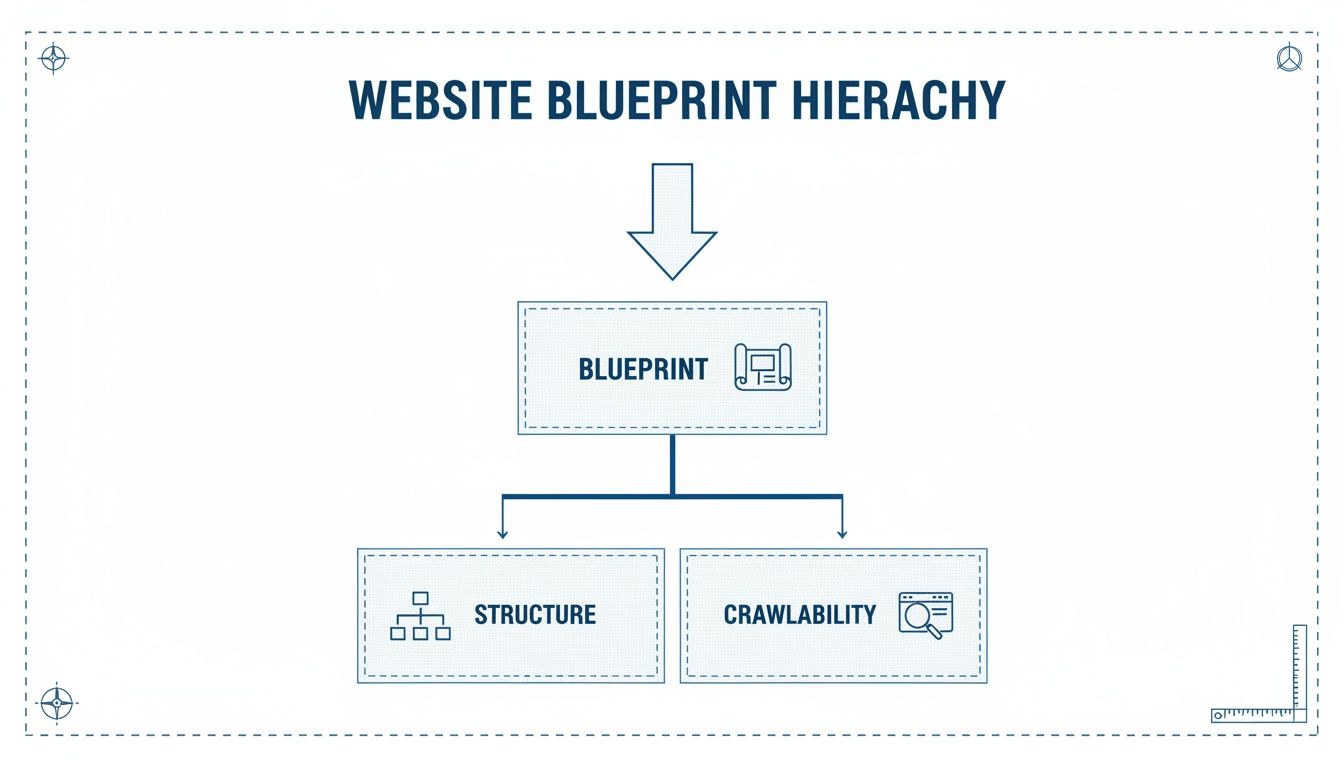
As the diagram suggests, a solid blueprint is the starting point. It directly informs a clear site structure, which in turn dictates how easily search engines can crawl and index your content.
The Rule of Three Clicks
A core principle guiding a shallow hierarchy is the famous “three-click rule.” The goal is simple: a user should be able to get from your homepage to any important page on your site in three clicks or less. This isn’t just a best practice; it has a real impact on your site architecture and SEO.
A shallow structure ensures search engine bots can find and index your pages without getting lost. If your best content is buried too deep, crawlers might give up, effectively making those pages invisible to search. For users, it means finding what they need quickly, which keeps them from getting frustrated and clicking the “back” button to a competitor’s site.
A shallow site architecture means that link authority flows from pages that tend to get lots of backlinks (like your homepage) to pages that you want to rank (like a product page).
Creating Clean URL Structures
The second pillar is building clean, descriptive URL structures. Your URLs are often the first impression you make. They act like signposts, giving both search engines and users a clear idea of what the page is about before they even click. A well-designed URL is short, readable, and includes relevant keywords.
Let’s look at a practical example for a page about commercial plumbing services:
- Poor URL:
https://yourcompany.com/index.php?category=4&page=112 - Good URL:
https://yourcompany.com/services/commercial-plumbing
The second one is instantly understandable. It mirrors the site’s hierarchy and reinforces the page’s topic—a clear win for SEO and user trust. Consistency is also key. All your URLs should follow a similar, predictable pattern. To understand the building blocks of a web address, it’s worth reviewing the basics of a Uniform Resource Locator (URL).
Designing Intuitive Navigation
Finally, the third pillar is intuitive navigation. This covers all the ways people move around your site—your main menu, footer links, breadcrumbs, and the internal links within your content. Your navigation is the roadmap you provide, guiding visitors toward their goals, whether that’s finding information, contacting you, or making a purchase.
Effective navigation is built from a few key components:
- Logical Menus: Your main navigation should feature your most important pages in an order that makes sense to your ideal customer. Use clear, simple language.
- Breadcrumb Trails: These helpful trails (e.g., Home > Services > Commercial Plumbing) show users exactly where they are, making it easy to backtrack without getting lost.
- Contextual Internal Links: Weaving links to other relevant pages into your content helps users discover more information and shows search engines how your content is thematically connected.
The following table breaks down how these three pillars directly influence your SEO performance.
Architectural Element Impact on SEO
| Architectural Pillar | Primary SEO Benefit | Secondary SEO Benefit |
|---|---|---|
| Logical Hierarchy | Improves crawl efficiency and indexation coverage. | Enhances PageRank flow from high-authority pages to deeper ones. |
| Clean URLs | Boosts keyword relevance signals and click-through rates from search results. | Makes URLs more shareable and easier for users to remember. |
| Intuitive Navigation | Reduces bounce rates and increases time on site. | Strengthens topical authority through contextual internal linking. |
By mastering these three pillars—hierarchy, URLs, and navigation—you’re not just organizing a website. You’re building a conversion-focused machine. This deliberate approach to site architecture and SEO goes beyond just ranking; it builds trust and usability, turning casual visitors into loyal customers.
Using Internal Links to Build Authority and Guide Users
If your site architecture is the blueprint, then internal links are the hallways and doorways connecting every room. They are the circulatory system that pushes authority and user attention from powerful pages—like your homepage—to the specific content you want to rank. This strategic linking serves a vital dual purpose for both site architecture and SEO.
First, internal links guide your visitors on a journey. When someone is reading a blog post about “The Benefits of Tankless Water Heaters,” a well-placed link to your “Tankless Water Heater Installation” service page is a natural next step. This creates a seamless path from information to action, keeping visitors engaged and moving them closer to a conversion.

Second, they are essential for distributing “link equity.” Your homepage naturally collects the most authority from external links. Through a smart internal linking strategy, you can channel that ranking power to important service or product pages, giving them the boost they need to compete in search results. Without these connections, your most important pages can become isolated islands, invisible to both users and crawlers.
Building Topical Authority with Pillar Pages
One of the most effective ways to leverage internal links is by creating “topic clusters.” The strategy is simple but powerful: create a central “pillar page” that offers a comprehensive overview of a major topic. This pillar then links out to several “cluster pages”—more detailed articles that explore specific subtopics.
For example, a law firm might create a pillar page titled “The Complete Guide to Estate Planning.”
- This pillar page would link out to cluster pages like “How to Create a Will,” “Understanding Living Trusts,” and “Choosing a Power of Attorney.”
- Crucially, each of these cluster pages links back to the main pillar page.
This creates a tightly-knit web of related content, signaling to search engines that you have deep expertise on the subject. This is how you establish topical authority. Websites that master this model are seen by Google as a comprehensive resource, earning them higher rankings and more qualified traffic.
Internal linking within a smart site architecture is like a roadmap for crawlers and users, distributing link equity to amplify rankings. Top sites wield this masterfully; while the average first-page Google result boasts hundreds of backlinks, strategic internal links can multiply that power significantly through equity flow.
Best Practices for Internal Linking
To get the most value from your internal linking, every link must be deliberate. Randomly scattering links won’t work.
A cornerstone of this practice is the use of descriptive anchor text—the clickable text in a hyperlink. Instead of generic phrases like “click here,” use text that accurately describes the destination page. For instance, linking with “explore our custom web design services” is far more powerful for both users and search engines than a vague “learn more.” You can see how this connects to your broader efforts by exploring our guide on what on-page SEO is.
Finally, it’s critical to fix “orphaned pages.” These are pages with no internal links pointing to them, making them nearly impossible for search engines to discover. Regular site audits will help you find these isolated pages so you can integrate them back into your site structure, ensuring every page has a chance to be indexed and contribute to your business goals.
Get In Touch
Integrating Speed and Mobile Design into Your Architecture
A modern site architecture is about more than just logical hierarchies and clean URLs. In an era where your customers are on their phones and expect instant results, speed and mobile-friendliness must be baked into your website’s foundation. They aren’t just features—they are fundamental pillars that directly impact user satisfaction and search rankings.
Think of your architecture as the highway system for your website’s data. A poorly designed system creates traffic jams, slowing everything down and frustrating visitors into leaving. That bounce tells search engines your site offers a poor experience. This is where technical performance becomes an inseparable part of site architecture and SEO.

The image above highlights the kind of metrics Google uses to measure a site’s health, drawing a straight line from your architectural choices to tangible performance scores.
Understanding Core Web Vitals
To quantify what “good user experience” means, Google introduced Core Web Vitals (CWV). These aren’t abstract technical terms; they are metrics that measure real-world user interactions and have become significant ranking factors.
- Largest Contentful Paint (LCP): How fast does your main content load? This measures perceived load speed, telling the user they’re in the right place quickly.
- Interaction to Next Paint (INP): How responsive is your page? INP measures the delay from a user’s click or tap to the moment the page visually responds.
- Cumulative Layout Shift (CLS): How stable is your page layout? This tracks how much content unexpectedly jumps around as it loads—a major source of frustration when a user tries to click a button and it moves at the last second.
Your architectural decisions—how you structure code, load resources, and handle media—directly influence these scores. A high-performing site architecture is one that is deliberately designed to excel in these three areas.
Page speed is a ranking powerhouse, deeply connected to Core Web Vitals. Consider that 63.31% of global traffic now comes from mobile devices, and a staggering 53% of users will abandon a site if it takes longer than three seconds to load. Performance is simply non-negotiable. It’s no surprise that the average load time for a first-page Google result is just 1.65 seconds.
Designing for a Mobile-First World
Google now operates on mobile-first indexing. This means it primarily uses the mobile version of your site for indexing and ranking. Your desktop site is now secondary.
This fundamental shift demands that mobile design be an architectural priority from day one. The most effective strategy is responsive design, where your website’s layout fluidly adapts to fit any screen size, from a large monitor to a small smartphone.
This approach ensures a consistent and positive experience for every visitor, regardless of their device. From an architectural standpoint, it means building one flexible site instead of trying to maintain separate, resource-intensive versions for mobile and desktop.
Beyond layout, website speed is heavily influenced by media files. Learning how to optimize images for SEO can help ensure your visuals enhance performance rather than drag it down.
To build a genuinely fast, mobile-friendly architecture, integrate key practices from the start. You can explore a full range of website performance optimization techniques in our detailed guide, but core strategies include leveraging browser caching and minifying code to shrink file sizes. These structural optimizations work together to create a seamless experience that keeps users happy and signals quality to search engines.
Get In Touch
Avoiding Common Architectural Mistakes That Hurt SEO
Even with the best intentions, it’s easy to build a website with architectural flaws that sabotage your SEO efforts. These mistakes can make your best content invisible to search engines, create a frustrating user experience, and dilute your site’s authority, costing you leads and sales.
Think of a flawed site architecture as a maze with dead ends and confusing signs. It stops search engine crawlers in their tracks and makes it nearly impossible for users to find what they’re looking for. The good news is that identifying and fixing these problems is one of the most powerful things you can do for your site’s visibility.
The Problem of Orphaned Pages
One of the most damaging yet common pitfalls is the orphaned page. These are pages with zero internal links pointing to them. If there’s no path leading to a page, crawlers can’t find it. To a search engine, that page effectively doesn’t exist.
This often happens by accident. A new service page is created or a blog post goes live, but no one remembers to link to it from the main navigation, a category page, or another relevant article. The solution is to run regular site audits to find these isolated pages and weave them back into your site’s fabric with relevant, contextual links.
Overly Complex and Deep Navigation
Another classic mistake is an architecture that’s too deep or complex. This happens when your most important content—like a key service or product page—is buried four, five, or even more clicks from the homepage. It’s a guaranteed way to frustrate users and harm your SEO.
A deep architecture starves your most important pages of authority. Link equity flows down from powerful pages like your homepage, and the further away a page is, the less of that authority it receives, making it significantly harder to rank.
The fix is to flatten your architecture. Strive to make every important page accessible within three clicks of the homepage. This often means rethinking your main navigation, building out better category pages, and giving your key content the prominent placement it deserves.
Inconsistent URL Structures and Duplicate Content
An inconsistent URL structure often creates massive duplicate content problems. This issue arises when the same piece of content is accessible via several different URLs.
For instance, the same service page might be accessible through all of these addresses:
yourwebsite.com/services/cleaningyourwebsite.com/cleaning-services/mainyourwebsite.com/services?id=cleaning
To a search engine, these look like three separate pages with identical content. This confusion splits your ranking signals and can cause your own pages to compete against one another in search results—a problem known as keyword cannibalization.
The solution is to define a clean, logical URL pattern and stick to it. For existing duplicates, use canonical tags to tell search engines which URL is the “master” version you want indexed. This process of URL canonicalization consolidates your authority and brings much-needed clarity to your site structure.
How to Audit and Improve Your Site Architecture
Fixing your site architecture isn’t a one-time project; it’s a continuous process of refinement. The best way to begin is with a structured audit. This gives you a clear roadmap of what’s working, what’s broken, and where to focus your energy for the biggest impact on both site architecture and SEO.
A great first step is to visualize your current setup. Many SEO tools can generate a visual sitemap, revealing how your pages connect. This overview can be an eye-opener, instantly flagging problems like important pages buried too deep or illogical category structures that confuse users.
Starting Your Audit Process
Every good audit starts with discovery. You need to see your website exactly as a search engine does. This means running a comprehensive crawl to uncover every single URL, including those you’ve long forgotten. This process will almost certainly reveal technical errors that are quietly undermining your architecture.
Start by hunting for the highest-priority issues that kill conversions and rankings:
- Broken Internal Links: These create dead ends for users and crawlers, stopping the flow of link equity and frustrating potential customers.
- Orphaned Pages: Pages with no internal links are invisible. Your valuable content can’t be found, indexed, or ranked.
- Redirect Chains: When one redirect points to another, and then another, it slows down page loading and weakens the authority passed from the original link.
Fixing these technical issues is job number one. A clean, error-free site provides a solid foundation to build upon. This phase is a non-negotiable part of any professional SEO audit process, ensuring your site is technically sound before you make bigger strategic changes.
Implementing Phased Improvements
Once the technical cleanup is done, shift your focus to strategic improvements. It’s tempting to overhaul everything at once, but that approach is often risky. A smarter method is to work in phases, starting with changes that will deliver the most significant results quickly.
Improving site architecture is an iterative process. Focus on making incremental, data-driven changes rather than a complete overhaul. Consistent refinement is more effective and sustainable than a single, massive project.
A logical next step is your primary navigation and URL structure. Is your main menu easy to understand? Does it guide users to your most important categories? Your URLs should be just as clear—clean, descriptive, and consistent. For an e-commerce store, this might involve reorganizing product categories to better match how customers actually search and shop.
Finally, turn your attention to internal linking. Pinpoint your most authoritative pages, like your homepage or major content hubs. From there, ensure you are strategically linking out to the key product or service pages you want to rank higher. This deliberate distribution of authority transforms a random collection of pages into a powerful, interconnected web that search engines understand and reward.
Common Questions About Site Architecture and SEO
Even with a good grasp of the theory, putting it all into practice can bring up some tricky questions. Let’s tackle a few of the most common ones that come up when bridging the gap between site architecture and SEO.
How Many Clicks Deep Should a Page Be?
As a rule of thumb, your most important pages should be no more than three clicks from the homepage. This is the classic “three-click rule.” A shallow structure makes it incredibly easy for search engine crawlers to discover and index your content. More importantly, it helps users find what they’re looking for before they get frustrated and leave.
While this is a strong guideline, it’s not an unbreakable law. If a very specific, niche page logically falls four clicks deep within a perfectly organized category, that’s often fine. The real goal is to avoid burying your valuable, conversion-focused content so deep that both people and search engines give up before they find it.
Does URL Structure Really Matter for SEO?
Absolutely. While it may be a smaller piece of the puzzle, your URL structure is a confirmed ranking factor. A clean, descriptive URL gives both search engines and users a quick, clear signal about what the page contains. It reinforces your target keywords and can even boost your click-through rate from search results simply because users can see the link is relevant to their search.
Consider the difference:
- Poor:
yourwebsite.com/p?id=481 - Good:
yourwebsite.com/services/roof-repair
The second one is instantly understandable and builds trust. It provides context right away. For a deeper dive into the technical side, you can explore the standard components of a Uniform Resource Locator (URL).
What Is the Difference Between Site Architecture and Navigation?
It’s helpful to think of site architecture as the complete blueprint for your website. It’s the entire logical framework—the hierarchy of all your pages and how they’re organized into categories and subcategories behind the scenes.
Navigation, on the other hand, is how your visitors interact with that blueprint. It’s the user-facing elements like your main menu, breadcrumb trails, footer links, and sidebars. Your navigation is the collection of signposts that guides people through the structure you’ve created. While they are two separate concepts, they are completely dependent on each other; a logical architecture is what allows you to design a clear and effective navigation system.
At Galant Studios, we know that a powerful online presence is built on a solid foundation. Our team specializes in designing SEO-friendly site architectures that drive traffic, keep users engaged, and ultimately, grow your business. If you’re ready to build a website that performs as well as it looks, let’s connect.