
Choosing a web design agency is a critical investment, not just a line item on your budget. To find the right partner, you have to look past the pretty mockups. You need a team that understands your business, digs into SEO, scrutinizes their portfolio for real-world results, and aligns their vision of success with yours.
Think of it this way: a great website isn't just a digital brochure; it’s your best employee—a 24/7 salesperson, lead generator, and brand ambassador, all rolled into one. Your job is to hire the right team to build it.
Why Your Web Design Agency Is a Growth Partner, Not a Vendor

Here’s a common—and costly—mistake many businesses make: treating their web agency like a vendor. A vendor gets a task, completes it, and sends an invoice. A true growth partner, on the other hand, is invested in your long-term success. They understand the website isn't the finish line; it's the engine that drives your business forward.
This distinction is everything. A vendor builds a site that looks impressive, but a partner delivers one that converts visitors into customers. They accomplish this by weaving critical growth elements into the fabric of the project from day one.
These aren't just add-ons; they are core components:
- Search Engine Optimization (SEO): This is how your ideal customers find you on Google in the first place. A partner builds the site so it’s ready to rank from day one.
- User Experience (UX) Design: This makes your site easy and enjoyable to use, guiding visitors toward the actions you want them to take, like filling out a form or making a purchase.
- Conversion Rate Optimization (CRO): This is the science of turning your website traffic into measurable leads and sales.
- Performance Analytics: This involves tracking what’s working (and what isn’t) to make data-driven improvements over time.
Without these, even the most visually stunning website is little more than an expensive digital brochure. It might win awards, but it won’t grow your bottom line. You need a partner who measures their success by your metrics: leads, sales, and revenue growth. To better understand one of these key areas, our guide explains in detail what is user experience design.
Navigating a Crowded and Complex Industry
The first step in picking the right agency is realizing just how massive this industry is. In the United States alone, web design services are on track to become a $47.4 billion industry by 2025.
There are over 203,000 businesses offering these services, which makes the market incredibly saturated. This is why it’s so important to find a specialized, high-value provider instead of settling for a generalist. For a startup or small business where every dollar has a job to do, making the wrong choice isn't just a setback—it's a significant wasted investment.
Your website is your most powerful asset for attracting, engaging, and converting customers. Choosing an agency is not an expense; it is an investment in the primary tool that will drive your business forward.
Ultimately, you’re looking for a team that feels like an extension of your own. They should bring strategic ideas to the table, challenge your assumptions when necessary, and be fully accountable for the results their work delivers. This guide will give you a clear framework for finding that perfect partner.
Defining Your Project Goals and Scope
Before you contact a single web design agency, you must get crystal clear on what you want to accomplish. Approaching an agency without a solid plan is like asking a builder to construct a house without blueprints—you’ll get confused looks, vague proposals, and wildly inaccurate quotes. A well-defined project scope is your single most important asset in these early stages.
This prep work also helps you sidestep a notorious project-killer known as scope creep. This is where small requests and "can we just add…" moments balloon into major changes, blowing your budget and timeline. It’s a huge problem—the Project Management Institute found that it impacts over 52% of all projects. A clear brief is your anchor, keeping you and your future agency partner focused on the original vision.
Identify Your Primary Business Objective
First, answer this question: what is the single most important thing this new website must accomplish for my business? Vague goals like "improving our online presence" won't cut it. You need something specific and measurable.
Imagine it's six months after your new site goes live. What does success look like?
- Example 1 (Lead Generation): "Generate 50 qualified leads per month for our sales team through the contact form."
- Example 2 (E-commerce): "Achieve $10,000 in monthly online sales with an average order value of $75."
- Example 3 (Efficiency): "Reduce customer support tickets by 20% by creating a comprehensive, searchable knowledge base."
- Example 4 (Authority Building): "Attract 5,000 monthly visitors to our blog to establish our brand as an industry thought leader."
Nailing down one primary objective brings incredible clarity. It tells an agency what truly matters and ensures every decision—from the color palette to the code—is made with a clear business purpose in mind.
Define Your Ideal Customer and Their Journey
Here's a hard truth: your website isn't for you. It's for your customers. To build something effective, you must get inside their heads. Start by sketching out a simple user persona that covers their demographics, pain points, and what motivates them to act.
Practical Example: A local accounting firm targets small business owners who are stressed about taxes and short on time. Their website needs to speak directly to that pain point. The journey should be seamless: a clear "Services" page, transparent pricing, and a simple "Book a Consultation" form. The entire experience should be engineered to guide a frantic business owner from worried visitor to relieved client in as few clicks as possible.
A website must be a conversion-focused sales tool. If it only serves as a digital brochure, it fails to perform its most critical function: driving revenue and supporting business growth.
List Your Essential Website Features
Now that you know your main goal and who you're talking to, you can map out the core functionality your site needs. This isn't a wish list of every cool feature you've ever seen. Stick to the essentials required to hit your primary objective.
Your must-have list might include:
- E-commerce Functionality: A complete system for selling products, including secure payment gateways and inventory management.
- Integrated Blog or Resources Section: A home for content that attracts search traffic and positions you as an expert.
- Appointment Booking System: An integrated calendar that lets clients book a time to talk without a single phone call.
- Client Portal: A secure, members-only area where clients can log in to view project updates or access files.
This list gives agencies a technical roadmap to work from. For any business owner serious about turning website visitors into actual customers, it pays to dig deeper into the specific strategies that make this happen; our guide on conversion rate optimization tips is a great place to start.
By doing this foundational work, you turn a vague idea into a tangible project brief. It ensures that every agency you talk to is on the same page and knows exactly what you need to win.
How to Analyze an Agency Portfolio for Real Results
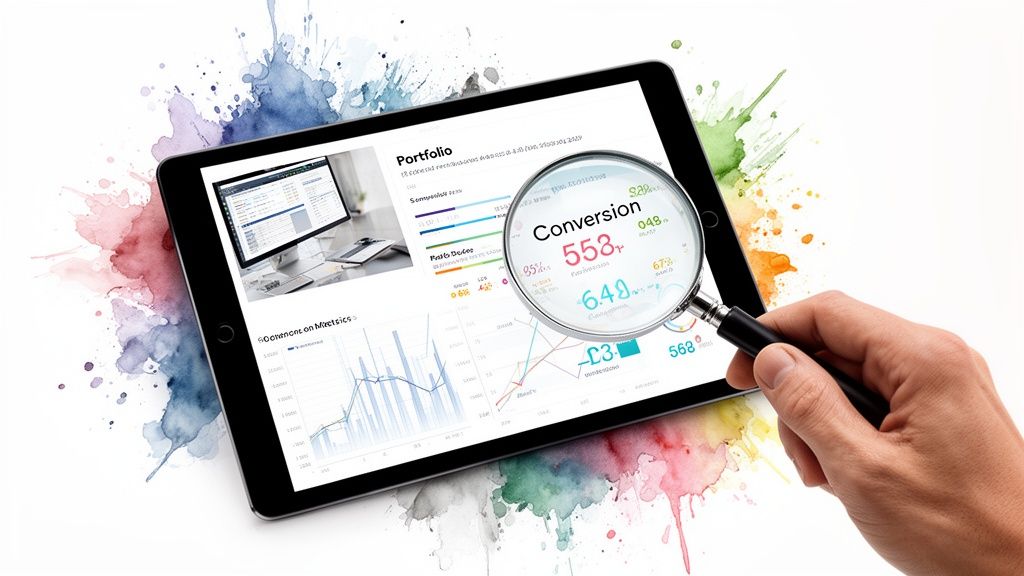
An agency's portfolio is their calling card. It's the most direct evidence you'll get of their skill, but a gallery of pretty websites just doesn't cut it. To truly evaluate a potential partner, you have to look beyond the surface and hunt for proof of actual business impact.
Many portfolios are built to dazzle you with slick visuals. Your job, however, is to find a team that builds high-performing business assets, not just digital art. This means you need to dig deeper, focusing on functionality, performance, and measurable results.
Moving Beyond Pretty Pictures
When you first land on an agency’s portfolio, resist the urge to judge based on looks alone. The real test begins when you open a few of their client websites in a new tab and put them through their paces.
Start by checking the core performance metrics that directly impact user experience and revenue. According to KissMetrics, a staggering 40% of users will abandon a website if it takes more than three seconds to load. Speed isn't a luxury; it's a necessity.
Actionable Checklist:
- Page Speed: How fast do their client sites actually load? Use a free tool like Google’s PageSpeed Insights to get an objective score. A score below 70 is a warning sign.
- Mobile Responsiveness: Resize your browser window or, even better, pull up the site on your phone. Does the design adapt seamlessly, or does it become a usability nightmare?
- Navigation Clarity: Can you tell what the business does within five seconds? Is it easy to find crucial information like services, contact forms, or pricing?
This initial audit quickly separates agencies that prioritize a great user experience from those just focused on aesthetics. If their other clients have slow, clunky websites, you can bet yours will be, too. To get a better handle on these fundamentals, check out our guide on web design best practices.
Scrutinizing Case Studies for Proof of Performance
Live websites show technical ability, but case studies reveal an agency’s strategic mind at work. A great case study isn’t just a project summary; it's a story of a business problem solved, backed by hard data.
Be on the lookout for agencies that are transparent about their results. Vague claims like "increased brand awareness" or "improved user engagement" are major red flags. You're looking for concrete metrics that prove their design work led to real business growth.
A portfolio without data is just an art gallery. Look for case studies that explicitly detail the challenge, the agency's solution, and the measurable results achieved, such as traffic growth, lead generation, or conversion rate improvements.
An agency that delivers genuine results will be eager to share the numbers. Look for proof points like:
- "Redesigned the checkout process, resulting in a 20% improvement in e-commerce conversion rates."
- "Launched a new SEO-focused content hub, leading to a 35% increase in organic traffic in the first quarter."
- "Implemented a new 'Request a Quote' form that generated 50% more qualified leads per month."
If their portfolio is full of beautiful designs but completely devoid of performance data, you have to ask yourself why. Are they unable to produce results, or just unwilling to share them? Neither is a good sign for a business owner looking for a growth partner.
Evaluating Expertise in Modern Technologies
The digital world moves fast, and your agency needs to be keeping pace. A modern portfolio should show a clear understanding of current and emerging trends that are vital for business success, especially AI integration and advanced SEO.
Industry data shows a clear shift here. From 2023 to 2025, digital agencies saw AI-related services jump from 10% to 17% of their total business. This tells us the market is moving toward more tech-savvy providers. And with over 70% of designers now reporting that AI speeds up their prototyping, agencies using these tools can give you a serious competitive advantage.
When you're choosing a web design agency, make sure they're not just building a website for today. Prioritize those who strategically integrate SEO and AI-driven design to ensure your business stays competitive for years to come. For more on this, the 2025 Digital Agency Industry Report offers some great insights.
Decoding Proposals, Contracts, and Pricing Models

This is where the rubber meets the road. Getting a handle on the financial side of a web design project is absolutely critical. A solid proposal and a transparent contract aren't just formalities; they are the foundation of a good working relationship. They protect your investment and, most importantly, prevent nasty surprises later on.
When a proposal lands in your inbox, it needs to be more than just a number. Think of it as the architectural blueprint for your project. Vague language or a simple price tag without detail is a major red flag.
This document should be your single source of truth, setting clear expectations from the very beginning. And if an agency is hesitant to provide a formal contract? That’s an immediate deal-breaker. Walk away.
Understanding Common Pricing Models
Web design agencies generally price their work in one of three ways. Understanding the pros and cons of each will help you pick the model that best fits your project scope and budget.
You'll almost always see one of these structures:
- Fixed-Price Project: This is as straightforward as it gets. The agency quotes a single, all-in price for a very clearly defined scope of work. It’s great for budget predictability, but can feel rigid if you need to pivot or add features mid-stream.
- Hourly Rate (Time and Materials): Here, you pay for the actual hours the team puts into your project. This offers fantastic flexibility for complex or evolving projects, but it can also lead to unpredictable costs if the scope isn't tightly managed.
- Monthly Retainer: This model is perfect for long-term partnerships involving ongoing work like SEO, content creation, or continuous site improvements. You pay a set fee each month for a predefined block of hours or a specific list of services.
So, which is right for you? A standard business website with a fixed set of features is a great candidate for a fixed-price agreement. A more ambitious, multi-phase platform might be better suited to an hourly rate. For a more detailed breakdown, this guide on understanding how consulting services are priced is a great resource.
Anatomy of a Strong Proposal and Contract
A great proposal does more than just list services—it tells a story. It should clearly show that the agency listened to your needs, understands your business goals, and has a strategic plan to get you there.
The contract then takes all those details and makes them legally binding. You'll want to scan this document for specific language on every key aspect of the project. This is your chance to prevent future misunderstandings.
A detailed contract is your best defense against scope creep and unexpected bills. If it's not in writing, it wasn't agreed upon. Make sure every deliverable, timeline, and payment milestone is spelled out.
A solid proposal and the contract that follows must include:
- A Detailed Scope of Work: This section should leave zero room for ambiguity. It needs to list every single deliverable, from the exact number of pages they’ll design to specific functionalities like e-commerce or a booking system.
- Project Milestones and Timelines: A clear schedule with firm dates for key deliverables (like wireframe approval, design completion, and development handoff) is non-negotiable. It’s how you hold everyone accountable.
- Clear Payment Schedule: This should break down the total cost into scheduled payments tied to project milestones. A common structure is a 50% deposit to start, with subsequent payments due as major phases are completed.
- Terms for Revisions and Feedback: The contract must state how many rounds of revisions are included at each stage. This simple clause prevents the project from getting stuck in an endless loop of minor tweaks, which can kill your budget and timeline.
- Ownership and Intellectual Property: This is critical. The contract must explicitly state that you—the client—will own 100% of the final work product once the final payment is made. This is a standard work for hire clause.
- Post-Launch Support and Maintenance: What happens after your site goes live? The contract should define if the agency offers a warranty period for bug fixes and outline the terms for any ongoing support or maintenance plans. Getting this clarity upfront saves major headaches down the line.
Web Design Agency Red Flag Detector
To help you spot potential trouble early on, here is a quick-reference table. Think of this as your early warning system during the vetting process.
| Red Flag | What It Looks Like | Potential Risk |
|---|---|---|
| Vague Proposals | A one-page quote with a single price and no breakdown of services. | Scope creep, unexpected costs, and a final product that doesn't meet your needs. |
| No Formal Contract | The agency wants to work on a handshake deal or an informal email agreement. | You have no legal protection if things go wrong. High risk of disputes over payment or deliverables. |
| Refusal to Share Client References | They claim client confidentiality or simply don't have any references to provide. | The agency may have a poor track record or lack of real-world experience. |
| Unrealistic Promises | Guarantees of "#1 ranking on Google in 30 days" or similar over-the-top claims. | They are likely using unethical "black-hat" SEO tactics that could get your site penalized by Google. |
| High-Pressure Sales Tactics | Creating false urgency with "limited-time offers" that expire in 24 hours. | They are more focused on closing the deal than on being the right partner for your business. |
| Lack of a Clear Process | They can't clearly explain their process for discovery, design, development, and launch. | Disorganized project management, missed deadlines, and a chaotic, stressful experience for you. |
Keep this table handy during your conversations. Catching these red flags early can save you an incredible amount of time, money, and frustration. If something feels off, it probably is. Trust your gut and don't be afraid to ask the tough questions.
Asking the Right Questions to Find the Best Fit
You've done the research and narrowed down your list. Now comes the most critical part: the initial conversations. This is your chance to look past the slick portfolio and polished sales pitch to see how an agency really operates.
Getting this right means asking strategic questions that go beyond the surface. Generic questions get you rehearsed answers. The goal here is to spark a real conversation that tells you if they're a good fit for your company, both culturally and operationally. A solid partnership is built on clear communication and aligned expectations, right from this very first meeting.
Understanding Their Process and Workflow
A disorganized agency is a recipe for a chaotic project. You need to find a partner with a structured, transparent process that keeps you in the loop and the project on track. Asking about their workflow isn’t about micromanaging; it’s about confirming they have a reliable system for delivering great work on time and on budget.
A good place to start is simply asking them to walk you through a typical project, from the initial kickoff meeting to the final launch.
Listen for details about:
- Project Management: How do they keep everything organized? Ask which tools they use, like Asana, Trello, or Basecamp, and whether you'll have access to see progress.
- Key Milestones: What are the major phases of their projects? Look for stages like discovery, wireframing, design, development, and testing. How do they handle client feedback and approvals at each stage?
- Your Point of Contact: Who will you be talking to day-to-day? Knowing if you'll have a dedicated project manager or if you'll be speaking directly with designers and developers is crucial for smooth communication.
Their answers should give you confidence that they run a tight ship, not a team just winging it. A well-defined process is one of the clearest signs of a professional and experienced agency.
Vague answers about process are a huge red flag. A seasoned agency will have a proven workflow they're proud to share. If they can't explain it clearly, it probably means they don't have one.
Probing Their Technical and Strategic Expertise
A beautiful website that no one can find or that doesn't work properly is a waste of money. Your questions need to dig into their strategy for performance, search visibility, and accessibility. These aren't just nice-to-haves; they're essential for any serious business website.
In fact, more than 60% of clients have fired or considered firing their agency due to poor practices that often come from a lack of strategic thinking. You need to make sure your potential partner is focused on your business goals, not just pretty pictures.
Here are a few questions to help you gauge their technical and strategic depth:
- SEO Integration: "How do you build SEO into the project from the very beginning? Can you give me an example of how you'd approach keyword research and site architecture for a business like mine?"
- Performance and Speed: "What is your strategy for ensuring the website loads in under three seconds? What specific techniques do you use for image optimization and code minification?"
- Accessibility Standards: "Are you familiar with the Web Content Accessibility Guidelines (WCAG)? How do you ensure the sites you build can be used by people with disabilities?" This is not only the right thing to do but also a legal requirement under laws like the Americans with Disabilities Act (ADA). You can learn more from the official Web Accessibility Initiative (WAI).
Their responses will quickly separate the agencies that build high-performing business assets from those that just design digital brochures.
Clarifying Post-Launch Support and Partnership
Launching the website isn't the end of the project. In many ways, it's just the beginning. A critical part of choosing the right agency is understanding what happens after your site goes live. You need to know how they’ll handle maintenance, support, and any issues that pop up down the road.
Without a clear post-launch plan, you could be left with a website you can't update and no one to call when things go wrong.
Make sure to get clear answers on their post-launch framework:
- Training and Handover: "Do you provide training on how to use the content management system (CMS)? Will my team be able to make basic text and image updates on our own?"
- Warranty Period: "Do you offer a warranty period after launch to fix any bugs or technical glitches? How long does it last?" A 30- to 90-day warranty is a standard sign of an agency that stands by its work.
- Ongoing Maintenance: "What do your ongoing support plans look like? Can you detail what they include (like software updates, security monitoring, backups) and what they cost?"
A great agency sees the launch as a milestone, not a finish line. They'll have clear, structured options for ongoing support to protect your investment and keep your website secure and running smoothly for years to come.
You've done the hard work. After all the research, portfolio deep-dives, and interviews, you're finally at the finish line. It can feel a little overwhelming to make that final call, but you've already done everything needed to choose the right partner with confidence.
Remember, this isn't just about finding the cheapest quote. It’s about investing in the agency that delivers the best long-term value for your business.
A Framework for Your Final Decision
To avoid getting swayed by a slick sales pitch or just gut feeling, it helps to put your top two or three contenders through one last objective review. A simple scoring system can cut through the noise and highlight the agency that’s truly the best fit.
Here’s what I recommend focusing on:
- Real Strategic Insight: Did they just talk about pretty designs, or did they genuinely grasp your business goals? The best agencies will be focused on how the website will generate leads, sales, and revenue for you.
- Communication & Vibe: Think back on your interactions. Were they responsive, clear, and easy to talk to? If communication was a struggle during the sales process, don't expect it to magically improve once the project starts.
- Proof in the Pudding: Go back to their portfolio one last time. Which agency had the most convincing proof of actual results? Look for hard numbers—things like traffic increases, better conversion rates, or more qualified leads for businesses like yours.
- Team & Culture Fit: Could you see yourself working with these people for the next few months? A good cultural fit makes for a smoother, more collaborative, and frankly, more enjoyable project.
Choosing a web design agency is about more than just a website; you're choosing a partner to build your single most important marketing asset. Strategic alignment and proven performance should carry just as much weight as the price tag.
From Contract to Kickoff
Once you've made your decision and given the agency the good news, things start moving quickly. This initial "onboarding" phase is critical because it sets the tone for the entire relationship. A great start builds momentum and makes sure everyone is on the same page.
First up, you’ll handle the paperwork. You’ll be sent the final contract (which you've already reviewed) to sign. Alongside this, you'll typically be asked to pay the initial deposit, which is often 50% of the total project cost. This payment secures your spot in their production schedule and officially gets the ball rolling.
With the formalities out of the way, the agency will schedule the official kickoff meeting. This is a big milestone—it’s the first real working session and it’s absolutely essential. Here, you’ll meet the entire team assigned to your project, from the project manager to the designers and developers who will bring your vision to life. The agenda will be packed: diving deep into your goals, confirming project timelines, and setting up the communication plan for the weeks ahead.
A well-organized kickoff meeting is a fantastic sign. It shows the agency is prepared and ensures everyone leaves aligned, energized, and ready to build something great together.
Common Questions Answered
Making a big decision like hiring a web design agency always comes with a lot of questions. Let's tackle some of the most common ones that come up as business owners go through this process.
What's a Realistic Budget for a New Website?
This is the big question, isn't it? The truth is, website costs are all over the map. They really depend on what you need—the complexity, the specific features, and the experience level of the team you hire.
For a solid, professionally built informational website for a local business, you're likely looking at a range of $5,000 to $15,000. If you're venturing into e-commerce with custom functionality, that number can quickly climb past $30,000.
A word of caution: if you get a quote that seems too good to be true, it probably is. Super-low prices can be a red flag for inexperienced designers or a sign that you'll be hit with unexpected costs down the road. Focus on the value and the potential return on your investment, not just the initial price.
How Long Will It Take to Build the Website?
The timeline is completely tied to the scope of work. For a standard small business site, a good rule of thumb is anywhere from 8 to 16 weeks. That's from the first kickoff call to the day you go live.
This timeframe accounts for all the critical stages: discovery and strategy, design mockups, the actual development and coding, plugging in all your content, and thorough testing.
What can slow things down?
- Delays from your side in providing content or feedback.
- Tricky integrations with other software you use.
- Requesting more revisions than what was originally agreed upon.
From my experience, the number one reason projects get delayed is slow feedback and communication gaps. A website build is a partnership; it needs active involvement from both you and the agency to keep the project moving forward.
What Happens After We Launch?
A great agency doesn't just hand over the keys and disappear. Their job isn't done the moment the site goes live. Any reputable firm will include a post-launch warranty, usually for 30 to 90 days, to iron out any bugs or technical glitches that pop up. Make sure this is spelled out clearly in your contract.
Once that warranty period is over, you'll want to think about ongoing care. Most agencies offer maintenance and support plans to handle the important stuff like software updates, security scans, and performance monitoring. This is how you protect your investment and make sure it keeps working for you long-term.
Ready to build a website that drives real business growth? Galant Studios combines expert SEO with stunning design to create high-performing websites that attract, engage, and convert your ideal customers. Start Your Project Today.