Driving traffic to your website is only half the battle. The real challenge, and where true growth lies, is converting those visitors into customers, subscribers, or leads. This is the core of Conversion Rate Optimization (CRO), a data-driven process of systematically enhancing your site to maximize the percentage of visitors who take a desired action. A high conversion rate means you’re making the most of your current traffic, leading to increased revenue, a better return on your marketing spend, and sustainable business growth.
This article moves beyond generic advice to provide a deep dive into proven conversion rate optimization tips that deliver measurable results. We will explore actionable strategies, from A/B testing methodologies and value proposition refinement to checkout process streamlining and leveraging social proof. Each tip is backed by practical implementation steps and real-world scenarios to guide you. The goal is to provide a clear roadmap for turning more of your clicks into loyal customers.
These strategies are designed for immediate impact, but CRO is an ongoing process of refinement. To dive deeper into immediate actions and broaden your understanding of optimization, consider these 5 easy ways to improve your conversion rate as a complementary starting point.
Get In Touch
1. A/B Testing and Multivariate Testing
A cornerstone of effective conversion rate optimization tips is moving away from guesswork and toward data-driven decisions. This is where A/B testing, also known as split testing, becomes invaluable. The methodology involves creating two versions of a single marketing asset (like a landing page or an email) and showing them to two similarly sized audience segments to see which one performs better against a specific goal. Multivariate testing expands on this by testing multiple variables and their combinations simultaneously, revealing which elements have the greatest impact on conversions. You can learn more about the statistical foundations of this method on Wikipedia’s A/B testing page.
How A/B and Multivariate Testing Drive Growth
By systematically testing changes, you can incrementally improve your user experience and directly influence conversion rates. For example, a SaaS company might test the headline “Manage Your Projects Efficiently” (Version A) against “Finish Projects 30% Faster” (Version B). If Version B leads to more sign-ups, they’ve found a more compelling message. This iterative process of hypothesis, testing, and analysis is fundamental to sustainable growth.
A Practical Approach to Split Testing
To get started, focus on high-impact elements first, such as your website’s main headline, primary CTA, or the hero image on your landing page. Here are a few actionable tips:
- Test One Variable at a Time: In a simple A/B test, changing only one element (e.g., the button text from “Buy Now” to “Add to Cart”) ensures you can confidently attribute any performance change to that specific modification.
- Ensure Statistical Significance: Use a sample size calculator to determine how many visitors you need in each group for the results to be statistically valid. Running a test for too short a time or with too little traffic can lead to misleading conclusions.
- Run Tests for a Full Business Cycle: Let your test run for at least one to two weeks to account for fluctuations in user behavior on different days.
This infographic outlines the core A/B testing workflow, from forming a solid hypothesis to analyzing the results.
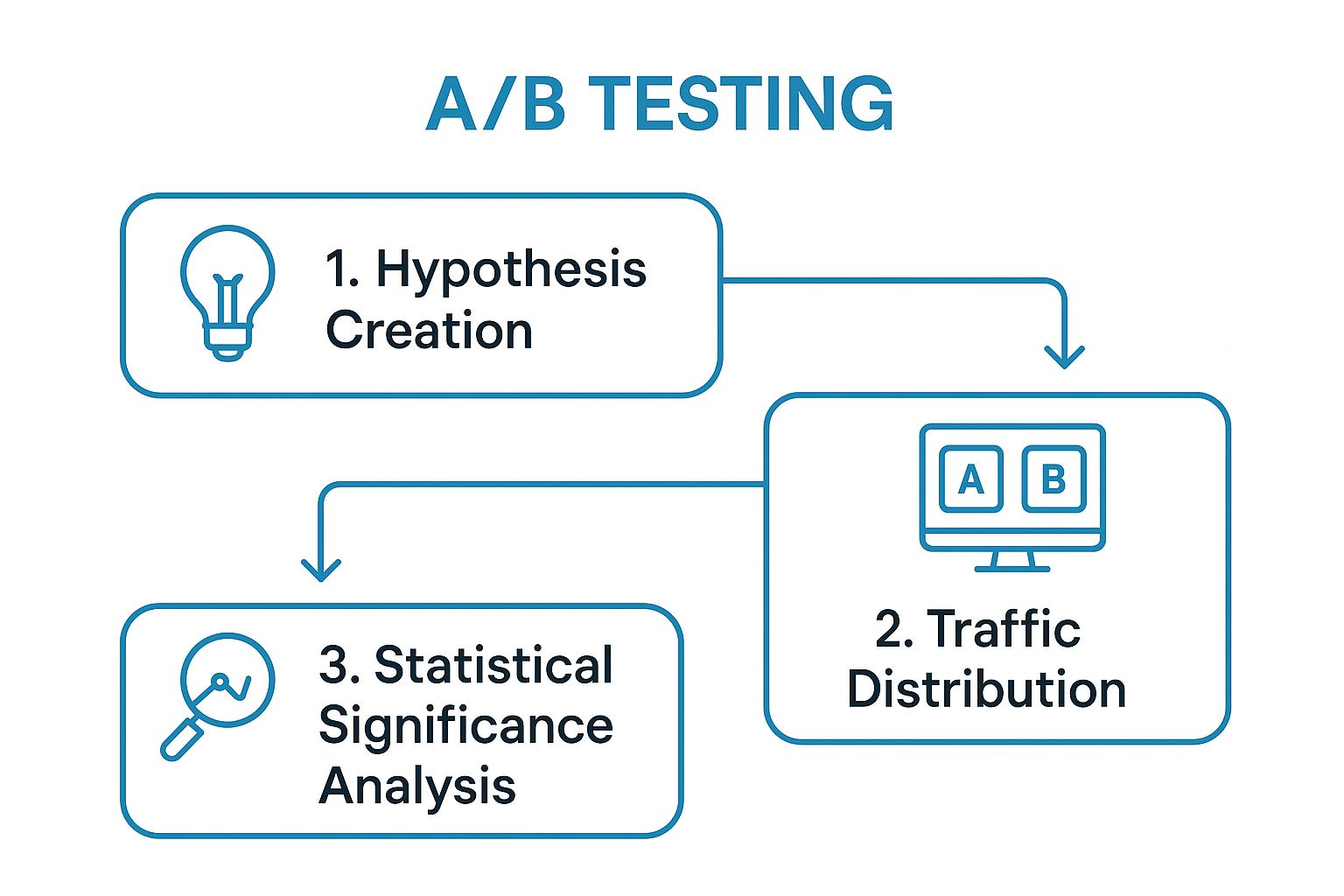
Following this structured process ensures that your optimization efforts are methodical and that you can trust the data to guide your next steps.
2. Optimize Your Value Proposition
Your value proposition is a concise promise of the value a customer will receive from your product or service. It’s often the first thing a visitor reads, and it must instantly answer the question: “Why should I buy from you and not your competitor?” A weak or unclear value proposition is a primary reason for high bounce rates, as users won’t invest time trying to figure out what you do. Optimizing this core message is one of the most impactful conversion rate optimization tips you can implement.
How a Strong Value Proposition Drives Growth
A compelling value proposition communicates benefits, solves a customer’s problem, and sets you apart from the competition, all within seconds. Slack, for example, promises to make you “more productive at work with less effort,” a clear benefit-driven statement. Similarly, Shopify’s “Anyone, anywhere, can start a business” effectively communicates accessibility and empowerment. These statements resonate because they focus on the outcome for the user, not just the features of the product. By clarifying your unique value, you attract more qualified leads who are more likely to convert. To truly optimize your value proposition, consider focusing on crafting persuasive language for your offerings, as highlighted in guides on writing compelling product descriptions that sell.
A Practical Approach to Crafting Your Value Proposition
Your value proposition should be front and center on your key landing pages, typically “above the fold” in the hero section. It’s not a slogan; it’s a clear statement of tangible results. Here are actionable tips to refine yours:
- Place it Prominently: Ensure your value proposition is the most dominant text element a visitor sees upon landing on your site. Don’t make them hunt for it.
- Use Customer Language: Avoid industry jargon and corporate buzzwords. Practical Example: Instead of saying “Leverage synergistic paradigms,” an email marketing tool could say “Send beautiful emails that your customers love to open.”
- Be Specific and Quantifiable: If possible, include numbers or specific outcomes. Instead of “Save time,” try “Cut your bookkeeping time in half.” This makes the benefit more concrete and believable.
- Test and Iterate: Your first attempt may not be the best. Use A/B testing to try different versions of your value proposition and see which one resonates most with your audience and leads to higher conversions. Once your message is refined, you will be better prepared to drive more targeted website traffic.
3. Streamline Your Checkout Process
One of the most critical moments in the customer journey is the final checkout. A complicated or lengthy process is a major source of friction that leads to lost sales. Streamlining your checkout involves methodically removing unnecessary steps, fields, and distractions to make purchasing as fast and easy as possible. With cart abandonment rates hovering around 70%, optimizing this final stage is one of the most impactful conversion rate optimization tips you can implement.
How a Simplified Checkout Drives Growth
Reducing friction at the point of sale directly translates to higher completion rates and increased revenue. For example, fashion retailer ASOS famously reduced its checkout abandonment by 50% simply by removing the requirement to create an account and offering a guest checkout option. Similarly, Walmart saw a staggering 98% increase in mobile conversions after a comprehensive redesign of its checkout flow. These examples prove that a seamless process isn’t just a convenience; it’s a powerful growth lever.
A Practical Approach to Checkout Optimization
To begin optimizing your checkout, analyze your current process from a user’s perspective and identify points of friction. Focus on clarity, speed, and trust. Here are a few actionable tips:
- Offer Guest Checkout: Forcing users to create an account is a top reason for abandonment. Always provide a prominent guest checkout option to reduce commitment and speed up the process.
- Minimize Form Fields: Only ask for essential information. Research from the Baymard Institute shows the average checkout contains too many fields. Practical Example: Do you really need a customer’s phone number for a digital download? If not, remove the field.
- Build Trust with Visual Cues: Prominently display security badges (e.g., SSL certificates, McAfee Secure) and accepted payment logos (Visa, PayPal, Apple Pay) to reassure customers that their information is safe.
- Show Progress: If your checkout has multiple steps, use a progress indicator (e.g., Step 1: Shipping, Step 2: Payment, Step 3: Review) to show users where they are in the process and how much is left. This manages expectations and reduces the likelihood of them giving up.
Get In Touch
4. Leverage Social Proof and Customer Reviews
One of the most powerful conversion rate optimization tips is to harness the psychological principle of social proof. First popularized by Robert Cialdini, this concept describes our tendency to assume that the actions of others reflect the correct behavior in a given situation. By showcasing positive customer experiences, reviews, and testimonials, you build trust and credibility, reducing friction for potential customers who are undecided. You can explore the broader theory on the Wikipedia page for Social Proof.
How Social Proof and Reviews Drive Growth
When prospective buyers see that others have purchased your product or service and had a positive experience, it validates their own consideration and alleviates purchase anxiety. This is why Amazon’s star-rating system is so prominent; it immediately signals a product’s quality and popularity. Similarly, Booking.com creates urgency and builds confidence by showing how many people are currently viewing a hotel or have recently booked it. This transparent validation can directly lead to higher conversion rates by making the decision feel safer and more informed.
A Practical Approach to Using Social Proof
To effectively integrate social proof, you need to make it a visible and authentic part of your user journey. Focus on placing these elements near key decision-making points, like product pages or checkout forms. Here are a few actionable tips:
- Showcase Detailed Testimonials: Instead of generic praise like “Great product!”, use specific testimonials that highlight a particular benefit. Practical Example: “This software helped our team reduce reporting time by 10 hours a week, freeing us up for more creative work.” – Jane Doe, Marketing Manager at Acme Corp.
- Use Real-Time Notifications: Tools that display recent purchases or sign-ups (e.g., “Jane from New York just bought a Pro Plan”) can create a sense of a busy, trusted storefront and encourage others to act.
- Display Trust Badges and Ratings: Prominently feature ratings from third-party sites like Trustpilot or Google Reviews. Also, include logos of well-known clients you’ve worked with to borrow their brand authority.
- Embrace Video Testimonials: A video of a happy customer sharing their story is often more compelling and harder to fake than text, providing a significant boost to your credibility.
5. Improve Page Load Speed and Mobile Optimization
In an age of instant gratification, a slow-loading website is a direct barrier to conversions. Page speed optimization focuses on minimizing the time it takes for a web page to load, while mobile optimization ensures a flawless experience on smartphones and tablets. Given that mobile traffic now dominates desktop in many industries, a non-responsive or slow mobile site can alienate the majority of your potential customers. These two elements are fundamental conversion rate optimization tips that address user expectations head-on.
How Speed and Mobile-Friendliness Drive Growth
The impact of speed on user behavior is well-documented. Research by Google shows that as page load time goes from one to three seconds, the probability of a bounce increases by 32%. Major brands have proven the direct link between speed and revenue. For example, Walmart saw a 2% increase in conversions for every one-second improvement in load time, while AliExpress boosted orders by 10.5% after reducing their load time by 36%. A seamless mobile experience builds on this, providing an easy path to purchase for users on the go.
A Practical Approach to Performance Optimization
Start by diagnosing your site’s current performance using a tool like Google PageSpeed Insights. This will provide a baseline and highlight specific areas for improvement. From there, focus on high-impact changes that deliver tangible results. Here are a few actionable tips:
- Compress and Optimize Images: Use tools to reduce image file sizes without a noticeable loss in quality. Practical Example: Use a tool like TinyPNG to compress your product images before uploading them. Implementing lazy loading, which only loads images as a user scrolls down the page, can also significantly cut initial load times.
- Leverage a Content Delivery Network (CDN): A CDN stores copies of your site on servers around the world, delivering content from the closest location to the user. This dramatically speeds up load times for a global audience.
- Minimize Code and HTTP Requests: Clean up your site’s code by minifying CSS, JavaScript, and HTML. Reducing the number of elements that a browser must load (like scripts and plugins) can make a significant difference.
- Prioritize a Mobile-First Design: Ensure your website provides an intuitive and fully functional experience on smaller screens. This involves more than just a responsive layout; it means optimizing navigation, forms, and CTAs specifically for mobile users. To learn more, explore the principles of a mobile-friendly website design on galantstudios.com.
Get In Touch
6. Create Compelling Call-to-Action (CTA) Buttons
A call-to-action (CTA) is the element on your page, like a button or link, that prompts a user to take a specific, desired action. Optimizing your CTAs is one of the most direct and impactful conversion rate optimization tips because these buttons serve as the final gateway between a visitor and a conversion. Effective CTAs masterfully combine persuasive copywriting, strategic design, and user psychology to guide visitors seamlessly through the conversion funnel.

How Compelling CTAs Drive Conversions
The difference between a generic CTA and a highly optimized one can be enormous. For instance, Performable (now part of HubSpot) increased clicks by 21% by changing their button color from green to red. Similarly, Netflix saw a significant lift in sign-ups when they changed their CTA from “Register” to the benefit-driven “Join Free for a Month.” These examples prove that small changes in language and design can lead to substantial gains.
A Practical Approach to CTA Optimization
To begin optimizing your CTAs, focus on clarity, value, and visual prominence. A user should immediately know what the button does and why to click it. The best CTAs are integral to a positive user experience. Here are a few actionable tips:
- Use Action-Oriented, First-Person Copy: Instead of “Submit” or “Download,” try benefit-focused phrases like “Get My Free Trial” or “Send Me the Guide.” This creates a sense of ownership for the user.
- Create Strong Visual Contrast: Your CTA button should stand out from the rest of the page. Use a contrasting color that draws the eye but still fits your brand palette. Practical Example: If your website has a mostly blue and white theme, an orange or bright green CTA button will pop.
- Add Urgency or Scarcity: Phrases like “Limited Time Offer” or “Shop Now Before It’s Gone” can motivate users to act immediately rather than putting it off.
- Ensure Mobile-Friendliness: CTAs must be large enough and have enough surrounding space to be easily tappable on smaller screens.
7. Implement Live Chat and Customer Support
One of the most effective conversion rate optimization tips is to close the gap between a customer’s question and your answer. Live chat provides real-time, on-site support, allowing visitors to get immediate assistance with issues or uncertainties that might otherwise prevent them from converting. This tool merges the convenience of digital browsing with the personal, reassuring touch of an in-person sales assistant, directly addressing friction points in the customer journey.
How Live Chat Drives Growth
By offering instant support, you can resolve doubts, clarify product features, and guide users through the checkout process, significantly reducing cart abandonment. For example, a customer hesitating on a pricing page might have a specific question about a feature. A live chat agent can answer that question immediately, preventing the customer from leaving the site to do more research. This immediate, conversational support builds trust and provides the final nudge many customers need to make a purchase decision.
A Practical Approach to Customer Support
Integrating live chat requires more than just installing a widget; it demands a strategic approach to engagement. Focus on high-intent pages like pricing or checkout. Here are a few actionable tips:
- Offer Proactive Invitations: Don’t wait for users to ask for help. Use triggers to proactively open a chat window on high-value pages or when a user shows signs of confusion, like dwelling on a checkout page.
- Train for Sales and Support: Equip your agents with sales techniques, not just problem-solving scripts. They should be able to identify upsell opportunities and guide users toward the best solution for their needs.
- Leverage Chatbots Strategically: Use AI-powered chatbots to handle basic, repetitive queries like “What are your shipping times?” and provide 24/7 support. This frees up human agents to focus on more complex, high-value conversations.
- Integrate Chat with Your CRM: Connect your chat history to customer profiles in your CRM. This allows for hyper-personalized interactions, as agents will have a full view of a customer’s past purchases and inquiries.
Pioneered by platforms like Zendesk and Intercom, conversational support has become a cornerstone of modern digital marketing and customer service.
Get In Touch
Conversion Rate Optimization Tips Comparison
| Item | Implementation Complexity 🔄 | Resource Requirements ⚡ | Expected Outcomes 📊 | Ideal Use Cases 💡 | Key Advantages ⭐ |
|---|---|---|---|---|---|
| A/B Testing and Multivariate Testing | Medium – requires setup and traffic for stats | Moderate – tools and sufficient traffic | Data-driven optimization, improved conversions | Websites with high traffic, optimizing design | Removes guesswork, concrete data, significant conversion lifts |
| Optimize Your Value Proposition | Low – mostly strategic and creative effort | Low – mainly marketing and user research | Clear communication, reduced bounce rates | Landing pages, homepage headers | Immediate visitor clarity, emotional connection |
| Streamline Your Checkout Process | High – technical integration and UX design | High – development and testing resources | Reduced cart abandonment, increased revenue | E-commerce sites with checkout processes | Direct revenue impact, improves satisfaction |
| Leverage Social Proof and Customer Reviews | Low to Medium – requires content collection | Moderate – managing reviews and curation | Increased trust, higher conversion rates | Product pages, service sites | Builds credibility, reduces purchase anxiety |
| Improve Page Load Speed and Mobile Optimization | High – technical optimization and ongoing work | High – specialized skills and tools | Faster load times, better SEO, higher conversions | Mobile-heavy sites, SEO-focused websites | Enhances UX, reduces bounce, boosts conversions |
| Create Compelling Call-to-Action (CTA) Buttons | Low – design and copywriting focused | Low – minimal technical resources | Increased click-through and conversions | All websites needing clear user guidance | High impact, easy to test, guides user actions |
| Implement Live Chat and Customer Support | Medium to High – technology and staffing needed | High – software, staff or bots | Immediate support, higher conversions | Service sites, high-value product sales | Provides instant help, reduces abandonment, generates insights |
Start Your Conversion Journey Today
Embarking on the path of conversion rate optimization is a commitment to continuous improvement, not a search for a single, magical solution. The seven strategies we’ve explored provide a comprehensive and powerful framework for transforming your website from a digital brochure into a high-performance conversion engine. By embracing a data-driven mindset, you can move beyond guesswork and make informed decisions that resonate with your audience and drive meaningful results.
Synthesizing Your CRO Strategy
The core takeaway is that these tactics are interconnected. A lightning-fast, mobile-optimized site (Tip #5) won’t convert if your value proposition is unclear (Tip #2) or your call-to-action is uninspired (Tip #6). Similarly, compelling social proof (Tip #4) builds trust, but a clunky, multi-step checkout process (Tip #3) can shatter that trust at the final moment. Each element supports the others, creating a seamless and persuasive user journey.
This is where the real work of implementing these conversion rate optimization tips begins. The key is to approach optimization as a scientific process:
- Hypothesize: “I believe changing my CTA button color from blue to orange will increase clicks because it stands out more.”
- Test: Use A/B testing tools (Tip #1) to run a controlled experiment, showing the original blue button to 50% of your traffic and the new orange button to the other 50%.
- Analyze: Collect enough data to reach statistical significance. Did the orange button actually lead to a higher click-through rate?
- Implement & Repeat: If the hypothesis was correct, implement the change. If not, learn from the result and form a new hypothesis.
This iterative cycle is the engine of sustainable growth.
From Theory to Actionable Growth
Mastering these concepts is valuable because it directly impacts your bottom line. A higher conversion rate means more leads, more sales, and a greater return on your marketing investment without necessarily increasing your traffic. It’s about maximizing the potential of every single visitor who lands on your site. By proactively removing friction, building trust, and clarifying your offer, you are directly aligning your business goals with your customers’ needs. This user-centric approach not only boosts conversions but also fosters brand loyalty and customer satisfaction over the long term. Start small, pick one area, and launch your first test today. Your future customers will thank you for it.
Ready to turn these insights into measurable results but not sure where to start? The team at Galant Studios specializes in data-driven CRO and website optimization, helping businesses like yours implement these advanced strategies with expert precision. Book a call with Galant Studios to learn how we can help you build a powerful conversion engine and accelerate your growth.