To improve your website’s ranking on Google, you need to zero in on three core pillars: creating high-quality content that genuinely satisfies a searcher’s needs, building authoritative backlinks from respected websites, and delivering a flawless technical user experience. When you get these right, you’re sending all the right signals to Google’s algorithm, paving the way for real, lasting ranking improvements.
The Real Foundation of Google Rankings Today
Trying to rank higher on Google can feel like you’re chasing a moving target. But the truth is, the fundamental principles of good SEO are more stable and user-focused than ever. It’s time to stop thinking about old-school “hacks” or keyword stuffing. Success today is all about proving your website’s value—to both people and search engines.
This requires a mental shift. Instead of asking, “How do I game the algorithm?” start asking, “How can I be the best possible resource for the user?” When you focus on creating truly helpful content, earning authentic endorsements (backlinks), and providing a smooth website experience, your goals and Google’s goals become one and the same.
The Three Pillars of Modern SEO
I like to think of a solid SEO strategy as a three-legged stool. If any one of those legs is weak, the whole thing wobbles. To build a stable foundation, you have to master these three areas:
- Content Mastery: This is so much more than just putting words on a page. It’s about deeply understanding what your audience is looking for and then creating the single best, most comprehensive answer they can find on that topic.
- Authority Building: In the SEO world, authority is primarily built through backlinks—when other sites link to yours. Google sees these links as votes of confidence, telling the algorithm that your content is trustworthy and credible.
- Technical Excellence: This is the nuts and bolts. It means your site needs to be fast, secure, mobile-friendly, and easy for Google’s bots to crawl and index. A technically sound site is the platform that lets your great content and authority shine.
This image really drives home how these elements stack up against each other.
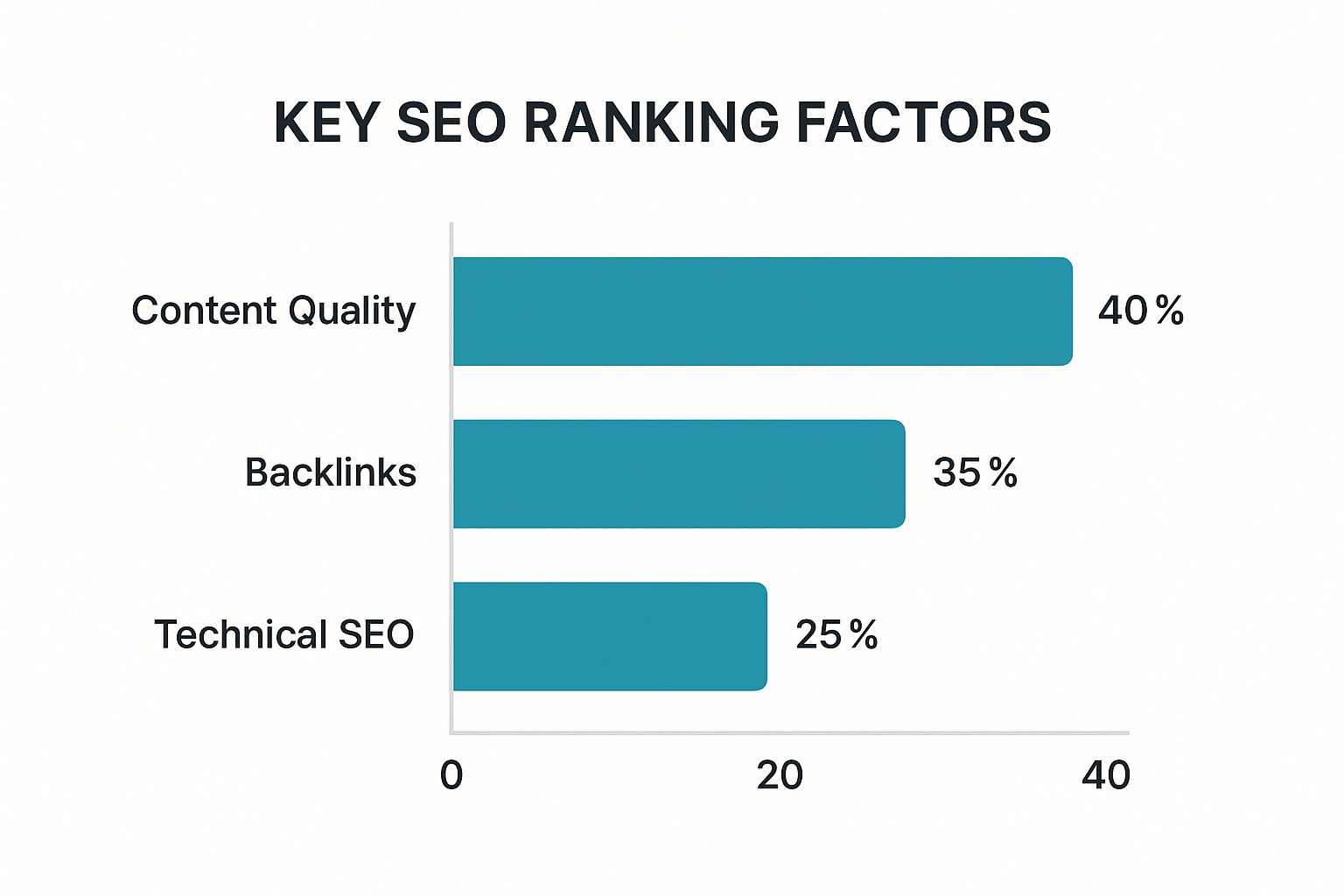
As you can see, while all three are essential, your content quality carries the most significant weight.
To help visualize where you should be investing your time, here’s a quick breakdown of the most influential factors in Google’s algorithm.
Where to Focus Your Google Ranking Efforts
| Ranking Factor | Influence Weight |
|---|---|
| High-Quality, Satisfying Content | 23% |
| Keywords in Meta Title Tags | 14% |
| Backlinks | 13% |
| Niche Expertise & Authority | 13% |
| User Engagement Signals | 12% |
This table makes it crystal clear: while technical aspects and links are vital, your primary focus should always circle back to the quality and relevance of your content.
Why Quality Content Reigns Supreme
The data consistently backs this up. A long-running, 15-year study from First Page Sage found that the single most important ranking factor is the consistent publication of high-quality content that satisfies user intent. It commands a massive 23% of the algorithm’s influence.
Other important factors follow, like having keywords in your meta title tags (14%), building a solid backlink profile (13%), and establishing deep niche expertise (13%). But the takeaway is clear: without a rock-solid content foundation, all your other SEO efforts will fall short.
The core of modern SEO is surprisingly simple: Provide the best possible answer for a search query. If you consistently solve a user’s problem better than anyone else, Google will reward you.
Ultimately, a winning strategy knits all these elements together. If you’re looking for a broader overview, there are many excellent strategies to improve search engine ranking that cover these topics in more detail. In the next few sections, we’ll dive deep into each of these pillars, breaking them down into practical steps you can start using today.
Craft Content That Both People and Google Will Actually Love

Let’s be honest: you can’t rank without great content. It’s the absolute cornerstone of any serious SEO effort. But what does “great” even mean? It’s not just about hitting a word count or stuffing in keywords. Great content solves a user’s problem so thoroughly that they have no reason to hit the back button.
You have to dig deeper than the keyword itself and get to the core of the search intent. What is the user really trying to figure out? Your job is to deliver an answer that’s not just good, but completely satisfying.
Find the Gaps Your Competitors Left Open
One of the most effective ways to create standout content is to scope out what’s already ranking and then blow it out of the water. This isn’t about copying—it’s about strategic one-upmanship.
Go ahead and Google your main keyword. Open up the top 3-5 results and put on your detective hat.
- What kind of content is winning? Are they how-to guides? List posts? In-depth case studies? This is a huge clue about what Google thinks users want to see for that specific query.
- What topics are they covering? Look at their H2 and H3 headings. These reveal the essential subtopics you absolutely need to include.
- Where did they drop the ball? This is your golden opportunity. Did they forget to answer a critical question? Are their stats from five years ago? Could you add a quick video tutorial where they only used text?
This kind of analysis gives you a clear roadmap. Say you’re a local plumbing company writing a guide on fixing a leaky faucet. You might notice the top articles are just long blocks of text. You can immediately create a more valuable resource by including your own step-by-step photos or, even better, a short video of you actually doing the repair.
Structure Content for Scanners (Because Everyone Scans)
The way you organize your content is just as vital as the words you write. Nobody wants to read a giant wall of text. It’s intimidating, and it’s a one-way ticket to a high bounce rate, which tells Google your page isn’t helpful.
Your goal is to make information feel effortless to absorb. If someone can scroll through and find their answer in seconds just by reading your headings, you’ve nailed the user experience. That’s what gets rewarded.
Here’s how to break things up for easy reading:
- Tiny Paragraphs: Keep them short and sweet—1 to 3 sentences is the sweet spot. This creates breathing room on the page.
- Meaningful Headings: Use H2s and H3s to create a logical flow. Instead of a vague heading like “Tips,” try something descriptive like “Essential Tools for a Drip-Free Faucet.”
- Lists, Lists, and More Lists: Use bullet points and numbered lists to break down steps, features, or key takeaways. They’re a scanner’s best friend.
Focusing on structure makes your content more engaging for people and helps Google better understand the hierarchy and important themes on your page. This is a critical piece of the puzzle to increase website traffic over the long term.
Prove You Know Your Stuff with E-E-A-T
Google is on a mission to rank content from sources that have real Experience, Expertise, Authoritativeness, and Trustworthiness—or E-E-A-T. You can’t just say you’re an expert; you have to prove it through your content.
Here are a few practical ways to build that trust and show off your E-E-A-T:
| Tactic | How It Looks in Practice |
|---|---|
| Show, Don’t Tell | Include original photos or videos of your team in action. A roofer could post a time-lapse of a real repair job. |
| Back Up Your Claims | Link out to credible sources like university studies, industry white papers, or government data to support your statements. |
| Feature Your Experts | Create detailed author bios that highlight credentials, certifications, and years of hands-on experience. |
| Leverage Social Proof | Weave in customer testimonials, reviews from sites like Google or Yelp, and detailed case studies. |
When you consistently apply these tactics, you send strong signals to Google that your content is reliable and comes from someone with genuine, real-world knowledge. It’s this combination of expert-led content and a fantastic user experience that truly moves the needle on your rankings.
Build Authority with Backlinks That Matter
Think of it this way: if your content is the engine, then quality backlinks are the high-octane fuel that rockets you up the search rankings. Google sees a backlink as a vote of confidence. When another credible site links to you, it’s a powerful signal that your content is valuable and trustworthy.
But here’s the catch—“high-quality” is the operative word. Not all links are created equal. A single, relevant backlink from a respected industry leader is worth more than a hundred generic links from spammy, irrelevant sites. We’re hunting for endorsements that actually move the needle.
First, Create Something Worth Linking To
Before you can even think about earning links, you need to create something people want to link to. This is where “linkable assets” come in. These aren’t just blog posts; they are pieces of content so uniquely valuable that other creators in your space feel compelled to reference them.
Your goal is to offer something that can’t be found just anywhere.
- Original Research & Data: Run a survey in your industry and publish the findings. A marketing firm, for example, could survey 500 small business owners on their biggest growth hurdles and turn it into a compelling report.
- The “Ultimate” Guide: Go deep. Create the single best, most thorough resource on a given topic. A local accounting firm could create an “Ultimate Guide to Small Business Tax Deductions” that becomes the go-to reference for entrepreneurs.
- Free Tools or Templates: Build something useful. A real estate agent could offer a free mortgage calculator, or a designer could share a free branding checklist. People love to share practical tools.
These assets become natural backlink magnets. You’re not just creating content; you’re creating a primary source.
The secret to effective link building is simple: create the resource that other people wish they had made themselves. When your content is the definitive answer, linking to it becomes a no-brainer for other creators.
Find Your Best Opportunities by Spying on Competitors
One of the smartest ways to jumpstart your backlink strategy is to see who’s already linking to your competition. If a website links to a competitor’s article, they’ve already shown they’re interested in the topic. This makes them a warm lead for your (even better) resource.
Using a good SEO tool, you can plug in a competitor’s URL and get a full list of their backlinks. Dig through this list to find relevant, high-authority sites. Are there patterns? Maybe they get a lot of links from industry blogs, news roundups, or resource pages.
This simple analysis hands you a pre-qualified list of outreach targets. The guesswork is gone—you already know they care about what you have to say.
Master the Art of Personalized Outreach
With a stellar linkable asset and a target list in hand, it’s time for outreach. Let’s be clear: generic, copy-paste emails are dead on arrival. Success comes from genuine personalization and showing how you can provide value.
Keep your email short, respectful, and to the point.
- Open with a genuine compliment. Mention something specific you liked about one of their articles. It proves you’ve done your homework.
- Introduce your asset. Briefly explain what it is and, more importantly, why their audience would find it useful.
- Suggest a natural fit. Gently point out where a link to your resource could enhance their existing content. For example, “I saw you mentioned [topic] in your post. My guide actually dives much deeper into that point and could be a great resource for your readers.”
Here’s a quick breakdown of what a non-spammy email looks like:
| Outreach Email Element | Example Text |
|---|---|
| Personalized Subject | Quick question about your recent article |
| Opening Compliment | Hi [Name], I really enjoyed your recent piece on local marketing strategies. Your point about community engagement was spot on. |
| The Ask & Value Prop | While reading, I noticed you mentioned the importance of local SEO. My team and I just published a detailed guide with a free checklist on that very topic. I thought it might be a great resource to share with your readers. |
| Closing | Either way, keep up the great work! Best, [Your Name] |
This approach frames your request as a helpful contribution, not a demand. Earning backlinks is a marathon, not a sprint, but it’s one of the most reliable ways to improve your website’s ranking and cement its authority for years.
For a more detailed playbook, check out our comprehensive guide on link building for SEO.
Put Your Visitors First to Boost Engagement
Google’s number one job is to give people the best possible answer to their questions. That means they don’t just look for websites with the right keywords; they look for sites that are genuinely helpful, easy to navigate, and even enjoyable to use. When you prioritize the user’s journey from start to finish, you’re sending all the right signals to Google.
Think about it from Google’s perspective. If someone clicks your link, easily finds what they need, and sticks around to read more, that’s a huge win. But if they land on your page and immediately hit the “back” button—a behavior called pogosticking—it tells Google your site wasn’t a good fit. Your goal is to make your website so seamless and valuable that visitors have no reason to bounce.
First Impressions Count: It All Starts with Page Speed
In SEO, speed isn’t just a feature; it’s a necessity. A slow-loading website is probably the quickest way to lose someone. The data doesn’t lie: even a one-second delay in page load time can slash your conversions by 7%. People expect things to be instant, and Google rewards the sites that deliver.
Thankfully, you don’t need to be a coding genius to speed things up. The biggest offender is almost always oversized images.
- Compress Your Images: Before you upload a single picture, run it through a compression tool. It’s not uncommon to see a 2MB photo shrink down to under 200KB with absolutely no noticeable difference in quality. This one step can shave seconds off your load time.
- Use Modern Formats: Ditch the old-school JPEGs and PNGs when you can. Modern formats like WebP offer much better compression, meaning smaller file sizes and faster loads.
- Turn on Caching: Browser caching is a simple trick that stores parts of your site (like your logo and navigation) on a visitor’s device. When they come back, their browser doesn’t have to re-download everything, making return visits feel lightning-fast.
These tweaks might seem small, but their cumulative effect on your site’s performance is massive. Faster pages lead to happier users, and happy users lead to better rankings.
We Live in a Mobile-First World, Design Accordingly
It’s official: more people browse the web on their phones than on desktops. That’s why Google now uses the mobile version of your site to decide how to rank it. A website that looks incredible on a 27-inch monitor but is a jumbled mess on a smartphone is going to have a really tough time climbing the search results.
This means your site absolutely must be mobile-responsive, adapting its layout gracefully to any screen. But don’t just stop there; really think about the mobile experience.
- Can you easily tap the buttons with your thumb?
- Is the text large enough to read without pinching and zooming?
- Does the menu open smoothly and make sense on a small screen?
A clunky mobile design is a deal-breaker for both people and search engines. To really get this right and keep visitors engaged, it’s worth diving into these actionable website UX best practices.
Write Titles That People Can’t Help But Click
Your title tag is your storefront window in the search results. It’s your one shot to grab someone’s attention and convince them your page is the answer they’re looking for. A killer title can dramatically improve your click-through rate (CTR), a powerful signal that tells Google your result is a good one.
Let’s say you’re looking up “how to fix a leaky faucet.” Which of these are you clicking?
- Bad: Faucet Repair
- Better: How to Fix a Leaky Faucet
- Best: Fix a Leaky Faucet in 5 Minutes (No Plumber Needed)
The third one, right? It’s specific, it promises a fast result, and it speaks directly to a user’s desire to save money. That’s the one that earns the click. Keep your titles under 60 characters so they don’t get cut off, and try to put your most important keywords near the front.
You could have the most amazing content in the world, but if your title is boring, no one will ever read it. Your title tag is the most important piece of advertising you’ll ever write.
Stop the Bounce with Clear, Simple Navigation
Once someone lands on your site, you want them to stay a while. This is where intuitive navigation comes in. If people can’t figure out how to find what they’re looking for, they’ll get frustrated and head straight back to Google. A logical site structure with clear menus encourages people to explore, which increases the time they spend on your site and proves to Google that you’re a valuable resource.
And make no mistake, Google is watching these user behaviors. Engagement metrics like direct traffic, return visitors, and especially pogosticking are all on their radar. Sites that keep users engaged and attract a lot of direct traffic are often seen as trusted brands, which can absolutely correlate with higher rankings.
Solidify Your Technical SEO Foundations

Let’s think about your website like a house. All the great content you create—the blog posts, the guides, the product pages—that’s the beautiful furniture and decor. But technical SEO? That’s the foundation, the plumbing, and the electrical wiring. If the foundation is cracked, it doesn’t matter how amazing the furniture looks. The whole house is in trouble.
This is why a rock-solid technical setup is completely non-negotiable if you’re serious about improving your website ranking on Google. It’s the behind-the-scenes work that ensures search engines can actually find, crawl, and understand your content efficiently. You could write the best article in the world, but if Google’s bots can’t get to it, it might as well not exist.
Create a Clear Roadmap for Search Engines
First things first: you need to hand Google a map of your website. We call this an XML sitemap. It’s a simple file that lists all the important URLs on your site, telling search engines which pages you consider a priority for them to crawl and index.
This is especially critical for larger sites or any website with pages that aren’t well-linked internally. When you submit your sitemap through Google Search Console, you’re essentially saying, “Hey, here are all my important pages. Please don’t miss anything!”
A sitemap tells Google where to go, while a robots.txt file tells it where not to go. Both are essential for guiding search engine crawlers effectively and making sure they spend their limited “crawl budget” on your most valuable pages.
You also need to control where the crawlers go. That’s what a robots.txt file is for. This little text file gives search bots instructions, telling them which pages or sections of your site to ignore. For instance, you’d probably want to block them from crawling internal search result pages or duplicate admin areas to keep low-value content out of the index.
Structure Your Content Logically
How you structure the content on the page itself sends a massive signal to search engines. A clear, logical structure helps Google understand the hierarchy of your information and what the main topics are. This is where your header tags come into play.
- H1 Tag: This is the main title of your book. Every page should have exactly one H1, and it must clearly state the page’s core topic.
- H2 Tags: Think of these as your chapter titles. Use H2s to break your content into major, distinct sections.
- H3 Tags: These are the sub-points within each chapter. Use them to organize ideas inside your H2 sections.
This isn’t just for bots, either. It makes your content so much easier for actual humans to read and skim. A well-structured page is a user-friendly page, and that’s a huge win in Google’s eyes. Our guide on technical SEO optimization gets into the weeds on these structural elements if you want to learn more.
Optimize Your On-Page Snippets and Images
Your on-page elements are your direct line of communication with Google. Getting them right is a fundamental step to improve your website ranking.
Start with your meta description. This is the short snippet of text that shows up under your title in the search results. While it’s not a direct ranking factor anymore, a compelling meta description can dramatically boost your click-through rate. You should write it like an ad for your page, telling the user exactly what value they’ll get by clicking.
And please, don’t forget your images. Search engines can’t “see” images like we do, so they rely on alt text to figure out what an image is about. Always write descriptive, relevant alt text for every single image. Instead of alt="image123.jpg", write something that actually describes the picture, like alt="blue modern kitchen island with marble countertops". This helps your images show up in Google Images and makes your site accessible to people using screen readers.
These technical fixes are foundational, but they’re part of a much larger ecosystem of ranking signals. An internal document leak recently confirmed just how granular Google’s system is, listing thousands of ranking modules and attributes. This underscores why a complete strategy that includes technical health, content, and user experience is so vital.
Beyond just technical fixes, optimizing your WordPress site’s speed is paramount for improving user experience and is a significant technical SEO factor. For those using the platform, these WordPress Site Speed Optimization Tips are a great place to start.
Common Questions About Google Rankings
When you start digging into SEO, a ton of questions pop up. It’s completely normal to wonder about how long this all takes, what to watch out for, and where to even begin. Let’s clear up some of the most common questions I hear all the time.
How Long Does It Take to Improve Website Ranking on Google?
This is the big one, isn’t it? Everyone wants to know when they’ll see results, and the honest answer is: it takes time. SEO is definitely a long game.
You can typically expect to see some encouraging movement in about 3 to 6 months of consistent, quality work. This isn’t usually a jump to the #1 spot, but it might mean climbing from obscurity on page ten to somewhere on page three or four.
Getting to the top of page one for a keyword people are actually searching for? That’s a different story. For competitive terms, you’re realistically looking at 6 to 12 months, sometimes longer. A brand-new website is starting from scratch and will almost always take more time to build trust with Google than an established site with a solid history.
Patience is your best friend in SEO. Think of every great article you publish or quality backlink you earn as laying another brick. You’re building an asset, and strong foundations aren’t built overnight.
What Are the Most Common SEO Mistakes to Avoid?
I’ve seen a lot of well-meaning SEO efforts get completely derailed by a few classic blunders. Knowing what not to do is just as crucial as knowing what to do.
The single biggest mistake is choosing quantity over quality. Churning out dozens of thin, unhelpful blog posts or chasing cheap, spammy backlinks from irrelevant websites will do more harm than good. Google is smart enough to see through it. It’s always better to create one truly exceptional resource than ten mediocre ones.
Another huge error is neglecting technical SEO. Your content could be award-winning, but if your site is slow, broken on mobile, or a nightmare to navigate, it’s all for nothing. A poor user experience is a direct signal to Google that your site isn’t worth ranking.
Finally, a lot of people miss the mark on search intent. You have to get inside the user’s head. If your page doesn’t genuinely solve the problem or answer the question behind their search, it’s never going to stick on page one.
Should I Focus On-Page or Off-Page SEO First?
This is an easy one: always start with on-page and technical SEO.
Think of it like building a house. Your on-page SEO is the foundation, the framing, and the electrical wiring. Your off-page SEO—like getting backlinks—is the fancy interior design and curb appeal. It makes absolutely no sense to start decorating a house with a crumbling foundation.
- Get your house in order first (On-Page): Nail down the fundamentals. Make sure your site is fast, secure, and looks great on a phone. Structure your content logically and target the right keywords.
- Then, send out the invitations (Off-Page): Once your website itself is solid, your off-page efforts will have a much bigger impact. A powerful backlink pointing to a slow, confusing page is a massive wasted opportunity.
At Galant Studios, we build fast, high-performing websites with SEO integrated from the very start, helping you climb the rankings and attract more customers. Discover how our expert services can drive real growth for your business by booking a call.