A great product description does more than just list features—it tells a story. It’s where persuasive copywriting meets smart SEO to answer a customer's unspoken questions, build their confidence, and create an emotional connection that turns a casual browser into a loyal buyer.
Why Great Product Descriptions Matter More Than Ever
Not long ago, a product description was an afterthought—a dry block of technical specs. Today, it’s one of your most critical sales assets. This isn't just a fleeting trend; it’s a direct response to a fundamental shift in how people shop.
Modern consumers are savvy researchers. They meticulously compare options, read reviews, and scrutinize every detail online before even considering a purchase. Your product page is no longer a simple digital brochure; it's your final, silent sales pitch. The words you choose must do the heavy lifting of a seasoned salesperson: anticipating questions, overcoming objections, and making an irresistible case that your product is the solution they need.
The Modern Shopper’s Journey
The path from discovery to purchase is rarely a straight line. A customer might see your product on social media, search for reviews on Google, compare it against competitors, and then finally land on your product page. After all that effort to get them there, a weak or uninspired description can unravel everything.
Consider the scale of this behavior. Global retail e-commerce sales are projected to reach over $8 trillion by 2027. With a staggering 81% of shoppers conducting online research before buying, millions of purchase decisions hang in the balance, often decided by the quality of the copy on a single page.
A vague description isn't just a missed opportunity; it's a direct path to a lost sale. To dig deeper into the numbers, you can explore more ecommerce statistics and trends to see just how competitive the market is.
A great product description acts as a bridge between a customer's problem and your product's solution. It confirms they have found what they were looking for and gives them the confidence to click "Add to Cart."
Before we dive into the "how," let's outline what a successful product description actually contains. These core components work together to inform, persuade, and convert.
Core Components of a High-Converting Product Description
| Component | Purpose | Practical Example Snippet (for a travel mug) |
|---|---|---|
| Headline | Grab attention with a benefit-driven title. | "The Last Travel Mug You'll Ever Need." |
| Benefit-Oriented Intro | Hook the reader by connecting the product to their needs or desires. | "Say goodbye to lukewarm coffee and messy spills on your morning commute." |
| Feature Bullets | List key features, but translate them into clear benefits. | "- Double-Wall Insulation: Keeps your drink piping hot for up to 12 hours." |
| Story/Scenario | Paint a picture of how the product fits into the customer's life. | "Imagine striding into your Monday meeting, coffee still perfectly hot…" |
| Social Proof | Build trust with reviews, testimonials, or awards. | "Join over 50,000 happy customers who've upgraded their mornings." |
| Call-to-Action (CTA) | Gently guide the customer toward the purchase. | "Ready for a better brew? Choose your color and order today." |
These components provide a solid framework. When you master combining them, you create a narrative that does more than just describe—it sells.
More Than Just Words
Beyond the immediate sale, effective product descriptions accomplish several key business goals at once. Think of them as a powerful tool for shaping your brand and building a genuine connection with your audience.
- Builds Trust and Credibility: Detailed, transparent, and well-written copy signals professionalism. It tells customers you stand behind your product and understand their needs.
- Reduces Returns and Inquiries: By clearly explaining what the product is, who it’s for, and how it works, you set accurate expectations. This proactive communication minimizes post-purchase frustration and lightens the load on your support team.
- Improves Search Engine Visibility: When you strategically include relevant keywords, you help search engines understand your page, making it easier for new customers to find you through organic search.
- Differentiates You From Competitors: Even if you sell a product similar to others, your description is a prime opportunity to stand out. Your brand voice, storytelling, and focus on specific benefits can be the deciding factor.
Ultimately, learning how to write product descriptions is much more than a copywriting skill—it’s a core business strategy. The following sections will give you an actionable workflow to turn your descriptions from simple text into powerful sales assets.
2. Know Your Customer Before You Write a Word

Before you type a single headline, you must understand who you're writing for. Trying to write compelling copy without getting inside your customer's head is like trying to sell a solution to a problem you don't understand. You might get lucky once, but you’ll never be consistently persuasive.
This initial research is about moving past basic assumptions to uncover what truly drives, frustrates, and motivates your ideal buyer. Great copy isn't about clever tricks; it’s about making a genuine connection. And that connection is impossible if you don't know who you're talking to.
Build Your Buyer Persona
A buyer persona is your north star. It's a semi-fictional profile of your ideal customer, built from market research and real data about your existing customers. A useful persona goes beyond simple demographics like age or location and delves into the psychology of your buyer.
Let's make this practical. Imagine you sell hand-poured, eco-friendly soy candles. A starting point might be "women, aged 25-45, interested in home decor." That’s too vague to be actionable.
A well-developed persona, let's call her "Eco-Conscious Elena," gives you much more to work with:
- Her Goals: She wants to create a calming, non-toxic atmosphere in her home. She actively seeks out and supports small, ethical brands that align with her values.
- Her Frustrations: She can't stand the headaches she gets from synthetic fragrances in mass-produced candles. She's also turned off by excessive plastic packaging and brands that "greenwash."
- Her Language: She uses phrases like "clean burn," "ethically sourced," "cozy evening," and "self-care ritual."
This level of detail is a goldmine for copywriting. Suddenly, you know exactly which emotional chords to strike. To really nail this down, it's worth diving into the specifics of creating buyer personas that actually work.
Translate Features Into Benefits
This is one of the most common mistakes in product descriptions: a laundry list of features. A feature is a fact about your product—what it is or what it has. A benefit is the positive outcome that feature delivers for the customer. It directly answers their silent question, "What's in it for me?"
Let’s stick with our candle company. A simple feature-to-benefit exercise can transform your raw product specs into persuasive selling points.
| Feature | Technical Detail | Customer Benefit |
|---|---|---|
| 100% Soy Wax | Made from natural, renewable soybeans. | "Enjoy a clean, soot-free burn that won't release toxins into your home, so you can breathe easy." |
| Essential Oil Fragrance | Scented only with pure plant extracts. | "Fill your space with a subtle, natural aroma—never an overpowering, headache-inducing chemical scent." |
| Recycled Glass Jar | The container is made from post-consumer recycled materials. | "Feel good about your purchase knowing it supports a sustainable, zero-waste mission." |
See the shift? Features are the "what," but benefits are the "so what." People buy based on benefits because they connect directly to their needs and desires—in this case, Elena's desire for a non-toxic, relaxing, and sustainable home.
The core of effective copywriting is empathy. You must be able to step into your customer's shoes and see the world—and your product—from their perspective.
Where to Find Your Customer’s Voice
The best copy isn't invented in a boardroom; it's borrowed directly from your customers. The goal is to find the exact words and phrases they use when talking about their problems and what they hope to find. This makes your copy feel instantly authentic and trustworthy.
Here are the best places to mine for this "voice of customer" data:
- Product Reviews: Scour your own reviews and, just as importantly, those of your direct competitors. Note the language in 5-star reviews (what did they love?) and 1-star reviews (what were their biggest frustrations?).
- Social Media Comments: Your comments section is a real-time focus group. Also, check out relevant online communities like Facebook groups or subreddits where your audience gathers.
- Customer Support Tickets: Your support inbox is a direct pipeline into your customer's mind. What questions pop up repeatedly? What problems are they trying to solve with your product?
As you gather this intel, you're building a "swipe file" of authentic language. When you reflect this language back to your audience, they feel seen and understood. For a more detailed walkthrough, our guide on how to create buyer personas can help you refine this entire process.
Putting in this work upfront is the single most critical step in writing product descriptions that don't just describe, but actually sell.
Proven Formulas for Persuasive Copywriting
Staring at a blank page can be intimidating. Thankfully, you don't have to start from scratch. Decades of advertising have given us battle-tested frameworks that reliably guide customers from their first glance to the final click.
Think of these copywriting formulas less as rigid rules and more as psychological roadmaps. They give your message a proven structure, ensuring you hook the reader, build genuine interest, and position your product as the obvious answer to their needs.
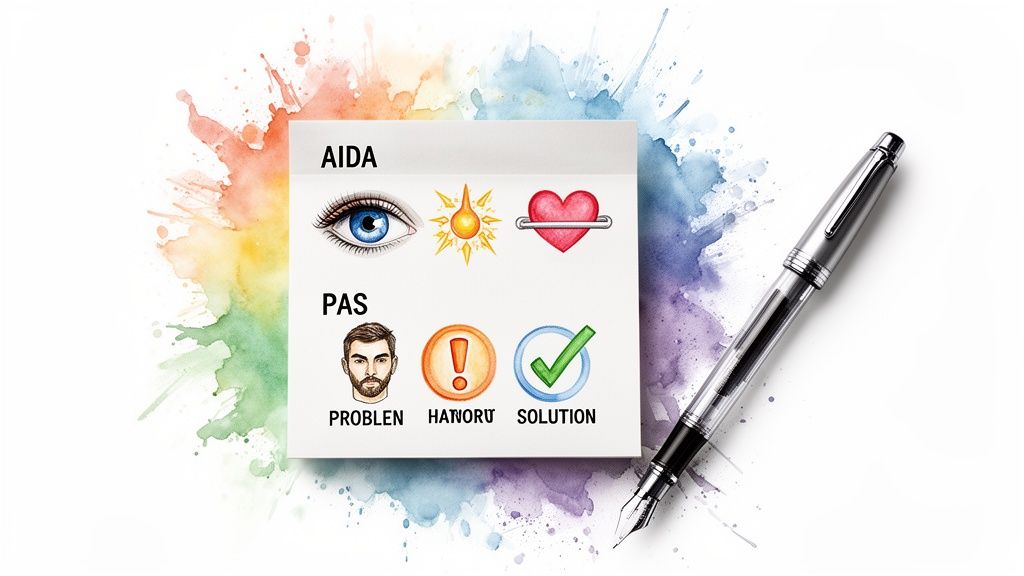
The AIDA Formula: Attention, Interest, Desire, Action
One of the most enduring frameworks is AIDA. It’s an acronym for Attention, Interest, Desire, and Action, outlining a path that mirrors how people naturally make decisions.
Let's apply it to a handcrafted leather wallet.
-
Attention: Your first line must stop the scroll. A generic opener like "High-Quality Leather Wallet" is invisible. Instead, lead with a bold, benefit-focused hook: "The Last Wallet You’ll Ever Need to Buy."
-
Interest: Now that you have their attention, hold it. Expand on that initial promise with compelling details. For the wallet, you could say: "Tired of bulky wallets that fall apart after a year? Ours is crafted from a single piece of full-grain leather that develops a rich, unique patina over time."
-
Desire: Here, you shift from logical interest to emotional want. Paint a picture of what life is like with your product. You might write: "Imagine the confidence of pulling out a wallet that reflects true craftsmanship—a piece that not only holds your essentials but tells a story of enduring quality."
-
Action: Finally, tell them exactly what to do next. Your call to action must be clear and direct. For instance: "Choose your leather finish and order the wallet built to last a lifetime."
The AIDA model is incredibly versatile, working for everything from physical products to professional services. It’s a core component of effective copywriting a website, where every word should guide the user forward.
The PAS Formula: Problem, Agitate, Solve
Another potent formula, especially for products that solve a specific pain point, is PAS: Problem, Agitate, and Solve. This framework connects with a customer’s frustration and presents your product as the ultimate relief.
Let’s apply it to noise-canceling headphones for a busy professional.
Problem
Start by identifying a core problem your customer faces, using their own language. "Struggling to focus in a noisy open office or on your daily commute?"
This opener immediately shows you understand their struggle.
Agitating the Problem
Next, you gently turn up the heat on that problem. Remind them of the negative consequences and frustrations it causes. This step is crucial for creating a sense of urgency.
"Every interruption breaks your concentration, costing you valuable time and energy. Important calls get drowned out, and finding your flow feels impossible."
Presenting the Solution
Now, you swoop in with the answer. After building that tension, you introduce your product as the clear, effective solution they've been searching for.
"Our ZoneFlow headphones create your personal bubble of silence. With a single switch, you can eliminate distractions, hear every word with crystal clarity, and reclaim your focus. It's time to work on your own terms."
The PAS formula is so effective because it follows a classic storytelling arc: conflict and resolution. It taps into a fundamental human desire to solve problems, making it incredibly persuasive.
Weaving in Storytelling and Sensory Language
Beyond these formulas, the best product descriptions often use storytelling and sensory words to create an immersive experience. People connect with stories on a much deeper level than they do with a dry list of features.
Sensory words are your secret weapon for bridging the gap between the screen and the real world. Since a customer can't physically touch your product, you must use language that evokes the senses for them.
Here's a quick comparison:
| Generic Description | Sensory-Rich Description |
|---|---|
| "This coffee has a strong taste." | "Experience the bold, smoky aroma and rich, velvety texture of our dark roast coffee, with a smooth, lingering finish." |
| "The blanket is soft." | "Wrap yourself in the plush, cloud-like comfort of this silky-soft cashmere throw, perfect for a cozy evening." |
By weaving these evocative elements into frameworks like AIDA or PAS, you create descriptions that don't just inform—they resonate, persuade, and make the product feel real.
Weaving SEO into Your Product Descriptions
Persuasive copy is pointless if your ideal customer never finds it. This is where Search Engine Optimization (SEO) comes in. It’s not about awkwardly stuffing keywords into your text. It’s about strategically using the exact language your customers use when they’re trying to solve a problem—a problem your product can fix. Done right, your product page transforms from a simple sales pitch into a valuable, discoverable asset.
Finding Your Core Keywords
The process starts with understanding the terms people type into search engines like Google. Keyword research uncovers these phrases, letting you align your copy directly with what your audience wants. It's a foundational skill, and you can get a full rundown in our guide on how to do keyword research.
For any product page, you’re generally looking for three types of keywords:
- Primary Keyword: Your main target, the most direct and high-volume term for your product. For a local bakery, this would be "custom wedding cakes."
- Secondary Keywords: Related phrases that add context, like "three-tier wedding cakes" or "elegant cake designs."
- Long-Tail Keywords: Longer, more specific queries that often signal a buyer who is closer to making a purchase, such as "custom wedding cakes with buttercream frosting in Denver."
Once you’ve gathered these terms, you have a blueprint for writing your description.
Strategic Keyword Placement
With your keyword list in hand, the real work begins: placing them naturally throughout your product page. The goal is a delicate balance—sending clear signals to search engines about your page's relevance without sounding robotic to your human readers.
Focus on integrating these terms into key on-page elements where they’ll have the most impact.
Key SEO Placement Areas:
- Product Title (H1 Tag): This is your prime real estate. Always lead with your primary keyword. (e.g., "Custom Wedding Cakes for Your Special Day")
- Meta Title & Description: These appear in search results and are your first chance to earn a click. Make them compelling and include your primary keyword.
- Subheadings (H2, H3 Tags): Use secondary keywords to structure your content and make it scannable. (e.g., "Our Signature Buttercream Frosting Options")
- Body Copy: Weave your primary, secondary, and long-tail keywords into your paragraphs and bullet points, but only where they fit naturally. Don't force it.
- Image Alt Text: This text helps visually impaired users and search engines understand your images. Describe the photo accurately and include a relevant keyword. (e.g., "Three-tier custom wedding cake with white roses.")
This structured approach helps search engines understand precisely what your page is about. If you're selling on a major marketplace, it's also worth reading a performance-driven guide to keywords for Amazon listings to see how to research and place terms within different platform constraints.
A Practical SEO Example
Let's bring this to life with our local bakery selling "Custom Wedding Cakes." Their research into long-tail keywords reveals that customers are searching for things like "vegan wedding cakes" or "gluten-free wedding cakes near me." These are huge opportunities.
To ensure your product pages are set up for success, follow a simple checklist. This ensures you've covered the most critical on-page SEO elements before you hit "publish."
Product Page SEO Checklist
| SEO Element | Best Practice | Why It Matters |
|---|---|---|
| Primary Keyword in H1 | Place your main keyword in the main page title (H1 tag). | This is the strongest on-page signal to search engines about your page's topic. |
| SEO-Friendly URL | Keep the URL short, readable, and include the primary keyword. | A clean URL helps both users and search engines understand the page content at a glance. |
| Compelling Meta Title | Write a unique meta title under 60 characters that includes your keyword. | This appears in the search results tab and is a major factor in click-through rates. |
| Engaging Meta Description | Craft a description under 160 characters with a CTA and keywords. | While not a direct ranking factor, it heavily influences whether a user clicks on your result. |
| Optimized Image Alt Text | Add descriptive alt text with relevant keywords to all images. | Improves accessibility and helps your product images rank in Google Images search. |
| Internal Linking | Link to other relevant products or blog posts on your site. | Distributes page authority and helps users discover more of your content. |
Following these steps methodically will put you miles ahead of competitors who just write what "sounds good."
Writing product descriptions has moved far beyond a purely creative task; it's now a data-informed discipline. Given that nearly 80% of small business owners and marketers write their own content, having a structured SEO workflow can turn a simple description into one of your most powerful sales assets.
Testing and Refining Your Copy for Better Results
Your first draft is never your final draft. The most effective product descriptions aren't just written once and forgotten; they're refined through continuous improvement. This is where we move beyond guesswork and start using real data to understand what actually clicks with your audience. Embracing a cycle of testing, learning, and optimizing is what separates good copy from great copy that consistently drives sales.
Technology can be a powerful creative partner in this process. AI writing assistants have become indispensable for overcoming writer's block and generating copy variations to test. The key is to remain human-led and AI-assisted. You control the brand voice, tone, and factual accuracy, while using tools to speed up brainstorming and production.
This isn't a future-gazing idea. In 2024, about 76% of content marketers were already using AI to help draft copy, and 79% of businesses said their content quality improved when AI was part of their workflow. It's a clear signal that smart technology is helping us create better content, more efficiently. You can dig into more of these insights in these content marketing statistics and AI adoption rates.
A Straightforward Guide to A/B Testing
A/B testing, or split testing, is a methodical way to compare two versions of your product description to see which one performs better. By changing just one element at a time—the headline, the call-to-action, or the opening line—you can get clean data on what influences customer behavior. Most modern e-commerce platforms have built-in tools or easy integrations that make this accessible to everyone.
The concept is simple: you show version A to one group of visitors and version B to another. After a set period, you analyze the data to see which version achieved a higher conversion rate.
Here are a few of the most impactful elements to test:
- Product Headlines: Pit a benefit-driven headline against a feature-focused one. For noise-canceling headphones, you could test "Advanced Active Noise-Canceling Technology" (Version A) against "Find Your Focus Anywhere" (Version B).
- Call-to-Action (CTA) Buttons: The words on your "buy" button matter. Test different phrases. Is "Add to Cart" better than "Buy Now"? What about "Get Yours Today"?
- Description Length and Format: Does your audience prefer a quick, punchy paragraph, or do they need a detailed list of bullet points? Test a concise summary against a more in-depth version.
A/B testing takes the guesswork out of copywriting. It replaces "I think this sounds better" with "The data shows this converts 15% more customers."
Implementing Your Tests and Analyzing Results
To run a solid A/B test, start with a clear hypothesis. For example: "A product headline emphasizing the emotional benefit of 'peace and quiet' will get more 'Add to Cart' clicks than a headline listing the technical feature of 'noise cancellation'."
With your hypothesis in hand, you can set up the test on a platform like Shopify or BigCommerce, using their A/B testing features or a third-party app. It is critical to let the test run long enough to achieve statistical significance. That's a technical term meaning you have enough data to be confident the results aren't just a random fluke.
Once the test is complete, analyze the data. Your platform will show you the winning variation. The next step is simple: make the winner the new default for all visitors. But the job isn't over. The insights you gain from one test should fuel the next. If the benefit-driven headline won, your next test could compare two different benefit-driven headlines to sharpen your messaging even more.
By consistently applying this data-driven approach, you build a powerful feedback loop, methodically improving the performance of every product description on your site and turning your words into a finely-tuned sales tool.
Common Questions About Writing Product Descriptions
Even with a solid plan, a few questions always seem to pop up when it's time to write. Let's tackle some of the most common hurdles so you can move forward with confidence and create copy that truly performs.
What's the Ideal Length for a Product Description?
There’s no magic word count. The right length depends on your product's complexity and your customer's needs.
A great starting point for most products is a short, punchy introduction of one or two paragraphs, followed by a scannable list of three to five bullet points.
For a simple item like a t-shirt, less is more. But if you're selling a high-tech drone or a complex piece of software, you'll need to provide more detail. Your job is to give shoppers all the information they need to feel confident hitting "add to cart" without overwhelming them.
What's the Single Biggest Mistake to Avoid?
Without a doubt, the most common pitfall is listing features instead of explaining benefits. It’s an easy trap to fall into.
A feature is a fact about the product. For example, "This backpack is made from water-resistant nylon." A benefit tells the customer what that feature does for them: "Your gear stays bone-dry and protected, even if you get caught in a downpour."
People buy solutions, not specs. Your job is to connect the dots for them, showing how each feature leads to a better outcome or solves a real problem.
The heart of great copy is translation. You must translate the technical "what" of your product into the emotional "why" for your customer. Shifting from features to benefits is what transforms a boring description into a powerful sales tool.
Should I Just Use the Manufacturer's Description?
It's tempting, but this is a critical mistake. Using the stock description provided by the manufacturer is a problem for two reasons.
First, it’s an SEO killer. When dozens or hundreds of other retailers use the exact same text, search engines see it as duplicate content, which can seriously hurt your chances of ranking. Second, you’re throwing away a golden opportunity to let your brand’s unique personality shine. This is your space to connect with your audience and show them why they should buy from you.
How Can I Make My Descriptions Sound More Authentic?
Authenticity comes from knowing your customers inside and out. The secret is to use the same language they do. Go read their reviews, check their comments on social media, and look through your support tickets.
- Listen for the words and phrases they use repeatedly.
- Weave their actual language into your descriptions.
- Keep your tone conversational, like you're talking to a friend.
- If it fits, share a quick story about why the product was created.
When you echo your customers' voice, your copy instantly feels more genuine and relatable. As research from institutions like the U.S. National Archives shows, stories make information memorable and persuasive. This approach builds the kind of trust that turns browsers into loyal buyers.
At Galant Studios, we specialize in turning brand stories into high-converting, SEO-optimized website content. We craft compelling product narratives that don't just get seen by search engines—they get your products sold.
Ready to elevate your online store? Learn how our content services can drive your business growth.