Writing for a website is much more than just filling a page with words. It’s the art of creating a persuasive conversation that guides visitors toward a specific goal. Every single word—from the main headline down to the text on a button—must be purposeful, clear, and focused on the customer to turn casual browsers into loyal clients.
The Blueprint for High-Converting Website Copy
Great website copy is never an accident. It doesn’t come from a sudden flash of inspiration in front of a blank screen. It’s built on a solid strategic blueprint—a foundational plan ensuring every word works toward a business goal. Without this groundwork, even the most beautifully written copy will fall flat, failing to connect with anyone or drive real results. This blueprint is what separates a website that just sits there from one that actively brings in business.
The heart of this strategy is a simple but powerful shift in perspective: you are not writing for your company; you are writing for your customer. This means you have to get out of your own head and dig deep into who your audience is, what problems keep them up at night, and the exact language they use to talk about their needs.
Before you even think about writing, you need a solid strategy for copywriting a website. The following table breaks down the essential components you must have in place. This isn’t just a checklist; it’s the foundation for every word you’ll write.
Table: Core Elements of a Website Copywriting Strategy
| Component | Description | Key Objective |
|---|---|---|
| Audience Persona | A detailed profile of your ideal customer, including their goals, challenges, and motivations. | To ensure every word resonates with the right person and addresses their specific needs. |
| Brand Voice Guide | A document defining your brand’s personality, tone, and style. | To maintain consistency, build trust, and make your brand instantly recognizable. |
| Goal Alignment | Clearly defined business objectives for each page (e.g., sign-ups, sales, demo requests). | To ensure your copy is engineered to drive specific, measurable actions. |
With these elements defined, you can move from guessing what might work to knowing what will connect.
Get to Know Your Target Audience
You can’t write a single effective headline until you have a crystal-clear picture of your ideal customer. And I’m not talking about vague demographics like “women aged 25-40.” That’s not nearly enough. You need to understand their psychographics—what drives them, what they’re afraid of, and what they secretly hope for.
- What are their real pain points? Look past the obvious, surface-level problems. A small business owner doesn’t just need “accounting software.” They need to “stop wasting weekends buried in spreadsheets” and “avoid the crushing stress of tax season.” That’s the real pain.
- What words do they use? Become an investigator. Scour online forums, read customer reviews, and dig into social media comments in your industry. Pay close attention to the exact phrases your potential customers use. This is a goldmine for authentic copy that feels like you’re reading their mind.
- What transformation are they after? People buy outcomes, not products. They don’t want a drill; they want a hole in the wall to hang a family photo. Your copy needs to paint a vivid picture of the “after” state they’ll achieve with your help.
The most common mistake I see is companies assuming they already know their audience. True insight doesn’t come from intuition; it comes from research. Actually listening to your customers is the single most valuable thing you can do.
Nail Down a Consistent Brand Voice
Your brand voice is your company’s personality. Is it authoritative and professional? Or is it friendly and a little quirky? A consistent voice is critical for building trust and making your brand feel familiar and reliable, whether someone is on your homepage or reading a blog post.
Practical Example: A financial advisory firm will probably adopt a formal, reassuring tone to build confidence (e.g., “Secure your financial future with our proven wealth management strategies.”). Meanwhile, a dog food brand might use a playful, witty voice to connect with pet owners on a more emotional level (e.g., “Happy tummies and wagging tails, guaranteed in every bowl.”). Once you define this voice, stick to it. It ensures everything you publish feels like it comes from the same trusted source.
Match Your Messaging to Your Business Goals
Every single page on your website needs a job to do. What is the primary goal of your homepage—to get email sign-ups? Is a blog post meant to drive traffic to a product page? Your copy must be laser-focused on guiding the visitor toward that specific action.
When you align your copy with a clear goal, you eliminate confusing or weak messaging. If the goal is for visitors to book a demo, then the copy should relentlessly focus on the benefits of seeing the product in action, leading them directly to a clear call to action like “Schedule Your Personalized Demo.” As you build out your blueprint, it’s also a great time to explore proven strategies to increase organic search traffic that converts.
The world of website copywriting exploded in 1995 when the U.S. National Science Foundation first allowed commercial activity on the internet, paving the way for giants like Amazon.com. This shifted copywriting from print to a digital space that now contains roughly 4.62 billion indexed webpages. In this crowded world, simply having a clear, compelling headline can boost conversions by around 25%. It just goes to show how critical strategic copy is. To dive deeper, you might find these conversion rate optimization tips helpful for maximizing your site’s performance.
Writing Headlines That Actually Get Read
Let’s be blunt: your headline is the most critical piece of copy on the entire page. It’s the gatekeeper. If it doesn’t hook a visitor in a matter of seconds, all the brilliant copy that follows might as well not exist. A great headline makes an instant promise, convincing someone to stop scrolling and start reading.

The headline’s one job is to scream value. It has to answer the reader’s silent, all-important question: “What’s in it for me?” This isn’t the place for clever puns or vague, artistic phrases. Clarity always trumps cleverness. A straightforward, benefit-focused headline will outperform a witty but confusing one 100% of the time.
Remember, people land on your page with a problem to solve or a goal to achieve. Your headline must immediately signal that you have their answer.
Formulas for Compelling Headlines
You don’t need to start from a blank page every time. Seasoned copywriters rely on proven formulas because they work—they tap directly into basic human psychology.
Here are a few actionable approaches:
- The Benefit-Driven Headline: This is the most direct route. It simply states the best outcome the reader will get. No fluff, just pure, customer-focused value.
- Practical Example: “Get Your Taxes Done in 10 Minutes, Guaranteed.”
- The Question Headline: Posing a question immediately engages the reader’s brain, prompting them to reflect on their own needs. It’s a great way to draw someone in.
- Practical Example: “Are You Paying Too Much for Business Insurance?”
- The “How-To” Headline: A timeless classic for a reason. It promises a clear, actionable solution to a specific problem, signaling that your content is practical and helpful.
- Practical Example: “How to Write a Business Plan That Attracts Investors.”
The best headlines often emerge from a deep understanding of customer pain points. When you know what keeps your audience up at night, you can craft a headline that speaks directly to their most pressing needs, making it almost impossible to ignore.
Tapping into Psychological Triggers
Beyond simple formulas, the most powerful headlines push psychological buttons to make their message irresistible. Mastering these is a core skill for anyone writing website copy.
One of the most potent triggers is curiosity. A headline that opens up a “curiosity gap”—the space between what someone knows and what they want to know—is incredibly compelling. You can do this by teasing a secret, challenging a common myth, or revealing something unexpected.
- Practical Example (Curiosity): “The One Mistake That’s Costing 90% of New Homebuyers Thousands.”
Another reliable trigger is urgency. By introducing scarcity or a tight deadline, you nudge people toward immediate action. This taps into the very human Fear of Missing Out (FOMO).
- Practical Example (Urgency): “Last Chance to Save 50% on Our Annual Plan.”
Weaving in Keywords Naturally
While you absolutely must write for humans first, you can’t afford to ignore the search engines. A truly effective headline has to include your primary keyword, but it needs to feel completely natural, not shoehorned in.
Let’s say your target keyword is “small business accounting software.”
| Forced and Unnatural | Natural and Compelling |
|---|---|
| “Small Business Accounting Software for You” | “The Easiest Accounting Software for Small Business Owners” |
| “Buy Our Small Business Accounting Software Today” | “Finally, Accounting Software That Saves Your Small Business Time” |
As a best practice, try to place your keyword near the beginning of the headline, since search engines tend to give more weight to words that appear early on. But never sacrifice impact or clarity to do so. Your goal is a perfect marriage of human appeal and algorithmic function, a balance that’s essential for modern website copywriting. For more on this, it’s always worth reviewing the government’s official guidelines on plain language.
Turning Features into Compelling Benefits
You’ve landed a visitor with a great headline. That gives you a few precious seconds of their attention. Now, the body copy has to deliver on that promise. This is where you move beyond the initial hook and start building a real, persuasive case, guiding the reader from mild interest to a genuine desire for what you offer. Think of this as the engine room of your website copy.
The single most important mental shift you can make here is moving from features to benefits. A feature is just a factual statement about your product or service—what it is or what it has. A benefit, on the other hand, is the positive outcome or transformation a customer gets because of that feature.
People don’t really buy a mattress with “memory foam technology” (that’s the feature); they buy “a night of deep, uninterrupted sleep” (the benefit). The feature is the what, but the benefit always answers the question, so what?
The Art of Translating Features into Benefits
To get this right, you need to become an expert translator. For every feature you’re tempted to list, force yourself to ask, “So what does this mean for my customer?” Keep digging until you arrive at an emotional, tangible outcome that resonates.
Let’s walk through a real-world example for a project management tool:
- Feature: “Our software offers real-time collaboration dashboards.”
- Translation (So what?): Okay, that means teams can see project updates instantly, without asking.
- Benefit: “Stop wasting time in status meetings and empower your team to hit every deadline with complete clarity.”
See the difference? The benefit is what sells. It connects the dots for the reader and paints a picture of a better future.
The core of persuasive website copy isn’t just describing your product; it’s illustrating your customer’s success. Your copy should be a mirror reflecting their goals back at them, with your solution acting as the bridge to get there.
Guiding Readers with Proven Frameworks
The good news is you don’t have to reinvent the wheel. Copywriters have relied on time-tested frameworks for decades because they tap directly into how people make decisions. Two of the most effective are PAS and AIDA.
The PAS Framework: Problem, Agitate, Solve
This structure is incredibly powerful because it starts with the customer’s pain point.
- Problem: State the specific problem your audience is facing, using the language they would use. (e.g., “Tired of juggling spreadsheets to track your business expenses?”)
- Agitate: Next, you pour a little salt on the wound. Describe the frustration or wasted time that comes with that problem. (e.g., “Every month ends in a frantic search for lost receipts and confusing calculations.”)
- Solve: Finally, introduce your product as the clear, simple solution that makes the pain disappear. (e.g., “Our app automates expense tracking, so you can focus on growing your business.”)
The AIDA Framework: Attention, Interest, Desire, Action
AIDA is a classic marketing model that works by guiding a reader through the entire conversion journey.
- Attention: Your headline and opening sentence grab their attention.
- Interest: You build on that by highlighting the problems you solve that are most relevant to them.
- Desire: This is where you really lean into turning features into benefits to create a strong want for your solution.
- Action: You wrap it up by telling them exactly what to do next with a clear call to action.
Using a framework like one of these gives your argument a logical flow that’s far more compelling and easier for a reader to follow.
Building Trust with Social Proof
No matter how persuasive your writing is, people are naturally skeptical. They expect you to say great things about your own product. That’s why social proof is one of the most powerful tools in your copywriting arsenal.
Social proof is simply evidence that other people have already used and valued your offering. This can take many forms:
- Testimonials: Short, punchy quotes from happy customers that highlight specific results. Always try to use a photo and full name for maximum credibility.
- Case Studies: In-depth stories that walk through a customer’s journey, from their initial problem to their success with your solution.
- Data and Numbers: Specific figures like “Over 10,000 small businesses trust us” or “We’ve helped our clients increase their leads by an average of 45%” add concrete, undeniable proof.
Weaving these elements into your copy helps dismantle purchase anxiety. It builds a foundation of trust that your own words can’t achieve alone, showing readers that their peers have already found success and making their own decision feel much safer.
Effective website copywriting truly is a cornerstone of modern marketing. In fact, 97% of marketers see content as a critical part of their strategy, and 35% credit well-written website copy specifically for improving their traffic and engagement. But quality is everything; poor grammar can send your bounce rate through the roof. This is why investing in professional-level copy pays dividends. Even today, word of mouth remains incredibly effective, boasting over 90% effectiveness in attracting new clients for copywriters. If you want to dive deeper into these trends, you can discover more insights about copywriting effectiveness on passivesecrets.com.
Weaving SEO into Your Website Copy Naturally
You can write the most persuasive, conversion-focused copy in the world, but it won’t do much good if nobody can find it. This is where Search Engine Optimization (SEO) becomes your best friend in the writing process. The real art lies in optimizing for search engines without ever sacrificing the natural flow and persuasive power of your message.
Think of it less as a technical chore and more as a way to make sure your hard work reaches the people who need to see it.
It all starts with understanding the exact words and phrases your potential customers type into Google. These keywords are the bridge connecting their problem to your solution. When you weave these terms into your writing, you’re not just feeding an algorithm; you’re sending a clear signal to both search engines and real people that your page is exactly what they’re looking for.
Integrating Keywords Without Sounding Robotic
The biggest fear writers have about SEO? That it will make their copy sound stiff, clunky, and unnatural. This only happens when keywords are jammed into sentences where they don’t belong. The goal should always be a seamless integration, making the keyword a natural part of a compelling, human-first sentence.
Practical Example: Let’s say you’re writing for a pet grooming service, and your target keyword is “eco-friendly dog shampoo.”
- Forced: “We use our special eco-friendly dog shampoo. Our eco-friendly dog shampoo is the best.”
- Natural: “We pamper every pet with a premium, hypoallergenic wash using our exclusive eco-friendly dog shampoo, ensuring a gentle yet thorough clean.”
The second example feels authentic. It provides context and value, working the keyword into a sentence that highlights a real benefit for the customer. This is the sweet spot where you satisfy search intent while maintaining a professional, persuasive tone.
A word of caution: avoid “keyword stuffing.” This outdated tactic involves repeating a keyword over and over, hoping to rank higher. Search engines like Google are far too sophisticated for that now and will actually penalize your site for it. Always prioritize relevance and readability.
Optimizing Your On-Page Elements
Beyond the main text, several other on-page elements are prime real estate for SEO. Placing keywords strategically in these spots gives search engines strong clues about your content’s focus.
- Headlines and Subheadings: Your main headline (the H1 tag) and subheadings (H2s, H3s) should almost always feature your primary or secondary keywords. This helps both users and search engines quickly scan and understand the page’s hierarchy and content.
- Image Alt Tags: This is the text that describes an image if it fails to load and is also used by screen readers for accessibility. Writing descriptive alt text that includes a relevant keyword (e.g., “golden retriever getting a bath with eco-friendly dog shampoo”) is a win for both SEO and user experience.
- Internal Links: Linking to other relevant pages on your own website is a must. It helps search engines understand the relationships between your content and spreads authority across your site. Plus, it keeps visitors on your site longer.
For those looking to get into the nitty-gritty, a deeper dive into techniques like Mastering SEO for Static Websites can offer more advanced technical insights.
Crafting Meta Titles and Descriptions That Convert
Your meta title and meta description are your first impression on the search engine results page (SERP). Think of them as a tiny ad for your content. They directly influence whether someone clicks your link or a competitor’s.
While the meta description isn’t a direct ranking factor, it has a huge impact on your click-through rate (CTR), and a high CTR is an important signal to search engines.
Here’s a quick checklist to make sure your on-page elements are always dialed in.
On-Page SEO Checklist for Website Copy
| Element | SEO Best Practice | Example |
|---|---|---|
| Meta Title | Keep it under 60 characters. Include the primary keyword near the beginning. Make it compelling. | “Expert Web Copywriting Services |
| Meta Description | Stay under 160 characters. Summarize the page’s value and include a call to action. | “Transform your website traffic into customers. Our expert copywriters craft SEO-optimized content that drives results. Get your free quote today!” |
| H1 Headline | Use only one H1 per page. It should contain your primary keyword and clearly state the page’s topic. | “Website Copywriting That Sells” |
| Image Alt Text | Be descriptive and concise. Include a relevant keyword where it feels natural. | “Marketing team reviewing a website copywriting draft on a laptop.” |
| Internal Links | Link to at least 2-3 other relevant pages on your site using descriptive anchor text. | “…learn more about our content strategy framework.” |
By following these guidelines, you ensure every piece of copy is working hard for your search rankings.
A great meta description should be an active, benefit-driven summary of your page. It needs to be concise and include a call to action. For more hands-on advice, you can learn how to write meta descriptions that grab attention. When you treat these elements as critical pieces of copy, you turn a simple search listing into a powerful tool for driving qualified traffic right where you want it.
This infographic breaks down the core steps for creating a call to action that actually gets clicks.
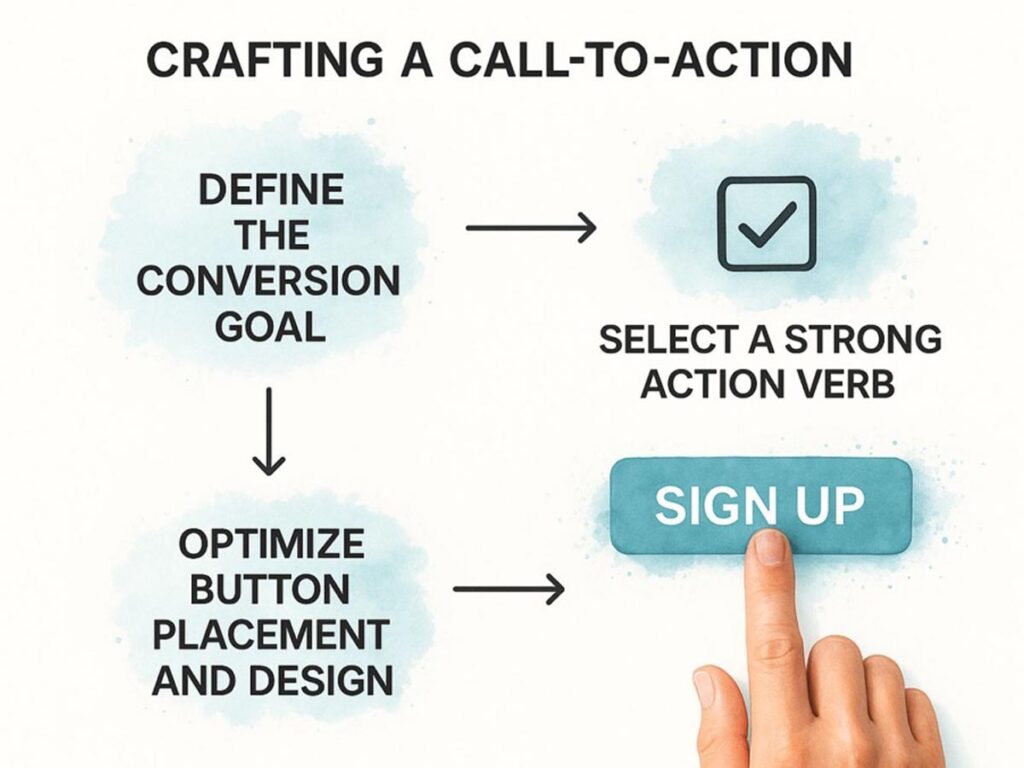
As you can see, an effective CTA is never an afterthought. It’s a strategic component built on clear goals and persuasive language.
Crafting Calls to Action That Drive Conversions
You’ve put in the work—you’ve written a magnetic headline and compelling body copy that keeps your reader engaged. But all that effort can go to waste if the final step falls flat. This is where your Call to Action (CTA) comes in. It’s the bridge between a visitor simply reading your page and actively taking the next step.
A weak or vague CTA leaves people hanging, unsure of what to do next. It can single-handedly stop a potential customer in their tracks.

Think of the CTA as the final, crucial instruction. It’s the moment you transform a reader’s interest into a measurable conversion. To do that, it needs to be crystal clear, concise, and persuasive.
Moving Beyond Generic Commands
One of the most common missteps is the use of generic, high-friction words on CTA buttons. You’ve seen them a thousand times: “Submit,” “Click Here,” or “Learn More.” These words are uninspired and, frankly, lazy. They don’t communicate any real value to the user and can absolutely kill your conversion rates.
Instead, your CTA copy should be laser-focused on the benefit. It needs to tell the user exactly what they will get by clicking. This simple shift removes hesitation and reframes the action as a win for them, not a task you’re asking them to complete.
Here are a few practical swaps that make a world of difference:
- Instead of “Submit,” try “Get My Free Audit.”
- Instead of “Sign Up,” use “Start Your Free Trial.”
- Instead of “Download,” go with “Send Me the Ebook.”
See the difference? These examples are packed with action and speak directly to the value the user will receive right now. Clicking becomes a logical and rewarding choice.
A great CTA reduces cognitive load by answering the question, “What happens next?” When the outcome is clear and desirable, the user is far more likely to take the requested action. This clarity is a cornerstone of conversion-focused copywriting.
The Power of A/B Testing Your CTAs
Even tiny tweaks to your CTA copy can lead to surprisingly big wins. This is where A/B testing becomes your best friend. It’s a straightforward method of comparing two versions of a page to see which one performs better, and it’s essential for optimizing your CTAs. This practice is a core part of making smart, data-driven decisions, a topic the U.S. General Services Administration covers well in their resources on making data-driven decisions.
You can test almost anything. For example, you could experiment with:
- Verb Choice: “Start Your Journey” vs. “Get Started Now”
- Benefit Framing: “Claim Your Discount” vs. “Save 20% Today”
- Button Color: A high-contrast color like orange vs. a more subtle blue
The key is to isolate one variable at a time. By measuring the results of these small changes, you can systematically improve your CTAs and dial in the highest possible conversion rate for your page.
Using Primary and Secondary CTAs
It’s important to remember that not every visitor is at the same point in their journey. Some are ready to buy this very second, while others are just starting their research. To cater to both, you need a smart strategy that uses both primary and secondary CTAs.
Primary CTA: This is your main goal—the single most important action you want someone to take. Make it impossible to miss with a bold, contrasting color. A perfect example is “Request a Quote.”
Secondary CTA: This is your alternative for people who aren’t quite ready to commit. It’s a lower-pressure option that keeps them engaged. It should be visually less prominent, maybe as a simple text link or a ghost button (an outlined button with no fill). For instance, “See Our Pricing Plans.”
This two-pronged approach gives your most qualified leads a direct path forward while creating an opportunity to nurture those who need a bit more information. It ensures you’re serving every type of visitor, which is how you maximize engagement and conversions across your entire website.
The Secret to Great Copy? Ruthless Editing.
Let’s get one thing straight: nobody writes a perfect first draft. Great copy isn’t just written; it’s meticulously rewritten. That initial draft is just the raw clay. The real magic happens in the editing phase, where you chisel away the fluff and sharpen your message until it’s powerful, persuasive, and drives action.
This isn’t just about catching typos. It’s about scrutinizing every single word and sentence. Does it earn its place? Does it move the reader forward? The goal is to cut anything that weakens your core message, bolster your key points, and polish the language until it’s crystal clear and perfectly on-brand.
Your Self-Editing Checklist for Sharper Copy
To edit your own work effectively, you need to step back and look at it through your audience’s eyes. It’s tough, but a checklist can force that objectivity.
- Is it crystal clear? If a sentence makes you pause even for a second, rewrite it. Ditch the jargon and complex phrasing.
- Is the tone right? Does the copy sound like your brand, consistently, from the first word to the last?
- Is it active and confident? Swap passive phrases for strong, active verbs. Instead of “Time is saved by our software,” write “Our software saves you time.” See the difference?
- Is it concise? Could you say the same thing in fewer words? Hunt down and eliminate every redundant word and filler phrase.
Here’s a pro tip that never fails: read your copy out loud. Your ears will catch awkward phrasing, clunky sentences, and a rhythm that just feels off. If it doesn’t sound right when you speak it, it won’t connect with your reader.
This simple auditory check is a game-changer for ensuring your copy has a natural, conversational flow. It helps bridge the gap between text on a screen and genuine human connection, which is a cornerstone of effective user experience. If you want to dig deeper into that connection, you can learn more about the principles of what is user experience design.
Tools That Help You Polish Your Work
While your brain is the best editing tool, a little help from technology can speed things up and provide data-driven insights.
I often recommend the Hemingway App to writers. It’s fantastic for quickly highlighting overly complex sentences, finding sneaky instances of passive voice, and flagging weak adverbs. It pushes you to write with the kind of bold clarity that keeps people reading.
Ultimately, remember that website copywriting is never truly “done.” Once your pages are live, the refinement continues. You’ll A/B test headlines, watch how users behave, and learn what truly connects with your audience. This ongoing cycle of improvement is what turns a good website into a great one. The value of this skill is undeniable—the global copywriting services market hit $25.29 billion in 2023 and is expected to reach $42.22 billion by 2030. Learn more about these copywriting statistics and trends on bloggingwizard.com.
At Galant Studios, we transform your website into your most powerful marketing asset. Our expert team combines strategic SEO with compelling copy to ensure your business not only ranks higher but also converts visitors into loyal customers. Let us help you tell your story and achieve your growth goals.