
A content calendar is much more than a simple to-do list; it’s the strategic blueprint for your entire marketing effort. It’s where you transform abstract business goals into a tangible plan, turning random posts into a proactive, conversion-focused strategy that builds authority and drives measurable growth. This document is the key to creating content with purpose.
Why a Content Calendar Is Your Secret Weapon

Many business owners see a content calendar as just another spreadsheet—one more tedious task on an endless to-do list. This view misses the immense strategic value it offers. A well-designed calendar isn't busywork; it's a powerful asset that converts scattered, last-minute efforts into a cohesive engine for growth.
Think of it this way: you wouldn't build a house without a blueprint. Why would you build your brand's online presence without one? A calendar provides the structure needed for a predictable, successful outcome. To fully appreciate this, it's worth understanding what a content calendar is and how it functions as a strategic tool, not just a schedule.
From Reactive Posting to Proactive Strategy
Without a plan, content creation is often a reaction—to a slow sales day, a competitor's post, or a fleeting moment of inspiration. This leads to inconsistent messaging, wasted effort, and missed revenue opportunities. A content calendar forces you to think ahead, ensuring every blog post, social media update, and video serves a specific business goal.
Here’s how this proactive approach creates tangible results for real businesses:
- A local HVAC contractor: Instead of scrambling during the first heatwave, they use their calendar to schedule seasonal maintenance guides months in advance. A spring article on "5 Signs Your AC Needs a Tune-Up" captures early-bird search traffic and generates service calls. A fall guide on "How to Prepare Your Furnace for Winter" addresses immediate customer needs, driving preventative maintenance appointments.
- A neighborhood boutique: The owner maps out her entire holiday promotion schedule by September. This detailed plan includes early-bird gift guides, a Black Friday email campaign, and last-minute "shop local" reminders, ensuring she captures maximum revenue during the peak retail season without the usual chaos.
This forward-thinking approach keeps your content timely, relevant, and purposeful. You stop chasing trends and start building a reliable resource that converts your audience into customers.
Building Authority and Boosting Local SEO
Search engines like Google reward consistency and authority. When you regularly publish valuable content centered on specific themes, you signal to algorithms that you are an expert in your field. A content calendar is the tool that makes this consistency achievable.
Each piece of content you schedule becomes another asset that can rank for valuable keywords, answer your customers' pressing questions, and build your topical authority. Over time, this sustained effort directly improves your visibility in search results, driving more organic traffic and qualified leads.
A content calendar shifts your focus from merely creating content to building a strategic asset. It's the blueprint that ensures every article you publish serves a distinct purpose, whether that's attracting new leads, nurturing existing customers, or establishing your brand as the go-to authority.
The data backs this up. Teams with a structured content plan see better results. For instance, teams that use planning tools in their workflow publish 42% more content on average. For a local business, that increased output creates significantly more opportunities to rank on Google and connect with paying customers. This report from StoryChief dives deeper into how planning directly impacts productivity and outcomes.
Building the Strategic Foundation for Your Calendar
Before you brainstorm a single topic, you must lay the groundwork. A content calendar without a solid strategy is just a list of ideas—it might look productive, but it won't drive sales or grow your business. The first step in creating a content calendar that works is getting crystal clear on what you want it to accomplish.
Too many businesses get stuck on vague objectives like "get more traffic" or "increase engagement." These aren't goals; they're wishes. To see a real return on your investment, you must set specific, measurable targets that directly support your bottom line.
Defining Clear and Measurable Goals
Your goals must be concrete, with a deadline and a number attached. This focus is what makes your content accountable and connects every article and social post back to a tangible business outcome.
Here are practical examples of strong, conversion-focused goals:
- Goal: Increase lead generation from organic search.
- Actionable Metric: Generate 25 qualified quote requests through our blog content within the next 90 days.
- Goal: Grow our local customer base.
- Actionable Metric: Increase our email subscriber list by 300 local residents through content downloads over the next quarter.
- Goal: Improve search engine visibility for core services.
- Actionable Metric: Achieve a top-5 ranking for our three most profitable service keywords in our city by the end of Q3.
When you set these kinds of benchmarks, your content has a clear job to do, and you have a clear way to measure its success. For a more robust framework, a comprehensive content marketing plan template can help align these goals with your bigger picture.
Identifying Your Core Content Pillars
With your goals defined, it’s time to establish your content pillars. These are the 3-5 core themes your brand will own—the foundational topics that directly address your customers' needs and showcase your expertise. Every piece of content you create should tie back to one of these pillars.
Content pillars keep your messaging consistent and help you build topical authority with both search engines and your audience. For a business focused on local SEO, these pillars should be a direct reflection of your services and what your community is searching for.
For example, a local financial advisor might build their strategy around these pillars:
- Retirement Planning for Small Business Owners: Actionable advice tailored to local entrepreneurs.
- Local Real Estate Investment: Guides on navigating the city's property market.
- College Savings Strategies: Educational content for families in the community.
- Tax Optimization Tips: Timely articles aligned with IRS deadlines and local regulations.
Suddenly, you have a deep well of content ideas. The "Retirement Planning" pillar alone could inspire articles on SEP IRAs, 401(k) rollovers, and succession planning—all hyper-relevant to your target audience. This structured approach is the heart of an effective content marketing strategy. To map out your own pillars, our content marketing strategy template can guide you.
Researching Your Local Audience
The final piece of your strategic foundation is knowing exactly who you're talking to. Creating content without audience research is like throwing darts in the dark. You must understand your local customers' pain points, questions, and motivations to create content that resonates and converts.
Start with your existing customers. Review emails and listen to sales calls. What questions come up repeatedly? Those are your first blog posts.
Your most profitable content ideas come directly from your customers. Pay close attention to the specific language they use and the problems they're trying to solve. This is the key to creating content that not only ranks but also converts leads into sales.
Use free tools to discover what people are searching for. A tool like AnswerThePublic uncovers the exact questions people are asking about your services. Look at local Facebook groups or community forums like Reddit. What challenges are people discussing? This research ensures every piece of content you schedule is purposeful, targeted, and primed for success.
Choosing Your Tools and Designing Your Workflow
With a solid strategy in place, it's time to bring your plan to life. This is where we move from theory to practice, selecting the right tools and building an editorial workflow that turns great ideas into published content smoothly and efficiently. The goal is to create a repeatable system that eliminates chaos and empowers your team to deliver high-quality work on schedule.
The specific tool you choose is far less important than the process you build around it. Whether you use a simple spreadsheet or a sophisticated project management platform, the key is finding what works for your team's size and budget.
The diagram below shows how those foundational strategic steps—goals, pillars, and research—must come first. They provide the "why" before you get into the "how" of tools and workflows.
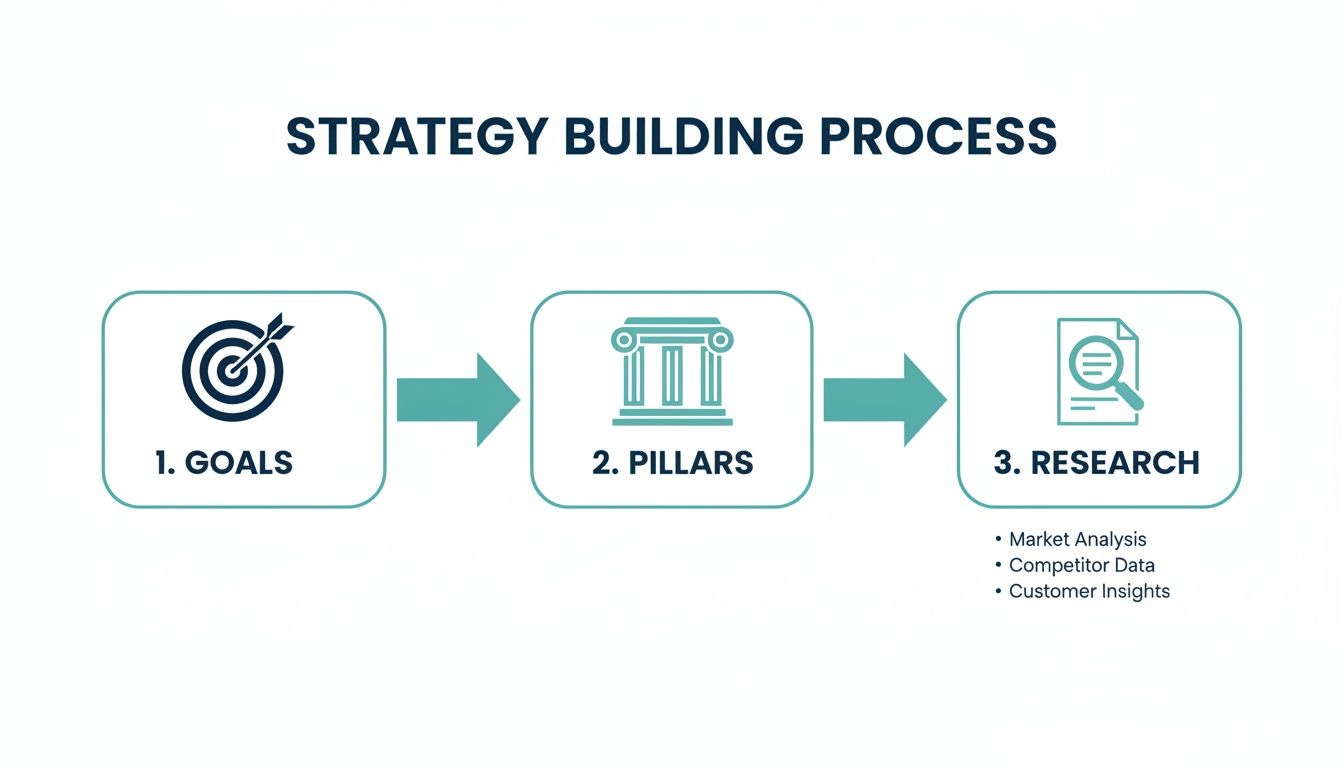
Think of this as your roadmap. A clear strategy provides the direction needed before diving into the mechanics of building the calendar itself.
Selecting the Right Content Calendar Tool
For many businesses, a well-organized spreadsheet is the perfect starting point. Tools like Google Sheets are free, collaborative, and incredibly flexible. As your operation grows, you might need more firepower, like task automation, team notifications, and integrated approval queues.
Here’s a quick comparison of popular options that work well for small businesses.
Comparison of Content Calendar Tools for Small Businesses
| Tool | Best For | Key Features | Pricing Model |
|---|---|---|---|
| Google Sheets | Solo creators & small teams on a budget. | Highly customizable, real-time collaboration, completely free. | Free |
| Trello | Visual planners who love a card-based system. | Kanban boards, checklists, easy drag-and-drop functionality. | Freemium |
| Asana | Teams needing robust project management. | Task dependencies, timeline views, detailed progress tracking. | Freemium |
| Airtable | Those wanting a hybrid spreadsheet-database. | Customizable views (grid, calendar, gallery), powerful filtering. | Freemium |
The right tool should make your life easier, not more complicated. Start simple. Only upgrade when you feel a genuine pain point that a more advanced tool can solve.
Designing Your Calendar Structure
No matter which tool you use, your content calendar needs several essential fields to be truly useful. These columns transform a simple topic list into a dynamic command center, giving everyone on your team clarity on what’s happening, when it’s due, and who’s responsible.
Your content calendar is the single source of truth for your entire content operation. Every key piece of information, from the target keyword to the publication status, should live here to keep everyone aligned and prevent costly miscommunication.
At a minimum, your calendar should include these fields:
- Publication Date: The exact day the content goes live.
- Topic/Headline: The working title optimized for clicks and SEO.
- Content Pillar: The strategic theme this topic supports.
- Target Keyword: The primary search phrase you're aiming to rank for.
- Format: The type of content (e.g., Blog Post, Video, Case Study).
- Author/Owner: The person responsible for creating the content.
- Status: The current stage of the piece (e.g., Ideation, Drafting, Review, Scheduled).
With this structure, anyone on your team can get a complete overview of the content pipeline at a glance.
Mapping Your Editorial Workflow
A documented workflow is the engine that drives your content calendar. It defines the exact stages a piece of content moves through, from idea to published and promoted asset. This clarity is crucial for maintaining momentum and spotting bottlenecks before they derail your schedule.
A practical workflow can be broken down into these steps:
- Ideation: Brainstorming and vetting new topics based on goals and research.
- Briefing: Creating a detailed outline with the target keyword, audience, and key talking points.
- Drafting: Writing the first version of the content.
- Review & Editing: Checking the draft for accuracy, clarity, tone, and SEO optimization.
- Scheduling: Uploading the final content into your CMS and setting the publish date.
- Promotion: Planning and executing distribution across other channels (social media, email newsletter, etc.).
By defining each stage and assigning ownership, you create a predictable and scalable system for producing high-quality content consistently.
Filling Your Calendar with High-Impact Content Ideas

An empty calendar is just a to-do list. The real value is created when you fill it with content ideas that genuinely connect with your audience and compel them to take action. This process feels less daunting when you know where to look for inspiration.
The secret is to stop thinking about "making content" and start focusing on solving your customers' problems. Every idea should be grounded in a deep understanding of who they are and what they need. A great way to build this is by creating detailed profiles of your ideal customers. If you're new to this, our guide on how to create buyer personas walks you through the entire process.
Uncover What Your Community Is Searching For
Your customers are constantly revealing what they want through their search queries. Basic keyword research allows you to discover the exact questions they’re asking and the problems they’re trying to solve.
For a local business, the gold is in long-tail, location-specific keywords. These are the longer, more descriptive phrases people use when they are close to making a purchase decision.
- A local roofer might find that instead of "roof repair," people are searching for "cost to fix roof leak in [City Name]."
- A financial advisor could discover queries like "best retirement planner for small business owners in [Neighborhood]."
These aren't just keywords; they are clear signals of customer intent. Each one can become a blog post, a short video, or a social media guide that directly answers a real, local need and drives qualified leads.
Find Your Opening by Analyzing Competitors
Your local competitors are a fantastic source of market intelligence. By analyzing what’s working for them, you can understand what resonates with your shared audience. More importantly, you can identify the gaps they've left wide open for you.
Pick your top three local competitors and review their blogs and social media. What topics generate the most comments and shares? Which of their services do they promote most heavily?
Don’t just copy what your competitors are doing. Look for what they’re not doing. If they all have detailed service pages but no customer case studies, that’s your opportunity. If they write expert-level guides but have no content for beginners, you can fill that void and capture a different segment of the market.
This analysis helps you position your content strategically. By offering a unique perspective or going deeper on a topic, you can immediately differentiate your business and attract customers they are ignoring.
The Power of Smart Content Repurposing
Creating high-quality content from scratch is time-consuming. That’s where content repurposing becomes your secret weapon for efficiency. It’s the key to maintaining a consistent publishing schedule without burning out.
The concept is simple: take one large, valuable piece of content—a "pillar" or "cornerstone" asset—and break it down into multiple smaller pieces for different platforms. This strategy maximizes the ROI of your initial effort and gets your message in front of your audience in various formats.
For instance, one in-depth guide on a core service could be repurposed into:
- A short explainer video for YouTube and your website.
- A series of five social media tips posted over a week on Instagram and Facebook.
- An infographic visualizing the key steps for Pinterest and LinkedIn.
- A highlight in your email newsletter driving traffic back to the full guide.
This method does more than just fill your calendar; it builds momentum and reinforces your message across channels. It's a powerful way to work smarter, not harder. You can learn more about how scheduling impacts performance in this guide from InfluenceFlow.
Executing and Measuring Your Content Plan
A perfectly organized content calendar is a great start, but it's only half the battle. Its true value is realized through execution and analysis. Even brilliant content ideas will fail if the final piece isn't optimized for search and you aren't tracking what happens after you hit "publish."
This is where your planning translates into performance. It’s the process of turning a static document into a dynamic, results-driven engine for your business. It starts with a simple pre-publishing checklist to ensure every detail is right before your content goes live.
Your Pre-Publishing Optimization Checklist
Before you schedule any post, run it through a final quality check with a sharp focus on SEO and conversions. This goes beyond proofreading; it’s about making sure your content speaks effectively to both your customers and search engines.
A practical pre-flight check should include these essentials:
- Optimized Title Tag and Meta Description: Does your title include the primary keyword and your city? Is the meta description a compelling summary that makes searchers want to click?
- Strategic Internal Linking: Have you linked to 2-3 other relevant pages or posts on your site? This helps Google understand your site’s structure and keeps visitors engaged longer.
- Location-Specific Language: Have you naturally included names of local neighborhoods, landmarks, or phrases like "near me" that people in your community search for?
- Clear Call-to-Action (CTA): What is the one thing you want the reader to do next? Every piece of content needs a clear next step, whether it’s "Request a Quote," "Call Us Today," or "Download Our Guide."
This systematic review builds consistency and extracts every bit of SEO potential from your content calendar.
Tracking the Metrics That Actually Matter
Once your content is live, your job shifts from creation to analysis. It's easy to get lost in data, but you only need to monitor a handful of key metrics to understand what's driving results. You can get everything you need from free tools like Google Analytics and Google Search Console.
The goal isn’t to track every number. It's to pinpoint the specific data that connects your content directly to your business goals. This is how you prove your content is working and make smarter decisions for the next quarter.
Focus on performance indicators that signal a real impact on your bottom line. For a more detailed breakdown, our guide on how to track SEO performance dives deep into meaningful analytics.
For a local business, these are the metrics that count:
- Organic Traffic & Leads: How many visitors and, more importantly, how many conversions (form fills, phone calls) are coming from your content?
- Keyword Rankings: Are you climbing the search results for your target local keywords? Track your position over time in Google Search Console.
- Conversion Rate: Of the people who read your content, what percentage takes the desired action? This tells you how persuasive your content is.
- Click-Through Rate (CTR): Are people in search results actually clicking on your link? A low CTR may indicate your headline or meta description isn't compelling enough.
Performing a Quarterly Content Audit
Your content calendar should be a living document that evolves based on real performance data. The best way to facilitate this is with a quarterly content audit.
Block out time every three months to review the numbers. Pull a list of your best- and worst-performing content from the last 90 days.
Then, ask these critical questions:
- What Worked? Did posts about a specific service consistently generate leads? Double down on that content pillar.
- What Flopped? Did certain topics or formats fail to resonate? Either cut your losses or re-imagine the topic from a new angle.
- Are There Update Opportunities? Can you refresh a high-performing post from last year with new data or images to give it another boost in the rankings?
This regular review cycle transforms your content calendar from a simple schedule into an intelligent, adaptive strategy. It ensures every new piece of content is backed by data, giving you the best possible chance to connect with your audience and grow your business.
Frequently Asked Questions
Even with a great plan, practical questions always arise during implementation. Here are answers to some of the most common questions business owners ask when building their first content calendar.
How Far in Advance Should I Plan My Content?
Finding the right balance between long-term strategy and short-term agility is key.
For most businesses, planning content one month in advance is the sweet spot. This provides enough time to be strategic and create high-quality assets without being too rigid to adapt to new trends or opportunities.
A hybrid approach works best: sketch out your major themes and promotional campaigns on a quarterly basis. Then, fill in the specific topics and post details one month at a time. This way, you have a clear direction for the quarter but can remain flexible week to week.
What Is the Most Important Field in a Content Calendar?
While every field serves a purpose, the most critical for workflow management is the "Status" column.
"Topic" and "Publish Date" tell you what you're doing, but "Status" tells you where things stand. It turns your calendar from a static list into a dynamic project management tool.
Common statuses include:
- Idea
- Outlined
- Drafting
- In Review
- Scheduled
- Published
A quick scan of this column instantly reveals bottlenecks (e.g., three articles stuck in "Review") and ensures you always have content ready to publish, eliminating last-minute panic.
How Do I Find Time to Manage a Content Calendar?
This is the biggest hurdle for many. The thought of adding another task can feel overwhelming. However, a content calendar is a time-saving tool, not a time-wasting one.
The secret is to batch your work. Don't try to plan a little each day. Instead, block off a dedicated chunk of time to plan the entire month ahead.
A content calendar doesn't create more work; it organizes the work you're already doing. By batching your planning, you eliminate the daily scramble for ideas and the mental energy wasted on deciding what to post next.
For example, set aside 2-3 hours on the last Friday of each month. Use that time to brainstorm ideas, do keyword research, and fill in the calendar for the next 30 days. This single, focused session will buy you an entire month of clarity and smooth execution. The principles are similar for all types of planning, as seen in guides for building social media calendars, which also emphasize batching to save time and improve consistency.
Ready to stop guessing and start growing? At Galant Studios, we build data-driven SEO and content strategies that turn your website into a powerful lead-generation machine. Let our experts craft a plan that gets you seen by the right local customers. Visit us at Galant Studios to learn more.