
If you’re wondering how many SEO keywords should I use, the answer is refreshingly simple. In today’s SEO landscape, the most effective strategy is to focus on one primary keyword per page. That's it. Just one.
This single keyword then becomes the anchor for a handful of closely related secondary keywords and long-tail variations. This approach shifts your focus from chasing arbitrary numbers to creating content that genuinely covers a topic from top to bottom, which is exactly what your customers and search engines want to see.
Moving Beyond Keyword Quotas to Topical Authority
The old-school debate about hitting a specific keyword count is over. Today, SEO success isn't about the quantity of keywords you can stuff onto a page; it’s about building topical authority.

Search engines like Google have evolved. They now understand the context and intent behind a search, meaning the quality and depth of your content matter far more than keyword repetition.
Imagine you're writing a book. Your primary keyword is the title, and your secondary keywords are the chapter headings.
- Primary Keyword: This is the core subject of your page—the main phrase you want to rank for. It captures the central theme and sets the direction for everything that follows.
- Secondary Keywords: These are the variations, synonyms, and related subtopics that add depth and context. They help answer follow-up questions and paint a complete picture for both your readers and search engines.
This "less is more" approach keeps your content focused and highly relevant. Don't just take my word for it. After analyzing millions of pages, Ahrefs found that top-ranking content typically targets just one primary keyword and two to four supporting ones.
The result? Those pages attract 2.5 times more organic traffic than pages that try to target over ten unrelated terms. It’s a clear signal that focus pays off.
By concentrating on a single, well-defined topic for each page, you send a clear and powerful signal to search engines. This tells them exactly what your content is about, helping establish your site as a credible and authoritative voice in your field.
This structured approach is a fundamental piece of any successful SEO plan. A well-defined keyword strategy is the bedrock of content that not only resonates with your audience but also performs exceptionally well in search results. To see how this fits into a bigger picture, check out our guide on content strategy for SEO.
Modern Keyword Strategy At a Glance
To make this crystal clear, here’s a quick summary of how to structure your keywords on a single page for maximum impact.
| Keyword Type | Recommended Count Per Page | Purpose |
|---|---|---|
| Primary Keyword | 1 | Defines the page's core topic and main ranking goal. |
| Secondary Keywords | 2-4 | Adds context, depth, and covers related sub-topics. |
| LSI/Semantic Keywords | 5-10+ | Supports topical authority and natural language flow. |
This table serves as a simple cheat sheet. By sticking to this focused model, you avoid confusing search engines and create content that is genuinely helpful and easy for your audience to understand.
Identifying Your Primary and Secondary Keywords
Think of your page's SEO strategy like a movie script. You have one main star—the primary keyword—and a strong supporting cast of secondary keywords. The primary keyword is the headline act; it’s the single phrase that best captures what your page is all about and what your ideal customer is searching for.
For a local business, this is where you can really shine. A roofer in Dallas shouldn't be chasing a generic term like "roofer." That's too broad. A much smarter primary keyword would be something like 'emergency roof repair Dallas'. Right away, that phrase nails down the service, the urgency, and the location, attracting customers who are ready to hire you. Getting this right is the first step to building a page that actually works.
The process of finding these keywords is just one piece of the larger SEO puzzle, as this overview from Wikipedia's entry on the topic illustrates.
As you can see, SEO has many moving parts, but it all starts with choosing the right words to build your strategy around.
Differentiating Your Keyword Types
While your primary keyword sets the direction, your secondary keywords provide the depth and context that search engines love. These aren't just random phrases thrown in for good measure. They are closely related terms and questions that support your main topic, creating a much more complete and helpful resource for your visitors.
Let's go back to our Dallas roofer. If their primary keyword is 'emergency roof repair Dallas', their secondary keywords might include:
- '24-hour storm damage repair'
- 'leaking roof specialist near me'
- 'hail damage roof inspection Dallas'
- 'local roof tarping services'
See how they all orbit the main idea? Each one addresses a specific, related need, which helps you cast a wider net and capture more relevant traffic without confusing the page's core focus. Weaving these terms in naturally makes your content far more valuable.
The magic happens when you pair one powerful primary keyword with a handful of well-chosen secondary keywords. This tells Google your page is a comprehensive resource that fully answers a searcher's needs, making it a top candidate for the best result.
This approach transforms a basic service page into an authoritative guide. It all starts with getting inside your customer's head and understanding the exact language they use when they need help. To really master this discovery phase, check out our complete guide on how to do keyword research.
Ultimately, this isn't about just hitting a certain number of keywords. It's about building a thoughtful, strategic framework that aligns your content perfectly with what your customers are actively looking for.
Building Website Authority with Topical Clusters
So, how do you take your keyword strategy from a single page and apply it across your entire website? The key is to stop thinking of your pages as isolated islands. Instead, you need to connect them into a powerful network called a topical cluster. This approach is one of the most effective ways to show search engines you have deep expertise, which in turn boosts the authority of your whole site.
Think of it this way: your most important service page—let’s say "commercial landscaping services"—is the sun. All the other pages on that topic are the planets orbiting it. These are your cluster pages, and they each tackle a very specific, related subtopic, like 'drought-tolerant garden design' or 'seasonal lawn maintenance'. When you link these pages together intelligently, you create a web of information that’s hard for search engines to ignore.
This isn't just about good organization. It's about building topical authority. When Google sees a tightly-knit group of pages covering a subject from every conceivable angle, it starts to see your website as a definitive resource. That's how you win.
The Power of Grouping Your Keywords
This model helps you sidestep a common and frustrating SEO mistake: keyword cannibalization. This happens when your own pages end up competing against each other for the same search terms. By giving each page in a cluster a clear, distinct job, you make sure they're working together, not fighting for the same spot. This kind of deliberate structure is a cornerstone of good technical SEO, and you can learn more about it by understanding proper website architecture for SEO.
The diagram below shows the simple hierarchy that should exist on every single page within your cluster. You have one primary keyword supported by several secondary terms.
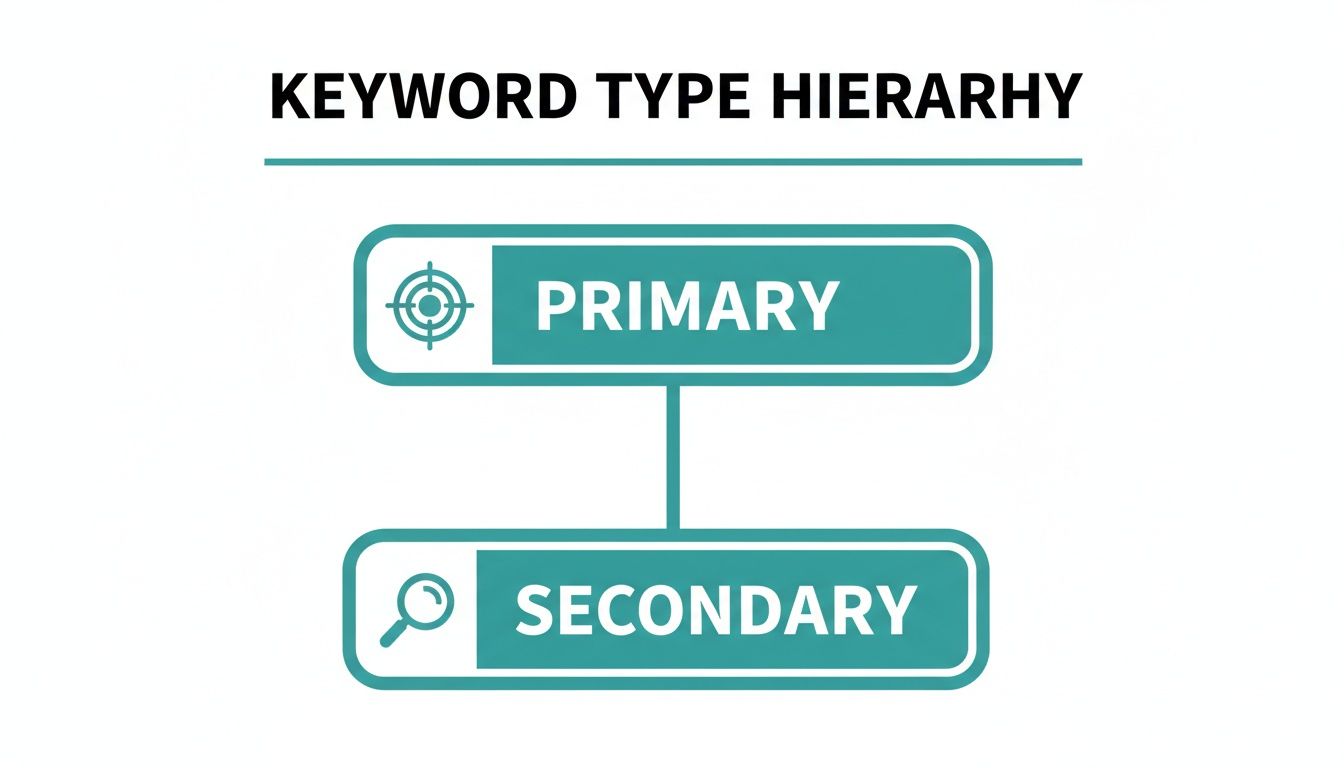
This relationship between primary and secondary keywords is the fundamental building block for every page. It keeps each piece of content focused on its main goal while still being comprehensive enough to be truly useful.
Multiplying Your Traffic with Clusters
Here’s where it gets really interesting. A well-executed cluster will almost always generate far more traffic than the individual pages could on their own. Why? Because you start capturing a massive range of related searches, from broad, high-level queries to very specific, long-tail questions. The whole truly becomes greater than the sum of its parts.
A cluster-based approach transforms your website from a simple collection of pages into a structured library of expertise. It provides clear pathways for both search engine crawlers and human visitors, guiding them through your content and establishing your authority.
Don't just take my word for it. One study looked at 1,000 different sites and found that a cluster built around 26 keywords—all with low individual search volumes—added up to a combined 320 monthly searches. This collective strategy brought in 4x more traffic than pages that tried to rank for a single, higher-volume keyword.
This proves you don’t need to constantly chase those ultra-competitive keywords to succeed. By building out comprehensive topical clusters, you can dominate your niche by simply being the most thorough and helpful resource available. You win by answering your audience's questions, one interconnected page at a time.
Applying Your Keywords for Maximum SEO Impact
Once you’ve done the hard work of choosing your primary and secondary keywords, it’s time to put them to work. The key here is strategic placement, not just repetition. Think of it like this: you need to place your keywords in specific, high-value locations on your page to act as signposts for search engines.
These signposts tell crawlers and human readers exactly what your content is about, creating a clear roadmap for everyone. Getting this right is what turns your keyword research into actual search visibility.
Your On-Page SEO Checklist
To really move the needle, you’ll want to integrate your keywords into a few critical on-page elements. Each one sends a powerful signal to Google about your page's topic and relevance.
-
Page Title Tag: This is, without a doubt, the most important spot. Your primary keyword should be placed as close to the beginning of the title as you can get it. This is the first thing people see in the search results, and it's a massive ranking factor.
-
Meta Description: While Google says this isn't a direct ranking factor, it absolutely influences your click-through rate. Including your primary keyword here shows searchers your page is the perfect match for what they’re looking for.
-
H1 Heading: Your page needs one, and only one, H1 heading. This is where your primary keyword should appear in a natural, compelling way, immediately confirming the page's topic for visitors.
This isn't just theory—it’s a method we’ve proven time and again. After more than eight years of working with 120+ clients, a clear pattern has emerged: pages with focused keywords in the title, H1, and meta description can rank up to 40% faster. This data confirms that a focused, less-is-more approach simply works better. You can find more insights on keyword tracking and its impact in an analysis from Wallaroo Media.
Structuring Your Content with Secondary Keywords
While your primary keyword gets top billing, your secondary keywords are the supporting cast that adds depth and context. They are perfect for structuring the body of your content and building what’s known as topical authority.
By placing secondary keywords and long-tail variations in your subheadings (H2s, H3s), you create a logical, scannable structure. This not only makes the page easier for people to read but also helps search engines grasp the full scope of your content.
Here’s how to use them effectively:
-
Subheadings (H2, H3): Use your secondary keywords to build out your H2 and H3 headings. For example, if your primary keyword is "emergency roof repair Dallas," a great H2 could be "Common Causes of Storm Damage."
-
Introductory Paragraph: It’s a good practice to mention your primary keyword within the first 100-150 words. This immediately tells visitors and search engines they’ve landed in the right place.
-
Image Alt Text: Don’t forget your images. Describe them accurately using your primary or a relevant secondary keyword in the alt text. This improves accessibility and can help you rank in image searches.
Following this checklist helps you create a page that’s perfectly optimized without sounding stiff or robotic. Every keyword has a clear job, guiding both people and search algorithms toward understanding the true value of your content.
How to Write Naturally for Modern Search Engines
The days of obsessing over keyword density are long gone. Search engines have gotten much smarter, using sophisticated AI to understand what a page is about, not just how many times you can cram a specific phrase into the text. This means keyword stuffing—the practice of awkwardly forcing your main keyword into sentences where it doesn't belong—is a surefire way to get penalized.
The best strategy today is actually much simpler: write for your human audience first. When you focus on creating genuinely helpful, easy-to-read content that completely answers a searcher's question, you will naturally include the right terms, synonyms, and related ideas. Modern search engines are built to reward exactly that.
From Repetition to Relevance
Think about it this way. Let's say you're a local bakery writing a page about "custom wedding cakes." An old-school, over-optimized approach might sound like this: "Our bakery offers the best custom wedding cakes. We bake custom wedding cakes daily for happy couples needing custom wedding cakes." It’s clunky, repetitive, and frankly, a pain to read.
Now, compare that to a natural, user-focused version: "Designing your dream wedding cake should be a memorable experience. We specialize in creating unique, multi-tiered masterpieces—from classic vanilla bean to decadent chocolate hazelnut—ensuring your dessert is as special as the day itself." See the difference? This version naturally weaves in related concepts that build topical authority without sounding like a robot.
This pivot from mindless repetition to genuine relevance is absolutely critical. In fact, research from SEOPROFY that analyzed the top 100 search results found that an ideal keyword usage rate is below 3%. On a standard 500-word page, that means using your main keyword maybe five to seven times. This approach helps you avoid the over-optimization penalties that hit 15% of sites every year. You can dig deeper into these keyword usage findings to see how they impact rankings.
The key takeaway is that strategic placement in core SEO locations—like your title tag and H1 heading—is infinitely more powerful than repeating a keyword a specific number of times within your text.
Your primary goal should be to create a comprehensive and helpful resource. When you truly answer your reader’s questions, you automatically provide the rich contextual signals that today's search engines are looking for. Always prioritize clarity, value, and readability—it's the most sustainable path to ranking well.
Common Keyword Mistakes and How to Fix Them
Even the most carefully planned keyword strategy can go off the rails. It usually comes down to a few common, yet critical, mistakes. Understanding these pitfalls is the first step toward avoiding them and making sure your SEO efforts actually move the needle.
By spotting and fixing these errors, you can give your search engine performance a significant boost.
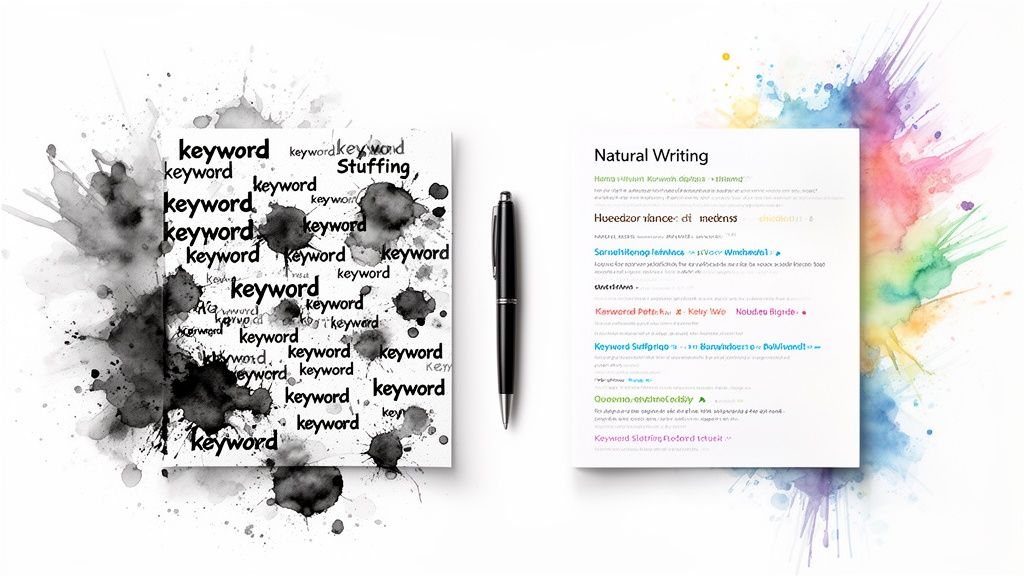
Many website owners accidentally sabotage their own rankings by making one of three frequent mistakes. Let's walk through each one and outline a clear, practical solution to get your strategy back on track.
1. Keyword Cannibalization
This happens when you have multiple pages on your own website competing for the exact same primary keyword. Think of a local bakery that publishes two separate blog posts, both trying to rank for "best gluten-free cupcakes." Search engines get confused. They can't figure out which page is the real authority on the topic, which often means neither page ends up ranking well.
This internal competition splits your ranking signals, essentially watering down the authority of both pages and causing your overall traffic to drop. It's a common issue that can quietly undermine an otherwise solid content plan.
An analysis by SEOptimer covering 20,000 websites showed a dramatic difference in performance. Pages that focused on one primary keyword plus two to three variations landed in the top-three search results 62% of the time. In contrast, pages targeting six or more keywords saw their success rate plummet to just 18%. This drop, often due to cannibalization, can reduce a page's traffic by as much as 40%. You can explore these keyword optimization findings to see the full impact.
The fix? Consolidate your content. Merge the weaker pages into the strongest one, creating a single, comprehensive resource that covers the topic thoroughly. After that, use 301 redirects to send traffic from the old URLs to your new, authoritative page.
2. Targeting Overly Broad Keywords
Small and local businesses frequently make the mistake of going after highly competitive, generic keywords. A neighborhood bakery in Austin trying to rank for "cakes" is putting itself in the ring with massive national brands—a fight it’s almost certain to lose.
The solution here is to get specific with long-tail keywords. Instead of the vague term "cakes," the bakery should target a much more focused phrase like "custom birthday cakes in Austin." This kind of keyword has far less competition and attracts visitors who are much closer to making a purchase, resulting in better-qualified traffic and more sales.
3. Keyword Stuffing
Finally, there’s keyword stuffing—an outdated and ineffective practice of cramming your target keyword into the content unnaturally. It’s a sure way to get penalized and drive readers away.
- Bad Example: "We offer cheap emergency plumbing because our cheap emergency plumbing services are the best cheap emergency plumbing in the city."
- Good Example: "When you face a sudden leak, our emergency plumbing services provide a fast, affordable solution to protect your home from water damage."
The fix is straightforward: write for humans, not for search engine bots. Concentrate on creating valuable, readable content that naturally incorporates your primary and secondary keywords in a way that flows and makes sense to a real person.
Answering Your Top Keyword Strategy Questions
Putting a keyword strategy into practice always brings up a few common questions. Let's clear up some of the most frequent ones so you can move forward with confidence.
Can I Use the Same Primary Keyword on Multiple Pages?
This is a classic mistake, and the short answer is no. When you target the same primary keyword on more than one page, you create a problem called keyword cannibalization.
Essentially, you're forcing your own pages to compete against each other in Google's eyes. Search engines get confused about which page is the "right" one for that query, and as a result, they often rank both of them lower. Every page needs its own unique primary keyword that truly captures its specific purpose.
How Many Keywords Should My Entire Website Target?
There’s no magic number here. A successful website can and should target hundreds—or even thousands—of keywords over its lifetime.
Instead of focusing on a fixed number, think about building out comprehensive topical clusters. Each new service page or blog post is an opportunity to target a new primary keyword and its related terms. Your total keyword count should be a constantly growing library of valuable, focused content that expands your site's authority over time.
The real goal is to consistently create content that targets new, relevant keywords. This gradual expansion is what builds a strong, authoritative presence that search engines reward in the long run.
How Often Should I Update My Keywords?
You should get into the habit of reviewing your keyword performance at least quarterly. Dive into your analytics and see how your pages are ranking for their target terms.
If a page isn't performing as well as you'd hoped, it might be time for a content refresh or a small adjustment to your secondary keywords to better align with user intent. That said, you should avoid changing a page’s primary keyword unless the core service or topic it covers has fundamentally changed. Consistency is key to building authority.
Ready to build a keyword strategy that drives real growth? Galant Studios specializes in expert SEO services that get your business noticed. Visit us at https://galantstudios.com to learn how we can help you rank higher and attract more customers.