Choosing the right way how to pick keywords isn’t just about plugging ideas into a tool and chasing high-volume search terms. It’s about strategy. It’s about deeply understanding your customer and aligning every piece of content with your core business goals. The entire process starts not with a tool, but with a clear picture of what you want to achieve and who you want to attract. This is how you find the keywords that don’t just bring traffic—they bring customers.
Building Your Strategic Keyword Foundation

Powerful keyword research begins long before you open any software. It starts with a firm grasp of your business objectives and the specific people you’re trying to reach. A common mistake is chasing vanity metrics—high-volume keywords that look impressive but deliver traffic that never converts. The real goal is to build a strategy where every single keyword serves a direct purpose for your business, attracting not just any visitor, but the right visitor.
A strong keyword foundation is essential for long-term success. It’s one of the most reliable strategies for consistent traffic growth, especially when adapting to constant search engine updates. When you get this alignment right, you stop wasting resources and start generating meaningful results.
Define Your Content Objectives
First, ask yourself a critical question: what do you want this content to do? Before compiling a list of potential terms, get crystal clear on your goals.
Are you trying to:
- Increase brand awareness and become a known authority?
- Generate qualified leads for your sales team?
- Drive direct sales through your e-commerce platform?
- Educate and retain your existing customers?
Each objective demands a completely different keyword strategy. For instance, a business focused on lead generation should zero in on keywords that signal a user is actively evaluating solutions, like “best software for project management.” Conversely, a brand aiming to build awareness would target broader, informational queries like “what is agile methodology” to cast a wider net.
Clearly defined goals act as your filter. They empower you to discard irrelevant keywords and focus your energy on terms with the highest potential to impact your bottom line.
Map Your Customer’s Journey
Understanding the path a customer takes—from realizing they have a problem to making a purchase—is non-negotiable. This journey has distinct stages, and the language people use changes dramatically at each step. By mapping this process, you can create content that meets users exactly where they are, building trust and guiding them toward your solution.
Let’s break down the journey into actionable stages:
Awareness Stage: The customer has a problem but might not have the words to describe it. Their searches are broad and informational. For a company selling ergonomic office chairs, a user at this stage might google “why does my back hurt at work.” This is your chance to be the helpful expert.
Consideration Stage: Now, the customer is actively researching solutions. They’re comparing different products, brands, and features. Their searches become more specific, like “best ergonomic chairs for lower back pain.” Here, you can position your solution against competitors.
Decision Stage: The customer is ready to buy. They’re looking for transactional signals—pricing, reviews, discounts, and where to purchase. Their queries are highly specific and commercial, such as “buy Herman Miller Aeron chair online.” This is where you close the sale.
By aligning keywords with each stage of this journey, you create a seamless content experience that guides a potential customer from their initial pain point directly to your solution. This approach transforms you from a seller into a trusted advisor.
Brainstorming seed keywords from the perspective of each stage ensures you develop a balanced content strategy. It shifts the focus from just selling a product to solving the customer’s problem—the real key to building a loyal audience and driving conversions.
Mapping Keyword Intent to Your Content Funnel
To put this into practice, you need a framework that matches user intent with the right kind of content. When you know why someone is searching, you can deliver exactly what they need, building credibility and satisfying Google’s algorithm at the same time.
| User Intent | Description | Example Keywords | Ideal Content Type |
|---|---|---|---|
| Informational | The user is seeking knowledge or answers. They are in the early stages of their journey. | “how to improve posture,” “benefits of standing desks” | In-depth blog posts, guides, infographics, videos |
| Navigational | The user wants to find a specific website or brand. They already know where they want to go. | “Herman Miller official site,” “Steelcase chairs login” | Your homepage, branded landing pages |
| Commercial | The user is investigating products with intent to buy soon. They are comparing options. | “best office chairs under $500,” “ergonomic chair reviews” | Comparison articles, product reviews, case studies |
| Transactional | The user is ready to make a purchase and is looking for a place to do it. | “buy Aeron chair,” “discount on office furniture” | Product pages, ecommerce category pages, pricing pages |
Using a map like this helps you visualize your entire content funnel. It ensures you’re not just creating content for people ready to buy today, but also building valuable relationships with future customers at every stage of their decision-making process.
How To Uncover High-Impact Keyword Opportunities
With a solid strategic foundation, it’s time to find the specific keywords that will bring your plan to life. This is where you transition from a simple ‘seed’ list to a rich database of high-impact opportunities. The goal isn’t just to amass a massive list of terms; it’s to identify strategic keyword clusters with genuine business potential.
There’s a reason the global keyword research tools market is so valuable. Consider this: over 90% of online experiences begin with a search engine, and organic search drives approximately 53% of all website traffic. Your ability to pick the right keywords is directly tied to your digital visibility and, ultimately, your bottom line.
From a Single Idea to a Full Content Plan
Let’s walk through a practical example. Imagine your business sells eco-friendly shipping supplies, and your core seed keyword is “sustainable packaging.” It’s a solid starting point, but far too broad to build a focused content strategy around. We need to expand this single idea into a comprehensive plan that speaks to different user needs.
By plugging “sustainable packaging” into a tool like Google Keyword Planner or Semrush, you can instantly uncover a wide range of related terms. The initial results might show variations like:
- eco-friendly packaging solutions
- biodegradable packing materials
- compostable mailers for small business
- recyclable shipping boxes wholesale
Immediately, these variations give you more specific paths to explore. They reveal the different language your audience uses and hint at their underlying goals—whether they’re looking for general information or sourcing specific products for their business.
Expanding Your Reach with Long-Tail and Question Keywords
The real magic happens when you dig deeper for long-tail keywords and question-based queries. These longer, more specific phrases have lower search volume individually, but they carry much higher intent to convert. Someone searching for “sustainable packaging” is browsing. Someone searching for “where to buy compostable mailers for clothing” is ready to make a purchase.
To find these gems, use your tool’s features to isolate questions or filter for keywords with more than four words. For our “sustainable packaging” example, this process could uncover high-value queries like:
- What is the most environmentally friendly packaging? (Informational intent—perfect for a comprehensive guide.)
- Are biodegradable peanuts better than styrofoam? (Commercial investigation—ideal for a comparison article.)
- Cost of sustainable packaging for e-commerce (Transactional intent—perfect for a pricing guide or product category page.)
These question-based keywords are pure gold. They give you direct insight into your audience’s pain points and knowledge gaps, essentially handing you a ready-made list of content topics that will resonate deeply.
Uncovering Competitor Keywords
One of the most effective shortcuts to finding high-impact keywords is to see what’s already working for your competitors. By identifying the terms driving traffic to their sites, you get a proven roadmap of topics that connect with your shared audience.
Most major SEO tools, like Ahrefs and Semrush, let you enter a competitor’s domain and see exactly what they rank for. Look for keywords where they rank on the first page but not in the top three spots. These are “striking distance” opportunities where creating superior content could allow you to leapfrog them. For e-commerce businesses, a crucial part of this process involves thorough Amazon PPC keyword research, which has its own unique nuances.
By systematically expanding your seed list, digging into long-tail queries, and ethically spying on your competition, you can transform a simple idea into a powerful, data-driven content plan.
Making Sense of Keyword Metrics and Data
Generating a massive list of keywords is the easy part. The real skill lies in turning that raw data into a coherent strategy that drives results. This means getting comfortable with the core metrics you’ll find in any keyword research tool: Search Volume, Keyword Difficulty, and Cost Per Click (CPC). Understanding what these numbers truly represent is the key to making smart, profitable decisions.
A classic mistake is fixating only on keywords with the highest search volume. While tempting, these terms are almost always hyper-competitive and attract an audience with broad, undefined intent. A keyword with lower volume but high specificity is often far more valuable because it captures someone who is ready to buy.
The image below perfectly illustrates this trade-off, comparing three sample keywords across search volume and keyword difficulty.
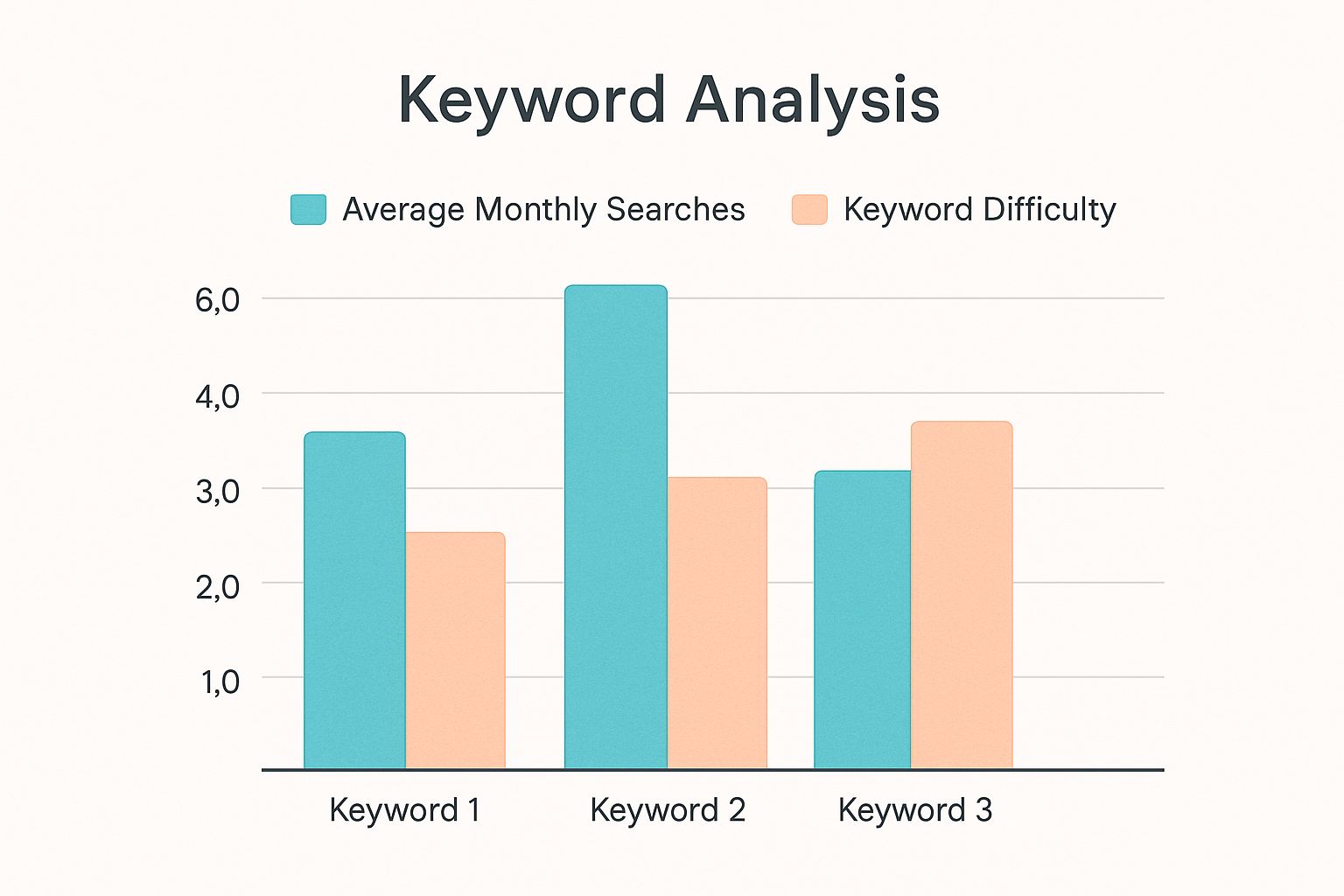
As you can see, every keyword strategy is a balancing act between opportunity and competition.
Interpreting Core Keyword Metrics
To build a practical keyword qualification process, you need to evaluate potential terms on a blend of opportunity, competition, and relevance to your business goals. Let’s break down the most important metrics you’ll be working with.
Search Volume: An estimate of how many times a keyword is searched per month. It’s a good starting point for gauging potential traffic, but it should never be your only factor. High volume often means high competition and very general user intent.
Keyword Difficulty (KD): Usually shown as a score from 0-100, this metric from tools like Ahrefs or Semrush estimates how hard it will be to rank on the first page of Google. It’s calculated by analyzing the authority and backlink profiles of the pages that already rank. If your website is new, targeting keywords with lower KD scores is a much more realistic path to success.
Cost Per Click (CPC): This tells you what advertisers are willing to pay for a single click on an ad targeting a specific keyword. Even if you’re focused on organic SEO, a high CPC is a powerful clue. It signals strong commercial intent—meaning people who search that term are looking to spend money.
My favorite opportunities are “sweet spot” keywords: those with moderate search volume, a manageable difficulty score, and a high CPC. This trifecta points directly to a commercially valuable audience without the fierce competition of a major head term.
When you analyze keywords, use a system to evaluate their potential. The checklist below can help you systematically assess each term.
Keyword Metrics Evaluation Checklist
| Metric | What It Means | High Value Indicator | Low Value Indicator |
|---|---|---|---|
| Search Volume | Estimated monthly searches for a keyword. | High enough to justify the content creation effort. | So low it won’t drive meaningful traffic. |
| Keyword Difficulty | How hard it is to rank on page one (0-100). | A score your site can realistically compete for. | Too high for your current domain authority. |
| CPC | Average cost advertisers pay per ad click. | High CPC suggests strong commercial intent. | Low or $0 CPC often means informational intent. |
| Relevance | How closely the keyword aligns with your product/service. | Directly solves a problem your product addresses. | Tangential or completely unrelated. |
Using a structured approach ensures you’re making data-informed decisions. After you’ve chosen your keywords, the next step is knowing how to track SEO performance to validate that your efforts are actually delivering results.
The Overlooked Power of Long-Tail Keywords
While high-volume “head” terms get all the attention, the real conversions often happen in the long-tail keywords. These are longer, more specific search phrases—typically three or more words—that drive incredibly targeted traffic.
Here’s a practical example: someone searching for “shoes” is just browsing. But a person searching for “women’s waterproof trail running shoes size 8” knows exactly what they want and is much closer to making a purchase. That specificity is why long-tail keywords almost always have higher conversion rates.
The data backs this up. An incredible 94.74% of all keywords get 10 or fewer searches per month. Meanwhile, only 0.0008% of keywords exceed 100,000 monthly searches. If you only focus on high-volume terms, you’re ignoring the vast majority of the search landscape where your best customers are looking.
Building a Balanced Keyword Portfolio
The goal isn’t to choose between high-volume and long-tail keywords. An effective strategy builds a balanced portfolio that speaks to users at every stage of their journey.
Your final keyword list should contain a healthy mix:
- High-Volume “Reach” Keywords: These are ambitious, top-of-funnel targets that build brand awareness. Ranking for them is a long-term project.
- Medium-Volume “Authority” Keywords: These terms help establish your expertise. Ranking here drives well-qualified traffic and shows you’re a credible source.
- Low-Volume “Conversion” Keywords: These are your long-tail workhorses. They carry high commercial intent and are designed to drive leads and sales from people ready to act now.
By creating this strategic blend, you build a robust content plan that balances big-picture goals with achievable, short-term wins. This methodical approach ensures every piece of content you create serves a clear and valuable purpose.
Analyzing SERPs to Decode User Intent

Keyword research tools provide essential data, but the search engine results page (SERP) reveals the true story. Metrics like search volume and difficulty are a solid starting point, but they can’t tell you the most important thing: what is the user really trying to accomplish?
Understanding the “why” behind a search separates a good keyword list from one that drives business growth. This is why a manual SERP analysis is non-negotiable. You have to actually Google your target keywords to see what’s ranking. This simple step validates your research and saves you from wasting time on keywords you have no realistic chance of winning.
The Four Core Types of Search Intent
Every search query falls into one of four main categories. When you align your content with the dominant intent for a keyword, you work with Google’s goal of providing relevant results, dramatically improving your chances of ranking.
- Informational Intent: The searcher wants an answer. They have a question and need information, often using queries like “how to,” “what is,” or “why.”
- Navigational Intent: The user knows where they want to go and is using the search engine as a shortcut. Think “Galant Studios login” or “HubSpot blog.”
- Commercial Intent: The user is in research mode, investigating products or services with a plan to buy soon. They’re comparing options with terms like “best,” “review,” or “vs.”
- Transactional Intent: This is the “ready to buy” stage. The user wants to make a purchase or take action now, using keywords like “buy,” “discount,” “price,” or “for sale.”
Categorizing your keywords this way is fundamental. It ensures you create the right asset for the right person at the right time. For example, trying to rank a product page for an informational keyword like “what is SEO” will almost always fail because it’s a complete mismatch for what the user wants.
The Manual SERP Analysis Workflow
With a list of potential keywords, it’s time to roll up your sleeves and see what you’re really up against. This process involves looking past the numbers to understand the context and competitive landscape for each query you’re serious about targeting.
The goal of SERP analysis is to reverse-engineer what Google already considers a high-quality, relevant result. By studying the top-ranking pages, you get a blueprint for what your content needs to do—and how you can do it even better.
This manual review is also a reality check. As you evaluate keywords, see who you’d be competing against. If the first page is dominated by household names like Amazon or government resources like the U.S. Small Business Administration, you need to be honest about your ability to compete. As many top SEO professionals say about keyword research, this strategic thinking is what separates amateurs from pros.
What to Look for on the SERP
As you review the results for a target keyword, watch for these key patterns. They are clues that tell you exactly what kind of content to create to have a fighting chance.
Identify the Dominant Content Format: What types of pages are ranking? Are they all blog posts? Product pages? Videos? If the top five results for “best office chair for back pain” are all long-form review articles, a simple product page won’t cut it.
Analyze Content Depth and Angle: How comprehensive are the top-ranking articles? Are they loaded with custom images and original data? What specific subtopics do they cover? Look for unique angles they missed or gaps in their coverage that you can exploit.
Check for SERP Features: Note any special features on the page, like a “People Also Ask” box, image packs, video carousels, or a Featured Snippet. These features are direct signals from Google about related user questions and the formats they prefer.
Assess Competitor Authority: Look at the Domain Authority (DA) or a similar metric for the sites on page one. If they’re all high-authority, established brands, you’ll likely have better luck targeting a more specific, long-tail version of that keyword where the competition isn’t so fierce.
By methodically breaking down the SERPs, you shift from simply picking keywords to strategically choosing your battles. This step is crucial for ensuring every piece of content you create is perfectly engineered to meet user intent and has a realistic shot at ranking.
Turning Your Keyword List Into a Content Plan
You’ve done the hard work of research and now have a solid, prioritized list of keywords. But a list is just raw material. The real value is created when you transform that data into an actionable content roadmap.
This is where we move beyond the outdated approach of matching one keyword to one page. To build real authority and see significant results, we need to think bigger. That means organizing your keywords into logical groups, or what’s known in SEO as topic clusters.
Embrace the Topic Cluster Model
The topic cluster model is a powerful way to build topical authority. It signals to Google that you’re an expert on an entire subject, not just a few random terms.
Here’s how it works: you create a central, comprehensive piece of content called a pillar page. This page covers a broad topic from a high level. Then, you create several related articles, called cluster pages, that dive deep into specific sub-topics. Each cluster page links back to the main pillar page.
For example, your pillar page might target the broad term “office ergonomics.” From that central hub, you’d link out to more specific cluster articles targeting long-tail keywords like:
- “how to set up an ergonomic desk”
- “best ergonomic mouse for carpal tunnel”
- “benefits of a standing desk converter”
This interconnected structure does more than help you rank for individual keywords; it creates a web of content that can rank for dozens of related queries. More importantly, it provides visitors with a genuinely helpful, comprehensive resource, which builds trust and keeps them on your site longer.
Grouping related keywords into a topic cluster creates a content ecosystem where the whole is greater than the sum of its parts. You’re not just chasing rankings; you’re establishing your site as the definitive resource in your niche.
Map Your Clusters to Your Website
Once you’ve grouped your keywords into clusters, the next step is to determine where they will live on your site. This is a critical process of deciding whether to create something new or optimize what you already have.
Start with a quick content audit. Go through your existing site and look for pages that already touch on the themes in your keyword clusters. Often, you’ll find an old blog post or a thin service page that can be updated and expanded. This is almost always faster than starting from scratch.
For every cluster, ask these key questions:
- Does a relevant page already exist? If yes, can it be expanded and optimized to fully satisfy the intent behind the keywords in your cluster?
- Is the existing page the right format? Your SERP analysis is your guide. If all the top-ranking results are long-form guides, an existing product page isn’t the right fit.
- If nothing exists, what’s the plan? Based on your research, decide on the best format for a new piece of content. Should it be a blog post, a landing page, a detailed guide, or a video tutorial?
This mapping exercise gives you a concrete blueprint. You might end up with a list of five existing articles to update and ten new ones to create. Suddenly, your abstract keyword list becomes a prioritized to-do list for your content team.
Build a Prioritized Content Calendar
A keyword strategy without a schedule is just a wish list. The final piece of the puzzle is to plug your content map into a tangible content calendar. This ensures you execute your strategy systematically, build momentum, and see tangible results.
You can’t do everything at once, so prioritization is crucial. A powerful approach is to organize your calendar based on a mix of factors:
- Commercial Intent: Go after the “money” pages first. Prioritize content targeting keywords with clear transactional or commercial value, as these will have the most direct impact on your bottom line.
- Competitive Opportunity: Look for low-hanging fruit. These are keywords with manageable difficulty scores where you have a real shot at ranking quickly. Early wins are fantastic for morale and for proving the value of your SEO efforts.
- SERP Features: Did your research reveal a Featured Snippet opportunity? Content targeting these keywords should jump to the top of your list. If you’re new to this, we have a complete guide on how to optimize for featured snippets that can help.
A well-structured calendar turns your SEO plan into a series of clear, actionable tasks. It’s the engine that drives your strategy forward, ensuring consistent progress that compounds into serious organic growth over time.
Common Questions About Picking Keywords
Even with a solid process, you’ll inevitably encounter tricky situations during keyword research. Let’s tackle some of the most common questions marketers ask when trying to refine their strategy.
A classic question is whether a keyword with only 10 or 20 monthly searches is worth the effort. My answer is almost always a resounding yes—if that search term has clear commercial intent. These low-volume, long-tail keywords often come from people who are very close to making a purchase decision.
Think about it: a single conversion from a keyword with 10 searches per month is infinitely more valuable than zero conversions from a popular term getting 10,000 searches. Focus on the quality and intent of the traffic, not just the raw numbers.
How Often Should I Do Keyword Research?
Keyword research isn’t a one-and-done task. It must be a regular part of your marketing cadence because markets shift, customer language evolves, and new competitors emerge. As a best practice, I recommend a comprehensive review of your keyword strategy at least once a year.
However, you should be checking in and looking for fresh opportunities every quarter. This rhythm keeps you agile enough to capitalize on new trends without rebuilding your entire plan from the ground up. A new product launch or a sudden industry shift can instantly create a whole new set of keywords to target.
Treat your keyword list as a living document. By constantly refining it, you ensure your content strategy remains perfectly aligned with what your audience is actually looking for, preventing your hard work from becoming obsolete.
This proactive mindset is what keeps you ahead of the competition, allowing you to capture new search traffic before everyone else starts fighting for it.
What If My Site Has Low Authority?
It’s a common challenge. For a new website or one with low domain authority, trying to rank for highly competitive keywords is a recipe for frustration. If this is your situation, your strategy must be built on precision and patience.
Forget about broad, high-volume terms for now. Instead, focus your energy on these three areas:
- Hyper-Specific Long-Tail Keywords: These are your best friends. Find ultra-niche queries with low competition where you can realistically create the single best resource on the web.
- Local SEO Keywords: If your business has a physical presence, local search is a goldmine. Terms like “ergonomic office chairs in San Diego” are far easier to rank for than their broad national counterparts. For actionable guidance on local marketing, the U.S. Small Business Administration offers trustworthy official resources.
- Building Topical Authority: Concentrate on becoming the definitive expert in one very specific niche. By creating an exhaustive cluster of content around a single subject, you signal your expertise to search engines and begin building the authority needed to eventually compete for bigger terms.
Focusing on these achievable wins creates the momentum you need. Over time, you’ll build your site’s authority and earn the right to compete for more valuable, high-traffic keywords.
At Galant Studios, we turn complex keyword research into a powerful growth engine for your business. Our expert SEO services are designed to make sure every piece of content you publish is perfectly targeted to attract and convert your ideal customers. Visit us at https://galantstudios.com to see how we can elevate your brand’s visibility.