In the world of SEO, it’s easy to chase complex strategies and forget the fundamentals. But for any business that relies on local customers, building a solid foundation of local citations isn’t just important—it’s the bedrock of your entire local marketing strategy, directly influencing whether customers find you or your competitors.
Why Local Citations Still Matter for Your Business

At its core, a local citation is any online mention of your business’s core information: its Name, Address, and Phone number (NAP). You’ll find them everywhere from major business directories and social media profiles to hyper-local blogs and industry-specific websites.
Think of each consistent NAP mention as a vote of confidence. These digital footprints confirm to search engines like Google that your business is legitimate, currently operating, and located exactly where you say it is. This verification is a critical piece of the puzzle for how Google decides who wins a spot in the coveted local map pack results—the difference between being seen and being invisible.
A Tale of Two Bakeries
Let’s translate this into a real-world scenario. Imagine two bakeries on the same street, both vying for the attention of a hungry local.
“Sweet Treats Bakery” has a messy online footprint. An old address from their previous location is listed on one directory, a typo sits in the phone number on another, and their Yelp page uses a slightly different business name. This digital chaos sends confusing, untrustworthy signals to search engines.
Down the block, “Crumb & Co.” has a flawless citation profile. Their NAP is identical across every platform—Google Business Profile, Apple Maps, local food blogs, and niche directories. Every listing is complete, accurate, and perfectly aligned.
Now, when someone pulls out their phone and searches for “bakeries near me,” which business do you think Google will trust and promote? Crumb & Co.’s consistent data makes it the reliable, safe bet, pushing it higher in the map results and driving more foot traffic, calls, and website clicks. That’s the conversion-focused power of citations in action. It’s not just an SEO task; it’s a direct path to new customers.
The Tangible Benefits of a Strong Citation Profile
When you get your local citations right, the benefits extend far beyond search rankings. Businesses with a clean, consistent online footprint see tangible results that impact their bottom line.
- Dominate Local Search Visibility: This is the most immediate win. Consistent, accurate citations across key platforms are a massive trust signal for search engines. It’s a foundational factor in climbing the local search ladder.
- Build Unshakeable Customer Trust: When a potential customer finds the correct information about your business everywhere they look, it builds instant confidence. In contrast, inconsistencies breed frustration and can lead directly to lost sales. Imagine a customer driving to an old address—you’ve likely lost them forever.
- Establish Authority and Relevance: Securing citations on well-respected, industry-specific websites tells Google you’re a legitimate authority in your field. A plumber listed on a home services directory gains more topical relevance than one on a generic site.
A clean citation profile is the bedrock of local search visibility. It tells search engines and potential customers that your business is credible, active, and trustworthy.
Getting this right is a huge part of your overall effort to raise your Google SEO ranking and win in local search. Research consistently shows that businesses with complete and consistent listings on platforms like Google Business Profile, Bing Places, and Yelp see a direct boost in their local visibility. It’s how search engines verify you are who you say you are.
Key Citation Platforms and Their Strategic Importance
To help you get started, here’s a look at the foundational citation sources every local business must prioritize. Focusing your efforts on these platforms first will deliver the biggest impact on your local search visibility.
| Platform | Type | Primary Benefit |
|---|---|---|
| Google Business Profile | Core Data Aggregator | The single most important listing for local search and Google Maps visibility. |
| Apple Maps | Core Data Aggregator | Essential for reaching iPhone users, who represent a significant portion of mobile search. |
| Bing Places | Core Data Aggregator | The primary source for Bing search and map results, a key channel for many demographics. |
| Yelp | Review/Directory | A powerful platform with high domain authority that strongly influences consumer decisions. |
| Social/Directory | Acts as both a social platform and a business directory, often appearing in search results. | |
| Industry-Specific Sites | Niche Directory | Listings on sites like Avvo (for lawyers) or Houzz (for contractors) build topical authority. |
Building out your presence on these platforms creates a powerful, consistent signal that proves your business’s legitimacy and relevance to both search engines and customers.
How to Conduct a Thorough Local Citation Audit
Before you build a single new citation, you must understand your current online footprint. Jumping into a citation building campaign without a proper audit is a classic, costly mistake. It’s like trying to renovate a house without first inspecting the foundation—you could end up reinforcing a structure that’s fundamentally flawed.
When you skip this step, you risk building on a shaky base of inconsistent data. This doesn’t just waste your time; it can actively damage your local search performance by confusing search engines.
This audit is your opportunity to find and eliminate the “poison pills” of local SEO: old addresses, disconnected phone numbers, duplicate listings, and mismatched business names. These are the errors quietly sabotaging your visibility.
The image below illustrates the direct line between consistent business information (NAP), better local search rankings, and, ultimately, more customers contacting your business.
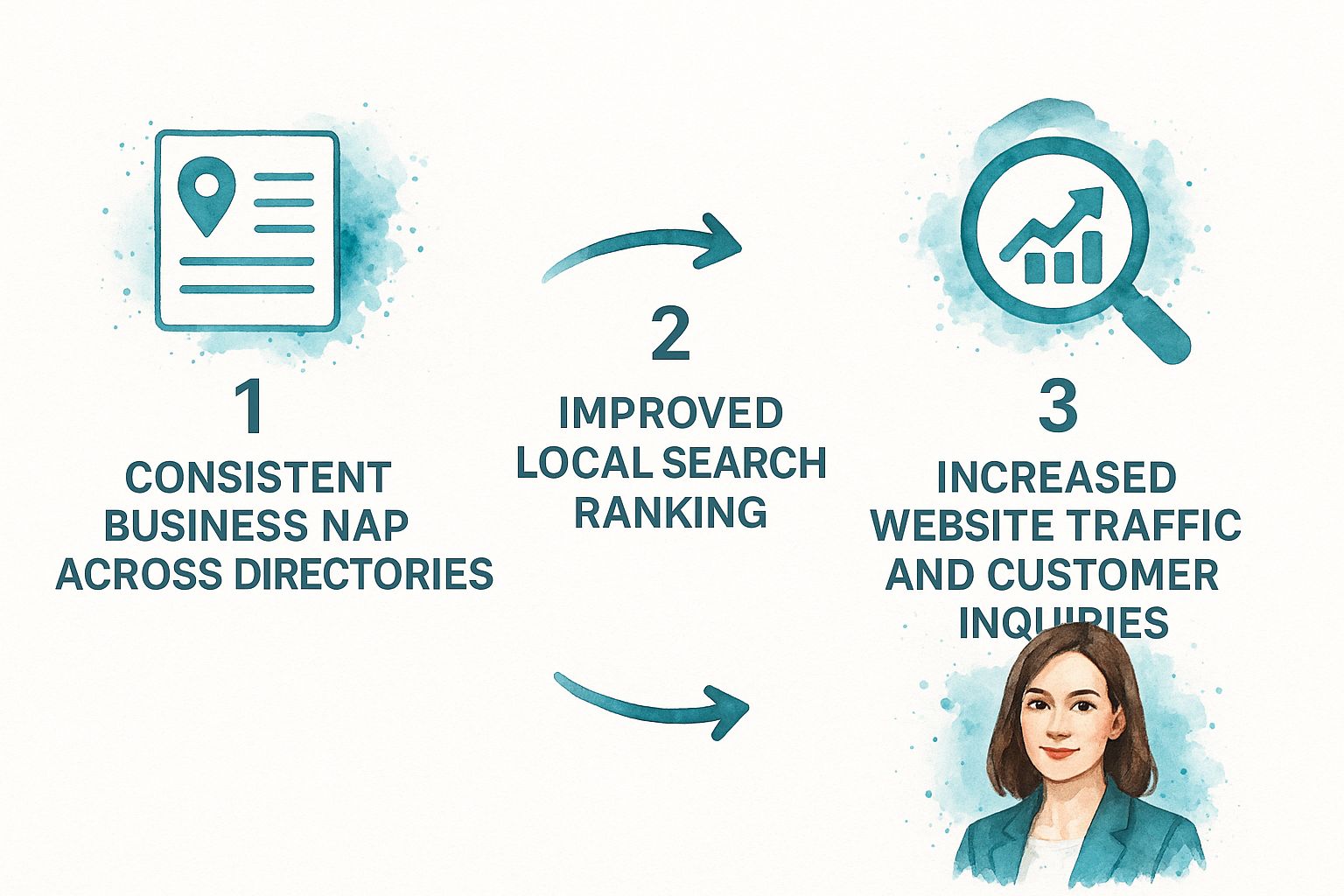
As you can see, cleaning up your citations is the foundational work. It directly impacts how search engines perceive your business and paves the way for tangible results like more website traffic and new leads.
Uncovering Your Digital Footprint
First, you need to find every single mention of your business online—the good, the bad, and the ugly. This requires going deeper than a simple Google search for your brand name. A more precise method is using advanced search operators directly in Google.
"Your Business Name" + "Your City""Your Business Name" + "Your Phone Number""Your Street Address" + "Your City""Your Phone Number"
Running these specific searches often uncovers listings you never knew existed, especially on old directories populated by third-party data aggregators. Every time you find a citation, log it in a spreadsheet. This document will become your roadmap for the entire cleanup operation.
Identifying Critical NAP Inconsistencies
The core of the audit is spotting inconsistencies in your Name, Address, and Phone number (NAP). Even tiny variations can confuse search engines and dilute the authority of your correct business information.
For example, a local accounting firm I worked with was struggling to appear in the map pack. The audit revealed their official name was “Smith & Jones Accounting, LLC,” but various directories listed them as “Smith and Jones Accounting” or simply “Smith & Jones.” These seemingly minor differences created enough inconsistency to hold them back.
The goal is 100% NAP consistency. Flag every variation for correction, no matter how small—think “St.” vs. “Street,” “Co.” vs. “Company,” or the inclusion of “LLC.”
For a deeper dive into the nitty-gritty of this process, our complete guide to performing a local SEO audit includes a detailed checklist to make sure you don’t miss a thing.
Organizing Your Audit Findings for Action
Your audit spreadsheet doesn’t need to be complex, but it must be functional. Set up columns to track the essential details for each citation you uncover. Getting organized now is what makes the cleanup campaign efficient and manageable.
| Directory Name | URL of Listing | Status (Correct/Incorrect) | Issue (e.g., Wrong Address, Old Phone) | Action Needed (Update/Remove) |
|---|---|---|---|---|
| Yelp | [URL] | Incorrect | Old phone number listed | Claim and update listing |
| Yellow Pages | [URL] | Correct | N/A | Monitor |
| LocalBlog.com | [URL] | Incorrect | Misspelled street name | Contact site owner |
This structured approach transforms a messy pile of search results into a clear action plan. Once your spreadsheet is populated, you’ll have a precise to-do list of every incorrect citation that needs your attention. This documented audit is the only way to launch a successful local citations strategy, ensuring everything you build from here on out rests on a solid, consistent foundation.
Developing a Winning Citation Building Strategy

In local SEO, the game has changed. Gone are the days of blasting your business information across hundreds of generic directories and hoping for the best. That “more is more” approach is not just outdated; it’s ineffective. Today, a winning citation strategy is built on quality, relevance, and precision.
It’s time to stop chasing volume and start focusing on impact. This means strategically selecting the most valuable citation sources for your specific business. By taking a thoughtful, tiered approach, you can invest your time and resources where they’ll deliver the best results, building a powerful and authoritative online footprint that drives real customer action.
The Three Tiers of Citation Sources
To bring order to the chaos of local citations building, organize potential sources into three distinct tiers. This framework helps you prioritize, starting with the absolute must-haves before moving on to specialized opportunities that give you a competitive edge.
- Foundational Data Aggregators: Think of these as the wholesalers of business data. Major data aggregators supply information to a massive network of other websites, apps, and directories. Getting your NAP correct here is non-negotiable, as this accurate information will propagate across the web, fixing downstream errors at the source.
- High-Authority Core Directories: This tier is composed of the household names that customers trust and use every day. We’re talking about platforms like Yelp, Bing Places, and Apple Maps. A strong, accurate, and complete presence here is essential for establishing baseline trust and visibility.
- Hyper-Relevant Niche Directories: This is where you gain a real strategic advantage. These are the industry-specific and location-specific directories that signal deep relevance to search engines. For example, a listing on Avvo is far more valuable to a law firm than a hundred listings on generic business sites. For a restaurant, being on TripAdvisor is critical.
When you work through these tiers systematically, you build a robust citation profile that search engines can easily understand, verify, and ultimately, trust to recommend to their users.
Structured vs. Unstructured Citations
As you map out your strategy, you’ll encounter two main types of citations: structured and unstructured. A healthy and resilient citation profile needs a deliberate mix of both.
Structured citations are the most common type. They appear in a consistent, organized format on business directories where your NAP information is placed into clearly labeled fields. These listings form the backbone of your citation profile, giving search engines clean, reliable data to crawl.
On the other hand, unstructured citations are more organic mentions of your business information. This could be a local news article about your grand opening, a blog post from a food critic reviewing your restaurant, or a sponsorship mention on a local charity’s website. These are incredibly powerful because they happen naturally and signal genuine local relevance and authority.
A winning local citation strategy balances the foundational stability of structured listings with the organic authority of unstructured mentions. One provides the blueprint of your business identity, while the other colors it with real-world relevance and community engagement.
Quality Over Quantity: The Modern Approach
The focus in modern local SEO has shifted decisively. While business websites now appear in 47% of local search results, the directories that house citations still account for a significant 31% of visibility. The key difference is which directories matter.
The most impactful platforms have expanded beyond generic listings to include powerful, industry-specific sites like Tripadvisor for hospitality or Avvo for legal services. On these sites, structured citations offer reliable, niche-specific data that search engines love.
This tailored approach gets results. For example, a law firm that focuses on securing accurate citations on legal-specific directories in addition to the core platforms can achieve measurable growth in client acquisition, largely by improving visibility in the local map pack. You can explore additional findings about local citation effectiveness and see how this strategic focus delivers tangible results.
This all reinforces the need for a targeted strategy. Instead of chasing hundreds of low-value listings, concentrate your efforts on securing and perfecting your presence on the platforms that matter most to your industry and your customers. This quality-first mindset is the cornerstone of any effective local citations campaign today.
Getting Your Hands Dirty: Building and Claiming Listings
With your audit complete and a clear strategy in place, it’s time to roll up your sleeves and begin the manual work of local citation building. This is where you’ll systematically claim existing listings and, when necessary, create new ones from scratch.
The goal here isn’t just to drop your business information online. It’s to transform every profile into a powerful asset that actively attracts and converts local customers. Think of each listing as a digital storefront—it needs to be accurate, informative, and inviting.
Claim and Verify Your Core Listings
Your first priority is to secure your foundational profiles on platforms like Google Business Profile, Yelp, and Bing Places for Business. These major directories often auto-generate listings from public records, so there’s a good chance a profile for your business already exists, whether you created it or not.
Start by searching for your business name on each of these core sites. If you find a listing, look for a prompt like “Claim this business” or “Is this your business?”. This will initiate the verification process, which is how the platform confirms you are the legitimate owner.
Verification methods differ but usually involve one of the following:
- Postcard Verification: A physical postcard with a unique PIN is mailed to your official business address. This is a common method used by Google.
- Phone Verification: An automated call or text is sent to your business phone number with a verification code.
- Email Verification: A code is sent to an email address using your business domain (e.g.,
info@yourcompany.com).
Be prepared for this to take time. Postcard verification can take up to two weeks. It might feel slow, but it’s a crucial security step to protect your listing from being hijacked. Patience is key to getting it right.
Move Beyond Basic NAP Optimization
Once you’ve verified a listing and gained control, the real optimization work begins. A correct Name, Address, and Phone number (NAP) is just the price of entry. To truly stand out and convert searchers into customers, you must enrich each profile with compelling, helpful information.
Start with your business description. Don’t settle for a generic, keyword-stuffed sentence. Tell a story that connects with your ideal customer. For instance, instead of “Plumbing services in Springfield,” a plumber could write something far more persuasive: “Your trusted Springfield plumber for over 20 years, specializing in 24/7 emergency leak repair and water heater installation. We guarantee fast, reliable service.”
Beyond text, rich media is non-negotiable. High-quality photos of your storefront, your team in action, and your finished projects build immense trust. According to Google, businesses with photos on their profiles receive 42% more requests for driving directions and 35% more clicks to their websites. For a more detailed breakdown, our guide on local business listing optimization dives deeper into these advanced strategies.
How to Handle Common Verification Headaches
The process isn’t always smooth. One common frustration is discovering a listing has already been claimed—often by a former employee, a previous owner, or an old marketing agency. In this case, you must follow the platform’s protocol to request an ownership transfer. This usually starts with contacting the current owner through the directory’s system. If they don’t respond, you’ll need to escalate the issue to the support team, providing documentation like a utility bill or business registration from a source like a state’s Secretary of State website to prove ownership.
Another frequent problem is getting stuck in a verification loop where postcards never arrive. If this happens, don’t give up. Document every attempt—take screenshots, save emails—and contact the platform’s support team directly. Showing them a clear record of your efforts can often help them push through a manual verification.
Automating Citation Management For Long-Term Success

While manually building your first citations is a valuable learning experience, it’s rarely a sustainable long-term strategy. The internet is constantly changing: directories shut down, new ones emerge, and incorrect business data can resurface without warning.
For any business with multiple locations—or any owner who values their time—keeping a citation profile perfect by hand becomes a frustrating and inefficient chore. This is where you must think smarter, not just work harder.
Automation tools are designed to solve this problem. Citation management services do the heavy lifting, ensuring your business information stays consistent and accurate across the web without constant manual intervention. These platforms distribute your data, hunt for mistakes, and block harmful duplicate listings in real-time. Think of it as a 24/7 protective shield for your online presence.
The Manual Vs. Automated Dilemma
Choosing between a hands-on approach and an automated solution comes down to your specific situation. The right call depends on your budget, scale, and the time you can realistically commit. A small, single-location business might manage with manual updates, but that equation changes fast as you grow.
A direct comparison makes the decision clearer. Manual building offers total control and has no subscription cost, but it will consume your time. Automated services deliver efficiency and peace of mind for a recurring fee.
The core trade-off is between time and money. Manual citation management costs you hours, while automated services cost you dollars. The most effective choice is the one that best aligns with your business’s most valuable resource.
To help you weigh your options, this table breaks down the key differences between the two approaches.
Manual vs. Automated Citation Management
| Factor | Manual Building | Automated Services |
|---|---|---|
| Cost | No direct cost, but high time investment. | Monthly or annual subscription fees. |
| Time | Extremely time-consuming, especially at scale. | Highly efficient, saving dozens of hours. |
| Consistency | Difficult to maintain over the long term. | Actively monitors and corrects inconsistencies. |
| Duplicate Suppression | Requires constant manual searching and removal. | Automatically identifies and suppresses duplicates. |
| Reporting | Requires manual tracking in spreadsheets. | Provides detailed, automated performance reports. |
| Scalability | Not scalable for multi-location businesses. | Easily manages hundreds or thousands of locations. |
After reviewing the comparison, it becomes clear that while manual effort has its place, automation offers a scalable path to protect your investment over time.
How Automation Platforms Work
So, how do these services actually work? Platforms like BrightLocal or Yext operate by connecting directly to a vast network of directories, data aggregators, and online maps. You enter your correct NAP (Name, Address, Phone number) and other key business details into their system once. The service then pushes that verified information across its entire network, ensuring widespread consistency from a single dashboard.
The real value, however, is in the ongoing monitoring. These platforms constantly scan the web for any mention of your business and flag inconsistencies as they appear. If an old, incorrect address suddenly resurfaces on an obscure directory, the system catches it and works to fix it, protecting your local SEO authority before a small issue can become a major problem. Learning about automating repetitive tasks can shift your entire operational mindset, freeing you to focus on growing your business.
The results speak for themselves. Businesses with accurate citations across major platforms can increase their discoverability by an average of 20-25%. Moreover, small businesses using management tools often see up to a 15% faster recovery from ranking drops caused by bad data. This data proves that a proactive citation strategy isn’t just a “nice-to-have”—it’s fundamental to staying competitive.
Answering Your Top Questions About Local Citations
As you dive into managing your local citations, you’ll inevitably encounter specific situations that most guides don’t cover. These are the real-world questions that can stop a project in its tracks.
Let’s clear up some of the most common points of confusion. Getting these details right is often what separates a decent local SEO effort from a dominant one.
Do I Need Citations If My Business Doesn’t Have a Physical Storefront?
Yes, absolutely. This is a critical point for service-area businesses (SABs)—think plumbers, electricians, or any professional who travels to their clients.
Even without a public-facing location, you still have a registered business address and a defined service area. Citations are crucial for helping search engines verify your legitimacy and understand precisely where you operate. This is how you appear in the search results when a customer in your service area searches for what you do.
The key is to maintain consistency with your registered address across all listings, even if you choose to hide the street address on your public Google Business Profile.
What’s the First Thing to Do If My Business Moves?
A business move is a make-or-break moment for your local SEO. If handled incorrectly, you can flood the internet with conflicting information, seriously damaging your rankings for months.
Your immediate priority is to update your most critical online assets in this order:
- Google Business Profile: This is your top priority. Update your address and complete the re-verification process as quickly as possible.
- Core Data Aggregators: Next, update the main data suppliers that feed hundreds of other directories.
- Top-Tier Directories: Manually update the heavy hitters like Yelp, Bing Places, and Apple Maps.
Once the most important listings are updated, your work isn’t done. You must conduct a full citation audit to hunt down every single mention of your old address. Leaving outdated information on even a few sites creates significant confusion for search engines and can drag down your local visibility.
Are Citations on Social Media Actually Important?
They’re more important than many people realize, though they play a slightly different role. A platform like Facebook or LinkedIn isn’t a traditional directory, but it’s often one of the first places customers look for information.
Having your correct NAP on social profiles accomplishes two key things:
- It reinforces consistency. Every trusted platform that lists your correct business details adds another signal of trust for search engines.
- It improves the user experience. When a customer finds you on Instagram, they should be able to get accurate directions or click a “Call” button that works. Bad information creates friction and costs you business.
How Long Until I See Results from Building Citations?
Local SEO is a marathon, not a sprint. You won’t see a jump in rankings overnight. After you’ve cleaned up old listings and built new, high-quality ones, it can take anywhere from a few weeks to several months for search engines to crawl, index, and trust that new information.
The timeline depends on a few factors:
- The authority and crawl rate of the sites you’re listed on.
- How often search engine bots visit those specific sites.
- The state of your citations before you started (it takes longer to fix a mess than to build from scratch).
The best practice is to start tracking your local keyword rankings before you begin. This gives you a clear baseline to measure your progress over the next three to six months. Be methodical and patient, and you’ll see your local search presence steadily climb.
At Galant Studios, we transform your online presence into a powerful engine for growth. Our expert SEO and website optimization services are designed to get you seen by the right local customers, turning searches into sales. Let us handle the complexities of local citations building so you can focus on what you do best.
Start Dominating Your Local Market with Galant Studios