When a potential customer in your neighborhood pulls out their phone to search for “pizza near me” or “emergency plumber,” whose business pops up first? Local SEO is the engine that ensures the answer is yours. It’s a specialized marketing approach designed to make your business the most visible and trusted choice for local searchers on Google.
In short, it’s the most direct path to connecting with nearby customers who are actively looking to make a purchase, right now.
Why Local SEO Is Your Greatest Advantage
Think about that critical moment when someone needs your service. A leaky pipe doesn’t wait. A craving for coffee needs a quick fix. That search for “emergency plumber near me” or “best coffee shop in downtown” is where business is won or lost. This is where local SEO services for small business become your most powerful tool, acting as a digital signpost that guides motivated customers right to your door.
Imagine your business on a digital main street. A strong local SEO strategy is like having the most well-known person in town standing outside, personally recommending your shop to everyone who walks by looking for exactly what you sell.
Turning Clicks into Customers
This online visibility isn’t just about looking good online; it translates directly into real-world customers and sales. The link between a local search and a purchase is incredibly strong. Consider this: a staggering 46% of all Google searches are from people seeking local information.
Even more compelling, 78% of local searches on mobile devices lead to an offline purchase, often within the same day. These aren’t just casual browsers; they’re high-intent buyers ready to spend money. You can explore more of these powerful small business SEO statistics to see the full picture.
Local SEO is no longer just a marketing tactic. It’s a core business strategy for capturing motivated customers at the exact moment they’re ready to buy, bridging the gap between an online search and a sale.
To give you a clearer picture, let’s break down the essential services that make up a powerful local SEO plan. These components work in harmony to build your visibility and attract the right customers.
Core Components of Local SEO Services
| Service Component | Primary Goal | Key Benefit for Small Business |
|---|---|---|
| Google Business Profile (GBP) Optimization | Maximize visibility in Google Maps and the “Local Pack.” | Puts your business on the map—literally. This makes it effortless for customers to find you, call you, and get directions with a single tap. |
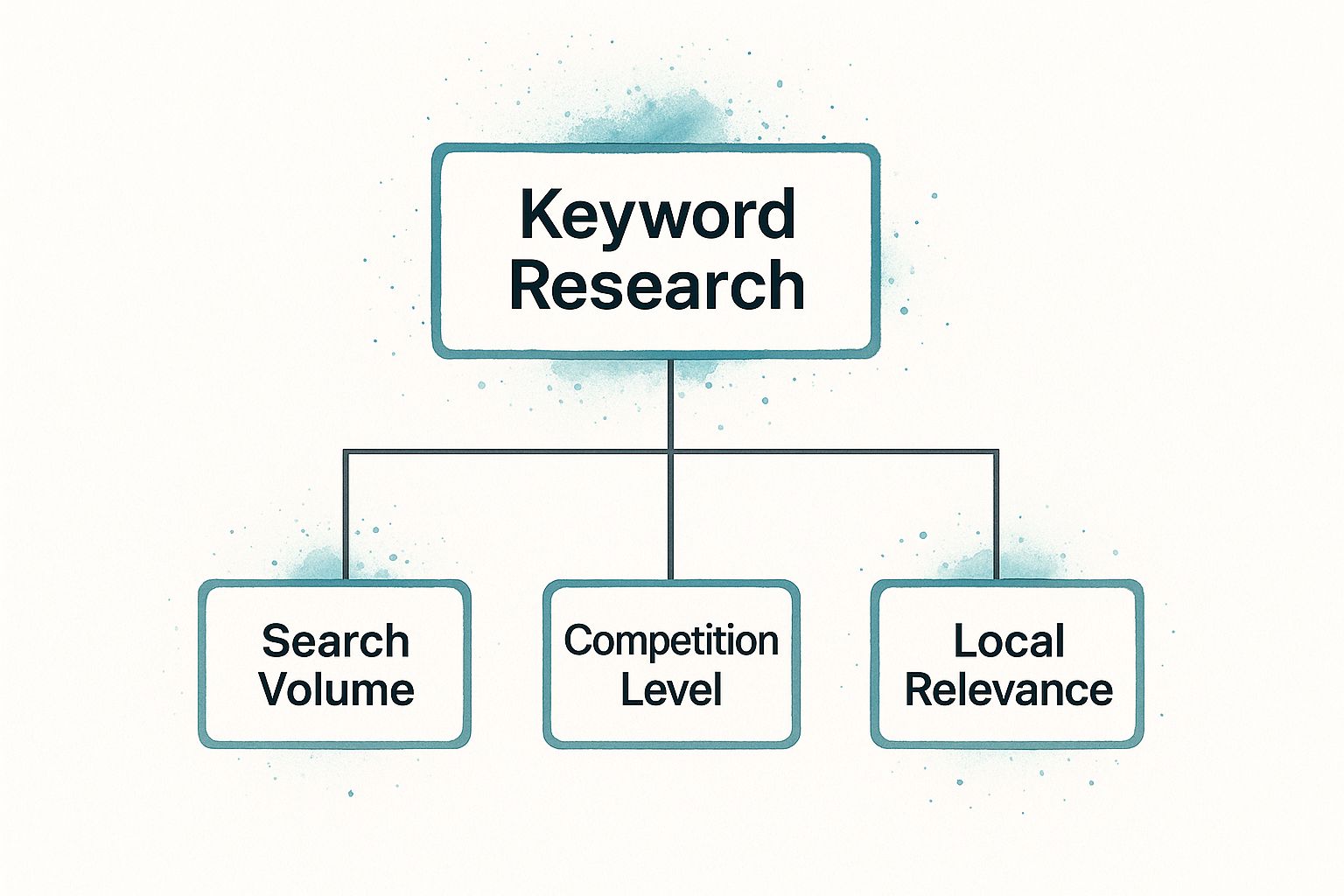
| Local Keyword Research & On-Page SEO | Rank for location-specific search terms (e.g., “bakery in Brooklyn”). | Attracts highly relevant local traffic to your website. You show up for customers actively seeking your services in your specific area. |
| Local Link Building & Citations | Build authority and trust with Google through local mentions and backlinks. | Establishes your business as a credible, recognized local authority. This directly boosts your search rankings over competitors. |
| Online Review & Reputation Management | Encourage positive reviews and manage customer feedback. | Builds social proof and trust. Positive reviews are a major factor in both customer decisions and Google’s ranking algorithm. |
These are the foundational pillars of any successful local strategy. When executed correctly, they produce tangible results you can see in your business’s growth.
The Tangible Benefits for Your Business
Investing in a focused local SEO strategy delivers returns that directly impact your bottom line. This isn’t about vague online metrics; it’s about real, measurable growth that you can see and feel.
Here’s what you can expect:
- Increased Foot Traffic: As more local customers find you online, more people will walk through your door. It’s that simple.
- More Phone Inquiries: A well-optimized profile makes it effortless for potential customers to call you right from the search results, often leading to immediate bookings or sales.
- Higher Revenue: By consistently attracting more qualified local customers, you naturally drive more sales and grow your business.
Ultimately, a strong local SEO presence makes you the go-to choice in your community, paving the way for sustainable, long-term success.
Mastering the Foundations of Local Search
A winning local SEO strategy rests on three core pillars that work together to build your digital presence. Think of it like constructing a building: you need a solid foundation, strong walls, and a reliable roof. For your business, these elements are what make you visible and trustworthy to both local customers and search engines.
The first essential pillar is On-Page SEO. This is all about optimizing your website’s content and structure to clearly signal your local relevance to Google. It goes far beyond simply listing your city; it’s about weaving your location into the very fabric of your site with content that speaks directly to your community.
For example, a plumber in Chicago shouldn’t just target the generic term “plumber.” A much smarter, more effective approach is to create dedicated pages for services like “emergency plumbing in Lincoln Park” or “drain cleaning services for Gold Coast homes.” This hyper-local strategy helps you show up precisely when customers are searching for specific solutions in their neighborhood.
Your Digital Storefront: Google Business Profile
Next up—and arguably the most critical component—is your Google Business Profile (GBP). Don’t think of this as just another online listing. Treat it as your primary digital storefront. For many local customers, your GBP is the very first interaction they’ll have with your business, as it appears prominently in Google Maps and the coveted “Local Pack” search results.
Having a fully optimized profile is non-negotiable. Key actions include:
- Ensuring NAP Consistency: Your Name, Address, and Phone number must be absolutely identical everywhere—on your website, your GBP, and any other online directory. A tiny difference, like using “St.” instead of “Street,” can confuse search engines and harm your ranking.
- Leveraging All Features: Get in the habit of adding high-quality photos of your work, your team, and your location. Use Google Posts to announce special offers and updates, and be sure to actively answer questions in the Q&A section to demonstrate your expertise.
This consistent activity signals to Google that you are an active, legitimate business that deserves a top spot. For a deeper dive, our guide on how to optimize Google My Business offers a step-by-step walkthrough to make your profile shine.
Building Trust with Citations and Links
The third and final pillar is Local Link Building and Citations. Citations are simply mentions of your business’s NAP information on other relevant websites, such as Yelp, Yellow Pages, or directories specific to your industry. Each consistent citation you secure acts as a vote of confidence.
Getting your business listed in reputable local and industry-specific directories is how you build authority online. It’s the digital equivalent of getting a referral from a respected member of the community. The more trustworthy sources that vouch for you, the more Google trusts that your business is a legitimate and important part of the local scene.
If you’re looking for a complete breakdown of these core strategies, you can explore a detailed guide on how to do local SEO for small businesses. Mastering these three pillars provides the essential framework for any successful local SEO campaign.
How to Choose the Right Local SEO Partner
Picking an agency to handle your local SEO is one of the most important decisions you’ll make for your business. The right partner becomes a true extension of your team, driving real, measurable growth. The wrong one, however, can burn through your budget with little to show for it. To avoid that, you need a solid framework for vetting potential partners.

The first step is to look past the slick sales pitches and focus on what really matters: proven results. A trustworthy agency will be an open book, ready and willing to show you their past successes. Their confidence should stem from hard data, not just hollow promises. Your job is to ask the right questions to get to the truth.
Key Questions to Vet Potential Partners
When you’re speaking with a potential provider of local SEO services for a small business, your mission is to understand their strategy, communication style, and track record. Don’t be shy. Arm yourself with direct questions to get the clarity you need to make an informed choice.
Here are the essentials to get you started:
- Can you share case studies or client references from businesses similar to mine? This is non-negotiable. You need proof they understand the unique challenges of your industry and local market. A glowing success story for a national e-commerce brand means very little to a local plumbing company.
- How do you measure and report on success? Listen closely. The answer should revolve around key performance indicators (KPIs) that directly impact your bottom line—think phone calls, quote requests, appointment bookings, and clicks on the “get directions” button. If they only talk about vague metrics like “impressions,” that’s a red flag.
- What does your communication and reporting cadence look like? A great partner establishes a clear, consistent rhythm for updates. Whether it’s a detailed monthly report or bi-weekly check-in calls, you should never be left wondering what they’re doing or how it’s working.
- Who will be my primary point of contact? Knowing who you’ll be working with day-to-day gives you a sense of the agency’s internal structure and how dedicated they’ll be to your business.
A true local SEO partner should feel like an investment, not an expense. They should be as obsessed with your business goals—like increasing foot traffic and phone calls—as you are.
Red Flags to Watch For
Knowing what to look for is only half the battle; you also need to recognize the warning signs of a bad fit. Certain claims and practices are classic red flags in the SEO world. For a more exhaustive list, our guide on local SEO agency selection goes into much greater detail.
For now, be extremely wary of any agency that:
- Guarantees #1 Rankings: This is the oldest trick in the book. No one can guarantee a specific ranking on Google. The algorithms are far too complex and are always changing, making such a promise both impossible and dishonest.
- Lacks Transparency: If a provider is cagey about their methods or hides behind a “proprietary process,” run. A reliable partner will be completely open about the strategies they plan to use to help your business succeed.
- Offers a “One-Size-Fits-All” Package: Every local business is different. A cookie-cutter, low-cost package is a recipe for disappointment because it fails to account for your unique goals and competitive landscape. Your strategy needs to be custom-built for you.
Decoding Local SEO Service Pricing Models
Trying to figure out how much professional SEO costs can feel like a puzzle. The good news is that most agencies stick to one of three common pricing structures. Understanding these models is key to finding a plan that fits your budget and your business goals. The real objective is to find a partner who delivers clear value, not just a long list of tasks.
Monthly Retainer: The Long-Term Growth Engine
The most common structure is the monthly retainer. Think of it as a subscription to continuous improvement and growth. This model is built for businesses that are in it for the long haul and understand that real, sustainable results don’t happen overnight. Just as consistent workouts yield the best fitness results, a retainer ensures your SEO efforts never stop adapting to Google’s updates and your competitors’ moves.
For example, a local dental practice on a retainer would receive ongoing management of its Google Business Profile, creation of blog content about local community health events, and steady building of citations on trusted directories. This consistent work builds momentum month after month, cementing the practice as the local authority.
Project-Based and Hourly Work: For Specific Goals
Not every business needs an ongoing commitment right away. For those situations, a project-based fee is the perfect fit. This model is designed for a one-time goal with a clear beginning and end, like hiring a specialized contractor for a specific job. Maybe you need a brand-new website launched with a rock-solid local SEO foundation, or you have inconsistent business listings across the web that need a thorough cleanup. This model gives you a fixed price for a defined outcome.
Then there’s hourly consulting. This option provides high-level strategic guidance when you need it. It’s ideal for businesses that have a team to handle the day-to-day work but need an expert to steer the ship. You might bring in a consultant for a technical audit, to help brainstorm a content strategy, or to troubleshoot a stubborn ranking problem. You’re paying for expertise, not just execution.
The right pricing model boils down to your primary goal. Are you aiming for steady, compounding growth (retainer), tackling a specific one-off task (project), or in need of expert advice to guide your internal team (hourly)?
A Look at the Numbers
When considering the cost, it’s helpful to compare it to the alternative. For most small businesses, outsourcing SEO is far more cost-effective than trying to build an expert team in-house. In fact, many businesses can save significantly by outsourcing their SEO compared to the cost of hiring, training, and retaining an internal team with benefits and salaries.
To give you a clearer picture, here’s a breakdown of the common pricing models and what you can generally expect.
Comparison of Local SEO Pricing Models
| Pricing Model | Typical Cost Range | Best For | Key Consideration |
|---|---|---|---|
| Monthly Retainer | $500 – $5,000+ per month | Businesses committed to long-term, sustainable growth and continuous improvement. | Success is a marathon, not a sprint. Requires a consistent budget for compounding results. |
| Project-Based | $1,000 – $25,000+ per project | Businesses with a specific, one-time need like a website redesign or citation cleanup. | The scope must be clearly defined upfront to avoid unexpected costs. |
| Hourly Consulting | $100 – $300+ per hour | Businesses with an in-house team that needs strategic direction or specialized expertise. | Best for strategy and audits, not for ongoing implementation work. |
As you can see, the right fit depends entirely on your needs. Globally, hourly SEO rates can run from $20 to $250, and comprehensive monthly retainers for local SEO services for small business often land between $2,000 and $20,000, depending heavily on the scope and competition. For a deeper dive, you can find more SEO outsourcing statistics that break down costs by business size and location.
Ultimately, the best pricing model is one that offers a transparent, predictable path to hitting your goals, turning your marketing budget into a powerful and profitable investment.
Measuring Local SEO Success and ROI
How do you know if your investment in local SEO is actually paying off? It’s one thing to see your business pop up in a search, but the real test is whether those online efforts are leading to more customers and higher revenue. True success isn’t measured in abstract numbers like impressions; it’s about tracking the specific actions that directly impact your bottom line.

The entire point is to prove a positive return on investment (ROI). You need a clear, undeniable line connecting your SEO work to an increase in paying customers. This requires a sharp focus on metrics that reflect real-world decisions made by potential clients.
A huge part of this is understanding the financial return of your marketing. You can learn more about how to calculate ROI to get a firm grasp on how these specific activities feed into your revenue stream.
Key Performance Indicators for Local SEO
To get a clear picture of your campaign’s health, you have to concentrate on the data that signals genuine customer intent. These are the metrics that go beyond simple visibility and show you exactly how people are engaging with your business once they find you.
Here are the most important KPIs to watch:
- Google Business Profile Interactions: This is ground zero for local engagement. Watch the number of phone calls, requests for driving directions, and clicks to your website that come directly from your GBP listing. A steady climb in these interactions is a powerful sign that your visibility is translating into real interest.
- Local Organic Traffic: Using a tool like Google Analytics, you can isolate website traffic coming from organic search within your service area. An increase here proves your strategy is attracting the right local audience, not just random visitors from across the country.
- Keyword Ranking Improvements: While rankings aren’t revenue, they are a critical leading indicator. You must track your position for high-intent, local keywords like “emergency plumber in Austin.” Moving up for these terms puts you directly in front of motivated buyers at the exact moment they need you.
- Conversion Rate from Local Traffic: This is where the rubber meets the road. The ultimate measure is how many of those local visitors take a meaningful step, like filling out a contact form, booking an appointment, or making an online purchase.
Connecting Metrics to Business Growth
The real magic happens when you connect these data points to tell a story. For example, you might see that a 20% increase in your ranking for “best brunch spot downtown” directly resulted in a 15% rise in weekend direction requests and a 10% jump in phone calls for reservations.
By focusing on these actionable KPIs, you can confidently assess the performance of your local SEO services for small business. This data-driven approach allows you to make informed decisions, justify your marketing spend, and ensure your investment is generating measurable, profitable results.
This framework turns SEO from a confusing marketing expense into a predictable engine for customer acquisition. When you track the right metrics, you can clearly see how better online visibility translates into more people walking through your door and growing your business.
Advanced Strategies for Competitive Markets
When you’re fighting for visibility in a crowded market, simply mastering the basics of local SEO won’t be enough to dominate. To truly pull ahead of the competition, your small business needs to go a step further. It’s about implementing smarter, more focused tactics that capture highly motivated local customers and build undeniable authority in Google’s eyes.

One of the most powerful moves you can make is creating hyperlocal content. This means moving beyond generic “service in [Your City]” pages. Think with surgical precision.
For example, a roofing company in a storm-prone area could create a dedicated page for “hail damage repair in the Northwood neighborhood.” They could even write a blog post detailing “how to choose the right shingles for homes in our historic downtown district.” This strategy speaks directly to customers in specific areas, making your business the obvious, expert choice.
Implementing Technical Enhancements
Another game-changer lies on the technical side of your website: local business schema markup. Think of this as a special vocabulary you add to your website’s code. This structured data translates your business information—address, hours, services, even ratings—into a language that search engines like Google perfectly understand.
The payoff? Google can use this clean data to generate “rich snippets” right in the search results. These are the eye-catching listings with star ratings, event details, or FAQs that make you stand out and can seriously boost your click-through rate.
By speaking Google’s language through schema markup, you provide the clarity it needs to feature your business more prominently, helping you stand out visually from competitors in search results.
Proactive Reputation Management
Finally, an advanced strategy demands a proactive approach to your online reputation. Don’t just sit back and hope for good reviews; you have to actively encourage them from your happy customers.
Even more importantly, respond to every single review—both the good and the bad. A thoughtful, professional response to a negative review can instantly turn a bad situation into a public display of fantastic customer service. This builds trust and social proof, which are incredibly powerful ranking signals.
These advanced strategies don’t replace the fundamentals, like accurate NAP data, but build on top of them. For a deeper dive into that critical element, check out our guide on local citations building. When you combine these tactics, you solidify your position as a local leader, even in the most competitive fields.
A Few Common Questions About Local SEO
If you’re a small business owner exploring local SEO, you probably have a few questions. That’s a good thing. Getting clear on the process is the first step toward making a smart investment in your company’s future. Let’s tackle some of the most common questions we hear.
How Long Does It Take to See Results From Local SEO?
This is usually the first question on everyone’s mind. While you might see some positive movement from changes to your Google Business Profile within a few weeks, real, sustainable results take time to build.
You should realistically expect to see significant, stable ranking improvements within 3 to 6 months. Think of it like planting a garden. You can’t sow a seed today and expect a full harvest tomorrow. Local SEO is a long-term strategy that builds on itself, creating a strong foundation that pays dividends for years to come.
Can I Just Do Local SEO Myself?
Absolutely. Many business owners can and should handle the basics, especially keeping their Google Business Profile updated and accurate. It’s a great place to start.
However, if you’re in a competitive market, a DIY approach often hits a ceiling. This is where professional expertise makes a real difference. Advanced strategies in technical SEO, creating content that ranks, and building high-quality local links are what it takes to consistently outperform your competitors and secure those top spots.
What’s the Real Difference Between SEO and Local SEO?
It all comes down to geographic intent.
Standard SEO is about getting visibility on a national or even global scale. A company selling software online, for example, wants to rank for users anywhere in the world.
Local SEO, on the other hand, is all about connecting with customers in your immediate service area. It adds a geographical component to every search, focusing on keywords like “bakery in Denver” or searches made on a mobile device like “plumber near me.” It’s designed to put your business in front of people who are physically nearby and ready to buy.
Ready to make your business the top local choice? Galant Studios specializes in expert local SEO strategies that drive real growth. Let’s put your business on the map.