Imagine your business has the best spot on Main Street, but online. That’s local SEO. It’s the art of making your business the first, most trusted answer when people in your neighborhood search for the products or services you offer. The result? A direct line to more foot traffic, more phone calls, and more paying customers.
Why Local SEO Is Your Small Business Superpower

Picture this: your ideal customer is standing just a few blocks away, smartphone in hand, searching for exactly what you sell. In that critical moment, will they find you, or will your competitor down the street get the business?
Local SEO is your unfair advantage. It puts your business directly in front of these motivated, ready-to-buy customers. Forget casting a wide, expensive net. This is a laser-focused strategy designed to make you the go-to choice for the most valuable audience you have: the people in your own community.
The Power of “Near Me” Searches
A staggering number of online searches are from people looking for something nearby, right now. This is where a smart local SEO strategy pays dividends. According to Google’s own data on local search behavior, nearly half of all searches have local intent.
Think about what that means for your business. Almost one out of every two people using Google is actively seeking a local solution. When they search for “bakery near me” or “emergency plumber in Springfield,” they aren’t just browsing—they have a problem and are ready to pay for the solution. Your business needs to be that solution.
For a small business, local SEO isn’t just another line item in a marketing budget; it’s a fundamental growth engine. It transforms your online presence from a passive brochure into an active salesperson that brings customers through your door 24/7.
Becoming a Pillar of the Community
A brilliant local SEO plan does more than just get you found online. It weaves your business into the fabric of your community. It sends a clear signal to both Google and your neighbors that you are a legitimate, trusted, and active part of the local economy.
Ultimately, mastering local SEO for small business helps you:
- Dominate the Map: Get featured in Google’s “Map Pack” and the top local search results, where most clicks happen.
- Build Unshakeable Trust: A well-managed online profile overflowing with positive reviews makes you the obvious, credible choice.
- Drive Immediate Action: Make it effortless for customers to call you, get directions, or book an appointment directly from the search page.
- Outsmart the Competition: Leapfrog competitors who are neglecting their digital backyard.
This guide will walk you through the practical, actionable steps to turn your online presence into your most powerful tool for local growth.
Optimizing Your Google Business Profile
If you do only one thing for your local SEO, make it this: perfect your Google Business Profile (GBP). Think of it as the digital front door to your business. It’s often the very first impression a potential customer has when they search for services like yours on Google or look you up on Maps.
This isn’t just a static listing; it’s a dynamic, interactive storefront. A neglected profile is the modern equivalent of having a “Closed” sign hanging on your door when you’re open for business. A well-managed profile, however, becomes your most effective salesperson, working tirelessly to bring in local customers.
Building Your Foundation The Right Way
First, you must claim and verify your profile. Google will typically mail a postcard with a verification code to your physical address. This isn’t just a formality; it’s a critical step that proves to Google you are a real, operating business at that location, which is a massive trust signal.
Once verified, your mission is to fill out every single section of your profile. Incomplete profiles look unprofessional and untrustworthy. In fact, customers are 2.7 times more likely to consider a business with a complete profile to be reputable. You can explore more local SEO statistics to see just how much this matters.
A complete Google Business Profile is one of the strongest trust signals you can send. It communicates professionalism and reliability before a customer ever picks up the phone or walks through your door.
The Essential Fields for Maximum Impact
Every field in your profile is an opportunity to give Google—and your customers—the exact information they need to choose you.
1. Business Name, Address, and Phone Number (NAP)
This is the holy trinity of local SEO. Your NAP data must be 100% consistent everywhere it appears online, from your GBP to your website to every business directory. A tiny difference, like using “St.” on one platform and “Street” on another, can create confusion for search engines and harm your rankings.
2. Business Categories
Choosing the right categories is a game-changer. Select a primary category that perfectly describes your main service (e.g., “Plumber,” “Italian Restaurant,” “Hair Salon”). Then, add secondary categories for everything else you offer, such as “Water Heater Installation,” “Catering Services,” or “Manicures.” This simple step helps you appear in more specific, high-intent searches.
3. Services and Products
This is where you showcase your expertise. Don’t just list your category as “Landscaper.” Use the Services section to detail everything you do:
- Lawn Mowing & Maintenance
- Garden Bed Design & Installation
- Tree & Shrub Pruning
- Seasonal Clean-Up
For retail businesses, the Products section is your digital shelf space. You can upload specific items with photos and prices, turning your profile into a mini online catalog that drives sales.
4. Business Description
You have 750 characters to tell your story. Don’t waste them on a dry list of services. Talk about what makes you different. Are you a third-generation family business? Do you use sustainable materials? Weave in important keywords naturally while conveying your unique value.
Turning Your Profile into an Engagement Hub
A “set it and forget it” mindset won’t work. To truly dominate, treat your GBP like an active social media channel. At our agency, we’ve seen how regular activity can skyrocket engagement. We share more advanced strategies on how to optimize your Google My Business profile to achieve this impact.
Start by consistently using these features:
- Photos and Videos: People want to see who they’re doing business with. Upload high-quality, authentic photos of your storefront, your team in action, finished projects, and happy customers. Visuals build instant trust and connection.
- Google Posts: Think of these as free mini-ads. Share updates, promotions, new blog content, or company news directly on your profile. They appear right in the search results and prove your business is active and engaged.
- Questions & Answers: Proactively answer common questions. You can post your own FAQs like “Do you offer free estimates?” or “What are your holiday hours?” and answer them yourself. This controls the narrative and provides helpful information instantly.
By dedicating time to optimizing and updating your Google Business Profile, you’re not just creating a listing; you’re building a powerful asset that drives calls, website clicks, and foot traffic, cementing your reputation as the go-to business in your area.
Mastering On-Page Signals for Local Search
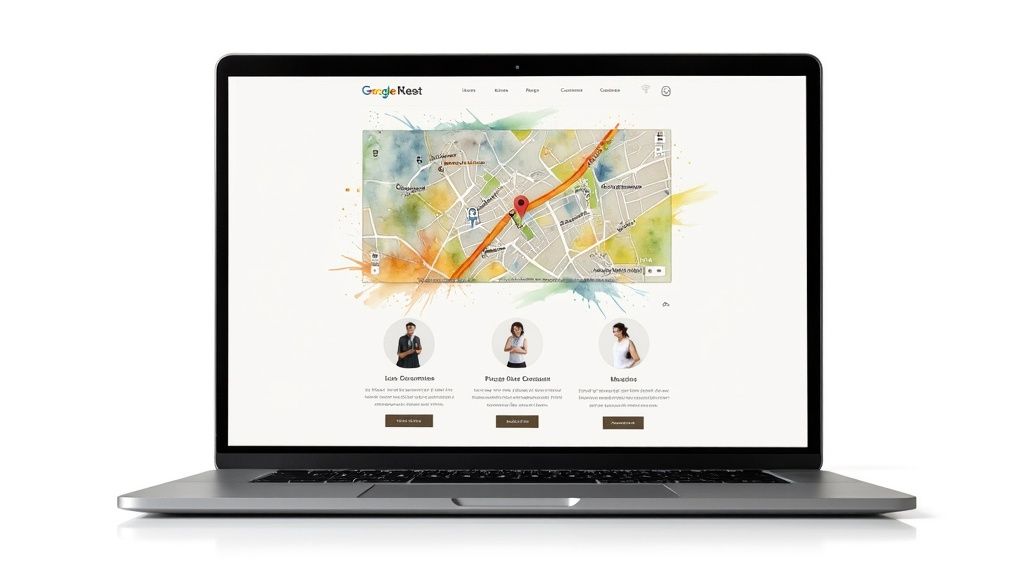
While your Google Business Profile acts as your digital storefront, your website is your home base. It’s the one place online where you have complete control over your brand story, where you can truly showcase your expertise and convert visitors into customers. Optimizing your website for local search—known as on-page SEO—is about sending crystal-clear signals to search engines about who you are, what you do, and most importantly, where you do it.
Think of it like merchandising a retail store. You wouldn’t hide your best products in a back corner; you’d display them prominently. Similarly, your crucial location details shouldn’t be buried on your website. Every page is a fresh opportunity to reinforce your local relevance and authority.
When you nail this, your website becomes a powerful magnet for local leads, working in tandem with your GBP to create a one-two punch that dominates local search results.
Weaving Location Into Your Website’s DNA
To rank in local searches, your website needs to shout your location from the rooftops. This means strategically incorporating your city, state, or neighborhood into key areas of your site. This isn’t about awkwardly stuffing city names everywhere; it’s about integrating them naturally where they provide value to both human visitors and search engine crawlers.
A perfect place to start is your homepage’s title tag—the main headline that appears in browser tabs and search results. A generic title like “Top-Quality Plumbing Services” is forgettable. A locally-optimized version like “Expert Plumbing Services in Springfield | Free Estimates” is far more powerful.
This simple tweak immediately tells Google and potential customers where you operate. This same logic applies to your meta descriptions—the short summaries under the title in search results. A compelling, locally-focused description can be the deciding factor that earns you the click over a competitor.
Here are the key on-page elements to optimize:
- Title Tags: Include your primary service and your city or main service area.
- Meta Descriptions: Write a persuasive summary that includes your location and a clear call to action (e.g., “Call today!”).
- H1 and H2 Headings: Use headings to structure your content and include local keywords where they fit naturally.
- Image Alt Text: Describe your images for search engines and visually impaired users. This is another great spot to add a location when relevant (e.g., “custom kitchen remodel in downtown Springfield”).
The Critical Importance of NAP Consistency
As with your Google profile, your Name, Address, and Phone Number (NAP) is the bedrock of your on-page local SEO. The information on your website must be an exact match to your GBP and other online directories. Even a tiny discrepancy can create confusion for search engines and erode the trust you’re trying to build.
Ensure your NAP is easy to find on your website. The best practice is to place it in the footer, so it appears on every page, and also feature it prominently on a dedicated contact page. This constant reinforcement signals reliability and makes it incredibly simple for customers to contact you.
Your NAP is your digital fingerprint. Ensuring it is consistent across your website and all other online platforms is one of the most critical and foundational elements of a successful local SEO for small business strategy.
Creating Dedicated Pages for Each Location
If your business serves multiple towns or has several physical locations, a single, generic “Service Areas” page won’t cut it. To truly compete, you need to create a unique, dedicated page for each location. This allows you to craft hyper-relevant content that speaks directly to customers in that specific community.
For instance, a roofing company serving two cities could build separate, targeted pages:
- A page titled “Expert Roof Repair in Springfield,” filled with testimonials from Springfield clients, details about local building codes, and an embedded map of their Springfield office.
- Another page titled “Trusted Roofing Contractors in Shelbyville,” highlighting projects completed in that town and discussing common roofing issues caused by the local climate.
This strategy sends powerful signals to search engines that you are a true local authority in each of those places. Each page should feature the location-specific NAP, business hours, and an embedded Google Map. The U.S. Small Business Administration offers excellent resources on defining your business location, which can help ensure the details on your site align with what search engines expect. You can review their guidance on the SBA website to get it right.
Building Trust with Citations and Reviews
Your website and Google Business Profile are only half the battle. A huge part of your local reputation is built across the wider internet. Every mention of your business on a directory, review site, or local blog acts as a digital word-of-mouth referral.
These off-site signals are crucial. They validate to search engines that you are a legitimate, active, and respected member of the local business community. This builds a powerful foundation of trust that directly impacts your search rankings. Mastering this comes down to two key components: citations and reviews.
Securing Your Digital Footprint with Citations
A citation is any online mention of your business’s Name, Address, and Phone number (your NAP). You’ll find them on sites like Yelp, industry-specific directories like Houzz for contractors, or your local Chamber of Commerce website. Each one acts as a third-party verification, confirming to Google that your business information is accurate.
The golden rule here is consistency. Your NAP information must be identical—down to the last comma and abbreviation—everywhere it appears online. Inconsistencies create doubt in the eyes of search engines, which can harm your visibility.
To get started, focus on securing listings in these key places:
- Major Data Aggregators: These services feed your business data to hundreds of smaller online directories, amplifying your reach.
- Core Public Directories: You must have a presence on Yelp, Apple Maps, and Facebook.
- Industry-Specific Directories: Identify the go-to directories for your niche. If you’re a lawyer, that’s Avvo; a hotel, TripAdvisor. These signal true expertise in your field.
We provide a deeper dive into this process in our guide on local business listing optimization.
The Overwhelming Power of Online Reviews
Reviews are the modern-day currency of trust. They are the social proof that drives nearly every local consumer decision. But their influence extends beyond potential customers; reviews have a massive impact on your search rankings.
Google’s algorithm closely examines the quantity, quality, and velocity (how frequently you get them) of your reviews to gauge your business’s real-world prominence and trustworthiness.
The image below illustrates just how much these customer interactions matter.
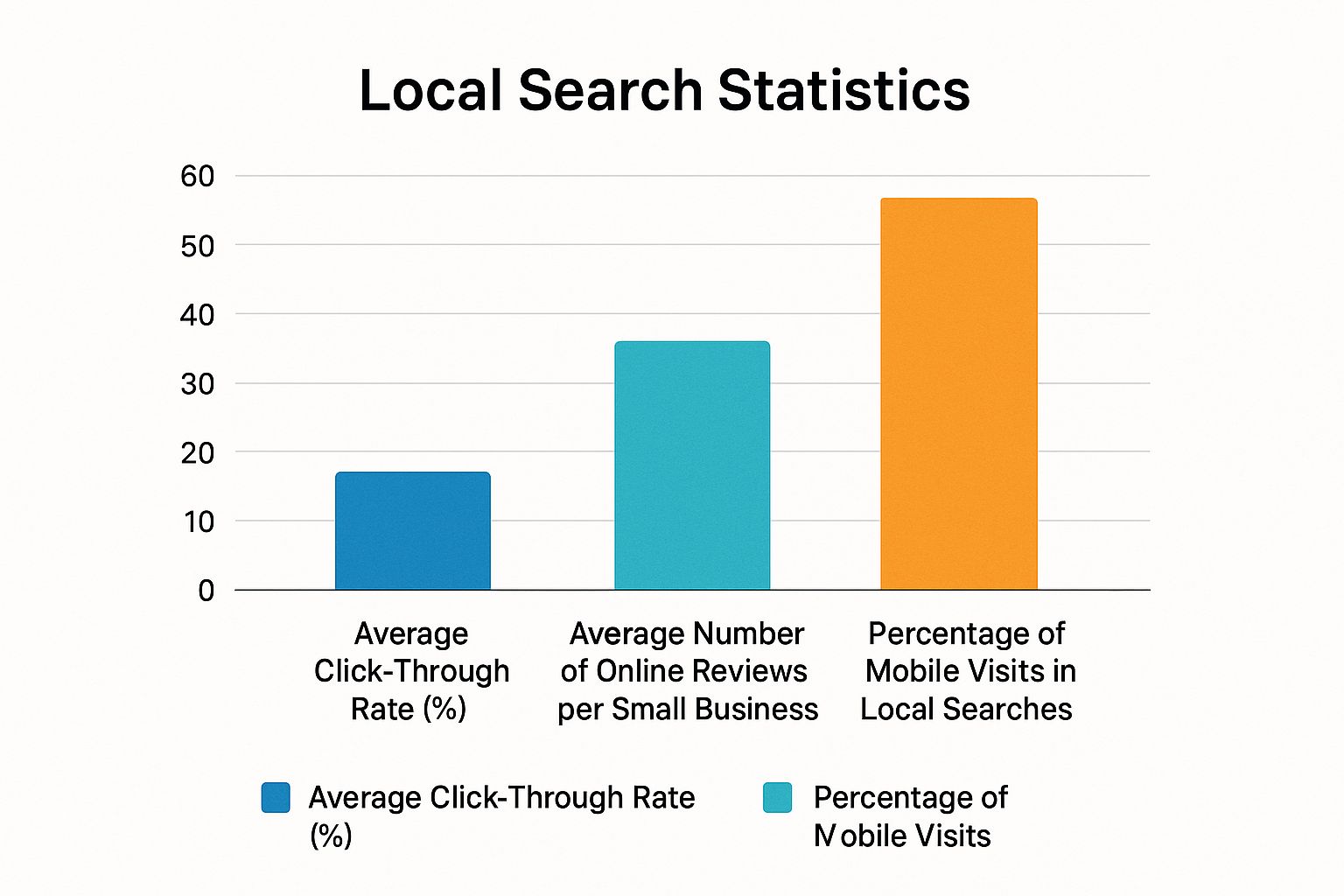
The data is clear: online reviews are not a “nice-to-have”—they are central to how customers find and choose local businesses. A stellar review profile can be the single factor that makes a searcher click your listing instead of a competitor’s, even if you rank slightly lower.
With the overwhelming majority of consumers turning to Google for reviews, a proactive reputation management plan is no longer optional. It’s a core business function essential for survival and growth.
To help you focus your energy, let’s break down the most impactful local SEO ranking factors.
Table: Key Local SEO Ranking Factors
This table highlights the signals with the biggest influence on your local search visibility. Use it to prioritize your efforts and focus on what truly moves the needle.
| Ranking Factor | Description | Why It Matters for Small Business |
|---|---|---|
| GBP Signals | The completeness and optimization of your Google Business Profile (e.g., categories, keywords, photos). | This is your digital storefront on Google. A well-managed profile is the single most important factor for ranking in the Map Pack. |
| Review Signals | The quantity, velocity (how fast you get them), and diversity of your online reviews. | Reviews are a direct reflection of customer trust. More high-quality reviews signal to Google that you are a prominent and reliable local choice. |
| On-Page Signals | The presence of your business Name, Address, and Phone (NAP), keywords in titles, and overall content relevance on your website. | Your website needs to reinforce what your GBP claims. It tells Google you are an authority for your services in your area. |
| Link Signals | The quality and relevance of other websites linking back to yours (backlinks). | Backlinks from other respected local businesses or organizations act as endorsements, boosting your site’s authority. |
| Citation Signals | The consistency and volume of your NAP mentions across online directories and websites. | Consistent citations verify your business’s existence and location, building a foundation of trust with search engines. |
As you can see, your online reputation—built through reviews and consistent citations—is woven directly into Google’s local algorithm. It’s not just about what you say about your business, but what the rest of the web says, too.
Proactively Managing Your Reputation
Waiting for reviews to trickle in is a recipe for slow growth. The businesses that dominate local search have a system for actively encouraging feedback and managing it professionally.
Your response to a review is not just for the person who wrote it; it’s a public demonstration of your customer service for every future prospect who reads it.
Encouraging Positive Reviews
Make it effortless for happy customers to share their experience. A simple follow-up email with a direct link to your Google review page can work wonders. You can also place a QR code on your front counter or at the bottom of an invoice. The easier you make it, the more likely they are to follow through.
Responding to All Reviews
Replying to every review—good and bad—shows you are engaged and genuinely care about the customer experience. For positive reviews, thank the person by name and mention something specific from their feedback. For negative reviews, respond quickly, acknowledge their frustration without being defensive, and offer to take the conversation offline to find a solution. This simple act can turn a critic into a loyal customer and proves to everyone else that you stand behind your work.
Creating Content That Attracts a Local Audience

For a local business, content marketing has a laser-sharp focus. You’re not trying to reach everyone; you’re trying to connect with the people in your own backyard.
This means moving beyond generic articles and creating resources that speak directly to the unique needs, interests, and challenges of your local customer base. When you do this, your website transforms from a digital business card into a genuinely useful community hub. It proves you’re invested in the area you serve, which builds incredible brand loyalty and sends powerful ranking signals to Google.
Identifying Local Customer Pain Points
The most effective local content solves real, local problems. Before you write a single word, put yourself in your customer’s shoes. What are they searching for? What questions do they have that are specific to your town or service area?
A local plumber, for example, could write a guide on dealing with the region’s notoriously hard water. A landscaping company might create an article about native plants that can survive the local climate. This hyper-focused content immediately establishes you as the go-to expert.
Here’s how to uncover these golden content ideas:
- Listen to your customers: The questions they ask you every day are a goldmine for content topics.
- Talk to your team: Your front-line employees know customer pain points better than anyone. Ask them about the most common questions they hear.
- Monitor local social media: What are people asking for recommendations for in neighborhood Facebook groups? These discussions are a direct line into the mind of your local consumer.
Frameworks for High-Impact Local Content
Once you have a list of local pain points, you can create content that proves your expertise and builds trust before a customer even thinks about calling.
Your content needs to answer one simple question for the reader: “Why should I choose you over anyone else?” The best answer is demonstrating you understand their local world better than the competition.
For example, a roofer in a hurricane-prone area could publish an article titled, “A Homeowner’s Guide to Hurricane-Resistant Shingles in [City Name].” That title alone screams local authority and solves a major problem for people in that specific place.
Practical Examples of Local Content
Generic blog posts get lost in the noise. It’s the hyper-local content that makes you stand out and shows you understand your community in a way a national chain never could.
Here are a few powerful content ideas that drive local business:
1. Neighborhood-Specific Service Guides
Create in-depth guides for the specific neighborhoods you serve. A real estate agent, for instance, could publish a “Complete Guide to Moving to the [Neighborhood Name] area,” detailing local schools, property taxes, and the best coffee shops.
2. Local Project Case Studies
Show, don’t just tell. Put together detailed case studies of projects you’ve completed for local clients. Include plenty of photos and testimonials to build credibility and help potential customers visualize the quality of your work.
3. Community Event Involvement
If your business sponsors a local sports team or participates in a town festival, write about it! This content highlights your commitment to the community and builds a positive local brand image.
A fantastic real-world example is this guide to finding the best eyelash extensions in Chicago. It perfectly illustrates this strategy by serving a very specific audience in a single city, attracting precisely the right kind of search traffic. By putting these ideas to work, you can transform your website into a powerful magnet for local customers.
Local SEO Tools and Measuring Your Success
Running a local SEO strategy without the right tools is like navigating a new city without a map. You might eventually get where you’re going, but you’ll waste a lot of time and energy along the way. To see what’s working, you must track your progress with real data.
This means using specific tools to monitor performance and focusing on the metrics that actually signal business growth. The good news? You don’t need a huge budget or a complicated software suite to get started.
With a few key instruments, you can sharpen your local SEO for small business and see exactly how your efforts are translating into revenue.
Essential Tools for Your Local SEO Toolkit
To truly manage your local presence, you need tools for a few key jobs: discovering local keywords, tracking your search rankings, and analyzing performance. Many of the most powerful options are either free or highly affordable.
Google Business Profile Insights: This is your command center. It’s built right into your GBP dashboard and shows you exactly how customers are finding your profile and what they do once they’re there—like calling, asking for directions, or visiting your website.
Google Keyword Planner: This free Google tool is a goldmine for discovering the exact terms people in your service area are searching for. You can easily filter by city or region to zero in on valuable local keywords.
BrightLocal: For businesses ready to invest in growth, a platform like BrightLocal is a fantastic all-in-one solution. It helps you track your local rankings, manage your online reputation, and build citations, giving you a clear picture of where you stand against the competition.
Key Performance Indicators That Actually Matter
It’s easy to get lost in a sea of data. That’s why you must focus on key performance indicators (KPIs) that connect directly to your bottom line. “Impressions” are nice, but they don’t pay the bills. The real value is in data that shows customers are taking action.
The goal isn’t just to rank higher. The goal is to confirm that those rankings are bringing in actual customers. Tracking actions like phone calls and direction requests provides undeniable proof of your local SEO’s ROI.
Here are the metrics that tell the real story of your success:
1. Google Business Profile Actions
This is the most direct measure of your local SEO efforts. Inside your GBP Insights, keep a close eye on these three core actions:
- Website Clicks: The number of people who clicked from your profile to your website.
- Clicks-to-Call: How many users tapped the “Call” button, most likely from a mobile device.
- Direction Requests: The number of potential customers who asked for directions to your physical location.
An upward trend in these numbers is a clear sign that your strategy is driving real-world business. Small businesses are the backbone of local economies, a fact supported by official data from the Census Bureau’s website, and tracking these actions proves your own local impact.
2. Local Keyword Rankings
You’ll want to monitor your position in search results for your most important local keywords, like “plumber in Springfield” or “best coffee shop near me.” A steady climb in rankings for these terms is a strong signal that Google views you as a relevant and authoritative local solution.
Your Local SEO Questions, Answered
Diving into local SEO can feel overwhelming. Getting clear answers to common questions is the best way to build a solid strategy and avoid the mistakes that trip up many business owners. Let’s tackle the most frequent ones.
How Long Until I See Real Results From Local SEO?
This is the big one. While you might see a small bump in activity within a few weeks of optimizing your Google Business Profile, meaningful, lasting results take time. Think of it like planting a garden; the initial work is quick, but it takes time for the roots to take hold.
For a comprehensive local SEO strategy, you should expect to see significant movement in your rankings and leads within 3 to 6 months. True local authority is built through consistent effort, not overnight gimmicks.
Can I Handle Local SEO on My Own, or Should I Hire Someone?
Many aspects of local SEO are perfect for a hands-on business owner. Keeping your Google Business Profile updated, actively requesting customer reviews, and writing content about local events are all highly effective DIY tasks.
Where it can get tricky is the more technical side, such as optimizing your website’s code for local search or building a large-scale citation campaign across dozens of directories.
A hybrid approach works best for many small businesses: handle the day-to-day engagement yourself, but bring in an expert for an initial audit and to help map out a clear strategy. This gives you control while ensuring you’re building on a strong foundation.
What’s the Single Biggest Mistake to Avoid?
If one mistake can derail your local SEO efforts faster than anything else, it’s inconsistent NAP (Name, Address, Phone Number) information.
When Google sees one version of your address on your website, a slightly different one on Facebook, and an old phone number in a local directory, it gets confused. That confusion erodes trust, and without trust, you won’t rank. Your first and most critical task is to ensure your core business information is 100% identical everywhere it appears online. No exceptions.
Ready to turn local searches into loyal customers? The team at Galant Studios specializes in crafting expert SEO strategies that get your small business seen. Learn how we can help you dominate your local market.