Let’s be blunt: local link building isn’t just an SEO task. It’s the art of earning digital votes of confidence from trusted local sources. It’s how you acquire backlinks from websites geographically relevant to your business, sending a powerful signal to search engines that you are a legitimate, important part of the local community. This isn’t about casting a wide net; it’s a precision strategy designed to make you the obvious choice for customers in your service area.
Get this right, and you don’t just compete in local search—you start to dominate it.
Why Local Link Building Is Your Competitive Edge

In a crowded market, winning local customers starts with building digital trust. Search engines view high-quality, relevant backlinks as the ultimate endorsement. Think about it: when a local chamber of commerce, a popular neighborhood blog, or another nearby business links to your website, it’s not just a click—it’s a signal to Google that you are a credible authority in your geographic area.
This isn’t just theory; it translates directly into tangible results. A strong local backlink profile is a cornerstone for improving your visibility on Google Maps and securing those top spots in geo-targeted searches. While this is a focused part of a much bigger picture, you can get the full rundown in this guide on Search Engine Optimization (SEO). Each quality link you build reinforces the message to Google that you are a valued part of the local ecosystem.
The Data Behind Local Search Dominance
The emphasis on local SEO is completely driven by clear consumer behavior. An incredible 99% of consumers now use the internet to find local businesses. On top of that, “near me” searches have surged by over 900% in recent years, showing a definitive shift in how people find services in their area.
Even more compelling is what happens after the search. Statistics show that 78% of local searches on a mobile device result in a purchase, whether online or in-store. This proves that investing time and resources into local link building isn’t just for visibility—it’s about directly connecting with a high-intent audience that is ready to buy.
Local link building moves beyond traditional SEO by focusing on geographic relevance. It’s not about who has the most links, but who has the most authoritative and trusted links within a specific community.
Connecting with Your Community
At its core, local link building is about more than just satisfying search engine algorithms. It’s about weaving your business into the digital fabric of your community.
This process strengthens your online presence and solidifies your reputation as the go-to provider in your area. By understanding the key factors that drive local rankings, you can build a strategy that connects with customers long before your competitors even have a chance.
Building Your Foundation with Citations and Directories
Before you can chase those high-impact local links, you need to get your digital house in order. Think of it as laying the groundwork for a skyscraper. This essential foundation is built on local citations and directory listings—the fundamental trust signals that search engines rely on. Nailing this first step is non-negotiable for any serious local link building campaign.
The heart of this process is NAP consistency. This isn’t just jargon; it stands for your Name, Address, and Phone number. When every mention of your business online shows this core information identically, it sends a clear, powerful message to Google: this business is real, it’s legitimate, and it’s located exactly where it says it is.
The Critical Role of NAP Consistency
Imagine Google as a detective verifying your business’s location. If it finds you listed on ten different websites, but three have an old address and two have a slightly different phone number, it creates doubt. This inconsistency is a major red flag that erodes the trust search engines have in your business data, which can seriously damage your local search rankings.
Local citations are a core component for winning in local search, especially in the Google Maps pack. Having perfectly accurate and consistent Name, Address, and Phone number (NAP) details across your Google Business Profile, niche directories, and even your local chamber of commerce website is what builds that ranking reliability.
Auditing Your Existing Digital Footprint
Your first job is to play detective yourself. You need to conduct a full audit of your online presence, hunting down every place your business is mentioned and checking that NAP information with a fine-toothed comb. Tiny variations you might not even notice—like “St.” vs. “Street” or including a suite number on some listings but not others—can be enough to cause confusion.
A great way to get a handle on this is to Master Local Citation Building with a structured approach. Here’s an actionable plan:
- Check the Big Data Aggregators: Start with the major data sources that feed hundreds of other sites. Getting it right here creates a positive ripple effect.
- Review Top-Tier Directories Manually: Go directly to the heavy hitters like Yelp, Apple Maps, and any key directories specific to your industry.
- Use Google Search Operators: A simple search like
"Your Business Name" "Your Street Address"or"Your Business Name" "Your Phone Number"can uncover listings you never knew existed.
Once you start finding these, create a simple spreadsheet. Track the URL, the incorrect NAP, the correct NAP, and the status of your update request. Staying organized is the only way to tackle this systematically. If you want a deeper dive, our guide on how to build local citations walks through this process in more detail.
Discovering High-Value Directory Opportunities
After you’ve cleaned up the mess, it’s time to be proactive and build new, high-quality citations. We’re not just talking about submitting to any old directory. The goal here is relevance. You want to find directories that are highly specific to your city, neighborhood, and industry.
Your competitors are probably listed on all the obvious sites. The real edge comes from digging deeper and finding the niche and hyper-local directories they’ve missed. This is where a smart strategy separates itself from a basic one.
For example, a boutique hotel should seek listings on local tourism board websites, city travel guides, and wedding vendor directories. A local law firm should target legal directories, the local bar association website, and other professional organizations.
One of the best starting points is your local Chamber of Commerce. These organizations exist to support and promote local businesses, making their member directories an incredibly valuable and authoritative source for a local backlink. According to the U.S. Chamber of Commerce, these groups serve as a central hub for business advocacy and community engagement. Joining your local Chamber almost always comes with a listing in their online directory—a trusted, high-quality link you can secure right away.
Earning Authentic Links Through Community Engagement
Once you’ve laid the groundwork with citations, it’s time for what truly moves the needle. The most powerful local backlinks aren’t just built; they’re earned. This is where your business stops being another listing and starts becoming a respected part of the local community.
Getting involved isn’t just about goodwill—it’s a powerful, sustainable way to acquire high-authority backlinks that your competitors can’t simply buy. This approach is built on relationships, generating the kind of authentic endorsements that search engines love. A link from a trusted local organization is a massive vote of confidence.
Sponsoring Local Events and Organizations
One of the most straightforward ways to weave your business into the local fabric is through sponsorships. When you support a local event, a youth sports team, or a neighborhood charity, you often get official recognition, which almost always includes a link from their website back to yours.
But don’t just write a check. The real magic happens when you get actively involved. Genuine participation forges stronger connections, and those connections lead to better link opportunities.
- Youth Sports Teams: Sponsoring a little league or local soccer team is a time-tested strategy for a reason. Your company name on the jerseys is great, but the real SEO prize is the link you’ll get from the team’s roster or sponsor page on the league’s official website.
- Charity Fun Runs or Galas: Find a local cause your customers care about and align your business with it. In return for your sponsorship, you’ll almost certainly be featured on the event’s website and promotional materials—all with valuable links pointing back to your site.
- Neighborhood Festivals: Putting your brand behind a local arts festival or seasonal block party gets you in front of hundreds, if not thousands, of residents. This often results in a high-authority link from the official event page, which might even be on a city government domain (.gov), a huge win for SEO.
Links from these trusted, non-commercial community hubs send a strong signal to Google that your business is stable, supportive, and a core part of the local scene.
The chart below shows just how these different local link building strategies stack up.
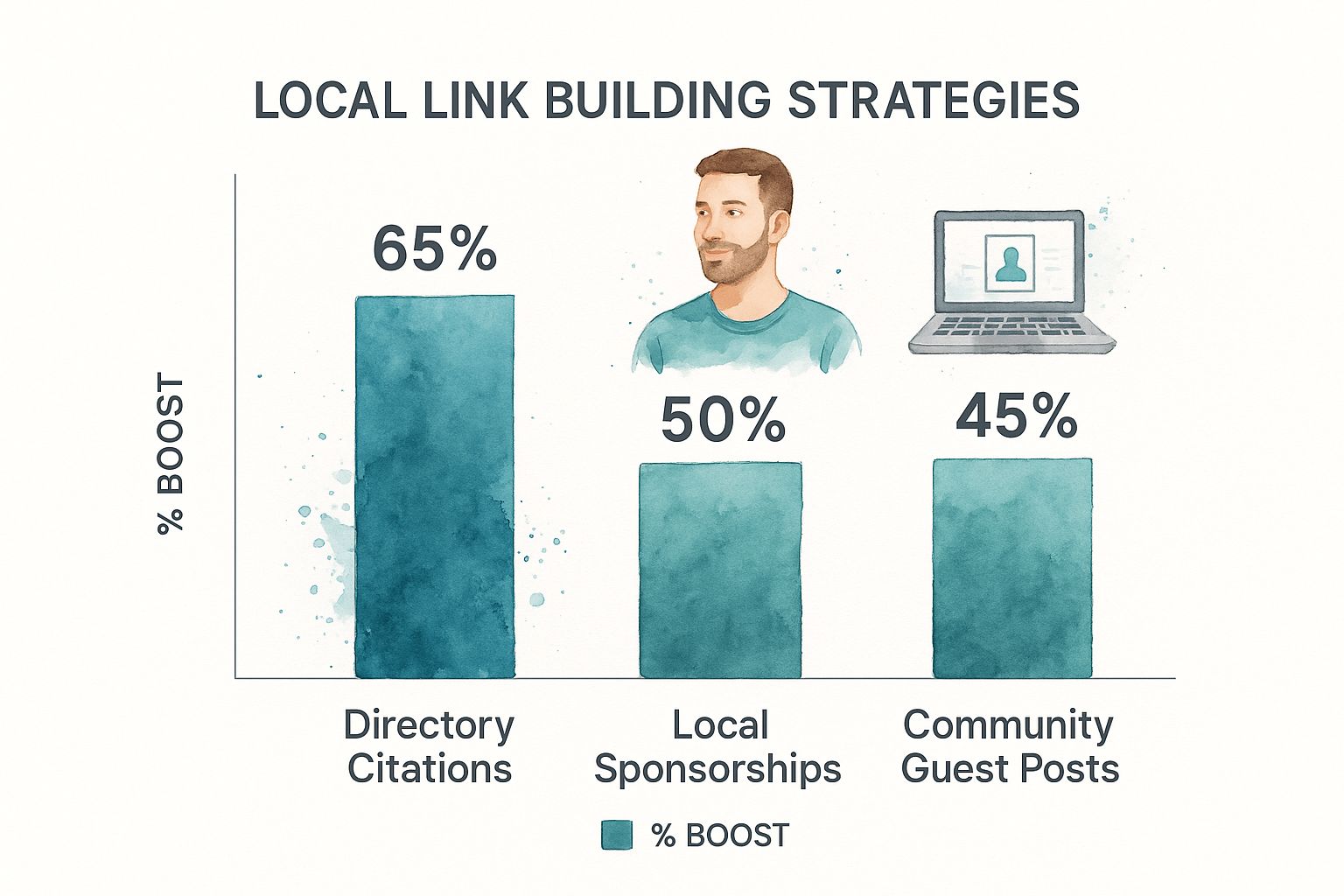
As you can see, while directories are important, it’s community-focused tactics like sponsorships and local guest posts that provide the authoritative gains that build long-term trust and authority.
To give you a clearer picture, here is a breakdown of common community-based tactics, comparing their potential impact against the effort required to pull them off.
Local Community Link Building Opportunities
| Tactic | Potential SEO Impact | Effort Level | Example |
|---|---|---|---|
| Sponsor a Youth Team | Moderate | Low | Getting a link from the littleleague.org sponsor page. |
| Host a Free Workshop | High | High | A local accounting firm hosts a “Small Business Tax” seminar and gets links from the Chamber of Commerce and local business blogs. |
| Sponsor a Local Festival | High | Moderate | A restaurant sponsors a food festival and earns a link from the city’s official event website. |
| Partner with a Charity | Very High | Moderate | A law firm partners with a local non-profit for a fundraiser, resulting in links from the charity’s site and local news coverage. |
Each of these paths offers a unique way to embed your business in the community. The key is to find the opportunities that align best with your brand, your resources, and your local market.
Creating Valuable Local Resources
Another incredibly effective strategy is to create content so genuinely helpful that other local organizations and businesses want to link to it. You’re not asking for a favor; you’re providing a resource. This turns your website into a local authority, attracting backlinks naturally.
Start by thinking about what local residents, visitors, or other businesses are actually searching for.
For example, an HVAC company could do more than just write about its services. What if they hosted a free “Winter-Ready Home” workshop? That’s a newsworthy event. It creates real value and can attract coverage (and links) from local bloggers, the city’s event calendar, or even the local news.
The goal is to become the source of information, not just a seller of services. When you provide genuine value to the community, local link building becomes a natural byproduct of your marketing efforts.
Think about developing a comprehensive local guide. This could be a detailed blog post, a dedicated page on your site, or even an interactive map that becomes the go-to resource for a specific topic.
Actionable Examples of Local Resource Guides:
- A real estate agent could create “The Ultimate Guide to Family-Friendly Parks in Austin,” complete with photos, a list of amenities for each park (is there a playground? a public restroom?), and location details. Local parenting blogs and community forums would be eager to link to such a useful guide.
- A local brewery could publish “A Guide to the Best Hiking Trails Near Marin County,” detailing trail difficulty, highlights, and a map. This is prime content for links from tourism sites, outdoor gear shops, and hiking blogs.
- A dental practice might develop a “Healthy Eating Guide for Kids in Portland,” featuring local farmers’ markets and restaurants with healthy kids’ menus. This is a public service that other local health-oriented businesses would be happy to share.
Yes, this kind of content takes real effort. But the return is enormous. Every link you earn this way strengthens your site’s authority and solidifies your reputation as a helpful local expert. This approach transforms local link building from a chore into a genuine act of community service that also happens to drive serious business growth.
Using Local Digital PR to Get Noticed

While community involvement builds a strong foundation, local digital PR is how you earn the high-authority backlinks that truly move the needle. This is the next evolution of local link building—it’s about becoming the story, not just participating in it.
This is an intensive strategy, but the payoff is immense. A single successful campaign can deliver more SEO impact than months of conventional link building.
The core idea is to create something genuinely newsworthy—a compelling story, unique data, or a valuable local resource—and pitch it to local journalists, bloggers, and media outlets. When they cover your story, they link back to your site, positioning you as a recognized local authority.
Finding Your Newsworthy Angle
Every business has a story, but the skill lies in finding the angle that makes it compelling to a wider local audience. Journalists are always looking for fresh content, but it has to resonate with their readers. Your job is to uncover the newsworthy potential in your day-to-day operations.
Not sure where to start? Here are a few angles that consistently work:
- Significant Milestones: Are you celebrating your 10th anniversary? Expanding to a new location? These events are perfect opportunities to share your business journey and connect with the community on a deeper level.
- Unique Charity Initiatives: Think beyond a simple check. If your dental practice is hosting a “Free Dental Day for Veterans,” that’s a powerful human-interest story a local news outlet would jump on.
- Insightful Local Data: You have expertise your community doesn’t. A local real estate agency could publish a report on “The Top 5 Most Desirable Neighborhoods for First-Time Buyers in Austin,” backing it up with hard numbers and local market trends.
The key is to think like a journalist. Ask yourself, “Why would someone who isn’t my customer care about this?” If you have a solid answer, you’ve found your story.
Creating Local Linkable Assets
A linkable asset is a piece of content so valuable that other websites can’t help but link to it. For local SEO, the most potent assets are grounded in specific, geographic data. These become the centerpiece of your PR campaign, giving journalists a tangible resource to cite.
Here are a few actionable ideas:
- A Localized Infographic: Create a sharp, visually appealing infographic on a local topic. A landscaping company could design one titled “The Most Drought-Resistant Plants for the Phoenix Climate.”
- A Hyper-Local Study or Report: Conduct a small-scale study and share the findings. A local coffee shop could survey 100 residents to find “Our City’s Favorite Coffee Drink” and publish the results.
- An Interactive Local Map: Build a tool the community can use. A bike shop could create an interactive map of the “Best and Safest Cycling Routes” in the area, complete with difficulty ratings and points of interest.
By creating a resource that genuinely serves the community, you shift your outreach from an ask to an offer. This simple change makes a journalist’s job easier and dramatically increases your chances of earning that link.
Mastering Media Outreach
With your newsworthy asset ready, the final piece of the puzzle is pitching it to the right people. This demands a targeted, personal approach. Blasting a generic email to every journalist in town is a surefire way to get ignored.
Your outreach needs to be methodical. Start by building a media list of local journalists, bloggers, and influencers who cover your industry or community. Track down their direct email addresses and make sure every pitch is personalized.
This approach is becoming the gold standard for a reason. An analysis of over 500 SEO professionals found that 48.6% now consider digital PR the single most effective link building tactic. This reflects a major shift in the industry, especially as traditional strategies become more expensive—some campaigns now cost upwards of $8,406 per month. You can dive deeper into these trends by reading the full link building research and its implications.
Here’s a simple, effective template you can adapt for your own outreach:
- Subject: Story Idea: [Your Compelling, Local-Focused Headline]
- Body:
- Hi [Journalist’s First Name],
- My name is [Your Name], and I’m the founder of [Your Local Business]. I saw your recent article on [Mention a Specific, Relevant Article They Wrote] and thought a local story we’re working on might be a good fit for your readers.
- We recently [Briefly Explain Your Newsworthy Angle or Asset – e.g., “published a report on local home-buying trends”]. One of our most surprising findings was that [Share One Fascinating, Local Statistic or Fact].
- You can see the full report here: [Link to Your Asset]
- Is this something you might be interested in covering for [Publication Name]?
- Best,
- [Your Name]
This template works because it’s direct, respectful, and shows you’ve done your homework. By combining a newsworthy angle with a valuable local asset, you set your local link building efforts up for incredible success.
Advanced Strategies and Common Pitfalls
Once you’ve mastered the basics, it’s time to get more sophisticated. Foundational tactics get you in the game, but to pull ahead of the competition, you need to refine your approach. This is where we move beyond low-hanging fruit and start thinking like a chess player, anticipating moves and identifying high-impact opportunities while avoiding common traps.
Reverse-Engineer Your Competitors’ Success
One of the smartest things you can do is a deep dive into your competitors’ backlink profiles. This isn’t about copying them; it’s about strategic intelligence. Using an SEO tool, you can see exactly who is linking to the top-ranking local businesses in your field.
What are you looking for? Patterns and high-value links. Did they get a great write-up in the major local newspaper? Are they consistently mentioned on niche blogs you’ve never heard of? This analysis gives you a proven roadmap. You can see what’s already working and target those same—or similar—sources for your own business.
Turn Broken Links into Your Wins
Here’s an often-overlooked tactic: broken link building. The concept is simple but incredibly effective. You find relevant local websites—like a city tourism guide or a business association’s blog—and look for links that lead to a dead page (a 404 error).
When you find one, you reach out to the site owner. You’re not just asking for a link; you’re helping them fix their website. You let them know about the broken link and politely suggest your own relevant page as a perfect replacement. This only works if you have a genuinely useful resource to offer.
- Practical Example: A local plumbing company finds a “Home Maintenance Checklist” on a popular real estate blog. One of the links, pointing to an article on “How to Winterize Your Pipes,” is broken. The plumbing company emails the blog’s editor, flags the dead link, and offers their own comprehensive guide on the same topic as a substitute.
It’s a classic win-win. You provide value by helping them clean up their site, and in return, you land a powerful, contextually relevant backlink.
Critical Mistakes That Can Tank Your Efforts
Knowing what not to do is as important as knowing what to do. In the race to get more links, it’s easy to make mistakes that can set you back or even get your site penalized by Google.
A mature local link building strategy is about building a profile that looks natural, adds real authority, and can stand the test of time against algorithm updates. Simply chasing a high number of links is a recipe for long-term failure.
Here are the biggest mistakes to avoid:
- Paying for Links: This is the cardinal sin of link building. Buying links directly violates Google’s guidelines. It might feel like a quick win, but search engines are incredibly good at sniffing out these schemes. Getting caught can lead to devastating penalties that wipe out your search visibility overnight.
- Submitting to Low-Quality Directories: There’s a world of difference between a respected local directory and a spammy link farm. Listing your business on junk sites provides zero SEO benefit and can create a toxic association for your brand. Stick to reputable, well-managed directories relevant to your industry and location.
- Ignoring Link Relevance: Not all links are created equal. A backlink from a high-authority website that has nothing to do with your business or location is practically useless for local SEO. A link from a small but highly relevant local blogger is often far more valuable than one from a major national site with no local connection.
A truly effective link building strategy is built on the pillars of relevance and authority. By focusing on these advanced tactics and steering clear of common errors, you can build a powerful, lasting competitive edge in your local market.
Your Local Link Building Questions Answered

As you put these strategies into practice, questions are inevitable. This final section tackles the most common queries from business owners and marketers starting their local link building journey. Think of it as a quick reference to keep you on track.
How Long Does It Take to See Results from Local Link Building?
This is the big one, and the honest answer is: it depends. SEO is a long-term play, not an overnight fix. Patience is your most valuable asset.
You can often see the first glimmers of progress within two to three months. This usually comes from foundational work like claiming business listings and cleaning up citations across major directories. These early wins help search engines verify your business, which can improve your visibility in local map packs.
For the more powerful links—the kind you earn through community outreach or PR—the timeline is longer. It can take four to six months for the authority from those high-quality backlinks to kick in and create significant movement in organic search results. The key is consistency; each link you build adds to the momentum.
What Is the Difference Between a Citation and a Backlink?
It’s easy to confuse these two, but understanding the distinction is crucial. They’re related, but they do very different jobs for your business.
- A local citation is any online mention of your business’s Name, Address, and Phone number (NAP). A citation doesn’t even need a clickable link to count. Its main job is verification—proving to search engines that your business is real and located where you say it is.
- A backlink, on the other hand, is a clickable hyperlink that directs a user from one website to yours. This is a direct connection that passes authority or “link equity.”
Think of it this way: citations confirm who and where you are. High-quality backlinks endorse what you know and how trusted you are in your community. A winning local strategy needs a healthy mix of both.
How Many Local Links Do I Need to Rank?
Everyone wants a magic number, but one doesn’t exist. The focus should always be on quality over quantity.
A single, highly relevant link from a major local newspaper is worth far more than dozens of links from low-quality, spammy directories.
Your best benchmark is your competition. Look at the backlink profiles of the businesses that consistently rank at the top for your most important keywords. This won’t give you a number to hit, but it will show you the caliber and type of links you need to compete. Your goal is to build a natural, diverse, and authoritative link profile, not just to chase an arbitrary count.
Should I Do Local Link Building Myself or Hire an Agency?
Deciding between a DIY approach and bringing in a professional comes down to your available resources, expertise, and your local market’s competitiveness.
You can absolutely handle many foundational tasks in-house, like managing your Google Business Profile and submitting to key local directories.
However, advanced strategies require a serious investment of time and specialized skill. Running a successful digital PR campaign, performing deep competitor analysis, and maintaining a consistent outreach schedule is practically a full-time job. If you have the time and desire to learn, a DIY approach can work. But if you’re in a competitive industry or simply don’t have the bandwidth, hiring a specialized local SEO agency can get you there much faster and deliver a far stronger return on your investment.
Ready to dominate your local market and connect with more customers? Galant Studios specializes in crafting expert local SEO and link building strategies that deliver measurable results. Let’s build your online authority together. Learn more about our SEO services.