Great website copy doesn’t just appear. It’s not about stringing together fancy words to describe what you sell; it’s a deliberate, strategic process designed to connect with an audience, build a brand, and guide people to take a specific action.
This all starts long before you write the first headline. It begins with a deep dive into your customer’s world, a hard look at your competition, and a crystal-clear goal for every single page.
Laying the Groundwork for Persuasive Copy
The most compelling copy is built on a solid foundation of research and strategy. This is where you stop guessing what your customers want and start knowing what they truly need. Think of it as creating a blueprint that ensures every sentence you write serves a specific, conversion-focused purpose.
Skipping this stage is like building a house without a plan. You might end up with something that looks okay, but it won’t be functional. This groundwork ensures your content speaks directly to the right people, positions your brand effectively, and ultimately drives real results.
Define Your Ideal Customer
You can’t persuade someone you don’t understand. The first real task is to create detailed customer personas that go way beyond basic demographics like age or location. Your goal is to sketch out a profile of a real person, complete with their unique challenges, hopes, and motivations.
To build a useful persona, you need to answer specific, practical questions:
- What are their biggest pain points? For example, a small business owner’s pain point isn’t “needing marketing,” it’s “spending hours on social media with no new customers to show for it.”
- What does their ideal outcome look like? What is the “after” state they’re dreaming of? For that same owner, it might be “waking up to three new qualified leads every morning.”
- What’s holding them back? Uncover their hesitations. Do they think a solution is too expensive? Too complicated? Have they been burned before?
- How do they talk about their problems? Listen to the exact words and phrases they use on forums, social media, or in reviews. This is your source for authentic, high-converting language.
This exercise transforms an abstract “target audience” into a tangible person. Suddenly, you can write with genuine empathy, addressing their actual concerns and aspirations head-on.
Analyze Competitor Messaging
Let’s be honest: your website doesn’t exist in a bubble. Your prospects are constantly comparing you to your competitors, so your copy needs to give them an undeniable reason to choose you. This means you have to get forensic with your competitor analysis.
Look at how others in your industry are communicating. What are the common threads? Are they all competing on price? Are they obsessed with a particular feature? Or are they all telling the same brand story? Identifying these patterns is your key to finding a gap in the market.
Your unique value proposition is often found where your strengths meet your customers’ needs in a way your competitors aren’t addressing. This is your strategic advantage, and your copy must communicate it clearly and consistently.
The point isn’t to mimic what seems to be working for them. It’s to find your own lane. Differentiate your brand by zeroing in on what you do better, what you offer exclusively, or the unique perspective only you can bring to the table.
Establish a Clear Brand Voice
Once you know who you’re talking to and what makes you different, you need to decide how you’ll say it. Your brand voice is the personality your business shows through its words, and it needs to be consistent on every single page.
Think about the impression you want to make. Should your brand feel:
- Authoritative and professional? (Like a financial advisor)
- Friendly and conversational? (Like a direct-to-consumer brand)
- Inspirational and ambitious? (Like a high-end fitness company)
- Witty and playful? (Like a trendy snack brand)
A well-defined voice doesn’t just make you memorable; it builds trust. It’s also worth noting that a strong voice must work hand-in-hand with usability, so it’s wise to understand the fundamental principles of UX writing to ensure your style enhances the user’s journey, rather than complicating it.
Assign One Goal to Every Page
This last point is non-negotiable. Every single page on your website must have one primary job. A page that tries to do everything at once will fail at everything. Before you start writing, decide on the single most important action you want a visitor to take.
This singular goal, often called a Call to Action (CTA), might be to sign up for a newsletter, request a demo, purchase a product, or schedule a call. This focus is what makes copy effective. It ensures every headline, sentence, and button works in harmony to guide the user toward that one specific outcome.
Practical Example: A blog post’s primary goal might be to get newsletter sign-ups. Therefore, the CTA should be “Join our newsletter for more tips,” not a mix of “Follow us on social,” “Check out our services,” and “Read another post.”
If you want to map this out more formally, our comprehensive content marketing strategy template can help you align every piece of content with a specific business objective.
Crafting Headlines That Command Attention
Your headline is the most important piece of real estate on your entire page. Think of it this way: you have just a few seconds to convince a visitor to stick around instead of hitting the back button. Your headline is your one shot.
A powerful headline does more than just announce what the page is about; it makes a promise, sparks curiosity, and sets the stage for everything that follows. If your headline falls flat, even the most brilliant, persuasive copy below it will never get read. It’s the gatekeeper to your message.
The Psychology Behind a Great Headline
What makes a headline really work? It’s not about being clever. The best headlines are grounded in a solid understanding of what makes people tick. They connect with a reader’s problems, their desires, and their emotions.
Ultimately, a winning headline does one of three things:
- It promises a clear, tangible benefit.
- It creates an “information gap” that makes the reader curious.
- It uses data or a specific number to build instant credibility.
Your goal is to answer the visitor’s unspoken question—”What’s in it for me?”—almost instantly. Vague, artsy headlines might sound good in a marketing meeting, but they rarely perform well. When it comes to writing copy that converts, clarity always beats cleverness.
This infographic breaks down a simple, repeatable process for hitting those psychological triggers every time.
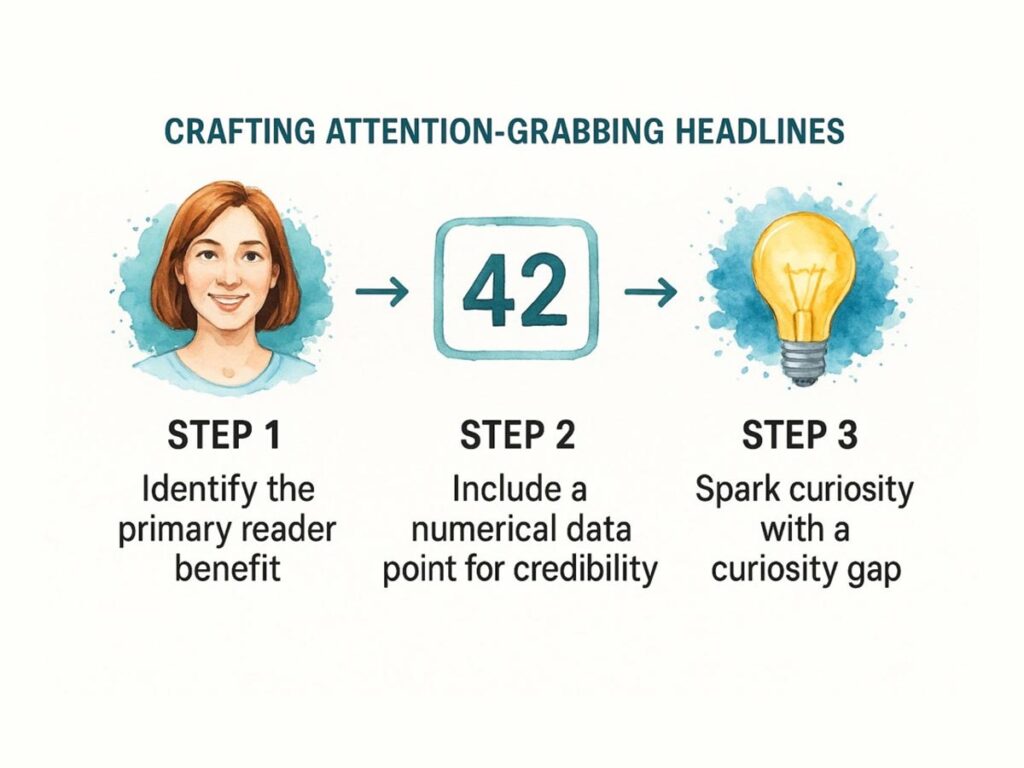
As the visual shows, a strong headline starts by pinpointing the reader’s main benefit. Then, you can layer on a number to make it feel more concrete and add a touch of curiosity to pull them down the page.
Practical Techniques for Writing Compelling Headlines
Knowing the psychology is one thing, but putting it into practice is another. A simple and incredibly effective technique is to use numbers. For some reason, headlines like “7 Ways to Improve Your SEO” consistently get more clicks. They feel concrete and set a clear expectation for the reader.
Another go-to method is to speak directly to your reader. Using words like “You” or “Your” creates an immediate, personal connection. It makes the benefit you’re promising feel more tangible and directly relevant to their situation.
Here are a few proven headline frameworks you can adapt:
- The “How-To” Headline: Promises a clear solution to a specific problem (e.g., “How to Write Website Copy That Actually Converts”).
- The “Benefit-Driven” Headline: Cuts right to the chase, focusing on the result your reader is after (e.g., “Increase Your Sales by 50% With Persuasive Copy”).
- The “Question” Headline: Engages a reader’s mind by making them seek the answer (e.g., “Are You Making These Common Copywriting Mistakes?”).
The right copy does more than just inform; it drives action. A well-written landing page is often the final step before a conversion, making your word choice critical. In fact, simple things like grammar and spelling errors can be enough to destroy credibility and spike bounce rates. For a deeper look, you can explore copywriting statistics and their impact.
Guiding Readers With Clear Subheadings
While your main headline is the hook, your subheadings are what keep the reader on the line. They serve as signposts, breaking your content into smaller, more manageable chunks. Let’s be honest—most people don’t read online; they scan.
Effective subheadings are a scanner’s best friend. They let someone quickly grasp the key takeaways of your article without having to read every single word. Keep them clear, concise, and descriptive of the section that follows.
Actionable Tip: Instead of a generic subheading like “Our Process,” try a benefit-driven one like “Get Results in 3 Simple Steps.” This continuously reinforces the value you’re providing and keeps visitors engaged all the way to the end.
Writing Body Copy That Persuades and Sells

So, your headline did its job and hooked the reader. Now what? The body copy is where you have to deliver on that initial promise. This is the real heart of persuasion, where you move a visitor from casual curiosity to genuine interest—and ultimately, to a decision.
The most common trap writers fall into is simply listing what a product or service does. But effective copy isn’t about you; it’s about your customer. This means shifting your entire perspective from technical features to compelling benefits. It’s a subtle but powerful change that makes all the difference.
From Features to Benefits
A feature is a dry, factual statement about your product. A benefit, on the other hand, is the positive outcome that feature creates for your customer. People don’t buy features; they buy a better version of themselves, a solution to a nagging problem, or a faster way to reach their goals.
Your job is to connect the dots between what your product is and what it does for them.
The essence of persuasive copy is answering the customer’s unspoken question: “What’s in it for me?” Every single sentence needs to pass this test. If it doesn’t offer clear value to the reader, it probably needs a rewrite or the delete key.
Mastering this is key. For a deeper dive into crafting compelling sales copy, I’d recommend learning how to write a product description that sells by translating product specs into tangible advantages.
Let’s look at how you can reframe your messaging from a technical feature into a customer-centric benefit. This table shows the transformation in action.
From Feature to Benefit: How to Reframe Your Message
| Product Feature | Customer Benefit | Example Copy |
|---|---|---|
| “Our software has a 256-bit AES encryption.” | “Your sensitive data remains completely secure and confidential.” | “Sleep soundly knowing your private information is protected with bank-level security, safeguarding your business from threats.” |
| “This hiking boot is made with waterproof materials.” | “Your feet stay dry and comfortable in any weather.” | “Trek through streams and sudden downpours with confidence. Our waterproof design ensures your adventure is never cut short by wet socks.” |
| “The project management tool integrates with Slack.” | “Your team communication becomes more efficient and streamlined.” | “Stop switching between apps. With seamless Slack integration, you can keep every project update and conversation in one place.” |
See the difference? The example copy doesn’t just state a benefit—it paints a picture of that benefit in the customer’s life.
Build Trust With Social Proof
No matter how eloquent your writing is, people are naturally skeptical of claims you make about yourself. This is where social proof becomes your greatest ally. It’s third-party validation that proves other people have trusted you and gotten great results.
You can weave several types of social proof directly into your body copy:
- Customer Testimonials: Pull direct quotes from happy clients. Using their full name, company, and even a photo lends them far more credibility.
- Case Studies: Go beyond a simple quote and tell the story of how you helped a specific client solve a problem. Use real data to show the transformation.
- Client Logos: If you’ve worked with recognizable companies, displaying their logos is a fast way to build authority.
- Data and Statistics: Hard numbers can be incredibly persuasive. Think “Trusted by over 10,000 small businesses” or “Our clients increase revenue by an average of 35%.”
These elements work together to dismantle doubt and build the confidence a prospect needs to take the next step.
Guide the User With a Powerful Call to Action
Every word on the page should be steering the reader toward a single, specific goal. The Call to Action (CTA) is your final instruction, telling them exactly what to do next. A weak, vague, or hidden CTA is a conversion killer.
Your CTA needs to be unmissable and crystal clear. Use strong, action-oriented verbs that create momentum. Generic phrases like “Learn More” or “Submit” are far less effective than specific, benefit-focused commands.
Just look at the difference:
- Weak CTA: “Contact Us”
- Strong CTA: “Get Your Free Quote Now”
And another:
- Weak CTA: “Download”
- Strong CTA: “Download My Free SEO Checklist”
The stronger versions are specific, often create a sense of urgency (“Now”), and reinforce the value the user gets. When your CTA is the clear, logical conclusion to your persuasive narrative, you make it easy for the reader to say yes.
Integrating SEO Without Sounding Like a Robot
Powerful, persuasive copy is worthless if no one ever sees it. This is where Search Engine Optimization (SEO) comes into play, not as a separate task, but as a natural partner in the writing process. The real art is weaving in SEO best practices to get discovered by search engines without ever sacrificing that authentic, human-first voice you’ve worked so hard to create.
Forget the old-school advice about “keyword stuffing.” Today, great SEO copywriting is about understanding the exact language your audience uses when they’re looking for answers and seamlessly integrating it into content that is genuinely valuable. This balance ensures your pages rank for the right searches while speaking directly to the people you want to attract.
Uncovering Audience Intent with Keyword Research
Before you write a single word of optimized copy, you have to get inside your customer’s head. What are they actually typing into Google? This is the core of keyword research, and it’s the bedrock of any smart SEO strategy. It’s all about identifying the words and phrases people use when they need the solutions you offer.
But effective research goes much deeper than just grabbing popular terms. It’s about decoding search intent—the “why” behind the query. Is someone just gathering information? Are they actively comparing products? Or are they ready to pull out their credit card? Answering that question helps you tailor your copy to meet them exactly where they are in their journey.
If you want to master this crucial first step, our guide on how to do keyword research breaks down the entire process. Getting this right means you’re not just optimizing for a search engine; you’re creating content that genuinely helps, building trust from the very first click.
Strategically Placing Keywords for a Natural Flow
Once you’ve got your target keywords, the next challenge is to place them in your copy so they feel like they belong there. Nothing screams “I’m trying to rank” like a keyword awkwardly jammed into a sentence where it doesn’t fit. This kind of clumsy phrasing can instantly kill a reader’s trust.
So, where should you focus your efforts? Here are the high-impact spots to place your keywords naturally:
- Page Title and Meta Description: This is your first impression in the search results. A well-placed keyword here is critical for both rankings and getting the click.
- Headlines and Subheadings (H1, H2, H3): These act as signposts. Using keywords in your headings tells both readers and search engines what each section is about.
- The First Paragraph: Signal relevance right away. Including your main keyword early on confirms to the user (and Google) that they’ve landed in the right place.
- Image Alt Text: This is a simple but often overlooked opportunity. Descriptive alt text helps search engines understand your images and makes your site more accessible.
By thoughtfully weaving keywords into these key locations, you give search engines clear signals about your content without ever disrupting the reader’s experience.
The golden rule of modern SEO is simple: write for people first, then optimize for search engines. When you focus on providing clear, valuable, and engaging content, you naturally create something that search engines want to reward.
The first commercial internet service providers emerged in 1989, and according to the U.S. Census Bureau, over 90% of U.S. households now have an internet subscription. This widespread access has created immense competition, making high-quality, discoverable copy more critical than ever.
Enhancing Authority with Internal Linking
On-page SEO isn’t just about keywords; it’s also about building a smart, interconnected website. Internal linking—the simple act of linking from one page on your site to another—is one of the most powerful tools in your arsenal.
This practice achieves a few key things. First, it helps search engines crawl and index all the pages on your site more effectively. It also helps spread “link equity” or authority throughout your domain. Most importantly, it creates a better experience for your readers by guiding them to other relevant, helpful content, keeping them engaged longer and showcasing the true depth of your expertise.
How to Edit and Test Your Copy for Maximum Impact
Finishing your first draft isn’t the end of the road; it’s just the beginning. The real magic happens in the final stages, where disciplined editing and user-driven testing transform good writing into copy that actually drives business. This is where you sharpen your message, polish out the flaws, and let hard data guide your final decisions.
This crucial phase turns a creative piece into a strategic business asset. By approaching it with a clear framework, you ensure every word on the page is earning its keep—building trust and nudging your audience toward action.
Adopt a Multi-Layered Editing Approach
Trying to fix everything at once—from the persuasive arc to a misplaced comma—is a surefire way to miss important issues. I’ve found the most effective method is to break the editing process into distinct, focused passes, each with a single goal.
- Edit for clarity and persuasion: Read through the entire piece from your customer’s perspective. Does the story flow logically? Is the value proposition crystal clear? Hunt down jargon, confusing sentences, or anything that slows the reader down.
- Edit for voice and tone: Does the copy sound like your brand? Is the tone consistent and appropriate for the audience and the page’s goal?
- Proofread for mechanics: This is the final, meticulous check for grammatical errors, spelling mistakes, and typos. These small mistakes can instantly damage your brand’s credibility.
The Power of Reading Your Copy Aloud
One of the oldest tricks in the book is still one of the best: read your copy out loud. Your ears will catch what your eyes miss—awkward phrasing, clunky sentences, and jarring shifts in tone.
When you read silently, your brain tends to automatically fill in gaps and correct minor mistakes. Reading it aloud forces you to slow down and experience the rhythm of the words just as a reader would. This simple act helps you answer a few vital questions:
- Does this sound like a real person talking?
- Is the tone consistent with our brand voice?
- Are there any sentences that are a chore to get through?
This one technique can be the difference between copy that feels sterile and copy that truly connects.
A/B Test Your Way to Higher Conversions
Once your copy is polished and error-free, it’s time to let your audience be the judge. A/B testing, also called split testing, is how you find out which version of your copy actually performs better in the real world. You simply show two different versions of an element—like a headline or a button—to different segments of your audience and see which one gets more clicks or conversions.
A/B testing takes the guesswork out of copywriting. Instead of having an internal debate over which headline sounds better, you can let your audience’s behavior give you a definitive, data-backed answer.
This is where you can test small changes that make a big impact. For example:
- Headline: “Save Time on Accounting” vs. “Finish Your Invoicing in Half the Time.”
- Call to Action: “Get Started” vs. “Request Your Free Demo.”
- Testimonial: A quote focused on customer service vs. a quote focused on ROI.
The demand for effective copy is undeniable. The global copywriting services market was valued at $25.29 billion in 2023 and is projected to hit $42.22 billion by 2030. This growth just underscores how critical persuasive writing is, and rigorous testing is the key to unlocking its full power.
By systematically testing and refining your work, you start making informed decisions that directly boost your website’s performance. This is a foundational practice, and you can explore more conversion rate optimization tips to build on this momentum.
Common Questions About Website Copywriting
Even with a solid plan, you’re bound to hit a few roadblocks when you start writing. It happens to everyone. Let’s tackle some of the most common questions that pop up, so you can get unstuck and back to crafting copy that works.
How Do I Find the Right Tone of Voice?
Finding your brand’s voice isn’t about sounding clever; it’s about sounding real to the people you want to reach. It all starts with knowing two things inside and out: your ideal customer and your company’s core values.
A practical way to nail this down is to brainstorm adjectives that describe your brand’s personality. Are you professional, authoritative, and serious? Or are you more friendly, witty, and informal? Pick a few that feel right, then build a simple style guide. The most helpful part is including real-world “do’s and don’ts” so everyone on your team understands how to bring that voice to life.
What Is the Ideal Length for a Web Page?
I get this question all the time, and the honest answer is: there’s no magic number. The right length for any page depends entirely on its job and how much convincing your reader needs.
My guiding principle has always been: as long as it needs to be to persuade, and not a word longer.
A landing page for a simple newsletter signup might only need a couple hundred words to get the point across. But a sales page for a high-ticket consulting service? That’s going to need a lot more detail to answer every question and overcome every objection a potential client might have. Your focus should be on delivering a complete, compelling story, not hitting an arbitrary word count.
How Can I Measure the Success of My Copy?
You can’t improve what you don’t measure. Great copy isn’t a matter of opinion; it’s proven by data.
The most reliable metric is your conversion rate. A “conversion” is just the main thing you want someone to do on that page—whether that’s buying a product, filling out a form, or starting a free trial.
Here are the key numbers I always keep an eye on:
- Conversion Rate: What percentage of visitors actually took the desired action?
- Bounce Rate: How many people landed on the page and left without clicking anything else?
- Time on Page: Are people actually sticking around to read what you’ve written?
Tools like Google Analytics are essential for this. If you want to dig even deeper, heatmap tools can be incredibly insightful, showing you exactly which parts of your page people are reading, hovering over, and ignoring.
How Often Should I Update My Website Copy?
Think of your website copy as a living document, not something you write once and forget about. Your business evolves, your audience’s needs change, and the market shifts. While a complete overhaul isn’t necessary all the time, you should absolutely plan to review and refresh your most important pages at least once or twice per year.
Of course, any big change should trigger an immediate copy review. This includes launching a new product, targeting a new customer segment, or going through a rebrand. On a more regular basis, A/B testing key elements like headlines and CTAs is a smart way to keep your messaging sharp and performing at its best.
At Galant Studios, we transform your brand’s message into high-converting website copy. Our expert SEO and design services ensure your business not only ranks higher but also connects deeply with your target audience. Learn more about how we can drive your growth at Galant Studios.