If you’ve spent any time in the SEO world, you’ve asked the question: “how many seo keywords per page should I use?” While the question is timeless, the answer has changed dramatically. Forget the old rules of keyword stuffing and density percentages.
Today, the most effective, conversion-focused strategy is to target one primary keyword per page. This core concept is then supported by a cluster of related secondary and long-tail keywords that build topical authority. It’s a shift from chasing a keyword count to creating a comprehensive resource that genuinely solves users’ problems.
Shifting Focus From Keyword Count to Topical Authority

For years, SEO was a numbers game obsessed with keyword density. Marketers twisted their content into knots trying to hit a magic percentage, often creating copy that was awkward and unreadable. It was written for bots, not people.
Thankfully, search engines like Google have evolved.
Modern algorithms now use sophisticated systems to prioritize topical authority. Instead of just counting keyword mentions, they analyze the entire context of your page to understand how deeply it covers a subject. This is a game-changing shift.
Your goal is no longer to simply rank for a single keyword. Your mission is to become the definitive, go-to resource for an entire topic, answering not just the user’s initial query, but all the follow-up questions they didn’t even know they had.
This means the quality of your information and its direct relevance to a user’s problem are far more valuable than hitting an arbitrary keyword number. This approach doesn’t just win with search engines; it builds trust and drives conversions.
Get In Touch
The Evolution of Keyword Targeting
To see how far we’ve come, look at this side-by-side comparison of old tactics versus modern strategy.
| SEO Factor | Outdated Approach | Modern Approach |
|---|---|---|
| Primary Goal | Rank for a specific keyword | Become an authority on a topic |
| Keyword Metric | Keyword Density | Topical Relevance & User Intent |
| Content Strategy | Insert keywords a set number of times | Cover a topic comprehensively |
| User Experience | Often awkward and unnatural | Natural, helpful, and engaging |
The modern approach is holistic, user-centric, and ultimately, more profitable.
Introducing the Keyword Cluster Model
A far more effective strategy for today’s landscape is the keyword cluster model. Think of each page as a detailed chapter in a book. It has one main idea (the primary keyword) that it explores in-depth, supported by related concepts and sub-points (secondary keywords).
Here’s the practical breakdown for each page:
One Primary Keyword: This is the star of the show—the main topic your page promises to cover. It represents the core problem your audience is trying to solve.
Several Secondary Keywords: This is your supporting cast. They are synonyms, long-tail variations, and related questions that add critical context and depth, proving your expertise.
Practical Example: Imagine you run an e-commerce store selling coffee beans. Your primary keyword for a product page might be “organic whole bean coffee.” Your secondary keywords would naturally include phrases like “best fair trade coffee beans,” “arabica whole bean coffee,” and “how to store whole coffee beans.”
This strategy helps you build a rich, comprehensive resource that satisfies user intent from multiple angles. For a deeper dive, this practical guide on how many keywords to use for SEO provides more examples. Ultimately, this is about demonstrating genuine expertise—the exact quality search engines are built to reward.
Get In Touch
Moving From Keyword Density to Topical Relevance
Let’s be direct: the old myth of keyword density is dead. The practice of chasing a magic percentage and stuffing a keyword into your page a specific number of times led to robotic content that failed the only person who matters: your customer.
Today’s search algorithms are far more sophisticated. They don’t just count keywords; they use complex language models to understand the entire context of a page, gauging its expertise on a subject. This is why topical relevance has replaced keyword density as the true north of modern on-page SEO.
Think in Chapters, Not Keywords
A powerful way to visualize this is to think of your webpage as one comprehensive chapter in a book. A well-written chapter doesn’t repeat its title endlessly. It explores a core subject from every angle, using rich language, synonyms, and related ideas to paint a complete picture for the reader.
That’s the mindset you need for your content. When you create a page that covers a topic this thoroughly, you send a powerful signal to search engines: you are an authority. You’re showing them your page is a credible, one-stop resource that can fully satisfy a searcher’s needs and drive them to action.
The core question has changed. It’s no longer “How many SEO keywords per page?” It’s now, “How completely does my page solve this problem for a user?” Getting this right is the key to converting traffic into customers.
Search engines use advanced systems like Natural Language Processing (NLP) to understand content just like a person would. These systems recognize relationships between words and concepts, rewarding pages that provide holistic, well-rounded answers.
Building Topical Authority in Practice
So, how do you build this deep relevance? You broaden your focus from a single keyword to the entire “conversation” around that topic. Your goal is to strategically weave in all the elements that prove you know your stuff.
Here’s an actionable checklist:
Synonyms and Variations: If your main topic is “small business SEO,” also talk about “local company search optimization” or “search marketing for SMBs.”
Related User Questions: Use Google’s “People Also Ask” section or an SEO tool to find what real people are asking. Answer these questions directly in your content.
Conceptual Terms: For a page on SEO, you would naturally mention “backlinks,” “meta descriptions,” and “user experience.”
This approach leads to content that people genuinely want to read. The data supports this shift. Pages ranking at the top of Google today have significantly lower keyword density than top pages did just a few years ago.
Given that long-tail keywords—specific, conversational phrases—account for about 70% of all search traffic, the path forward is clear. It’s about covering a subject with a diverse vocabulary, not just hammering a single phrase. As this in-depth study on search ranking factors shows, focusing on the topic is key to creating valuable content that ranks and converts.
Choosing Your Primary and Secondary Keywords
Getting your keyword selection right is the bedrock of any successful content strategy. This isn’t about guesswork; it’s a deliberate process of identifying one high-value primary keyword and a handful of supporting secondary keywords. This combination signals to search engines that your page is a comprehensive authority on its topic.
Before you even open a keyword tool, define your page’s purpose. What is the user trying to accomplish? Are they looking for information (“what is SEO”), comparing options (“best SEO tools”), or ready to buy (“hire SEO agency”)? Understanding their search intent is critical for creating content that converts.
Understanding the Role of Each Keyword Type
To build a page that ranks, you need to assign a job to each keyword. Your primary keyword is the headline; the secondary keywords are the subheadings and bullet points that provide the details.
Primary Keyword: This is your page’s North Star. It’s the single most important term you’re targeting, representing the core user problem you solve. It should have a balance of search volume and achievable ranking difficulty.
Secondary Keywords: These are your supporting players. They include variations, synonyms, and long-tail phrases that add context and answer follow-up questions. They cast a wider net to capture related search traffic and demonstrate your expertise.
This strategic approach is a massive leap from the old days of keyword repetition. Now, it’s all about building topical relevance.
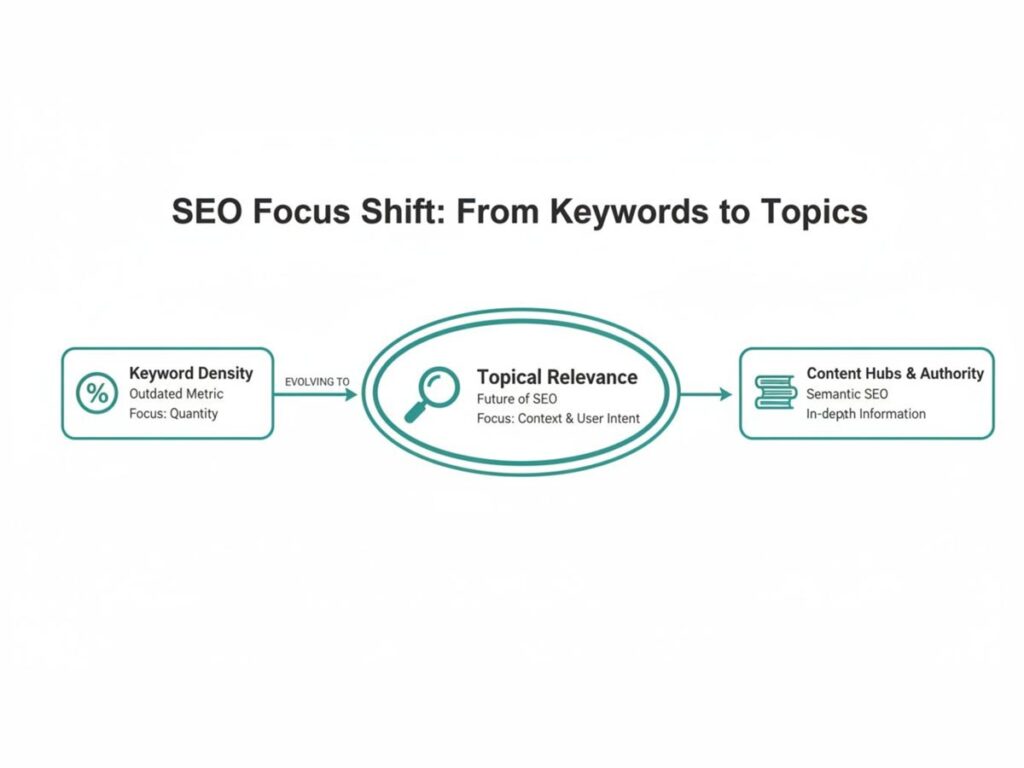
The focus has moved from isolated pages to creating interconnected content hubs that establish true authority.
How to Build a Keyword Cluster: An Example
Let’s make this practical. Imagine you’re a financial advisor creating a blog post. After some research, you identify a primary keyword with solid traffic and commercial intent.
Your primary keyword is the promise you make to a searcher. Your secondary keywords are how you fulfill that promise with compelling detail, proving your expertise and building trust.
For your financial advisor blog, a keyword cluster might look like this:
| Keyword Type | Example | Purpose |
|---|---|---|
| Primary Keyword | “how to start investing” | Targets the main, high-intent query for beginners. |
| Secondary Keyword | “best investment apps for beginners” | Captures a closely related, comparison-focused search. |
| Long-Tail Keyword | “how much money do you need to start investing” | Answers a specific, common question and barrier. |
| Informational Query | “what is a Roth IRA” | Provides helpful, educational content that builds trust. |
By weaving a cluster like this into your content, you create a single page that is far more valuable than one focused on a single phrase. This is how you signal authority and become a go-to resource. For more guidance, check out this expert take on how to choose keywords for your website.
How to Naturally Weave Keywords Into Your Content
Once you’ve chosen your keywords, the real art begins: integrating them into persuasive, natural-sounding copy. This is not about keyword stuffing. It’s about strategic placement that guides both your reader and search engines, confirming that your page delivers on its promise.
Think of your keywords as signposts. They need to be visible enough to show people and crawlers they’re in the right place, without being distracting roadblocks.
Getting Your Primary Keyword in the Right Spots
Your primary keyword is the theme of your page, so its placement needs to reflect that importance. Certain on-page elements carry more SEO weight than others, and these are precisely where you want your most valuable term to appear.
Here are the four most critical places for your primary keyword:
Page Title (Title Tag): This is the single most important location. Place your primary keyword near the beginning of the title tag to instantly signal your page’s topic in search results.
Meta Description: While not a direct ranking factor, a meta description that includes the keyword acts like ad copy, boosting click-through rates by showing searchers that your page is a perfect match.
H1 Heading: Your H1 is your main on-page headline. It must feature the primary keyword to reinforce the topic for every visitor who lands on your page.
Opening Paragraph: Include your primary keyword within the first 100-150 words. This immediately confirms the page’s relevance, reducing bounce rates and keeping users engaged.
Mastering keyword placement is a cornerstone of effective on-page optimization. By placing your primary keyword in these high-impact areas, you’re sending a clear signal to Google about your page’s purpose, laying a strong foundation for ranking. For a deeper dive, our guide on what is on-page SEO covers all the essentials.
Weaving in Secondary and Related Keywords
While your primary keyword gets top billing, your secondary keywords do the heavy lifting. They build topical depth and help you capture a wider net of searches. The key is to sprinkle these terms throughout your content where they make sense, creating a rich, comprehensive resource that reads naturally.
Look for opportunities to place secondary keywords here:
Subheadings (H2, H3): Using secondary keywords in subheadings helps structure your content and signals the relevance of each section.
Body Content: This is where you work in variations and related terms. The golden rule: never force it. The language must always sound human.
Image Alt Text: Write descriptive alt text for accessibility. If a relevant keyword fits naturally into the description, include it.
Internal Link Anchor Text: When linking to other pages on your site, use descriptive anchor text. This is a perfect, often-missed opportunity to use a secondary keyword.
You might hear about “keyword density,” but the concept is outdated. Studies show a density between 0.5% and 1% often appears organically in high-quality content. But this is an observation, not a rule. Modern SEO prioritizes quality and relevance over arbitrary numbers. You can discover more insights about keyword density and see why focusing on the user is always the winning move.
Common Keyword Optimization Mistakes to Avoid

Knowing what to do is only half the battle. Understanding what not to do is just as critical for protecting your rankings and delivering a positive user experience. A few common missteps can easily derail your content strategy and sabotage your results.
The most notorious mistake is keyword stuffing. This is an outdated tactic of unnaturally cramming your primary keyword into the text as many times as possible. Not only does it make your writing sound robotic and damage your credibility, but it’s also a clear signal to search engines that you’re trying to manipulate rankings, which can lead to penalties.
Modern SEO is a game of trust and authority. Keyword stuffing is the opposite—it sacrifices readability for a flawed attempt at gaming a system that is far too smart to be fooled.
The data proves that a light-touch approach is more effective. An analysis of Google ranking factors, based on a review of over 1,500 search results, found that the average keyword density for top-ranking pages was a tiny 0.04%. This confirms that Google rewards content that uses keywords naturally within a high-quality, relevant context.
Navigating Keyword Cannibalization
Another common trap is keyword cannibalization. This occurs when multiple pages on your website compete for the exact same primary keyword. By doing this, you dilute your authority and force search engines to guess which page is the most important. This confusion often causes all of the competing pages to rank lower than a single, consolidated page would have.
The fix is to assign each page a unique job and a distinct primary keyword.
Audit Your Content: Identify which pages are targeting identical or very similar primary keywords.
Consolidate and Merge: If two pages cover the same ground, combine the best elements into one definitive piece. Then, use a 301 redirect to pass the weaker page’s traffic and authority to the new, stronger one.
Differentiate Your Pages: If the pages serve slightly different purposes, re-optimize one for a new primary keyword that better reflects its unique angle.
Avoiding Intent Mismatch and Topic Dilution
Finally, two related errors can kill your conversions. The first is a mismatch with user intent. For example, writing a long, informational blog post for a keyword like “buy running shoes” is a classic mistake. The user wants to shop, not read an article.
The second is diluting your topic. This happens when you try to cover too many unrelated subjects on one page. A page that tries to be about “how many SEO keywords per page” and “social media marketing tips” will fail to build authority on either topic. It lacks focus and will never be seen as an expert resource for anything.
Get In Touch
Answering Your Top Keyword Strategy Questions
Even with a solid plan, practical questions always come up. Here are direct answers to some of the most common queries about keyword strategy to help you execute with confidence.
Can I Use the Same Main Keyword on Multiple Pages?
No, you should never do this. When you target the same primary keyword across multiple pages, you create keyword cannibalization. You’re essentially forcing your own pages to compete against each other for rankings.
This internal competition confuses search engines. They don’t know which page is the definitive resource, so they may split the ranking authority between them or decide neither is a great fit, causing both to rank lower. Every page on your website needs its own unique primary keyword and a clear, distinct purpose. If you find two pages covering the same ground, merge them into one authoritative resource.
How Do I Find Good Secondary and LSI Keywords?
Finding great supporting keywords is simpler than you think. The best place to start is Google itself.
Search for your primary keyword and analyze the “People also ask” and “Related searches” sections. These are direct clues from Google about what users are interested in. Next, use SEO tools to uncover related terms, synonyms, and long-tail variations. Finally, think like your customer: what related questions or problems would they have? Combining data from tools with genuine customer empathy will give you a powerful keyword list.
A well-rounded keyword list is built, not just found. It combines data-driven insights with an intuitive understanding of what your audience truly wants to know.
Is It Better to Update an Old Page or Create a New One?
In almost every scenario, you are far better off updating and improving an existing page, especially if it already has some traffic, backlinks, or ranking history. This strategy, known as a content refresh, lets you build on the authority the page has already earned.
When you enhance the quality, expand its depth with new keywords, and ensure all information is current, you capitalize on existing SEO momentum. Creating a new page for a similar topic forces you to start from scratch and dramatically increases your risk of keyword cannibalization. Only create a new page if the topic is completely different from anything else on your site.
Once your strategy is in motion, you must measure the results. Knowing how to track SEO performance is what transforms guesswork into a reliable, data-driven process for continuous improvement.
At Galant Studios, we transform websites into powerful growth engines with expert SEO and design. Let us help you climb the rankings and attract your ideal customers. Get in touch with us today to start building your online authority.