

Customer journey optimization is the art and science of refining every interaction a customer has with your brand to create a single, cohesive, and satisfying experience. It’s about looking past individual touchpoints—like a single ad or a purchase—and seeing the entire path a customer takes to drive loyalty, retention, and ultimately, your bottom line.
Why Customer Journey Optimization Is a Competitive Edge

Think of it like planning a perfect road trip. You wouldn’t just focus on the final destination; you’d map out the best route, plan for engaging stops, and anticipate potential bumps in the road. This is the essence of customer journey optimization. It’s far more than a marketing buzzword—it’s a core business strategy that turns a series of fragmented interactions into a single, seamless story that converts.
In today’s market, the customer experience is the brand. A single point of friction, whether it’s a confusing checkout page or an unhelpful support chat, can be enough to lose a customer for good. Mastering this process gives you a powerful, undeniable advantage, as customers now value the journey just as much as the product or service they’re buying.
The Shift From Transactions to Relationships
For years, businesses were laser-focused on the transaction—the sale. This approach is dangerously short-sighted. A truly successful company knows the relationship with a customer starts long before they ever click “buy” and continues long after the transaction is complete.
Customer journey optimization embraces this new reality by concentrating on a few key areas:
- Understanding Behavior: Digging into how customers find you, evaluate your offerings, and actually use your products.
- Identifying Friction: Pinpointing the exact obstacles that cause frustration and lead people to abandon their cart or close a tab.
- Proactive Improvement: Constantly refining every interaction to not just meet, but exceed, customer expectations.
This deep focus builds trust. It shows you value the customer’s time and business, which is a massive differentiator. The numbers back this up. According to market analysis, the global customer journey analytics market is projected to reach $32.5 billion by 2030. This explosive growth shows just how seriously businesses are investing in getting this right.
A superior customer experience begins with a deep understanding of the customer’s entire journey, not just isolated touchpoints. By mapping and improving this path, you transform casual buyers into loyal advocates.
Driving Sustainable Business Growth
Ultimately, the goal is to create a positive feedback loop. A smooth, intuitive journey leads to higher satisfaction, and that satisfaction builds loyalty. Loyal customers don’t just come back for more; they become vocal brand advocates, sharing their great experiences with friends, family, and colleagues.
This kind of organic, word-of-mouth marketing is priceless. It helps build brand awareness and brings in new customers at a much lower cost than traditional advertising. A dedicated focus on customer journey optimization isn’t just another business expense—it’s a direct investment in your company’s long-term health and sustainable growth.
Mapping the Modern Customer Journey Stages
Before you can optimize a customer’s journey, you have to know what that journey actually looks like. Think of it like a cartographer mapping out new territory; your job is to document every stage a person goes through, from the first inkling of a problem to becoming a loyal fan of your brand.
This isn’t just a thought exercise—it’s about creating a practical blueprint for growth. While the modern customer path is rarely a straight line, it generally follows a progression through five core stages: Awareness, Consideration, Conversion, Retention, and Advocacy. Understanding these phases is the key to meeting your customers exactly where they are, with the right message at the right time.
The Five Stages of the Customer Journey
| Journey Stage | Customer Goal | Common Touchpoints | Optimization Objective |
|---|---|---|---|
| Awareness | Find answers to a problem or need. | Blog posts, social media ads, search results, podcasts. | Be the helpful resource they discover first. |
| Consideration | Compare different solutions and providers. | Case studies, product demos, webinars, reviews, comparison guides. | Provide detailed proof that your solution is the best choice. |
| Conversion | Make a confident and easy purchase decision. | Checkout pages, pricing pages, free trial sign-ups, consultation forms. | Remove all friction and make the final step effortless. |
| Retention | Get maximum value from their purchase. | Onboarding emails, customer support, knowledge base, newsletters. | Deliver an exceptional post-purchase experience. |
| Advocacy | Share their positive experience with others. | Review requests, referral programs, social media mentions, community forums. | Turn happy customers into active brand promoters. |
This framework gives you a clear lens through which to view every interaction. Now, let’s explore what each of these stages feels like for the customer and what your role should be.
From Problem to Solution: The Awareness Stage
This is ground zero. A person has just realized they have a problem, but they might not even know how to describe it yet. They aren’t looking for your specific product; they’re looking for information and answers. Your goal here is simply to be the helpful expert they stumble upon.
Practical Example: A small bakery owner notices their monthly ingredient costs are creeping up. They Google “how to reduce food waste in a commercial kitchen.” They land on a blog post you wrote that offers five practical tips, subtly introducing your inventory management software as a way to automate tracking. At this stage, you’re not selling; you’re helping.
Evaluating Options: The Consideration Stage
Once a person understands their problem and knows solutions exist, they shift into research mode. In the consideration stage, they are actively comparing different products, services, features, and companies. This is where the real evaluation happens.
Your job is to provide tangible proof—case studies, testimonials, and clear feature breakdowns—that makes your offering the obvious choice.
Practical Example: That same bakery owner now searches for “best inventory software for small bakeries.” They find your comparison page that stacks your product against two competitors, highlighting your superior customer support and user-friendly interface. They also watch a 2-minute demo video showing exactly how the software solves their food waste problem.
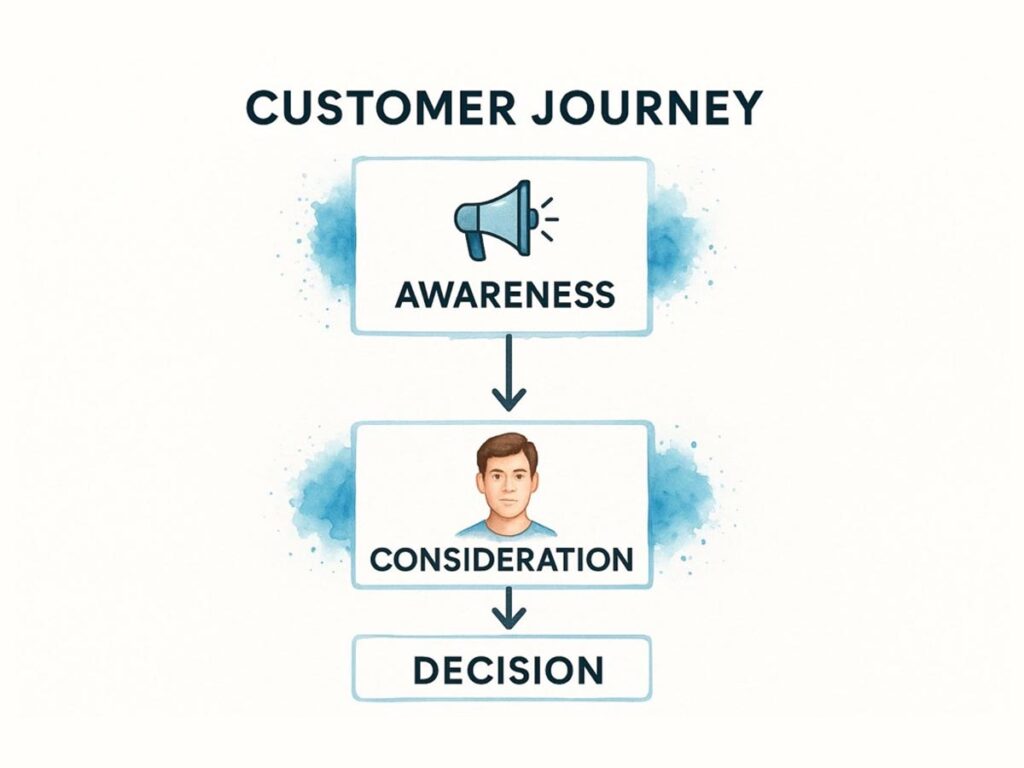
As the graphic shows, it’s a logical flow from recognizing a need to weighing the options and, finally, taking action.
From Prospect to Customer: The Conversion Stage
This is the moment of truth. After all their research, the prospect is ready to pull the trigger. They’ve decided to buy your product or sign up for your service. Your single most important job here is to get out of their way.
A clunky checkout page, a surprise shipping fee, or a confusing form can kill a sale in a heartbeat. At this final step, the entire experience needs to scream “simple and trustworthy.” This is where excellent what is user experience design becomes non-negotiable.
The single biggest threat to conversion is friction. Every unnecessary click, every confusing field, and every moment of doubt creates an opportunity for a potential customer to walk away.
Creating Lasting Relationships: The Retention Stage
The transaction is not the end of the journey. In many ways, it’s the beginning of the most valuable part. The retention stage is where you turn a one-time buyer into a long-term customer by delivering an outstanding post-purchase experience.
This means a seamless onboarding process, responsive customer support, and ongoing communication that actually provides value, not just sales pitches. A customer who feels seen and supported is one who sticks around. This stage is the engine that drives high Customer Lifetime Value (CLV).
Turning Customers into Fans: The Advocacy Stage
The final, and most sought-after, stage is advocacy. This is the point where happy, loyal customers become your volunteer marketing team. They leave glowing reviews, refer friends, and defend your brand online without being asked.
Advocacy is the ultimate sign that your customer journey optimization efforts are working. It creates a powerful, self-perpetuating flywheel where your best customers bring you your next best customers. To get a handle on all these interactions, using a user journey mapping template is a great way to visualize and document each touchpoint across all five stages.
Measuring What Matters for Journey Success
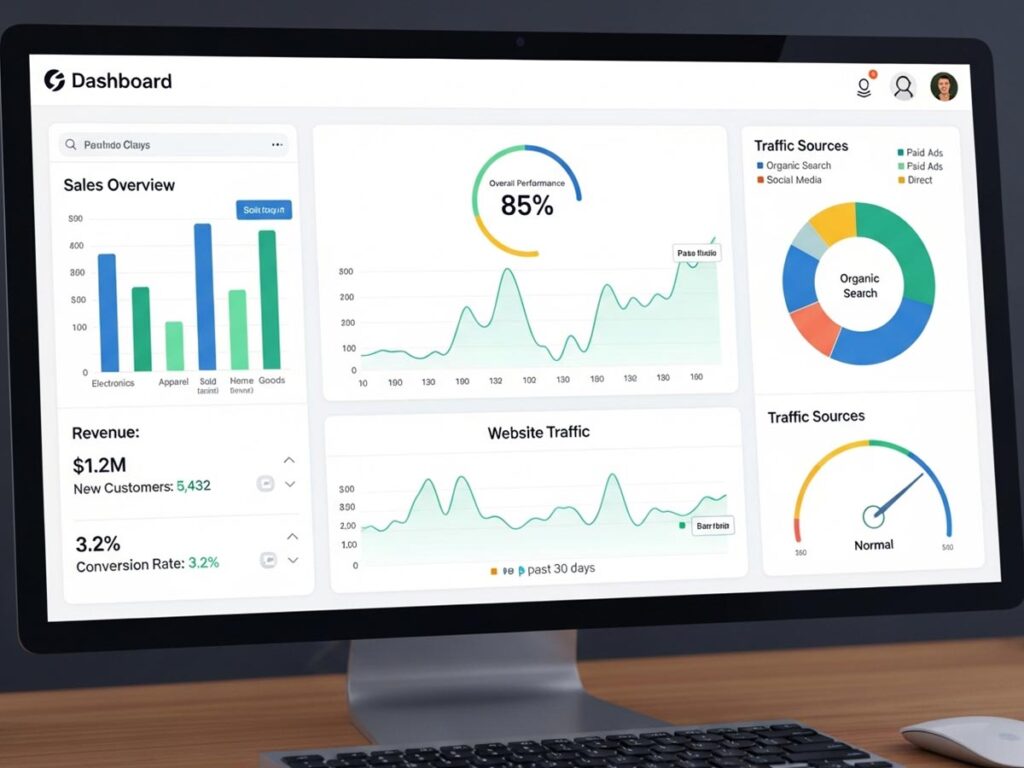
You can’t improve what you don’t measure. To know if your optimization efforts are working, you must look past surface-level numbers and zoom in on the key performance indicators (KPIs) that tell the true story of your customer’s experience.
Think of it like a doctor checking a patient’s vital signs. High website traffic might look healthy on the surface, but a high bounce rate on a key landing page is a clear symptom of a deeper problem. It’s a signal that there’s a disconnect between what a customer expected and what they found, pointing you directly to a point of friction that needs fixing.
Shifting From Raw Data to Actionable Insights
The real goal is to analyze data that flags specific behaviors at critical touchpoints. For instance, instead of just tracking overall site engagement, dig into the time-on-page for your pricing guides or comparison articles. If people aren’t spending much time there, it could mean your most important decision-making content is failing to connect with your audience.
Similarly, a high cart abandonment rate isn’t just a number—it’s a direct message from your customers. According to the Baymard Institute, the average cart abandonment rate is nearly 70%, often due to unexpected costs or a complex checkout process. This insight gives you the power to investigate the root causes and make targeted improvements. These are the kinds of specific, diagnostic metrics that fuel effective customer journey optimization.
Core Metrics That Define Journey Health
To get a complete picture of your journey’s performance, you need a mix of metrics that cover the entire customer lifecycle. Three of the most fundamental KPIs are Customer Acquisition Cost (CAC), Customer Lifetime Value (CLV), and Net Promoter Score (NPS).
Customer Acquisition Cost (CAC): This tells you the total cost of sales and marketing to bring in one new customer. If your CAC is climbing, it might signal that your awareness or consideration stage tactics aren’t efficient, prompting you to refine your targeting.
Customer Lifetime Value (CLV): CLV is a projection of the total revenue you can expect from a single customer over your entire relationship. A high CLV is a fantastic sign that your retention and loyalty efforts are paying off.
Net Promoter Score (NPS): This metric gets to the heart of customer loyalty by asking a simple question: “How likely are you to recommend our company to a friend or colleague?” The score reveals how many of your customers are promoters versus detractors, giving you a direct pulse on overall satisfaction.
A low Net Promoter Score is a critical warning sign. It suggests that even if customers are converting, their post-purchase experience may be creating detractors who can actively harm your brand’s reputation and future growth.
Applying Metrics to Every Stage
Each phase of the customer journey has its own set of vital signs. By tracking the right KPIs for each one, you can diagnose problems with surgical precision.
Awareness Stage:
- Metric: Branded Search Volume.
- Actionable Insight: An increase shows your brand recognition is growing. If it’s flat, your top-of-funnel content may not be resonating.
Consideration Stage:
- Metric: Lead Magnet Conversion Rate.
- Actionable Insight: This shows how effectively your case studies or webinars persuade prospects. A low rate means your proof points aren’t compelling enough.
Conversion Stage:
- Metric: Cart Abandonment Rate.
- Actionable Insight: A high rate points directly to friction in the final moments, like a clunky checkout or hidden fees.
Retention & Advocacy Stages:
- Metric: Churn Rate and Referral Rate.
- Actionable Insight: Together, these show how well you’re keeping customers (churn) and turning them into promoters (referrals), reflecting the success of your post-purchase experience.
By implementing this kind of measurement framework, you turn raw data into a clear roadmap for improvement. For a structured approach to tracking what really moves the needle, explore our guide on key digital marketing performance metrics.
Using AI to Create Hyper-Personalized Experiences

Artificial Intelligence is no longer a futuristic idea—it’s a powerful tool for creating personalized customer experiences at scale. For customer journey optimization, think of AI as a sharp assistant that sifts through massive amounts of data to understand what your customers are doing and, more importantly, what they’re likely to do next.
This capability allows you to deliver the perfect message to the right person at just the right time, much like how Netflix seems to know exactly what show you want to watch next. It cross-references patterns from millions of users to make an educated guess. AI gives your business that same predictive edge, whether you’re an e-commerce brand recommending a matching accessory or a B2B company sending a prospect the perfect case study.
Demystifying AI’s Role in the Customer Journey
At its core, AI automates and sharpens decision-making at every customer touchpoint. It processes information at a scale and speed no human team could match, enabling a level of responsiveness that was previously out of reach.
The practical applications of AI are already making a huge impact on the customer experience:
- Predictive Analytics: AI algorithms review past behaviors—like pages visited and purchase history—to forecast a customer’s next move. This makes it possible to engage proactively, like offering a discount right before someone abandons their shopping cart.
- Recommendation Engines: By spotting subtle patterns in user preferences, AI can dynamically suggest products or articles that are highly relevant to each individual, directly impacting metrics like average order value and time on site.
- AI-Powered Chatbots: Modern chatbots offer instant, 24/7 support by answering common questions and resolving simple issues. This frees up human agents to focus on complex problems, boosting both efficiency and customer satisfaction.
From B2B to B2C, AI is reshaping what’s possible in customer journey optimization. In fact, customer experience statistics on OnRamp show that 80% of customers are happy to use a chatbot if they can easily escalate to a human, highlighting why this technology is becoming so common.
Putting AI into Action for Better Experiences
You don’t need to completely overhaul your strategy to start using AI. The best approach is often to begin with targeted applications that solve specific friction points you’ve already identified.
The true power of AI in customer journey optimization lies in its ability to listen at scale. It can interpret the silent signals of customer behavior and respond with a personalized experience that feels both helpful and human.
Let’s imagine an e-commerce business wants to improve its conversion stage. Here are a few practical AI-driven actions:
- Personalized Website Content: An AI engine analyzes a visitor’s browsing activity. If they spend a few minutes looking at running shoes, the homepage banner automatically features the latest running gear on their next visit.
- Proactive Chat Support: A customer is on the checkout page but hasn’t completed their purchase after a minute. An AI chatbot could pop up with: “Hi! Have any questions about shipping or returns? I can help.”
- Tailored Email Follow-ups: After a purchase, AI can trigger a customized email sequence. Someone who bought a high-end coffee maker might receive an email a week later with tips on brewing the perfect espresso, building a stronger post-purchase relationship.
These aren’t science fiction scenarios. They are practical, achievable strategies that businesses are using right now to build smoother, more intuitive customer journeys.
Actionable Strategies for Each Customer Touchpoint
This is where the rubber meets the road—turning your maps and metrics into real-world improvements. An effective customer journey optimization plan isn’t a one-size-fits-all approach. It’s about having a specific playbook for each stage, tailored to what your customer is thinking, feeling, and trying to accomplish at that moment.
This goes beyond just clever marketing. It’s about systematically finding and removing friction while adding genuine value. Get this right, and the rewards are significant. Data from OnRamp shows that companies who master this can see a 54% better return on investment (ROI) from their marketing efforts, with 44% specifically putting money into analytics to make it happen.
Let’s dig into practical strategies you can use to fine-tune each phase of the journey.
Building Authority in the Awareness Stage
During the awareness stage, your job is to show up as a credible, helpful guide. People are looking for answers, not a sales pitch. Your strategy should be all about education and building trust from the first interaction.
- Actionable Insight: Create pillar content. Develop a comprehensive guide, like “The Ultimate Guide to Home Composting,” that covers the topic from every angle. This establishes you as an authority and attracts valuable backlinks.
- Actionable Insight: Target informational keywords. Focus on search terms like “how to fix a leaky faucet” or “what is content marketing.” This puts you directly in the path of your audience’s questions.
- Actionable Insight: Use multiple content formats. Turn your pillar guide into a video tutorial, an infographic, and a podcast episode to reach a wider audience.
Guiding Decisions in the Consideration Stage
Now, your prospect is actively weighing their options. Your goal is to give them compelling proof that your solution is the right one. This is where you pivot from broad education to specific, problem-solving content.
The consideration stage is your opportunity to eliminate doubt. Every piece of content should be designed to answer the question, “Why is this the right choice for me?” with undeniable clarity and evidence.
- Actionable Insight: Create a detailed comparison guide that honestly stacks your product against competitors, highlighting your unique selling points.
- Actionable Insight: Offer a frictionless free trial or a live demo. This gives people a risk-free way to experience your value for themselves.
- Actionable Insight: Showcase powerful case studies that tell a story: “Here was the customer’s problem, here’s how we solved it, and here are the results.”
Removing Friction in the Conversion Stage
The conversion stage is the home stretch. Your only focus here should be making the act of buying as simple and painless as possible. Drawing from proven strategies to enhance the overall ecommerce customer experience, here are some key tactics:
- Actionable Insight: Simplify your checkout forms. Ditch any non-essential fields. Only ask for what you absolutely need to complete the transaction.
- Actionable Insight: Be transparent with all costs upfront. Show shipping and taxes early in the process to prevent last-minute sticker shock.
- Actionable Insight: Use social proof. Display customer reviews, testimonials, and trust badges (“Secure Checkout”) right next to your call-to-action buttons.
Fostering Loyalty in the Retention Stage
The first sale is just the beginning. The retention stage is where you cultivate long-term value by delivering an outstanding post-purchase experience.
- Actionable Insight: Design a thoughtful onboarding email sequence that guides new customers toward success, ensuring they get the most out of their purchase from day one.
- Actionable Insight: Launch a loyalty program that rewards repeat business with exclusive discounts or early access to new products.
- Actionable Insight: Proactively check in. A simple email a month after purchase asking, “How are you enjoying your new [product]?” can make a customer feel genuinely valued.
Inspiring Promoters in the Advocacy Stage
This is where your happiest customers become your most powerful marketing channel. Your goal is to make it incredibly easy and rewarding for them to share their positive experiences.
- Actionable Insight: Create a well-structured referral program. Offer a real benefit—like a discount or store credit—to both the referrer and the new customer.
- Actionable Insight: Actively encourage user-generated content. Create a branded hashtag and feature customer photos on your social media. This provides authentic social proof and builds a real community.
Building Your Path to Continuous Improvement
We’ve covered a lot, from mapping touchpoints to digging into metrics. But if there’s one thing to take away, it’s this: customer journey optimization isn’t a project you check off a list. It’s a continuous cycle of listening, learning, and adapting.
Think of it as an interconnected system. The principles of mapping, tracking metrics, and using smart personalization all work together. Committing to this process means building a culture that is relentlessly focused on finding and smoothing out the rough patches for your customers. The good news? It starts with a single, focused action.
Your path to creating exceptional customer experiences starts not with a giant leap, but with the first, intentional step. Identify the single biggest friction point in your current customer journey and commit to solving it.
When you take that first step, you create momentum. Fixing one problem often shines a light on the next, and every improvement you make strengthens the bond you have with your customers.
This incremental approach is what makes customer journey optimization both achievable and sustainable. It’s a commitment to seeing your business through your customers’ eyes and making their success the engine of your own.
So, start small. Stay consistent. Build your path to continuous improvement one touchpoint at a time.
Frequently Asked Questions
As you dive into optimizing your customer journey, you’re bound to have some practical questions. Let’s tackle a few of the most common ones.
What Is the First Step in Customer Journey Optimization?
The absolute first step is creating a customer journey map. This is non-negotiable. Think of it as a blueprint for your entire customer experience.
The goal is to trace every interaction a person has with your brand, from the moment they realize they have a need all the way to becoming a loyal customer. To do this, pull data from your analytics, read customer surveys, and look at support tickets to get a true picture of what people are experiencing right now. This map will immediately highlight the friction points and reveal hidden opportunities.
What Are Some Essential Tools for This Process?
You don’t have to do this all by hand. A few key tools can make a world of difference.
- Analytics: A tool like Google Analytics is fundamental. It shows you exactly how people behave on your website, where they drop off, and which paths they take.
- Mapping: For building the visual map, collaborative platforms like Miro or Lucidchart are fantastic. They help your team see the entire journey clearly.
- Feedback: To get insights straight from the source, you need survey tools. Platforms like SurveyMonkey or Typeform are perfect for asking direct questions and understanding customer sentiment.
- Customer Data: A solid CRM (Customer Relationship Management) system is the backbone of personalization. Tools like Salesforce or HubSpot bring all your customer data together, allowing you to create tailored experiences at scale.
How Quickly Can I Expect to See Results?
This depends on the scale of the changes. Small tweaks can deliver surprisingly fast results. Fixing a confusing form on your checkout page or rewriting a muddled call-to-action can lift conversion rates in a matter of days or weeks.
A core principle of journey optimization is to embrace continuous, small improvements. It’s not about one massive overhaul. Consistent, incremental changes are what create lasting impact on customer satisfaction and loyalty.
On the other hand, bigger strategic projects—like implementing a new onboarding sequence or a personalization engine—will naturally take longer to bear fruit. These initiatives are designed to move the needle on long-term metrics like Customer Lifetime Value (CLV) and retention, so you’ll likely need a few months to see a measurable impact.
Ready to build a customer journey that actually converts? At Galant Studios, we specialize in high-performance, SEO-driven websites designed to turn visitors into loyal customers. Let’s build your path to growth together.

