Choosing the right SEO keywords is the bedrock of any successful search strategy. It’s the critical first step that connects what you create directly with what your audience is actively searching for. This isn’t about guesswork; it’s about sharp, deliberate market research. A strategic approach here is what separates anonymous traffic from visitors who are genuinely ready to engage, click, and convert.
Why Keyword Selection Is Your SEO Cornerstone

The image above gives a glimpse into how authority—once called “PageRank”—moves between websites. It’s a fundamental SEO concept, and a solid keyword strategy is what helps you build this authority by attracting the right kind of traffic and earning relevant links over time.
At its core, keyword selection is both an art and a science. It’s about getting inside the head of your ideal customer and understanding the exact language they use to solve their problems. You’re decoding their needs, questions, and frustrations as they type them into a search bar. When you align your content with those phrases, you’re doing more than just satisfying an algorithm; you’re building a direct bridge to a person who needs what you offer.
This process forces you to step outside your own assumptions. Instead of creating content around what you think customers want, you start focusing on what the data shows they are actually looking for. Nail this, and every article or page you publish will have a built-in audience just waiting to find it.
The Problem With Vanity Keywords
It’s always tempting to chase the big, broad, high-volume keywords. We call these “vanity” keywords for a reason. Imagine a new online bakery dreaming of ranking for the term “cakes.” Sure, it gets hundreds of thousands of searches, but it’s also brutally competitive and carries almost no specific intent.
Think about it: who is searching for “cakes”? Is it a child looking for pictures for a school project? A home baker searching for a recipe? Someone hoping to find a local bakery? The intent is so vague, you can’t possibly serve all those needs.
Chasing these broad terms usually ends in disappointment and wasted effort. You’ll often see:
- High Bounce Rates: People land on your site, realize it’s not what they wanted, and leave immediately.
- Low Conversion Rates: The traffic is so unfocused that very few visitors are actually in a position to buy anything.
- Wasted Resources: You pour time and money into ranking for a term that brings you little, if any, real business value.
A much smarter approach is to zero in on high-intent keywords. These are specific phrases that signal a searcher is much closer to making a decision, like “order custom birthday cake online.”
Shifting Focus to High-Intent Keywords
The real magic happens when you identify phrases that clearly reveal a user’s intent to act. While “cakes” is vague, a keyword like “gluten-free chocolate cake delivery Brooklyn” tells you precisely what that person needs, right now. The search volume will be a fraction of the broader term, but nearly every person who uses that phrase is a highly qualified lead for a bakery that fits the bill.
Understanding how this kind of keyword selection fits into broader essential marketing strategies helps you see its true impact on your bottom line.
This strategic pivot—from high-volume to high-intent—is what truly defines effective SEO. It’s how you attract an audience that isn’t just browsing but is actively looking for the exact solutions you offer. That’s what leads to higher engagement and, ultimately, more conversions.
Decoding the Pillars of Keyword Research
To truly master keyword selection, you must look beyond just finding phrases and start analyzing them strategically. Any effective keyword strategy boils down to three core concepts: Search Volume, Keyword Difficulty, and Search Intent. Getting these right is what separates a content strategy that actually works from one that’s just a shot in the dark.
Think of these three elements as a system of checks and balances. If one is off, your entire SEO effort can get wobbly. Let’s break down what each one means for your day-to-day work.
Search Volume: The Measure of Potential Reach
Search Volume is the most straightforward metric. It’s the estimated number of times people search for a specific keyword each month, often averaged over a year. High search volume points to a big audience, which naturally means more potential traffic for your site.
But volume alone can be a trap. A massive term like “coffee” might get millions of searches, which looks great on paper. The problem is, that traffic is incredibly broad and the competition is fierce. On the flip side, a very specific phrase like “low-acid single origin coffee beans” will have a much smaller search volume, but the people searching for it are highly motivated and know exactly what they want.
The real skill is finding that sweet spot—enough search volume to make the effort worthwhile, but specific enough that you’re attracting the right people who are likely to convert.
Choosing keywords is a balancing act. You need terms with enough search volume to matter, but not so much that you’re competing against industry giants for an audience that isn’t even looking for you.
Keyword Difficulty: The Competitive Landscape
Next up is Keyword Difficulty (KD). This is a score, typically from 0 to 100, that SEO tools assign to a keyword to estimate how hard it will be to crack the first page of Google. The score is calculated by looking at the authority (backlinks, domain age, etc.) of the websites already ranking.
A high KD score is a clear warning sign. It tells you that the top spots are locked down by established, authoritative domains. If you’re running a newer site or a small business, trying to rank for these keywords is like trying to win a marathon you entered a day late—it’s an uphill battle.
Practical Example: Imagine you just launched an online store selling leather goods. Targeting a keyword like “wallets” is a losing game; you’d be up against global brands with multi-million dollar marketing budgets. A much smarter move is to target a long-tail keyword like “handmade leather bifold wallet with coin pocket”. Its difficulty is far lower, the competition is minimal, and it puts you directly in front of a user who is looking for exactly what you sell.
Search Intent: The Why Behind the Search
This is where the real strategy comes into play. Search Intent is all about understanding the user’s underlying goal. When someone types a query into Google, what are they really trying to do? Are they looking for information, trying to navigate to a specific website, comparing products, or are they ready to buy something?
Matching your content to user intent is absolutely essential. If your page doesn’t deliver what the user was looking for, they’ll hit the back button, and Google notices that. In fact, research shows that 52.65% of all searches are informational, with only a small percentage being directly transactional. You can find more data on user search behavior in this report from Exploding Topics.
Getting intent right means you’re creating the perfect piece of content for each stage of the customer journey, guiding them from initial curiosity all the way to a final decision.
To help clarify this, let’s break down the four main types of search intent. Each one calls for a completely different kind of content.
Decoding Search Intent Types with Examples
| Intent Type | User Goal | Example Keyword | Ideal Content Type |
|---|---|---|---|
| Informational | To learn something or find an answer. | “how to brew pour over coffee” | Blog post, how-to guide, video tutorial |
| Navigational | To find a specific website or brand. | “Starbucks near me” | Homepage, store locator page |
| Commercial | To research products or services before buying. | “best espresso machines under 500” | Product review, comparison article, listicle |
| Transactional | To complete a purchase or take an action. | “buy Nespresso pods online” | Product page, pricing page, e-commerce category page |
By categorizing keywords this way, you ensure that the content you create is perfectly aligned with what the searcher actually wants to find, dramatically increasing your chances of ranking and engaging that user.
A Practical Guide to Finding Keyword Ideas

Before you ever open a keyword tool, start with empathy. Get inside your customer’s head. What problems are they actually trying to solve? What questions keep them awake at night that your business can answer?
The first step is a simple brainstorm. Jot down a list of broad “seed” topics central to what you do. For instance, if you run a business selling sustainable home goods, your initial list might include “eco-friendly cleaning” or “zero-waste kitchen.” Think of these as the big buckets.
Now, let’s fill those buckets. For each topic, start listing out the specific questions and pain points your ideal customer might be Googling. That “eco-friendly cleaning” topic could spawn phrases like “natural alternatives to bleach” or “how to make non-toxic all-purpose cleaner.” This gives you a “seed list” of keywords that are genuinely rooted in what your audience cares about.
Using Google as Your First Research Tool
You don’t need to jump straight into expensive software. Google itself is one of the most powerful keyword research tools you can use, and it’s completely free. It gives you a direct window into what people are searching for right now. You just need to know where to look.
Here are a few actionable spots within Google’s search results:
- Google Autocomplete: As you start typing a seed keyword into the search bar, pay close attention to the suggestions that pop up. These are popular, real-time queries people are actively using.
- People Also Ask (PAA): This box in the middle of the results is a goldmine. Each question reveals what searchers want to know next. Clicking one often reveals even more related queries, helping you build out entire content clusters.
- Related Searches: Scroll to the bottom of the page. This list gives you excellent alternative phrases and adjacent topics that can spark new content ideas and broaden your keyword list.
Tapping into these features is like having a direct line to your audience’s thought process. You get to see the exact language they use and the follow-up questions they have, which is invaluable.
Uncovering Competitor Keywords
A little ethical snooping on your competitors is a smart way to figure out how to choose SEO keywords that will give you an advantage. The goal isn’t to plagiarize their strategy but to spot gaps they’ve missed. Start with a list of your top three to five direct competitors.
Take a look at their websites. What are their page titles? What headlines are they using? What are their blog posts about? These elements are huge clues about the keywords they’re actively targeting. If a competitor’s blog is full of articles like “A Beginner’s Guide to Composting,” you can bet they’re going after keywords related to sustainable living and gardening.
This analysis helps you build a richer keyword list and often uncovers fantastic long-tail keywords you might have otherwise overlooked. These highly specific phrases usually have less competition and attract a much more motivated audience.
Understanding the search landscape is key. It’s a surprising fact, but a staggering 94.74% of keywords get 10 or fewer searches per month. This highlights the power of finding your niche with long-tail terms. In fact, these specific phrases make up about 70% of all search traffic and are crucial for getting noticed. You can dig deeper into these trends in this study on search statistics.
By combining your brainstorm with insights from Google and a quick competitor analysis, you’ll have a solid seed list ready for strategic analysis.
Alright, you’ve got a massive list of keywords. That’s a great start, but on its own, it’s just a jumble of data. The real work begins now: turning that list into a focused, high-impact action plan. This is where we sift through the noise and find the gold.
The trick is to blend hard data with your own business sense. You’ll need to pull key metrics from your SEO tools, mainly search volume and keyword difficulty, but that’s only half the picture. The other, arguably more important, half is figuring out how relevant each keyword is to what you actually sell.
This simple funnel shows how we’ll move from a broad list to a set of strategic priorities.
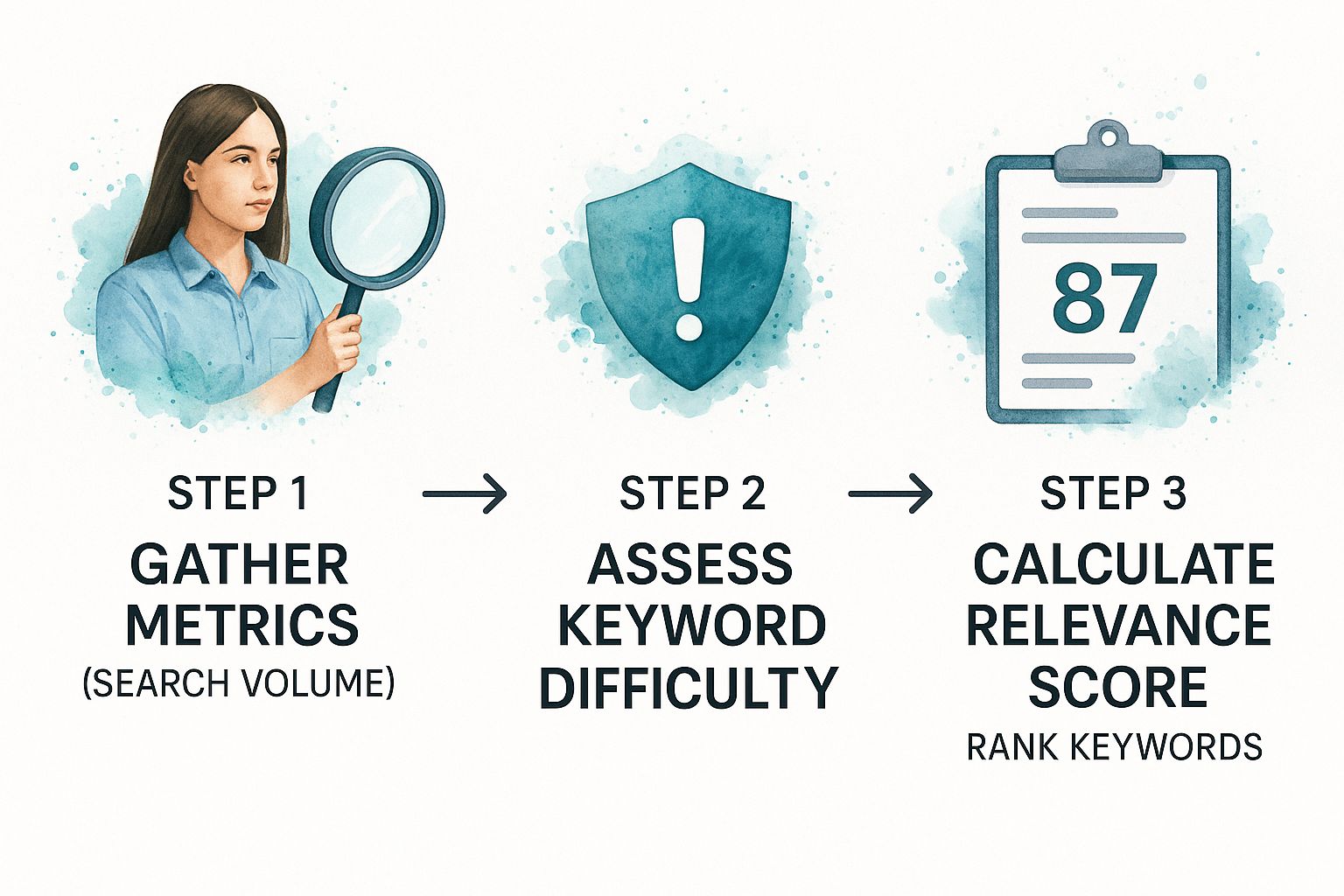
As you can see, we’ll funnel everything through three distinct evaluation stages to end up with a final, ranked list of keywords worth targeting.
H3: Balancing SEO Metrics With Business Relevance
Your first analytical pass involves grabbing two core metrics for every term on your list. Most SEO platforms, like Ahrefs or Semrush, make this straightforward.
- Monthly Search Volume: This tells you how many people are looking for a specific term each month. Think of it as the potential audience size.
- Keyword Difficulty (KD): Usually a score from 0-100, this estimates how tough it will be to crack the first page of Google.
It’s tempting to go straight for the keywords with massive search volumes, but that’s a common rookie mistake. A high KD score often means you’re up against industry giants with deep pockets and years of authority. For a smaller business, that’s a tough, uphill battle.
On the flip side, a keyword with super low volume might be easy to rank for, but if it only brings in a handful of visitors, is it really worth the time and effort? The sweet spot is almost always somewhere in the middle.
H3: Creating a Practical Scoring Model
To bring objectivity to this process, we need a scoring model. A simple but incredibly effective way to do this is by adding a “Relevance Score” to each keyword. I like using a simple 1-5 scale, where 5 means the keyword is a perfect bullseye for your product or service.
Let’s imagine you sell premium coffee beans online. Your scoring might look like this:
- “how to make cold brew”: This gets a Relevance Score of 3. It’s a great informational query for your target audience, but they aren’t ready to buy just yet. This is top-of-funnel content.
- “buy single origin coffee beans”: This is a clear 5. The searcher has their wallet out and is looking for exactly what you sell. This is bottom-of-funnel and has high conversion potential.
This one simple step adds a critical layer of business intelligence to your data. If you want to get even sharper with your scoring, a deep competitor analysis of digital marketing can show you what kinds of terms are actually driving sales for others in your space.
To organize this, I always recommend putting everything into a simple framework.
Keyword Prioritization Framework
This scoring model helps you objectively evaluate and rank keywords based on a combination of SEO metrics and business value. By assigning scores, you can systematically identify which terms offer the best strategic opportunity.
| Keyword | Monthly Volume | Difficulty Score (1-100) | Relevance Score (1-5) | Priority Score |
|---|---|---|---|---|
| [enter keyword] | [data] | [data] | [your score] | [calculated] |
| [example: buy coffee beans] | 12,000 | 45 | 5 | High |
| [example: best coffee grind] | 3,500 | 22 | 3 | Medium |
The “Priority Score” can be a simple calculation or a gut-check based on the other three columns. The goal isn’t a perfect mathematical formula but a clear, data-informed ranking.
By combining search volume, difficulty, and relevance, you can calculate a final Priority Score for each keyword. This data-driven approach removes guesswork and clearly highlights the most valuable opportunities.
H3: Identifying Your Low-Hanging Fruit
With your newly prioritized list, finding the “low-hanging fruit” becomes easy. These are the keywords that give you the best bang for your buck right now.
Look for terms that have:
- A solid, moderate search volume.
- A low-to-medium keyword difficulty score.
- A high business relevance score (4 or 5).
This methodical process takes you from a messy spreadsheet to a strategic asset. It ensures every piece of content you create is aimed at keywords that not only pull in traffic but also align perfectly with your business goals, ultimately bringing in more qualified leads and sales.
Mapping Keywords to Your Content Strategy

You’ve done the hard work of finding and prioritizing your keywords. Now what? The final, and arguably most critical, piece of the puzzle is translating all that data into a real-world content plan. This is where keyword mapping comes into play.
Keyword mapping is simply the process of assigning specific keywords to specific pages on your website. Think of it as creating a blueprint for your site’s SEO architecture. It’s how you turn a spreadsheet of promising terms into a strategic roadmap, ensuring every important page has a clear purpose and a target audience.
The goal here is to match the intent behind each keyword with the most logical page on your site. This alignment is what turns good research into great results.
Aligning Keywords with Content Types
The guiding principle of keyword mapping is simple: different kinds of keywords need different kinds of pages. It’s a common mistake to overlook this, and it’s often why well-written content just doesn’t rank. You have to meet the user’s expectation for the query they just typed into Google.
Let’s look at how this works in practice:
- Transactional Keywords: Someone searching for “buy organic dog food online” is ready to make a purchase. That keyword belongs squarely on a product page or an e-commerce category page where they can complete the transaction.
- Informational Keywords: A query like “is grain-free food good for dogs” signals a search for knowledge. This is a perfect opportunity for a comprehensive blog post or a detailed guide.
- Commercial Investigation Keywords: When a user types in “best puppy training collars review,” they’re in the comparison phase. A listicle, a head-to-head comparison article, or an in-depth review page is the ideal format to serve this intent.
Following this approach ensures every piece of content serves a distinct purpose in a user’s journey. It’s also a key element of your site’s technical health, a topic we explore further in our guide on what is on-page SEO.
Preventing Keyword Cannibalization
A meticulously crafted keyword map is your single best defense against an insidious problem called keyword cannibalization. This happens when multiple pages on your site accidentally compete for the same primary keyword, which confuses search engines and splits your authority.
By assigning one unique primary keyword to each page, you send a crystal-clear signal to Google about which page is the definitive resource for that specific query.
Keyword mapping eliminates internal competition and builds topical authority. It ensures each page has a unique focus, strengthening your site’s overall SEO structure and making your content easier for search engines to understand and rank.
While a solid keyword map is essential, it works best when combined with other smart SEO tactics. For instance, strategies like Using User-Generated Content to Improve Website’s Rankings can add another layer of authority and relevance to your pages.
In the end, this strategic planning makes your content efforts focused, efficient, and perfectly aligned with what your audience needs and your business wants to achieve.
Answering Common SEO Keyword Questions
Even the most seasoned marketing teams run into questions when digging into keyword research. It’s a complex process, and a few common sticking points pop up time and time again.
Let’s clear up some of the most frequent queries I hear. Getting these details right will help you build a keyword strategy that’s not just effective but sustainable for the long haul.
How Many Keywords Should I Target Per Page?
This is a classic question, and the answer is all about focus. For any given page, you should be laser-focused on one primary keyword. This is your main target, the phrase that perfectly encapsulates what the page is about.
From there, you can support that primary term with three to five secondary keywords. These aren’t random phrases; they should be closely related variations or long-tail versions of your main target.
Actionable Example: If your page’s primary keyword is “best trail running shoes,” your secondary keywords might be “waterproof trail running shoes review” or “trail running shoes for rocky terrain.” This strategy helps search engines understand the full context of your page, building deep topical relevance without ever looking like you’re stuffing in keywords.
What’s the Difference Between Short-Tail and Long-Tail Keywords?
Understanding this distinction is fundamental to building a smart keyword strategy. The main differences come down to their length, specificity, and the kind of results they typically deliver.
- Short-Tail Keywords: These are broad, one- or two-word phrases like “running shoes.” They get a ton of search volume, but the competition is fierce, and it’s hard to know what the searcher is really looking for.
- Long-Tail Keywords: These are much more specific, longer phrases, like “best waterproof trail running shoes for women.” The search volume is lower, yes, but the competition is also much lighter. More importantly, the user’s intent is crystal clear—they’re probably close to making a purchase.
A truly effective SEO strategy needs a healthy mix of both. Short-tail keywords are great for building brand authority over time, while long-tail keywords are your secret weapon for driving highly motivated, conversion-ready traffic right now.
How Often Should I Do Keyword Research?
Keyword research isn’t a “set it and forget it” task. It’s an active, ongoing part of any successful SEO program. Search trends evolve, your competitors make new moves, and your own business goals change. Your keyword list has to keep up.
As a rule of thumb, plan for a major strategic review at least once per year. This is your chance to reassess your core topics and make sure your high-level priorities are still on track.
On a more frequent basis, you should perform fresh research for every single new piece of content you create. And, of course, you have to keep an eye on your results. I always recommend learning how to track SEO performance and checking in monthly. This allows you to spot new opportunities or fix performance dips before they become a real problem.
At Galant Studios, we transform your keyword strategy into tangible business growth. Our expert SEO services ensure your website not only ranks higher but also attracts the right audience, turning visitors into loyal customers. Let’s build your online presence together. Book a Call