
Is your website attracting visitors but struggling to turn them into customers? You're not alone. Increasing your website's conversion rate isn't about chasing secret formulas; it's a methodical process of understanding what your visitors want, removing the obstacles in their path, and making it incredibly easy for them to say "yes." This guide will give you actionable strategies to transform your site from a digital brochure into a powerful conversion engine.
Laying the Groundwork for High Conversions
Before you change a single button or headline, you must build a solid foundation. This is the heart of Conversion Rate Optimization (CRO), a data-driven discipline focused on improving the percentage of visitors who take a desired action. If you're new to the concept, understanding what Conversion Rate Optimization is will shift your perspective from random tweaks to a strategic system for growth.
Think of this phase as drawing a map before a long journey. It ensures every change you make has a clear purpose and moves you closer to your business goals. This isn't about finding a single magic trick; it's about building a framework for continuous improvement.
Define Your Conversion Goals
First, what does a "conversion" actually mean for you? It’s not always a sale. A conversion is any meaningful action a visitor takes that moves them down the path to becoming a customer. Defining these micro and macro goals gives you clear targets to aim for.
For instance, a valuable action could be:
- Purchasing a Product: The ultimate e-commerce conversion.
- Requesting a Demo: A critical step for a SaaS business.
- Submitting a Contact Form: The primary goal for a service-based business.
- Subscribing to a Newsletter: Building a long-term relationship with a potential customer.
A sharply defined conversion goal turns anonymous traffic into measurable business outcomes. Without it, you're just collecting visitors, not building a pipeline.
Understand Your Audience Deeply
Once your goals are set, you must obsess over the people you're trying to reach. You cannot persuade an audience you don't understand. To get inside their minds, you need to uncover who they are, what motivates them, and what problems they're desperate to solve.
A powerful tool for this is learning how to create buyer personas. This exercise forces you to synthesize your customer research—from surveys, interviews, and analytics data—into a semi-fictional representation of your ideal customer.
This knowledge becomes the lens through which you make every decision. For example, a website selling complex financial software to enterprise clients needs to provide detailed whitepapers, case studies, and security documentation to build trust. In contrast, a direct-to-consumer brand selling sustainable fashion will thrive on compelling storytelling, user-generated photos, and transparent sourcing information to create an emotional connection.
Mastering Website Speed and Performance
In the digital world, speed is currency. A slow-loading website is one of the fastest ways to kill a conversion. User patience is razor-thin; every millisecond a potential customer waits for your page to load is an opportunity for them to click away to a competitor.
This isn't just an opinion—it's a well-documented business reality. Major retailers have studied this extensively. Walmart, for instance, discovered that for every 1-second improvement in page load time, their conversions increased by 2%. The numbers become even more stark when you look at broader industry data.
The Real Cost of a Slow Website
A site that loads in one second can achieve a conversion rate three times higher than a site that takes five seconds. The message is undeniable: speed is not a technical afterthought; it is a core component of the user experience that directly impacts your revenue.
Let's put this into perspective with some practical numbers.
Impact of Load Time on Conversion Rate
This table illustrates the direct correlation between website loading speed and potential conversion rate uplift, based on industry-wide benchmarks.
| Page Load Time (Seconds) | Potential Conversion Rate Lift | Example User Impact |
|---|---|---|
| 5 seconds -> 3 seconds | Up to 20% increase | The site feels responsive, keeping the user engaged and reducing frustration. |
| 3 seconds -> 2 seconds | Up to 35% increase | The experience feels almost instant, which builds confidence in your brand. |
| 2 seconds -> 1 second | Up to 50% increase | A completely seamless journey that removes friction and encourages action. |
As you can see, even small improvements in speed can yield significant returns by minimizing user frustration and keeping them on the path to conversion.
Finding the Bottlenecks in Your Performance
Before you can fix the problem, you need to diagnose it. A fantastic starting point is Google PageSpeed Insights. It’s a free, comprehensive tool that analyzes your site’s performance on both mobile and desktop and provides a prioritized list of actionable recommendations.
The report centers on Core Web Vitals, the specific metrics Google uses to measure real-world user experience. These include:
- Largest Contentful Paint (LCP): Measures how long it takes for the largest visual element on the page to load. Aim for an LCP under 2.5 seconds.
- First Input Delay (FID): Tracks how quickly your site responds to a user's first interaction (like a click). A good FID is under 100 milliseconds.
- Cumulative Layout Shift (CLS): Measures visual stability, preventing annoying layout jumps as the page loads. Your CLS score should be 0.1 or less.
Addressing the issues identified in this report gives you a clear, data-driven roadmap to a faster website.
High-Impact Fixes You Can Make Today
With your diagnostic report in hand, it's time to take action. The good news is that many of the most effective improvements don't require a complete site overhaul. For a much deeper dive, we've created a full guide on how to improve website speed with more detailed instructions.
This groundwork is fundamental to any successful CRO strategy. It's a continuous cycle of defining goals, tracking the right data, and making iterative improvements.
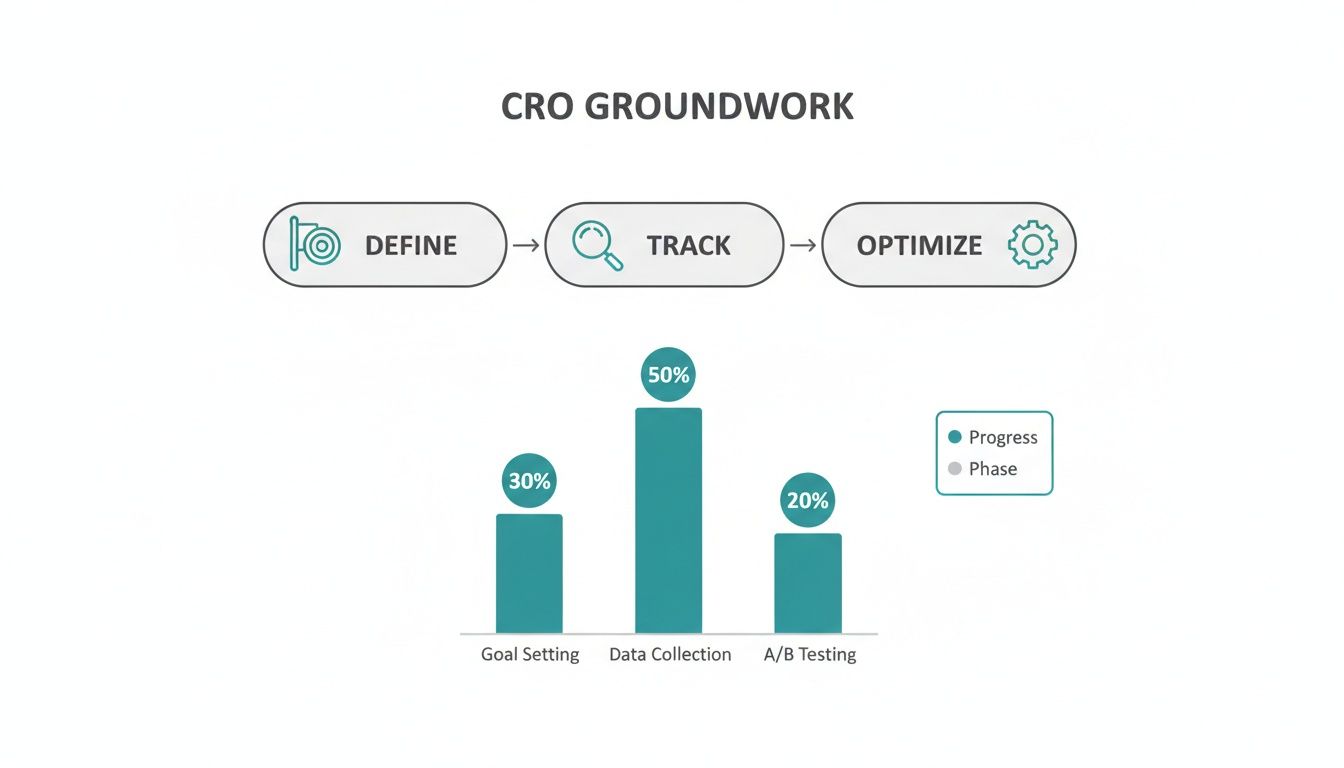
As the diagram shows, you are always moving from strategy (define) to analysis (track) and then to implementation (optimize).
Here are a few high-impact areas to focus on first:
- Optimize Your Images: Large, uncompressed images are the most common cause of slow load times. Use modern image formats like WebP and always compress images before uploading. This can dramatically reduce file size with no perceptible loss in quality.
- Leverage Browser Caching: Caching instructs a visitor’s browser to store static parts of your website (like your logo, CSS, and JavaScript files). On subsequent visits, the site loads almost instantly because their device already has these assets saved.
- Minify Code: Minification removes unnecessary characters—like spaces, comments, and line breaks—from your site's code. This makes the files smaller, allowing browsers to download and process them faster.
When you master your website's performance, you are doing more than improving a technical score. You are removing friction from the customer journey. A fast, responsive site feels professional and trustworthy, keeping potential customers engaged long enough to convert.
Enhancing User Experience and Navigation
Once your site loads quickly, the next challenge is the user experience (UX) itself. A lightning-fast website that's confusing to navigate will still fail to convert. Great UX acts as an invisible guide, leading visitors from their entry point to the final conversion action in a way that feels intuitive and effortless.
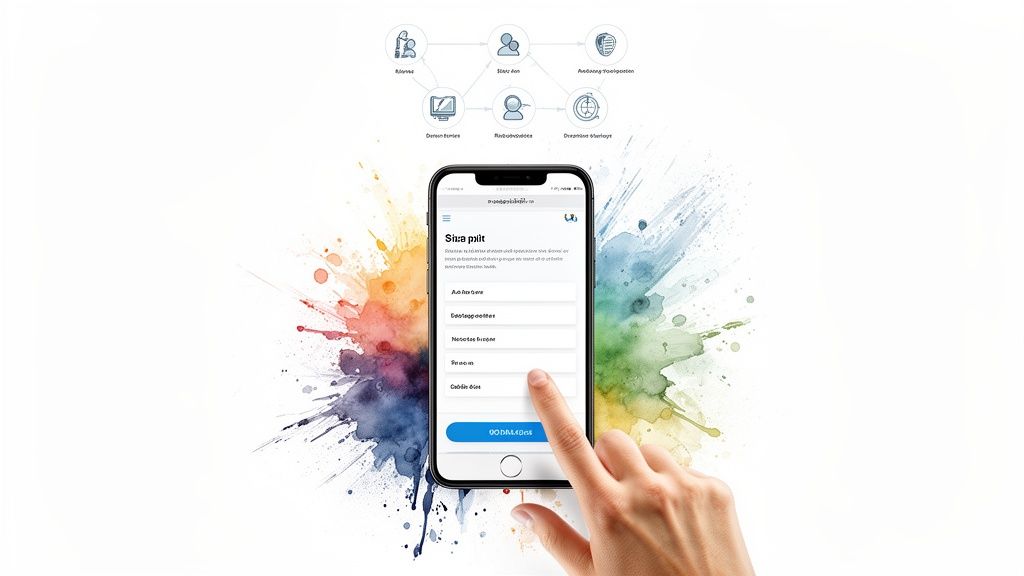
If a potential customer has to stop and think about where to click next, you've already introduced friction. Your job is to create a clear, logical, and predictable path for them to follow. This begins with a sensible site structure and culminates in an irresistible call-to-action.
Designing an Intuitive Site Structure
A confusing layout is a primary reason visitors leave a site. Your goal should be to help users find what they need with minimal effort. A helpful guideline is the "three-click rule," which posits that a user should be able to find any critical information on your site within three clicks.
This requires logical navigation menus, clear page hierarchies, and helpful features like breadcrumbs on deeper pages. For example, a home goods e-commerce site should have clear top-level categories like "Kitchen," "Bedding," and "Decor," with intuitive subcategories that guide users to specific products. This structure prevents user frustration and keeps them moving toward a purchase.
Crafting Compelling Calls to Action
Your Call-to-Action (CTA) is arguably the most important element on any conversion-focused page. It’s the final instruction that tells your visitor precisely what to do next. A weak, generic CTA like "Submit" or "Click Here" is a massive wasted opportunity.
An effective CTA must be:
- Action-Oriented and Benefit-Driven: Use strong verbs that promise a result. Instead of "Download," try "Get My Free Marketing Plan."
- Visually Prominent: The CTA button needs to stand out. Use a color that contrasts with the rest of the page but aligns with your brand, drawing the user's eye directly to it.
- Strategically Placed: Position CTAs where a user's attention naturally falls after they've absorbed your core message—such as directly below a product description or at the end of a compelling list of benefits.
Mastering these elements is fundamental to CRO. For a more detailed look, our guide on landing page design best practices covers strategies for building pages that consistently convert.
Simplifying Forms to Reduce Friction
Long, complicated forms are notorious conversion killers. Every additional field you require increases the cognitive load and the likelihood that a user will abandon the process. In fact, research consistently shows that a significant percentage of users will abandon a form simply because it’s too long or asks for unnecessary information.
A classic case study comes from Expedia. The company reportedly increased its annual profits by $12 million simply by removing one optional field—"Company Name"—from its booking form. This small change eliminated a point of confusion and streamlined the path to purchase.
Audit every form on your website with ruthless scrutiny. Is every single field absolutely essential for this specific transaction? You can always collect more information from customers later. By simplifying this final step, you dramatically increase the chances of securing the conversion now.
Building Trust Through Social Proof and Value
People buy from businesses they know, like, and trust. After optimizing your site's performance and user experience, your next task is to earn that trust. This is where a crystal-clear value proposition and authentic social proof become your most powerful conversion assets.
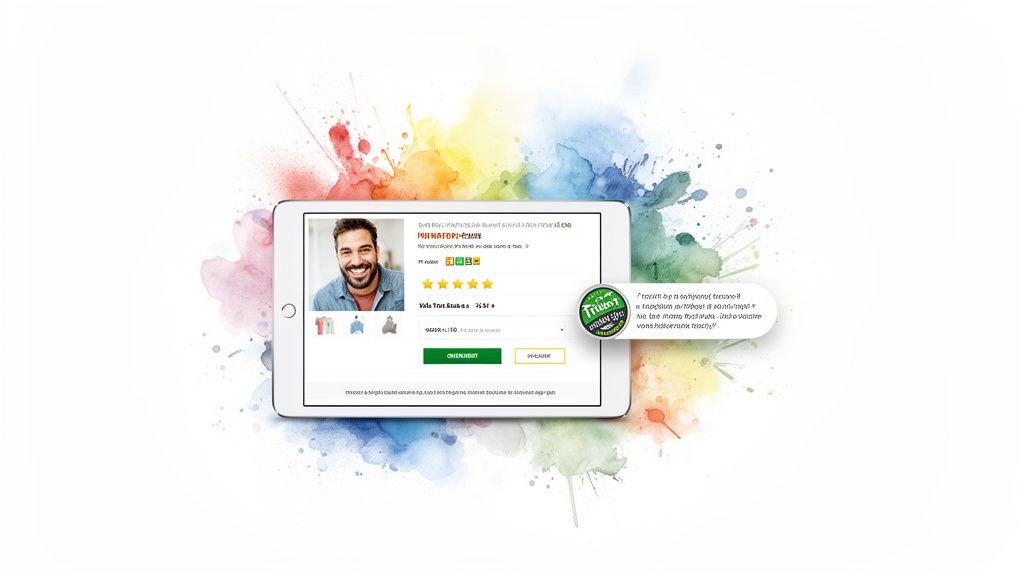
Without these elements, you are asking visitors to take a leap of faith. With them, you build a compelling case that transforms skeptical browsers into confident buyers. This is how you truly move the needle on your conversion rate.
Crafting an Irresistible Value Proposition
Your value proposition is your promise to the customer, delivered in a single, powerful statement. It must immediately answer their most pressing question: "Why should I choose you over all the other options?" This is more than a catchy tagline; it's the core of your conversion strategy, clearly articulating the unique benefit you deliver.
Your value proposition should be impossible to miss, placed front and center on your key landing pages. It must be specific and focused on the customer's desired outcome. For example, instead of a generic "We sell project management software," a stronger value proposition would be, "The Project Management Tool That Helps Marketing Teams Finish Projects 30% Faster." That communicates a tangible, desirable result.
The Undeniable Power of Social Proof
Once you've made a bold promise with your value proposition, you need to back it up. This is where social proof is essential. It leverages a powerful psychological principle known as the informational social influence: when we are uncertain, we look to the actions of others to guide our own.
You can weave several types of social proof throughout your website:
- Customer Reviews and Ratings: These are indispensable, especially for e-commerce. Star ratings and detailed reviews provide the unbiased validation that cautious buyers need to feel confident.
- Testimonials with Photos: A glowing quote is good. A glowing quote with a real name, title, and photo is exponentially more credible. Place these near key decision points, like a checkout page, to alleviate last-minute hesitation.
- Case Studies: For B2B businesses, in-depth case studies are non-negotiable. They provide a detailed narrative of how you solved a real-world problem for a client, offering concrete proof of your capabilities.
- Trust Badges and Certifications: Displaying security seals (like SSL certificates), industry awards, or logos of well-known clients can significantly reduce anxiety, especially when a user is about to enter payment details.
A pro tip: place relevant social proof directly beside your calls-to-action. Seeing that others have already made this choice and had a positive experience removes one of the final psychological barriers to conversion.
How Value and Trust Work Together
When a potential customer doesn't immediately grasp your value or doesn't feel they can trust you, they leave. This is the primary driver of high bounce rates and abandoned carts. While the average e-commerce conversion rate hovers around 2%, top-performing sites often exceed 3.5-5% because they have mastered the synergy between communicating value and building trust.
Consider that a leading reason for cart abandonment is unexpected costs at checkout—a perfect example of a broken value promise. You can find more ecommerce conversion rate insights on Digital Web Solutions.
When your value proposition sets a clear expectation and your social proof validates that promise, you create a customer journey that feels both compelling and secure. This one-two punch addresses both the logical and emotional drivers of a purchasing decision, giving you a powerful advantage in turning website traffic into revenue.
How to Use Customer Content to Build Unshakeable Credibility
Who is your most persuasive salesperson? It's not a member of your marketing team. It's your happiest customer.
In an age of polished advertising, consumers crave authenticity. This is where User-Generated Content (UGC) becomes a game-changer. It’s the raw, unfiltered proof from real people that your product lives up to its claims.
When you feature photos, videos, or social media posts from your actual customers, you add a powerful layer of credibility that you simply can't create yourself. You're showing your product "in the wild," helping potential buyers visualize themselves using it. This simple act can transform a skeptical visitor into an enthusiastic prospect.
Why Customer Content Works So Well
Seeing a real person use a product forges an immediate connection. It answers the silent questions every visitor has: "Would that work for me?" and "What does it look like without professional studio lighting?" This type of social proof is incredibly persuasive because it feels genuine and unbiased.
By integrating UGC into your product pages and marketing campaigns, you change the dynamic of the conversation. It's no longer your brand telling people how great your product is—it's their peers showing them. That kind of validation builds trust far more effectively than any advertisement ever could.
The data backs this up. An analysis of over a thousand websites found that when visitors interacted with UGC, the conversion rate more than doubled—a 102% lift. You can explore the full conversion statistics to see just how powerful this effect is.
How to Get and Showcase Great UGC
You can't just wait and hope that customers start creating amazing content for you. You need a proactive strategy. By implementing a simple system, you can generate a consistent stream of trust-building assets that work for you around the clock.
Here are a few proven methods to get started:
- Create a Branded Hashtag: Develop a unique, memorable hashtag for your brand and encourage customers to use it when they post about your products. Feature the best submissions on your website and social media channels to inspire others to participate.
- Run a Contest: People are naturally motivated by competition. Offer a compelling prize—a gift card, a free product, or a feature on your homepage—for the best photo or video submission. This not only generates a wealth of content but also fosters a strong sense of community.
- Automate Your Review Requests: A week or two after a purchase, send an automated email. Don't just ask for a star rating; explicitly ask customers to upload a photo or video showing how they're using and enjoying their new item.
When you turn customers into advocates, you create a self-sustaining growth engine. Their authentic content builds trust with new visitors, leading to more sales. Those new sales create more happy customers, who then generate even more powerful content for your brand.
Frequently Asked Questions About Website Conversion
As you delve into conversion optimization, it's natural for questions to arise. I've worked with countless businesses that, even after implementing new strategies, wonder about benchmarks, timelines, and priorities. Let's address some of the most common questions.
What Is a Good Website Conversion Rate?
This is the most common question, and the honest answer is: it depends entirely on your industry, business model, and traffic source.
While you'll often hear a general e-commerce average of 2-3%, using this as a universal benchmark can be misleading. A B2B company selling high-ticket enterprise software might be thrilled with a 0.5% conversion rate on demo requests. Conversely, a direct-to-consumer brand selling a popular, low-cost item could be aiming for 5% or higher.
The most important benchmark is your own past performance. The true goal of CRO is to achieve consistent, incremental improvement. Focusing on beating your own numbers month over month is a far more effective strategy than chasing an arbitrary industry average.
How Long Until I See CRO Results?
The time it takes to see a measurable impact from Conversion Rate Optimization (CRO) can vary significantly. Some changes can provide insights almost immediately, while others require more time to validate.
- Quick Wins: If you have sufficient traffic, simple A/B tests on elements like headlines, call-to-action button colors, or adding a trust badge can yield statistically significant results in as little as one to two weeks.
- Larger Projects: For more substantial changes—such as a complete redesign of your checkout process or launching a new landing page—you will likely need several weeks or even months of testing to gather enough data to make a definitive decision.
CRO is a marathon, not a sprint. The goal is to build a culture of continuous testing and learning. While quick wins are encouraging, the most profound business growth comes from a sustained commitment to understanding your users and systematically improving their experience.
Should I Prioritize Desktop or Mobile Conversions?
Your own analytics data holds the answer. Historically, desktop conversion rates have been higher, as people are often in a more focused "buying" mindset at their computer. However, this is only part of the story today.
For nearly every business, a mobile-first approach is essential. The modern customer journey is fragmented. Even if the final purchase happens on a desktop, the initial discovery, research, and consideration phases are now dominated by mobile. Your website must provide a flawless experience on a smartphone.
Your primary focus should be on optimizing the platform where your audience begins their journey with your brand. For most, that means ensuring your mobile experience is seamless, fast, and incredibly easy to navigate.
At Galant Studios, we transform websites into reliable conversion machines. Our data-driven SEO and conversion optimization strategies are designed to attract your ideal audience and guide them seamlessly from first-time visitor to loyal customer. Schedule your free consultation today to start turning more of your traffic into revenue.