Want to improve your website’s ranking on Google? The secret isn’t a single trick, but mastering three critical areas: creating genuinely helpful content, delivering a flawless user experience, and maintaining a technically perfect website. This isn’t about outsmarting Google’s algorithm. It’s about aligning your website with its core mission: to deliver the best, most relevant answers to every search query.
When you do that, higher rankings aren’t just possible—they’re inevitable.
Understanding How Google Actually Ranks Websites
Before you can climb the search results, you need to understand what Google truly values. Its algorithm is a sophisticated system that has evolved to reward websites that genuinely solve a user’s problem. Simply having a website isn’t enough anymore. Success comes from the powerful interplay between your content, your site’s performance, and its authority in your industry.
Think of it like building a house. Your technical SEO is the foundation. The content is the structure, the rooms, and everything that makes the house useful. And your off-page reputation, like backlinks, is the curb appeal—what the neighbors are saying about you. A cracked foundation makes the rest of it worthless.
The Three Pillars of Modern SEO
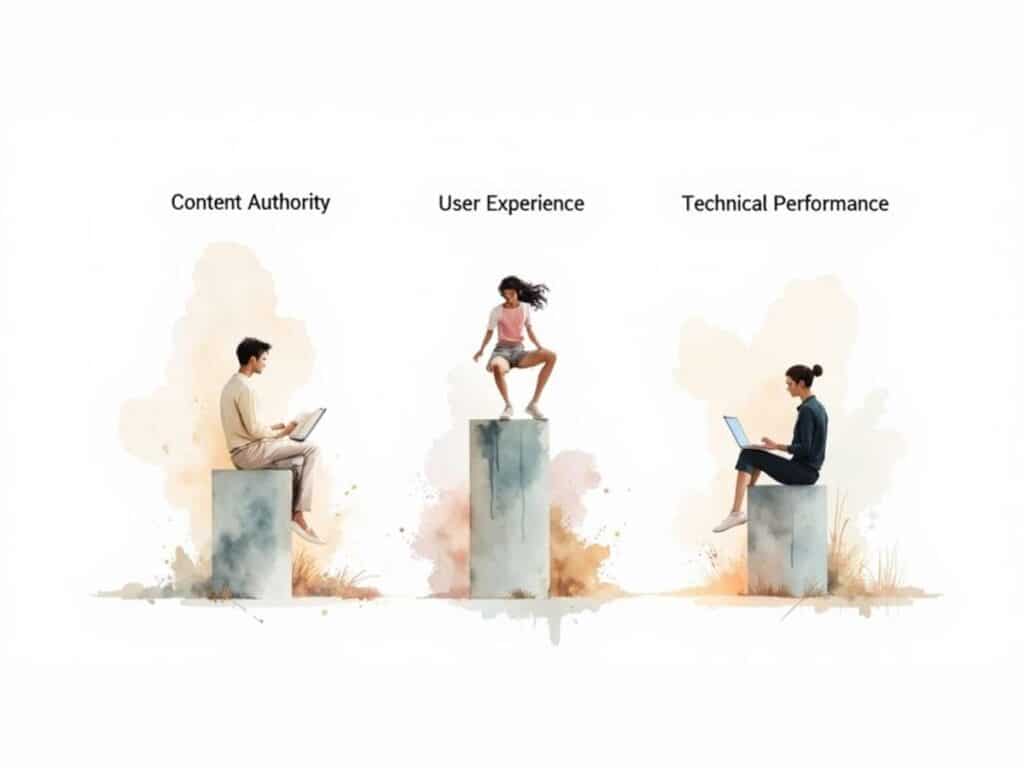
To build a strong, lasting presence that Google favors, your efforts need to be spread across three connected areas. Each pillar sends critical signals to search engines, and together they build a powerful case for why your site deserves to rank.
- Content Authority: This means establishing yourself as a go-to resource. It’s about creating content that is deep, accurate, and solves the specific problems your audience is searching for.
- Technical Integrity: These are the behind-the-scenes factors that determine how easily search engines can find, crawl, and understand your site. We’re talking about essentials like lightning-fast loading speeds, mobile-friendliness, and a secure HTTPS connection.
- Off-Page Trust: This is earned through external validation, primarily high-quality backlinks from other respected websites. Think of these links as “votes of confidence” that signal to Google that your content is valuable and trustworthy.
One of the biggest mistakes business owners make is treating SEO as a one-time project. The reality is that it’s a continuous cycle of creating value, optimizing for performance, and building trust. If you let any one of these pillars weaken, your ability to improve your website ranking on Google will stall.
Core SEO Pillars for Google Ranking Success
To help visualize how these areas work together, here’s a quick breakdown of the three fundamental pillars of modern SEO. Mastering the activities within each is key to achieving sustainable visibility on Google.
| SEO Pillar | Primary Goal | Key Activities |
|---|---|---|
| Content Authority | Become the most credible and helpful resource for your target topics. | Keyword research, long-form content creation, topic clustering, and regular content updates. |
| Technical Integrity | Ensure search engines can crawl, index, and understand your site flawlessly. | Site speed optimization, mobile-first design, structured data markup, and site architecture. |
| Off-Page Trust | Build external signals that validate your site’s authority and relevance. | High-quality backlink building, online reviews, brand mentions, and local citations. |
Focusing on these three areas provides a balanced, holistic approach that aligns perfectly with what Google wants to see from a top-ranking website.
What the Data Says About Ranking Factors
While Google keeps its exact algorithm a secret, years of industry research have given us a clear picture of what moves the needle. Content continues to be king, with a huge emphasis on consistently publishing top-tier material. A 2025 analysis found that satisfying, helpful content accounted for 23% of the ranking factor weight.
Backlinks, a cornerstone since the early days of PageRank, remain incredibly influential, coming in at 13%. This shows just how much Google still relies on other authoritative sites to vouch for your content. Beyond that, demonstrating niche expertise (13%) and keeping users engaged on your site (12%) are also major factors.
To get ahead, you need to understand the full picture. A great starting point is to dive into the various Search Engine Optimization Techniques that cover all aspects of improving your online visibility.
Building a Technically Sound SEO Foundation

Your website’s technical health is the invisible architecture holding up every piece of content you publish. If Google’s crawlers can’t easily navigate, render, and understand your pages, even the most brilliant articles will never see the first page. It’s like building a beautiful house on a shaky foundation—structural issues will eventually bring it all down.
To improve your website ranking on Google, you have to start here. Making your site technically sound simply means making it easy for search engine bots to do their jobs. And what’s good for them is almost always good for your human visitors, creating a faster, more intuitive experience for everyone.
Secure Your Site with HTTPS
One of the most fundamental technical signals is site security. Google has confirmed that having a secure site, indicated by HTTPS (Hypertext Transfer Protocol Secure), is a ranking signal. Moving from HTTP to HTTPS encrypts the data between a user’s browser and your server, protecting sensitive information like passwords and credit card numbers.
In today’s web, this is no longer optional. Modern browsers like Chrome plaster a “Not Secure” warning on non-HTTPS sites, which is a surefire way to lose visitor trust and send your bounce rate soaring. If you haven’t made the switch, getting an SSL certificate needs to be your top priority.
Master Your Site Structure and Navigation
A logical site structure is your roadmap for Google. It helps crawlers understand the relationships between your pages and, more importantly, figure out which content you consider most important. Think of it like a well-organized library; a clear hierarchy makes it simple for the librarian (Google) to find and categorize every book (your pages).
A simple, hierarchical structure almost always works best. For a local bakery, it might look something like this:
- Homepage -> Services -> Wedding Cakes
- Homepage -> About Us -> Our Bakers
This clarity helps spread page authority (or “link equity”) throughout your site and guides visitors exactly where they need to go with minimal frustration.
A common mistake is creating “orphan pages”—pages with no internal links pointing to them. If you don’t link to a page from somewhere else on your site, Google will struggle to find and index it. It effectively becomes invisible. Actionable Insight: Use a tool like Screaming Frog or the site audit feature in Ahrefs to find and fix orphan pages on your website.
Focus on Core Web Vitals and Page Speed
User experience is everything in Google’s eyes, and nothing screams “bad experience” louder than a slow-loading page. Page speed isn’t just a best practice; it’s a direct ranking factor. Google even has a specific set of metrics to measure this, known as Core Web Vitals.
These vitals break down the user’s loading experience into three key areas:
- Largest Contentful Paint (LCP): How long it takes for the main content to load. Aim for 2.5 seconds or less.
- First Input Delay (FID): How quickly your page responds when someone interacts with an element.
- Cumulative Layout Shift (CLS): This measures visual stability, preventing those frustrating moments when buttons or text jump around as the page loads.
Optimizing for these metrics isn’t negotiable if you’re serious about ranking. To get a head start, you can find practical strategies to improve website loading speed and build a solid technical foundation.
Ensure Your Website Is Mobile-Friendly
The majority of searches now happen on mobile devices, which is why Google shifted to mobile-first indexing. This means the mobile version of your website is the real version in Google’s eyes—it’s the primary one used for indexing and ranking. A clunky mobile experience will tank your rankings, even for people searching on a desktop.
Your first stop should be Google’s free Mobile-Friendly Test tool to see where you stand. The gold standard here is a responsive design that automatically adapts to fit any screen size. This approach guarantees a consistent, positive experience for every user, no matter what device they’re on. Digging into different website performance optimization techniques will give you a clear roadmap for achieving both speed and flawless mobile responsiveness.
Crafting Content That Answers User Intent
We’ve all heard the advice to “write great content” a thousand times. Frankly, it’s not enough anymore. To actually improve your website’s ranking on Google, you need to satisfy their user intent—the real reason they’re searching in the first place.
High-ranking content isn’t just well-written. It’s the most direct, helpful answer to the question someone is asking. Before you write a single word, you have to diagnose what your audience actually wants. Are they looking for information? Trying to find a specific website? Or are they ready to make a purchase?
Nailing this is the difference between getting buried on page ten and owning that top spot.
Decoding the Three Types of User Intent
Every search query fits into one of three main categories. Your first job is to figure out which bucket your target keywords fall into. If you build a sales-heavy product page for someone who is still in the research phase, you’ll just frustrate them and send a signal to Google that your page is a poor match.
Here’s the breakdown:
- Informational Intent: The user wants to learn something. Example: “how to fix a leaky faucet” or “what is compound interest.”
- Navigational Intent: The user is trying to reach a specific website or page. Example: “YouTube” or “Galant Studios login.”
- Transactional Intent: The user is ready to buy or take a specific action. Example: “buy Nike Air Force 1 size 10” or “plumber near me.”
This visual shows you just how important it is to get this right.
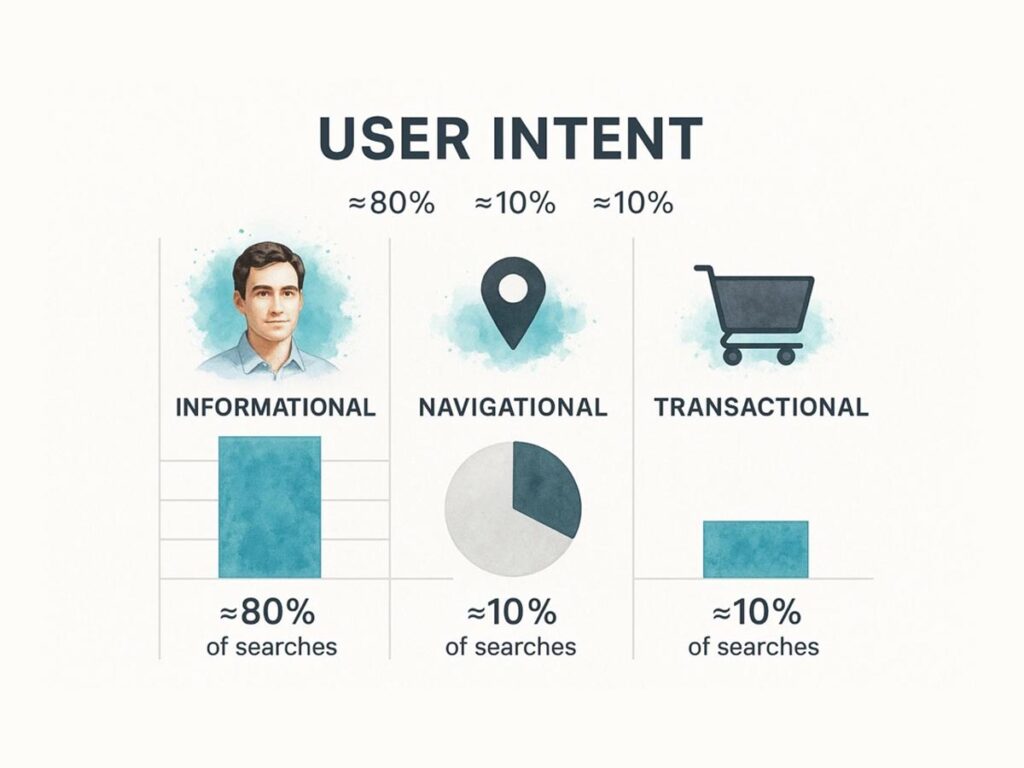
The data speaks for itself. With 80% of all searches being informational, you have a massive opportunity to attract an audience simply by providing expert answers and solving their problems.
Structuring Content for Maximum Impact
Once you know what the user wants, you have to structure your content to deliver the answer as quickly and clearly as possible. People don’t read web pages; they scan. A huge wall of text is an instant turn-off and a one-way ticket back to the search results.
You need to make your content scannable. Think short paragraphs, clear headings, bullet points, and visuals that break up the text. Every element should guide the reader’s eye to the information they came for. To get this process started, you can explore our guide on how to pick keywords for your business and make sure they align with your content strategy.
Think of your article’s structure as a conversation. Your H2 title poses the main topic, your H3s ask follow-up questions, and your body paragraphs provide the direct answers. This logical flow makes information easy to digest for both humans and search engines.
Building Topical Authority
Creating one-off articles isn’t going to cut it if you want to truly dominate the search results. The real goal is to build topical authority—proving to Google that your website is the definitive resource on a particular subject.
The best way to do this is by creating a “topic cluster.” This is a web of interlinked articles that covers a core topic from every angle.
For instance, a marketing agency might decide “Local SEO” is their core topic. They would start with a comprehensive “pillar page” giving a broad overview of the subject. From there, they’d create several “cluster” articles that dive deep into related subtopics.
That topic cluster might look something like this:
- Pillar Page: The Ultimate Guide to Local SEO
- Cluster Content: How to Optimize Your Google Business Profile
- Cluster Content: Building Citations for Local Businesses
- Cluster Content: The Importance of Online Reviews for Local Ranking
- Cluster Content: Local Keyword Research Strategies
Each of those cluster articles would link back to the main pillar page. This creates a powerful internal linking structure that showcases your expertise and helps Google understand the full depth of your knowledge. When you become the go-to source for a topic, you’ll find yourself ranking not just for one keyword, but for dozens of related searches.
Mastering User Engagement for Higher Rankings
What happens after someone clicks on your site from a search result is just as critical as getting that click in the first place. Google watches user behavior closely because it’s a powerful indicator of whether your page truly satisfied their search query.
Positive interactions signal that your page is a great match, reinforcing and even improving its ranking over time. Think of it as a user giving Google a thumbs-up. When they click your link and stick around, they’re essentially saying, “Yes, this is exactly what I was looking for.” A quick exit sends the opposite message.
The Power of Direct Traffic and Brand Trust
One of the most potent, yet overlooked, signals is direct traffic. This is when a user types your URL right into their browser or uses a bookmark. Why is that so important? It shows established brand recognition and genuine user trust—two qualities Google’s algorithm is built to reward.
In fact, one compelling study revealed a strong correlation between high volumes of direct traffic and better Google rankings. Google can indirectly measure these visits through its Chrome browser data. A steady flow of direct visitors tells the search engine that your site is a credible, authoritative destination people seek out on their own. You can dive deeper into how this works by reading the full research on Google ranking factors.
This makes a strong case for investing in brand-building activities right alongside your SEO work. The more people know and trust your brand, the more direct traffic you’ll attract, creating a fantastic feedback loop that strengthens your overall search presence.
Reducing Pogosticking and Improving First Impressions
The absolute worst signal you can send Google is when a user clicks your page, instantly dislikes what they find, and hits the back button to return to the search results. This behavior, known as “pogosticking,” is a massive red flag. It tells Google in no uncertain terms that your page failed to deliver on its promise.
To fight this, your page has to make an outstanding first impression. Here’s where to focus:
- Above-the-Fold Content: What a user sees without scrolling must immediately confirm they’re in the right place. The headline should align with their search, and the introduction needs to get straight to the point.
- Page Load Speed: We’ve mentioned this, but it’s crucial here. A page that takes more than a few seconds to load will be abandoned before your content even appears.
- Clean, Uncluttered Design: A chaotic layout cluttered with pop-ups and aggressive ads is overwhelming. A clean, professional design builds trust and helps users focus on the information they came for.
Actionable Insight: Look at your key landing pages as if you’re a first-time visitor. Ask yourself, “Can I understand what this page is about and if it will solve my problem within three seconds?” If the answer is no, it’s time to simplify your design and clarify your headline.
Positive vs. Negative User Engagement Signals
Knowing which user actions help or hurt your rankings is the key to optimizing your site for engagement. It’s helpful to see a direct comparison of the signals Google is likely evaluating.
Positive vs. Negative User Engagement Signals
| Signal Type | Positive Signal (Boosts Ranking) | Negative Signal (Hurts Ranking) |
|---|---|---|
| Dwell Time | User spends a significant amount of time reading your content. | User leaves the page almost immediately after arriving. |
| Click Behavior | User clicks internal links to explore other pages on your site. | User “pogosticks” back to the SERP to choose a different result. |
| Return Visits | User bookmarks your site or returns via direct traffic later. | User never returns to your website after their initial visit. |
| Interaction | User leaves a comment, fills out a form, or shares the content. | User shows no signs of interaction and simply bounces from the page. |
By focusing on strategies that boost dwell time, encourage exploration, and build a loyal audience, you are actively proving your site’s value to Google. This isn’t a quick trick; it’s a sustainable, long-term approach to earning and keeping high rankings.
Building Authority With Quality Backlinks

While you control your on-page and technical SEO, building off-page authority is a different game. It’s the part of the puzzle that truly helps to improve website ranking on Google, and it’s built primarily on one thing: backlinks.
Think of every quality backlink as a vote of confidence. When another website links to you, they’re essentially vouching for your content, telling both their audience and Google that your page is a credible source of information. This concept was the bedrock of Google’s original PageRank algorithm, and though things are more complex now, the core principle holds true. Links from respected sites pass authority to your site, which is a massive factor in your ability to rank.
But here’s the catch: not all links are created equal. It’s a classic case of quality over quantity. A single link from an authoritative industry journal will do more for you than a hundred links from irrelevant web directories.
Differentiating Good Links From Toxic Links
Knowing the difference between a helpful link and a harmful one is crucial. Pursuing the wrong kind of links won’t just stall your progress; it can actively damage your search rankings and even land you a penalty from Google.
Here’s a simple breakdown of what to look for and what to run from:
| Quality Link Characteristics | Toxic Link Characteristics |
|---|---|
| Comes from a topically relevant website. | Originates from an irrelevant or spammy site. |
| The linking site has its own strong authority. | The site is part of a private blog network (PBN). |
| The link is placed naturally within the content. | The link is in a footer or a spammy comment section. |
| Anchor text is descriptive and relevant. | Anchor text is over-optimized with exact-match keywords. |
Building a strong backlink profile is a long-term investment. It’s all about earning trust through strategic, value-driven efforts.
Create Link-Worthy Assets
The most sustainable path to earning quality backlinks is to create content that people genuinely want to link to. Instead of asking for links, you build something so useful that other website owners feel compelled to share it as a resource. These are “linkable assets.”
Here are a few practical ideas that consistently work:
- Original Research and Data: Conduct an industry survey, analyze your own data, or compile hard-to-find statistics into a single report. Example: A local real estate agency could publish an in-depth report on neighborhood market trends, becoming the primary source for that data.
- Comprehensive Guides and Tutorials: Aim to create the definitive guide on a topic in your niche. Make it so thorough that it becomes the go-to resource other bloggers reference when explaining the subject.
- Free Interactive Tools: Build a simple tool that solves a real problem for your audience. Example: A mortgage broker could create a “Home Affordability Calculator,” or a marketing firm could offer a “Headline Analyzer.” These tools are incredibly linkable.
When you have assets like these, outreach stops feeling like you’re asking for a favor and starts feeling like you’re offering something of real value. To get this right, you’ll need to develop a solid link building strategy centered on creating genuine utility.
A critical mistake is creating great content and just hoping people will stumble upon it. Creating the asset is only half the battle. The other half is strategic promotion and outreach to let the right people know it exists.
Master Targeted Outreach
Once your link-worthy asset is live, it’s time to get it in front of the right people. This isn’t about blasting a generic email to hundreds of websites. It’s a nuanced process of building relationships and finding contexts where your resource adds genuine value.
A successful outreach campaign usually follows these steps:
- Identify Prospects: Use SEO tools to find websites and blogs that have already written about your topic or linked to similar resources.
- Find the Right Contact: Pinpoint the specific editor, content manager, or author who would be most interested in what you’ve created. Generic emails to
info@rarely work. - Craft a Personalized Pitch: Write a short, personalized email. Get to the point quickly, explain why your resource is a great fit for their audience, and suggest how it could enhance a specific piece of their content.
Imagine you’ve just published that study on local consumer spending. You could reach out to a journalist who covers local business news, giving them a heads-up and offering early access to the data for a story they’re working on. This approach is mutually beneficial and results in the kind of high-authority backlinks that make a lasting impact.
Measure and Refine Your SEO Strategy
Getting to the top of Google is one thing; staying there is another challenge entirely. High rankings aren’t the result of a one-time fix. They come from a constant cycle of measuring, analyzing, and adjusting. This is how you move beyond guesswork and start making deliberate decisions that drive real growth.
The key is tracking the right metrics. Luckily, the two most powerful tools for this are completely free: Google Search Console and Google Analytics. Think of them as the dashboard and diagnostics for your website’s search engine journey.
Check Your Core Performance in Google Search Console
If you’re serious about SEO, Google Search Console (GSC) is non-negotiable. It’s the most direct line of communication you have with Google, offering unfiltered data on how the search engine sees your site.
Your home base within GSC is the “Performance” report. This is where you see which search queries bring people to your site, what pages are getting the most visibility, and how people are reacting to your site in the search results.
Keep a close eye on these four metrics:
- Total Clicks: How many people actually clicked on your link to visit your site.
- Total Impressions: The number of times your site appeared in someone’s search results.
- Average CTR (Click-Through Rate): The percentage of impressions that turned into a click (Clicks / Impressions).
- Average Position: Your average ranking for a given keyword or page.
These numbers tell a story. For example, a page with tons of impressions but a dismal CTR is a classic sign of a problem. It means Google thinks your page is relevant, but your title tag and meta description aren’t compelling enough to win the click. That’s a crystal-clear opportunity to do better.
Track What Happens Next with Google Analytics
GSC shows you everything up to the click. Google Analytics tells you what happens after. Did the visitor find what they wanted, or did they hit the back button immediately? This user behavior data gives crucial context to your SEO efforts.
Inside Google Analytics, head over to the “Acquisition” reports and filter for the “Organic Search” channel. This isolates the traffic that came directly from search engines.
A key metric to obsess over here is the engagement rate for your top organic landing pages. A high engagement rate is a strong signal to Google that your content is satisfying the user’s query, reinforcing that your page deserves its rank.
This is a direct feedback loop. When people consistently engage with your content, Google notices. This is why just getting the click isn’t enough—you have to deliver on the promise you made in the search results.
Why Every Ranking Position Matters
The need for constant measurement becomes obvious when you see how clicks are distributed in the search results. Data shows just how critical it is to land on the first page, preferably near the top. Research consistently shows that the top three organic results get the lion’s share of attention, capturing a staggering 68.7% of all clicks. The #1 spot alone, when there’s no featured snippet, gets 39.8% of the clicks. You can dive deeper into how Google patents influence SEO ranking factors to understand the mechanics behind this.
This data proves that the gap between ranking fifth and ranking second isn’t just a few spots—it’s the difference between being practically invisible and driving substantial traffic. By monitoring your performance, you can spot those opportunities to jump up a position or two, which can translate into a massive boost for your business.
Ready to stop guessing and start making data-driven decisions to improve your website ranking on Google? Galant Studios has over 8 years of experience helping businesses like yours master SEO. We integrate proven optimization strategies into every aspect of your site to drive measurable growth.
Schedule your free consultation today!