Is your business serious about sustainable, long-term growth? If so, the answer to “Is SEO worth it?” is a resounding yes. Search Engine Optimization isn’t just another line item on your marketing spreadsheet; it’s a direct investment in your most valuable digital asset—your website’s visibility and authority.
Think of it this way: SEO is like buying the land and building a flagship store in the busiest part of town. It takes an upfront investment and time to construct, but once it’s built, it becomes a valuable asset that generates revenue for years. Paid advertising, on the other hand, is like renting a pop-up kiosk in a mall. You get instant foot traffic, but the moment you stop paying rent, your presence vanishes.
This guide will give you a clear, no-nonsense look at the real costs and returns of SEO, so you can decide for yourself.
The Bottom Line: SEO is an Investment, Not an Expense

The core difference between SEO and other marketing channels comes down to ownership. SEO builds lasting equity that compounds. You’re not just renting visibility; you’re building a sustainable customer acquisition channel that you own. This distinction is crucial for any business planning beyond the next fiscal quarter.
If you’re wondering about its relevance today, it’s worth addressing common myths about SEO’s ongoing relevance. Understanding its role helps clarify why SEO remains a cornerstone of any robust digital strategy.
SEO is the only marketing channel that, when executed properly, continues to pay dividends long after the initial work is completed. It establishes a perpetual stream of qualified traffic, leads, and sales.
The financial data confirms this. The average return on investment (ROI) for a well-executed SEO campaign is a staggering 748%. That means for every $1 invested, businesses see an average return of $7.48.
These aren’t just vanity metrics. Certain industries see even higher returns, with financial services hitting a 1,031% ROI and real estate reaching an incredible 1,389% ROI. When you invest in SEO, you’re building a competitive moat around your business that’s difficult for competitors to replicate quickly. You become the go-to authority your customers are actively searching for.
SEO Investment vs. Expected Outcomes
To put it plainly, SEO builds equity, while paid ads rent visibility. This table breaks down what you can realistically expect from each approach.
| Attribute | SEO (Organic Search) | PPC (Paid Search) |
|---|---|---|
| Time Horizon | Long-term investment with compounding returns. | Short-term gains with immediate results. |
| Cost Structure | Upfront and ongoing investment in expertise and content. | Pay-per-click model; costs stop when ads do. |
| Asset Value | Builds a lasting digital asset (rankings, authority). | No residual value; visibility disappears when paused. |
| Trust Factor | High credibility and consumer trust in organic results. | Lower trust; users know it’s a paid placement. |
| Sustainability | Creates a self-sustaining source of traffic over time. | Dependent on continuous budget allocation. |
While paid search delivers a quick boost, SEO provides the foundation for durable, long-term success and a far greater return on your investment.
How SEO Actually Works for a Business

So, how does SEO actually move the needle? Let’s skip the technical jargon.
Imagine your website is a new bookstore and Google is the world’s most popular shopping district. SEO is the process of choosing the perfect location, designing an inviting storefront, and building a reputation that makes your store the go-to spot for history buffs or mystery lovers. It isn’t about finding a magic loophole; it’s a deliberate strategy built on three core pillars.
The Three Pillars of SEO Success
First is Technical SEO. This is like ensuring your bookstore has a solid foundation, clear signage, and wide, accessible aisles. It answers the question: can search engine “crawlers” (think of them as Google’s location scouts) easily navigate your site? This covers essentials like page load speed, mobile-friendliness, and a logical site structure. If the scouts can’t get in the door, the incredible books inside don’t matter.
Next is On-Page SEO. This is about what’s on your shelves. It involves deep keyword research to understand precisely what your customers are looking for, then creating high-quality, genuinely helpful content that provides the answers. For instance, a bakery wouldn’t just write about “cakes”; they’d create specific pages for “custom wedding cakes in Brooklyn” or “gluten-free birthday cake delivery.” This is like labeling every aisle and book perfectly, so customers and search engines know exactly what you offer.
Finally, there’s Off-Page SEO. This is your store’s reputation around town. It’s about earning credible recommendations from other respected experts. Online, these “recommendations” are backlinks—links from other authoritative websites pointing to yours. A link from a major food blog to your bakery’s wedding cake page is a powerful vote of confidence, telling Google that your business is a trustworthy source.
Search Engine Optimization is not about gaming the system. It’s about creating a better, faster, and more user-friendly experience that aligns with what search engines want to provide their users—the best possible answer to their query.
When these three pillars work together, you build real authority. That authority translates directly into higher rankings for the search terms that matter to your business. This visibility drives a steady stream of qualified customers to your website, allowing you to increase your organic search traffic without paying for every click.
Calculating the Real Return on Your SEO Investment
To truly determine if SEO is worth it, you must move beyond abstract benefits and look at the hard numbers. Calculating your Return on Investment isn’t just for accountants; it’s how you can justify the budget and forecast profitability from organic search.
The formula boils down to two key metrics: Customer Lifetime Value (CLV) and Cost Per Acquisition (CPA). CLV is the total revenue a customer brings in over their entire relationship with you. CPA is what you spend to acquire that customer. The magic of SEO is its power to dramatically lower your CPA over time.
A Practical Example: A Local Plumbing Company
Let’s walk through a real-world scenario. A local plumber knows their average customer is worth $2,500 over their lifetime (CLV). Currently, they rely on paid ads, spending $500 to acquire each new customer (CPA). It’s effective, but the cost is high and never decreases.
They decide to invest in an SEO campaign, targeting the high-intent keyword “emergency plumber near me,” which gets 1,000 searches per month in their city. A realistic goal for a solid SEO strategy is a top-three ranking. This position could capture 15% of all clicks, driving 150 new visitors to their website every month.
The key here is user intent. People typing that phrase into Google need a solution now. This is why organic traffic converts at an impressive average of 14.6%—dwarfing the 1.7% conversion rate of traditional outbound marketing.
Comparing SEO CPA vs. Ad Spend
Let’s do the math. At a 14.6% conversion rate, those 150 monthly visitors generate roughly 21 new leads. If the plumber closes 25% of those leads, they’ve just won five new customers that month—all from one keyword.
If the monthly SEO investment is $2,000, the Cost Per Acquisition from SEO becomes $400 ($2,000 / 5 customers). This is already a 20% savings compared to their $500 CPA from paid ads.
And here’s where it gets powerful. As the website builds authority and ranks for more keywords, the lead flow increases, but the monthly SEO cost often remains the same. The CPA continues to drop, turning SEO into an increasingly profitable growth engine.
Learning how to calculate marketing ROI helps you see exactly how the numbers can work in your favor. Of course, you need to monitor these metrics closely, which is why we put together a guide on how to track SEO performance. When you have this framework in place, SEO stops being an expense and becomes a predictable engine for growth.
Setting Realistic Timelines for SEO Success
A common reason business owners get frustrated with SEO is mismatched expectations about timing. Unlike paid ads, which deliver instant visibility, SEO is a long game that builds momentum over time.
Think of it like planting an orchard. You must first prepare the soil, plant the saplings, and provide consistent care. It requires patience. But once those trees mature, they produce fruit for years with minimal effort. The initial phase of SEO is about building a strong foundation, not chasing immediate traffic. You are methodically earning Google’s trust, and that doesn’t happen overnight.
This infographic breaks down the typical journey and what you can expect during the first year.
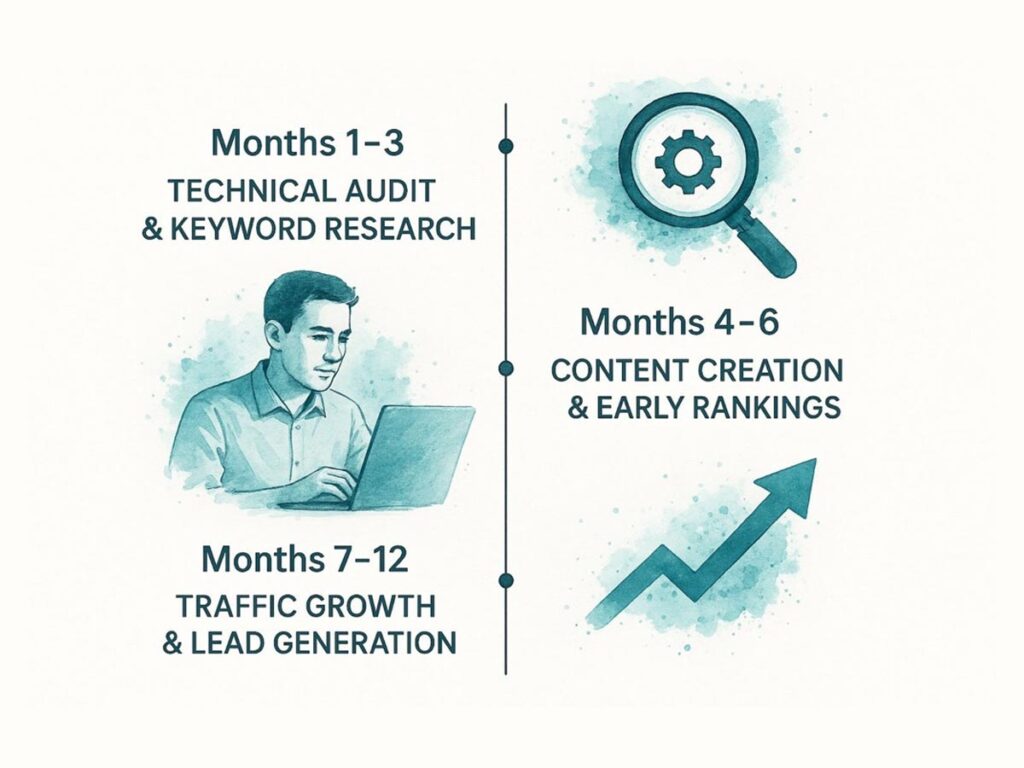
As you can see, the foundational work in the early months is what paves the way for measurable growth later on.
The Typical SEO Journey
Knowing what to expect at each stage helps set clear, achievable goals. Every step builds on the last, creating a compounding effect that steadily strengthens your digital presence.
Here’s a practical breakdown of the process:
Months 1–3: The Foundational Work
The first quarter is for deep analysis and repair. This involves a comprehensive technical audit to ensure search engines can crawl your site, in-depth keyword research to identify your best opportunities, and fixing any underlying issues holding you back. This is the unglamorous but critical groundwork.Months 4–6: Content and Early Traction
With a solid technical foundation, the focus shifts to creating high-value content that directly addresses your audience’s needs. During this phase, you’ll likely start seeing ranking improvements for less competitive, long-tail keywords. These early wins are vital signs that the strategy is on the right track.Months 7–12: Gaining Momentum
This is where your investment truly begins to pay off. You should see a noticeable increase in organic traffic, translating directly into more leads and sales. As your site’s authority grows, it will start to rank for more competitive, high-value search terms.
Most businesses see a positive return on investment within 6 to 12 months, with performance accelerating in the second and third years. While that may seem long, remember the alternative: when a paid ad campaign is turned off, the traffic stops instantly. A well-executed SEO strategy keeps delivering value long after the initial push. If you want to dive deeper into the data, you can explore why SEO is a sound investment for 2025 and beyond.
By the end of the first year, SEO should not be seen as a cost center but as a predictable and scalable engine for business growth.
After year one, the focus shifts from building to defending and expanding your market share, solidifying your authority, and reaping the powerful returns of a mature digital asset.
When You Should Not Invest in SEO
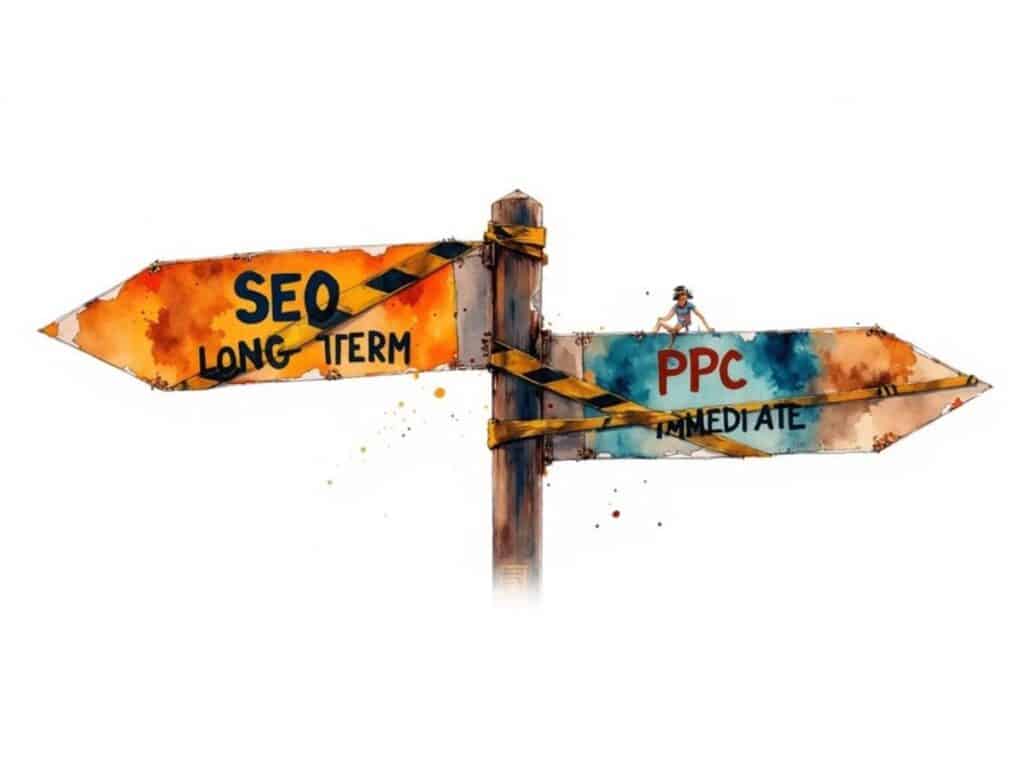
As powerful as SEO is, it’s not a silver bullet for every business challenge. A smart strategy means knowing when to prioritize other marketing channels. Answering “is SEO worth it?” sometimes means acknowledging that now isn’t the right time.
SEO is a strategic investment in a long-term asset, not a quick fix for a cash flow crisis. If you need sales this month to make payroll, the gradual, compounding nature of SEO won’t deliver fast enough. In that case, your budget is better spent on channels that produce immediate results.
When Other Channels Are a Better Fit
Certain business situations demand a different playbook. Identifying these scenarios helps you allocate your budget where it will have the most immediate impact.
Here are a few clear instances where SEO shouldn’t be your top priority:
- You Need Immediate Sales or Leads: Promoting a one-off webinar or a short-term holiday sale? The slow ramp-up of SEO is impractical. A targeted Pay-Per-Click (PPC) campaign on Google or social media can drive traffic and conversions within hours.
- You’re in a Brand-New Product Category: If you’re launching an innovative product nobody knows exists, there’s no search volume to capture. People can’t search for a solution they don’t know is possible. Your first task is to create demand through Public Relations (PR), influencer marketing, and educational content marketing to build awareness.
- Your Product-Market Fit is Unproven: Driving thousands of visitors to a product that doesn’t solve a real problem is a waste of money. If your core offering has flaws, or if you’re still figuring out who your customer is, focus on customer feedback and product development first.
SEO amplifies a great business; it cannot fix a broken one. Ensure your core operations—from customer service to product quality—are solid before you invest heavily in driving organic traffic.
Choosing the right strategy is about matching the tool to the task. For businesses with a proven product and a long-term vision, SEO is an unparalleled investment. But for those facing immediate revenue gaps or creating entirely new markets, more direct channels should take precedence.
So, What’s the Final Verdict on SEO?
After looking at the data, the timelines, and the strategic fit, the question isn’t if SEO is worth it. It’s when it should become a priority for your business. For any company serious about building a sustainable competitive advantage, SEO is not just another marketing tactic; it’s a foundational business strategy.
Paid ads are like renting an audience. SEO is like building a permanent digital headquarters. This asset doesn’t vanish when you stop paying a monthly bill. It continues to generate high-quality leads, build genuine trust, and deliver a return that consistently outperforms other marketing channels. The crucial shift in mindset is to stop seeing SEO as a cost and start treating it as a capital investment in your company’s future.
Moving From “If” to “How”
The conversation needs to move from if your business needs SEO to how you will execute it effectively. The numbers speak for themselves. Again and again, organic search proves to be a primary engine for profitable growth.
In fact, 49% of marketers now report that organic search offers the best ROI of any marketing channel, outperforming paid search, social media, and email. You can see how organic search stacks up against other channels to get a clearer picture of its impact.
The most successful businesses don’t ask if they can afford to invest in SEO. They ask if they can afford not to.
Your next step is to move from consideration to action. For some, that means an internal audit to find quick wins. For others, the best path forward is to explore affordable small business SEO services and get expert guidance from day one.
Using the frameworks in this guide, you can calculate a realistic ROI and build a strong business case. The time for sitting on the fence is over. Now is the time to start building your digital foundation and securing your company’s long-term success.
A Few Common Questions About the Value of SEO
When digging into SEO, a few practical questions almost always come up—especially around budgeting, execution, and how it fits with other marketing. Let’s tackle the most common ones.
How Much Should a Small Business Really Budget for SEO?
There’s no single magic number, but a realistic monthly budget for a small business partnering with a reputable agency typically falls between $1,500 and $5,000. This range covers the essential work required to see meaningful results: technical site health, consistent high-quality content creation, and strategic authority building.
It’s crucial to reframe this cost. It’s not a marketing expense; it’s a capital investment in a valuable digital asset. You’re building equity in your website’s visibility—an asset that will pay dividends for years.
Can I Just Do SEO Myself?
Technically, yes. You can certainly handle basics like optimizing your Google Business Profile or making simple on-page content tweaks. Many business owners start there.
However, modern SEO is a deep, technical, and ever-changing discipline. Achieving significant results requires specialized expertise. Partnering with a professional will almost always get you to your goal faster and help you avoid costly mistakes that could set your site back for months. For any business serious about growth, that expertise is a competitive advantage.
Should I Focus on SEO or PPC?
This isn’t an “either/or” dilemma; it’s a question of “when and why.” Think of it as speed versus sustainability.
- PPC is your sprinter. If you need leads today, want to test a new product offer, or have a time-sensitive promotion, PPC is the perfect tool. You pay for immediate visibility.
- SEO is your marathon runner. If you want to build a durable, long-term pipeline of high-quality traffic and cement your brand as an authority, nothing beats SEO.
The most successful businesses use both in harmony. PPC can drive immediate revenue and provide valuable keyword data that informs your SEO strategy, while your long-term SEO efforts build a sustainable foundation for growth. It’s a powerful one-two punch that delivers both short-term wins and lasting success.
Ready to stop wondering if SEO is worth it and start building a real asset for your business? At Galant Studios, we specialize in data-driven SEO strategies that create lasting value. Schedule a consultation with us today to see how we can turn your website into a powerful engine for growth.