Local keyword research is the art of discovering the exact words and phrases your neighbors use when they need your services. This isn’t just a technical SEO task; it’s about understanding your community’s needs so you can become their first and best choice. Get this right, and you don’t just get traffic—you get foot traffic, phone calls, and paying customers.
Why Local Search Intent Is Your Biggest Opportunity

Before diving into tools and tactics, let’s grasp why this is so critical. Local searches are fundamentally different from general queries. They are packed with immediate intent to visit, call, or buy—often right now.
Someone searching for “emergency plumber in Brooklyn” or “best coffee near downtown Austin” isn’t just browsing. They have a problem that needs a solution, and they’re actively looking for a local business to provide it. This direct line from a search query to a real-world transaction is what makes local SEO a powerful engine for small business growth.
Proper local keyword research ensures you appear at the exact moment a potential customer is ready to make a purchase.
The Power of Proximity and Purchase Intent
Consider the user’s mindset. A search for “how to fix a leaky faucet” is informational. That person is likely planning a DIY project. But a search for “24-hour plumber near me”? That’s a call for help. It signals an urgent problem that will almost certainly end with a paid service call.
This distinction is crucial for a local business. Your success isn’t measured in abstract clicks; it’s measured in booked appointments and customers walking through your door. Effective keyword targeting is one of the most powerful small business SEO strategies because it focuses your efforts on attracting people who are ready to act, not just browse.
Local searches are not about getting seen; they’re about driving revenue. When you target users with clear, location-based needs, you connect your business directly to a customer base that is primed to convert.
Connecting Searches to Tangible Business Growth
The data is clear: local searches lead to real-world action. Studies consistently show that the vast majority of local mobile searches result in a phone call or a store visit within 24 hours. This isn’t just theory; it’s a practical blueprint for growth.
- Practical Example: A local coffee shop targeting “best espresso downtown” can capture foot traffic from office workers on their lunch break.
- Practical Example: An HVAC company ranking for “AC repair Scottsdale” becomes the go-to solution for homeowners during a blistering summer heatwave.
By aligning your online presence with the precise language your local customers use, you transform your website from a digital brochure into an automated lead-generation machine. Mastering this is the first step toward a local SEO campaign that delivers measurable results.
Get In Touch
Building Your Foundational Keyword List

The real work of local keyword research begins with what you already know: your business and your customers. Your first goal is to build a foundational list of “seed” keywords by combining what you do with where you do it.
Think of this as the bedrock of your entire local SEO strategy.
The simplest formula is [Your Service or Product] + [Your Location]. This is the most direct way to connect with customers actively seeking a local provider. To start, list every service you offer and every product you sell. Don’t filter yourself; capture everything.
Identifying Your Core Service Keywords
First, articulate your core offerings in plain, customer-focused language. Avoid internal jargon. If you’re a plumber, your list starts with terms like “plumber,” “plumbing services,” and “drain cleaning.”
Then, expand to cover specific, often urgent, customer needs. That same plumbing company would add phrases like:
- Emergency plumbing repair
- Leaky faucet fix
- Water heater installation
- Clogged toilet service
Each of these represents a unique customer problem and, therefore, a valuable seed keyword. Think from the customer’s perspective: what problem are they trying to solve right now?
Layering in Geographic Modifiers
With your service list in hand, it’s time to add the “local” component. This is more than just adding your city name. Effective local optimization means thinking about every way a customer might describe their location.
Brainstorm all relevant geographic terms for your service area:
- City Name: The most obvious, like “Brooklyn.”
- Neighborhoods: Specific districts people identify with, like “Williamsburg” or “Bushwick.”
- Abbreviations or Nicknames: Local shorthand, like “MPLS” for Minneapolis.
- Nearby Landmarks: Well-known points of interest, like “near Prospect Park.”
- County or Region: Broader areas like “King County” that still carry local intent.
According to the U.S. Census Bureau, there are over 19,000 incorporated places in the United States alone, each with unique neighborhoods and local terms. Tapping into this granularity is what separates a generic strategy from a truly effective one.
To structure this process, use a simple matrix to systematically combine your services with locations. This ensures you don’t miss valuable combinations.
Local Keyword Brainstorming Matrix
| Core Service/Product | City/Town Modifier | Neighborhood Modifier | Qualifier (‘best’, ’emergency’) |
|---|---|---|---|
| e.g., HVAC Repair | e.g., Scottsdale | e.g., Old Town | e.g., 24-hour |
| e.g., Custom Cakes | e.g., Austin | e.g., Zilker | e.g., wedding |
| e.g., Dog Grooming | e.g., Miami | e.g., South Beach | e.g., affordable |
This methodical approach guarantees comprehensive coverage. A bakery in Austin shouldn’t just target “bakery Austin.” They should also target “custom cakes downtown Austin,” “sourdough bread near Zilker Park,” and “wedding cupcakes Travis County.” Each variation targets a slightly different but highly motivated local customer.
By combining your core services with a rich list of geographic modifiers, you create a keyword foundation that mirrors how local customers actually search. This initial brainstorming is the most critical step in making your marketing efforts relevant and effective.
Get In Touch
Tapping into Hyperlocal and ‘Near Me’ Searches
Modern local keyword research goes beyond city names. We’re in an era where the most valuable searches happen on the go, driven by immediate need. Mobile search has fundamentally changed how customers connect with businesses in their own backyard.
This shift is powered by the smartphone in everyone’s pocket. It’s estimated that the majority of local searches now happen on a mobile device. More importantly, users are increasingly using conversational phrases like “near me” when looking for local businesses—a trend that signals powerful, urgent intent.
The New Language of Local Search
People don’t talk to their phones the way they type. Instead of “plumber Brooklyn,” they ask natural questions like, “Hey Google, who is the best emergency plumber near me that’s open now?”
Your job is to anticipate and capture this language of need. This means focusing on longer, question-based phrases that mirror how people speak. Getting this right is a key part of a modern voice search strategy, which you can learn more about in our guide on how to optimize for voice search.
The most profitable local searches aren’t just about what or where. They’re about right now. Targeting the urgency behind phrases like “near me” and “open now” connects you with customers at their absolute highest point of intent.
How to Find These High-Intent Keywords
While broad, city-level keywords are important, hyperlocal searches are where the real action is. These queries capture users just a few blocks away, ready to visit or call. The intent behind a search like finding a property management company near me is crystal clear—they need help now.
Here’s how to uncover these valuable, spontaneous search terms:
Use Google Autocomplete: Start typing your main service into Google’s search bar, followed by “near me.” The autocomplete suggestions are a direct feed from real-world searches. Don’t forget to check the “People Also Ask” box for more question-based ideas.
Analyze Your GBP Insights: Your Google Business Profile is a goldmine of data. In the performance report, look at the “Queries” section. This shows you the exact terms people used to find your business. You will likely uncover “near me” variations you never considered.
Think Like Your Customer: Put yourself in their shoes. If your car breaks down, what would you say to your phone? Probably not “auto repair Chicago.” More likely, it’s “where can I get a flat tire fixed around here?” This role-playing exercise uncovers natural, high-intent phrases.
Actively hunting for these immediate, conversational phrases aligns your business with how modern customers actually search. This is how you capture the most motivated, ready-to-convert traffic.
Get In Touch
How to Validate and Prioritize Your Keywords
You’ve brainstormed a great list of potential keywords. Now, you must separate the high-value targets from the noise. This is where you transform your list into an actionable business strategy by validating each term.
This phase is about analysis. We’ll look at three critical factors: local search volume, competitive difficulty, and commercial intent. Skipping this step is a common mistake that leads businesses to waste time chasing keywords that never convert into customers.
Analyzing Search Volume and Local Competition
First, you need a realistic estimate of how many people in your specific service area search for your target terms. A keyword might have 10,000 national searches, but if only 20 are from your city, it’s not a priority.
Tools like Google Keyword Planner are perfect for this, allowing you to filter search volume estimates down to the city or metro area. This provides a clear picture of local demand.
However, volume isn’t everything. You must also assess the competition. Search for your top keywords in an incognito window. Who ranks on the first page? Are they national chains or other local businesses?
If the top spots are held by large, entrenched competitors, that keyword might be a long-term goal, not an immediate priority. Focus on terms where you have a realistic chance to rank and make an impact sooner.
The journey from a mobile search to your front door is often surprisingly short, highlighting the power of capturing local queries.
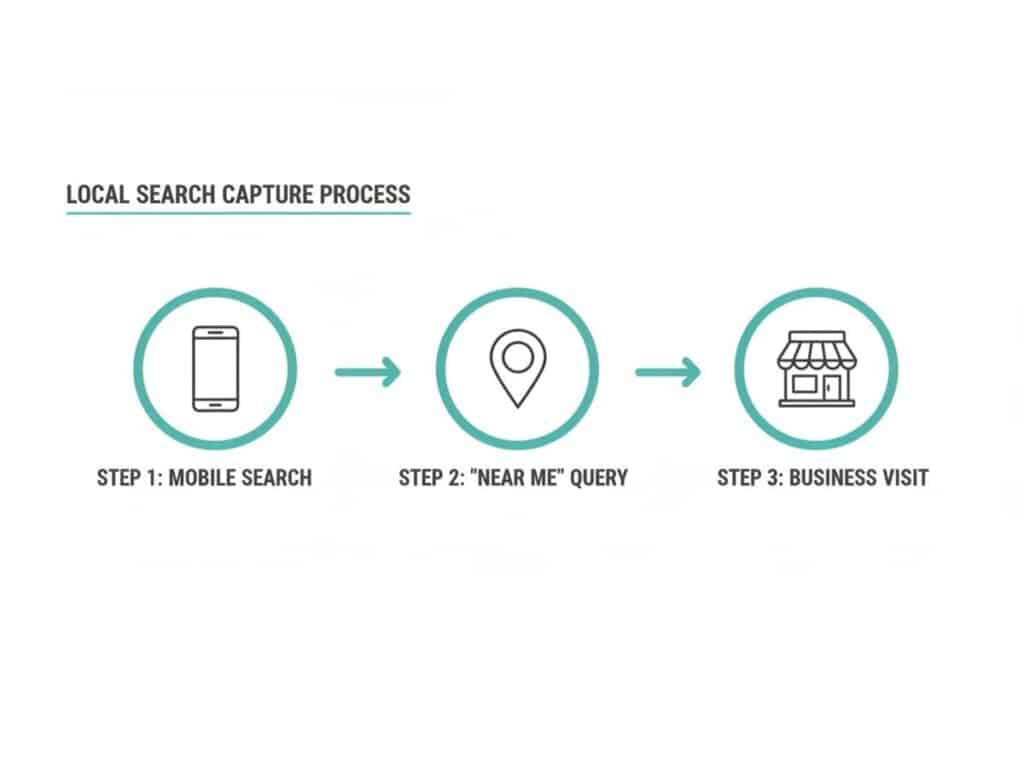
As you can see, a “near me” search often leads directly to a visit, underscoring the importance of prioritizing keywords that signal immediate action.
Gauging Commercial Intent
This may be the single most important part of validation. Commercial intent is about determining if the searcher is browsing or ready to buy. Some keywords attract researchers; others attract buyers.
A low-volume keyword with high commercial intent is almost always more valuable than a high-volume keyword with low intent. The goal isn’t just traffic; it’s profitable action.
You can spot intent by looking for specific “qualifiers” in the search phrase:
- High Intent Qualifiers: Words like “emergency,” “for hire,” “quote,” “near me,” or “open now” are strong buying signals. Someone searching for an “emergency plumber in Miami” needs immediate help.
- Low Intent Qualifiers: Phrases like “how to,” “ideas,” “what is,” or “DIY” suggest the searcher is in a research phase and not yet ready to purchase.
A Framework for Prioritization
To bring it all together, use a simple scoring system to turn your analysis into an actionable priority list. This removes guesswork and focuses your efforts where they’ll have the most impact.
Local Keyword Prioritization Scorecard
| Keyword | Relevance Score (1-5) | Estimated Local Volume | Commercial Intent (High/Med/Low) | Final Priority |
|---|---|---|---|---|
| emergency dentist dallas | 5 | 250 | High | High |
| best root canal cost | 4 | 70 | Med | Med |
| tooth pain at night | 3 | 120 | Low | Low |
| dental implants near me | 5 | 300 | High | High |
| how to whiten teeth | 1 | 450 | Low | Ignore |
By running your keywords through a scorecard like this, a clear hierarchy emerges. You can quickly identify which terms offer the best combination of relevance, achievable volume, and buying intent. This methodical process ensures your SEO efforts are directly tied to your business goals from day one.
Get In Touch
Bringing Your Local Keywords to Life
You’ve built a prioritized keyword list. Now it’s time to put that research into action by weaving your terms into your most valuable digital assets. This is where your spreadsheet becomes a powerful signal to search engines, establishing you as the authority for your services in your area.
The goal is to create a seamless experience where your website and Google Business Profile speak the same language. This consistency builds trust with both search engines and potential customers, turning your research into revenue.
Start with Your Google Business Profile
For any local business, your Google Business Profile (GBP) is your most important digital asset. It’s often the first impression a customer gets. Optimizing it with your top keywords is essential.
Focus on these key areas:
- Business Title: When it makes sense and fits Google’s guidelines, naturally including a primary keyword can have a significant impact. For instance, “Oak & Stone Pizzeria | Italian Restaurant” is better than just the business name. Avoid stuffing keywords.
- Business Description: Weave your main service and location keywords into the first few sentences. This is your chance to tell people what you do and where you do it, using the exact phrases they’re searching for.
- Services Section: This is a goldmine for relevance. Use this section to list every service you offer, incorporating the specific keyword variations you found during your research. Be as detailed as possible.
These updates directly influence your visibility in the Google Local Pack, where the majority of local clicks and calls originate.
Build Out Location-Specific Content on Your Website
While your GBP drives immediate visibility, your website is where you build authority and convert leads. Your keyword research should be the blueprint for your website’s content and structure.
A common mistake is lumping all services onto a single page. A far more effective strategy is to create a dedicated page for each core service, optimized for its own set of local keywords.
Actionable Example: Imagine a landscaping company in Denver. A generic “Services” page is ineffective. A smarter site structure would include distinct pages targeting specific searches:
yourwebsite.com/lawn-care-denveryourwebsite.com/sprinkler-repair-aurorayourwebsite.com/tree-trimming-lakewood
Each page must have unique, valuable content that answers the specific questions a customer searching for that service would have. Ensure your target keyword appears in the page title, URL, H1 heading, and naturally within the text. This focused strategy sends clear signals to Google about your expertise and provides a better user experience, ultimately driving qualified local leads.
Get In Touch
Lingering Questions on Local Keyword Research
Even with a solid plan, a few questions always come up. Clarifying these will help you sharpen your strategy and ensure your efforts pay off. Here are the most common ones.
How Often Should I Refresh My Local Keywords?
Your keyword list is a living document, not a one-time project. Conduct a full audit at least once a year or whenever your business changes significantly (e.g., adding a new service). This provides a fresh, high-level view of the market.
However, a quick check-in every quarter is also wise. This helps you stay on top of seasonal trends—like “emergency AC repair” in July—and spot new search patterns before your competitors. Consistent monitoring is how you uncover hidden opportunities.
Should I Go for High Search Volume or Pinpoint Relevance?
For local SEO, relevance almost always wins. It’s tempting to chase a keyword with massive search volume, but if the searcher’s intent doesn’t match your services, the traffic is worthless.
A hyper-specific, low-volume keyword with clear buying intent is worth far more than a high-volume term that attracts casual browsers. Your goal is not clicks; it’s profitable customer actions.
Consider a search like “vegan birthday cakes in Lincoln Park Chicago.” The monthly search volume may be low, but the person searching is ready to buy now. That one search is infinitely more valuable than a hundred searches for a broad term like “bakeries in Chicago.” Always prioritize keywords that connect directly to a sale.
What’s the Best Way to Handle Keywords for Multiple Locations?
If you have more than one business location, a one-size-fits-all keyword list will fail. While your core services are the same, each location requires a unique, tailored keyword strategy to succeed.
This means you must research the specifics for each area:
- Unique neighborhood terms that only locals use.
- Nearby landmarks or major streets people use as reference points.
- Different search patterns from one town to the next.
Most importantly, every physical location needs its own dedicated page on your website, optimized for its unique local keyword set. This must be paired with a separate, fully optimized Google Business Profile for each address. This is non-negotiable for signaling clear local relevance to both Google and your customers.
Ready to stop guessing and start ranking? Galant Studios specializes in data-driven local SEO strategies that connect your business with customers who are actively searching for your services. Visit us at https://galantstudios.com to see how we can build a powerful online presence for your brand.