If you’re serious about attracting local customers, you need to master local citations. Think of them as digital breadcrumbs scattered across the internet, each one leading back to your business. Every citation mentions your business’s Name, Address, and Phone number—the critical trifecta known in the industry as NAP data.
These mentions appear everywhere from online business directories and social media profiles to local blogs and news sites. They act as verification signals for search engines like Google, and getting them right is non-negotiable if you want to climb the local search rankings and get noticed by customers in your area.
What Are Local Citations and Why Do They Matter So Much?
Imagine you’re trying to convince a new acquaintance that you live at a specific address. If one person vouches for you, that’s a start. But if ten reputable neighbors all confirm your address, your claim becomes indisputable. That’s precisely how local citations work for your business in the eyes of Google.
Every time Google’s crawlers find your consistent NAP information online, it’s another vote of confidence that confirms your business is legitimate and located exactly where you say it is. This is absolutely critical because Google’s number one job is to serve users the most accurate and trustworthy local results possible.
When search engines find the exact same NAP data across dozens of authoritative sources, it builds immense trust. That trust translates directly into higher rankings in local search results, especially in the coveted Google Map Pack where ready-to-buy customers are looking.
Structured vs. Unstructured Citations: Know the Difference
Citations come in two main flavors. Understanding both is key to building a powerful, well-rounded strategy that drives results.
Structured Citations: These are your clean, organized business listings. Think of your profile on Yelp, Bing Places, or a niche-specific directory like Avvo for attorneys. Your business details are slotted into predefined fields (Name, Address, Phone), making it incredibly easy for search engine bots to read and verify your information.
Unstructured Citations: These are more organic, conversational mentions. You’ll find them in blog posts, local news articles, or social media updates. For example, a food blogger might write, “We had the best tacos at Joe’s Cantina on 123 Main Street today!” While less formal, these natural mentions are powerful trust signals, proving your business is a real, active part of the local community.
The Real-World Impact on Your Local SEO
I can’t overstate this: building an accurate and consistent local citation profile is one of the most foundational tasks in local SEO. These mentions help search engines confirm who you are and where you’re located. Without that fundamental trust, ranking for valuable “near me” searches is an impossible climb.
The image below shows the core pillars of Local SEO. Notice how citations directly influence both on-page signals and link building—two of the biggest pieces of the puzzle.

This drives home the point that citations aren’t just a box to check; they are woven into the very fabric of a winning local strategy, validating your business information and strengthening your entire digital presence.
At the end of the day, every accurate citation you build is another piece of evidence telling Google, “This business is real, it’s active, and it’s located right here.” This validation is a non-negotiable part of any serious local marketing effort.
Ultimately, a robust citation profile connects you with customers actively searching for your services right now, in your neighborhood. It’s a core component among other local search ranking factors that you simply cannot afford to ignore.
Creating Your Foundational Citation Profiles
Your journey to build local citations begins by establishing a single, authoritative source of truth for your business information. This isn’t just a preliminary step; it’s the most critical action you’ll take. Your Google Business Profile (GBP) must be that master record—the blueprint from which all other citations will be built.
Getting this profile perfect from day one saves you from the future nightmare of cleaning up inconsistent data that can sabotage your local SEO efforts before they even start. Accuracy here is non-negotiable.
The power of local search is undeniable—46% of all Google searches are from people looking for local information. For a business trying to capture that local market, a platform like Google Business Profile isn’t just an option; it’s essential. In fact, studies show that signals from a well-managed GBP account for roughly 32% of what determines local pack rankings.
Master Your Google Business Profile
Think of your GBP as the digital front door to your business. It’s often the very first impression a potential customer gets, so every detail must be meticulously optimized for both accuracy and persuasion. This profile feeds crucial information directly into Google Search and Google Maps.
A truly optimized GBP is more than just a list of your basic details; it’s a dynamic sales tool.
- Select Precise Categories: Don’t just pick “Restaurant.” If you’re a family-owned Italian place, choose “Italian Restaurant” as your primary category. Then, add secondary categories like “Pizza Restaurant” or “Catering” to capture every relevant search.
- Craft a Compelling Description: Use this space to tell your story. What makes you different? Mention your core services and weave in local keywords naturally. For instance, instead of “We fix pipes,” try “Your trusted family plumber serving the Anytown area for over 20 years.”
- Upload High-Quality Visuals: Show, don’t just tell. Post professional photos of your storefront, your team in action, happy customers, and your products. Regular photo uploads also signal to Google that your business is active and thriving.
To ensure you’re leveraging every feature, check out our comprehensive guide on how to optimize your Google Business Profile.
This workflow illustrates the right way to establish your core online presence from the start.
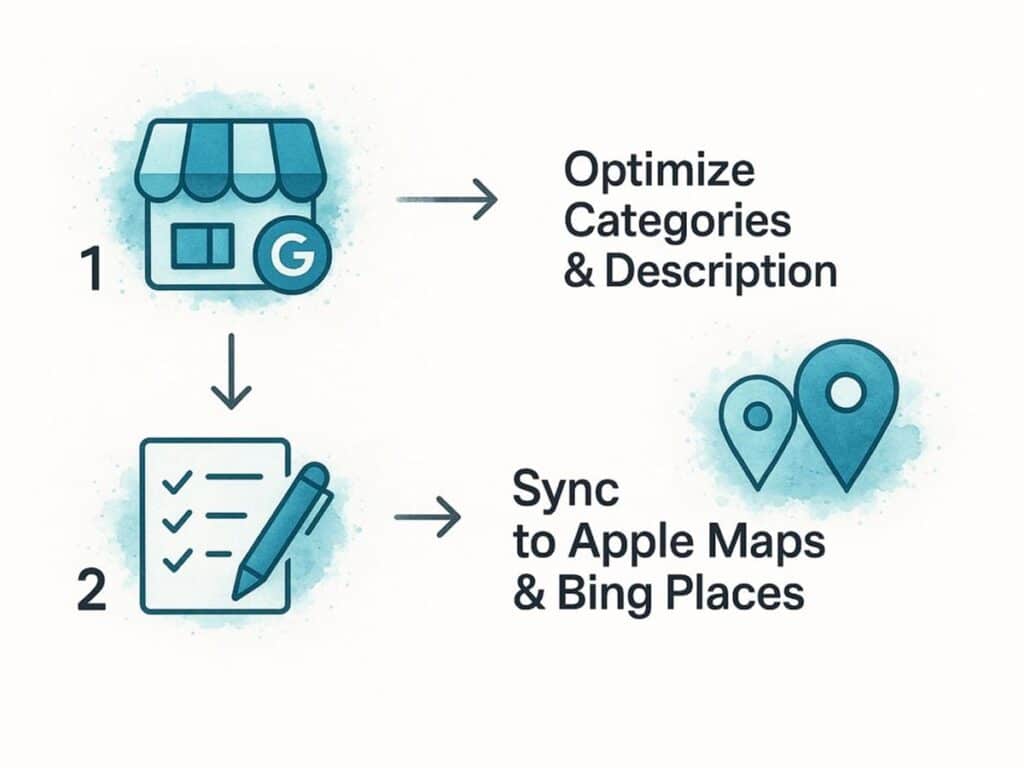
Starting with a perfectly tuned Google Business Profile and then mirroring that information across other major platforms is how you build a consistent and trustworthy digital footprint that wins customers.
Expand to Other Core Platforms
Once your Google Business Profile is polished and perfect, your next mission is to replicate that exact information on other key platforms. This is not the time for variation. The goal is to create a consistent echo of your NAP (Name, Address, Phone Number) data across the web’s most authoritative directories.
Before you chase dozens of smaller sites, lock down your presence on a handful of foundational platforms. These are the major data aggregators and high-authority directories that search engines trust implicitly.
Top Foundational Citation Sources
This table outlines the most critical platforms to claim and optimize first. Securing these listings will establish the core of your business’s online identity.
| Platform | Type | Key Optimization Point |
|---|---|---|
| Google Business Profile | Search Engine & Maps | This is your master record. Every detail must be 100% accurate and fully optimized. |
| Apple Maps | Maps & Navigation | Essential for iPhone users. Ensure your pin location is precise for “Get Directions.” |
| Bing Places | Search Engine & Maps | Microsoft’s equivalent to GBP. Claiming it ensures visibility for Bing search users. |
| Social & Directory | The business “About” section must match your GBP exactly, including the address and hours. | |
| Yelp | Review & Directory | A major source of reviews and business discovery. Complete every field available. |
| Yellow Pages | Legacy Directory | Still a trusted source of business data for both consumers and data aggregators. |
By securing these core profiles first, you build a solid, consistent base. This initial effort ensures that as you continue to build citations on more niche and industry-specific sites, you’re reinforcing an accurate and authoritative identity—which is exactly what search engines reward.
Actionable Tip: Treat your Google Business Profile as the definitive source. When you’re creating or updating listings on Apple Maps, Bing Places, or any other directory, have your GBP open and copy the details precisely. This discipline—from the business name down to the suite number—is the bedrock of a successful citation strategy.
How to Audit and Clean Up Your Existing Citations
Before you can build a strong citation profile, you have to demolish the faulty foundation that might already exist. Inaccurate listings—think old addresses, wrong phone numbers, or slight variations in your business name—aren’t just harmless errors. They are actively damaging your local SEO.
These inconsistencies create confusion for search engines and potential customers, eroding the trust you need to rank well. A full citation audit isn’t optional; it’s the critical first step to building a trustworthy online presence. The process involves hunting down every mention of your business online and methodically correcting every discrepancy. Without this clean slate, any new citations you build will just add to the chaos.

Uncovering Inconsistent Listings
Your first task is to find every single place your business information appears online—the good, the bad, and the ugly. You can tackle this with a mix of manual searching and powerful automated tools.
If you’re going the manual route, get comfortable with Google search operators. They are surprisingly effective for digging up forgotten listings.
Try searching for variations like:
"Your Business Name" + "Old Address""Your Business Name" -site:yourwebsite.com"Your Old Phone Number"
These simple searches often unearth outdated profiles you forgot existed or listings created by data aggregators without your knowledge. If that sounds tedious, tools like Moz Local or BrightLocal can do the heavy lifting, scanning hundreds of sites at once and delivering a clear report of all inconsistencies.
Prioritizing and Correcting Errors
Once you have your master list of citations, it’s time to triage. Not all errors are created equal. An incorrect suite number is a minor problem compared to a completely wrong street address or an old phone number that now rings to a different business.
The most critical errors to fix immediately are inconsistencies in your core NAP (Name, Address, Phone Number). These are the foundational data points search engines use for verification. Discrepancies here send the strongest negative signals.
I recommend creating a simple spreadsheet to stay organized. Track the URL of each incorrect listing, the specific error, and the date you requested a correction. Start with the heavy hitters—Google Business Profile, Bing Places, and Yelp—because changes on these high-authority sites carry the most weight. Most directories have a “suggest an edit” or “claim this business” option you can use to update your info. This meticulous work is the core of effective local business listing optimization.
Beyond just cleaning up your citations, consider how this fits into your larger strategy. A comprehensive an SEO technical audit service can uncover deeper issues that might be holding back your local search performance. Taking the time for a thorough cleanup ensures your efforts to build local citations are put on a solid, reliable foundation, maximizing your chances of boosting your rankings.
Uncovering Your Best Citation Opportunities
With your existing citations cleaned up, it’s time to shift from defense to offense. This is where you gain a competitive edge—by finding powerful, high-value citation opportunities that your competition has overlooked. We’re moving beyond simple consistency and into building genuine relevance and authority by getting your business listed in the right places.
The goal isn’t just to rack up a high number of listings. Think quality over quantity. A single mention on a highly respected, industry-specific website sends a much stronger signal to Google than a dozen listings on generic, low-quality directories.
Look for Niche and Industry-Specific Directories
Every industry has its own trusted online hubs. If you run a law firm, a listing on a site like Avvo is non-negotiable. For a home services contractor, a well-built profile on Houzz tells search engines exactly what you do and builds trust within your field. Think of these platforms as powerful, third-party endorsements.
To find these gems, put yourself in your customers’ shoes. Where would they look online to find a specialist like you?
- Start with simple searches like
"[your industry] directory"or"[your city] [your service] business listings". - Analyze the top-ranking competitors for your most important keywords. Use an SEO tool to see where they’re listed—their backlink profile is often a ready-made roadmap for your citation strategy.
- Don’t forget about professional associations. If you’re a member of one, they almost always feature a member directory that is a highly trusted source of information.
By getting your business on these niche sites, you’re not just adding another citation. You’re placing your business in a contextually relevant environment, which is precisely what Google wants to see.
Tap Into Hyper-Local Platforms
While industry relevance is crucial, local relevance is equally critical. You have to prove to search engines that you are a legitimate, active part of the community you serve. This means digging for citation sources specific to your city, county, or even your neighborhood.
A listing on your local Chamber of Commerce website, such as the U.S. Chamber of Commerce directory, or a mention in a neighborhood blog carries significant weight. These hyper-local sources validate your physical connection to the area you claim to serve—a cornerstone of local SEO.
Start exploring these local avenues:
- Chamber of Commerce: Joining your local chamber is a classic for a reason. It almost always comes with a listing in their trusted online directory.
- Local Business Associations: Seek out groups specific to your city or even your particular business district.
- Community Blogs and News Sites: Sponsoring a local Little League team or getting featured in a story can result in a powerful, natural citation that also builds priceless community goodwill.
How to Judge the Quality of a Citation Site
Let’s be clear: not all directories are created equal. Before you spend a single minute creating a profile, you need to quickly assess whether a site is worth your time. A low-quality, spammy directory can do more harm than good.
A quick check of a site’s Domain Authority (DA) using a tool like the MozBar can give you an instant read on its credibility in the eyes of search engines.
Focus your energy on platforms that are well-established, look professional, and are directly relevant to your business or location. This selective approach ensures that every citation you build is a positive asset, helping to lift your local search rankings. And remember, your digital strategy is only one part of local visibility. Exploring creative small business sign ideas can also make a huge difference in your physical presence and brand recognition right in your own neighborhood.
Maintaining Your Citations for Long-Term Success
Building local citations isn’t a “set it and forget it” task. If you treat it like a one-time project, you’re leaving your local search performance vulnerable to slow decay. Inaccuracies will inevitably creep in over time, silently eroding the authority you worked so hard to build. The only way to protect your investment is to have a solid system for ongoing management.

Think about how dynamic the web is. Data aggregators can overwrite your correct information with old data. New directories scrape whatever details they can find, which might be outdated. Even well-intentioned users can suggest edits that introduce errors. A proactive approach is the only defense against this digital entropy.
Setting Up a Monitoring System
The smartest way to protect your work is to set up alerts that notify you when and where your business is mentioned online. This allows you to catch inconsistencies immediately, before they have a chance to confuse search engines and damage your rankings. Don’t wait for your traffic to dip before you investigate; by then, the damage is already done.
You can get an effective monitoring process running with minimal effort.
- Google Alerts: This free tool is the perfect starting point. Create alerts for your business name, common misspellings, your address, and your phone number. Google will email you whenever it finds a new mention, giving you a chance to quickly check it for accuracy. You can learn more on the official Google Search Help page.
- Mention Monitoring Tools: For a more powerful solution, dedicated brand monitoring services can track mentions across the entire web, including social media, giving you a comprehensive view of your digital footprint.
By setting up a simple alert system, you move from tedious manual audits every few months to a state of continuous, low-effort awareness. This is the key to maintaining citation accuracy for the long haul.
Integrating Citation Management Into Your Workflow
To be truly effective, citation maintenance can’t be an isolated task. It must be woven into your everyday local SEO activities, creating a unified strategy where every piece supports the others. After all, consistency across every platform your customers see is what builds trust with both people and search algorithms.
Here’s how to make it part of your regular routine:
- Perform Quarterly Spot-Checks: You don’t need a deep audit every month. Just spend a few minutes each quarter checking your most critical citations—think Google, Apple Maps, and Yelp. This ensures your foundational listings stay perfectly aligned.
- Combine with Review Management: While you’re responding to customer reviews on a platform, take an extra five seconds to glance at the NAP information on that listing. It’s a simple habit that turns a daily task into a quick verification checkpoint.
- Align with GBP Posts: When you create a new Google Business Profile post about a sale or event, double-check that your core business information on other key directories reflects the same reality.
This integrated approach makes citation management feel less like a chore and more like a natural part of running your business online. It’s this discipline that will sustain and amplify the results of your initial efforts to build local citations.
Common Questions We Hear About Building Local Citations
Even with a solid plan, a few questions always pop up once you start the hands-on work of building citations. Knowing the answers ahead of time will help you set realistic expectations and ensure your effort pays off. Here are the most common things business owners ask us.
Think of this as your quick-start FAQ to navigate the process, sidestep common pitfalls, and get the most out of your time and investment.
How Long Until I Actually See Results?
This is, without a doubt, the number one question we get. Building citations is a fundamental piece of your SEO puzzle, but it’s a marathon, not a sprint. It can take anywhere from a few weeks to several months for search engines like Google to find, process, and ultimately trust your new or updated business listings.
The speed of your results depends on factors like the authority of the directory site and how often Google crawls it. As a general rule, you can expect to see noticeable improvements in your local search presence after three to six months of consistent, focused effort. Patience is crucial.
Our Take: I often tell clients to think of citation building like planting a garden. You do the hard work upfront—preparing the soil (auditing) and planting the seeds (building new listings)—but you don’t get a harvest overnight. It takes time and consistent nurturing before you see real growth.
What’s the Difference Between Structured and Unstructured Citations?
It’s crucial to understand the two main types of citations because a healthy local SEO strategy needs a mix of both to be truly effective.
Structured Citations: These are your classic business listings where your NAP (Name, Address, Phone Number) data is entered into specific, designated fields. Think of your profiles on Yelp, Bing Places, or a niche-specific site like Avvo for lawyers. The clean, predictable format makes it incredibly easy for search engines to read and verify your information.
Unstructured Citations: These are more organic, in-the-wild mentions of your business. You might find an unstructured citation in a local news article about a community event you sponsored, a blog post from a local influencer who reviewed your shop, or even just a mention on a neighborhood forum. These are powerful because they act as natural endorsements, signaling to search engines that your business is a real, active part of the local conversation.
Should I Build These Manually or Use a Service?
Another common crossroads is deciding whether to roll up your sleeves and build citations yourself or pay for a service to handle it. For most businesses, the most effective approach is a combination of both.
Doing it manually gives you complete control. This is the only way to get listed on those hyper-local blogs, community portals, or niche industry directories that automated tools often miss. It’s perfect for securing a handful of high-quality, highly relevant listings that your competitors might not have.
On the other hand, services like BrightLocal or Yext are fantastic for handling the core, foundational directories at scale. They can get you listed across dozens of major sites efficiently, saving you a tremendous amount of time.
The best strategy? Use a service to cover the basics and ensure consistency across the big players. Then, dedicate your own time to manually hunt down and secure those unique, high-impact opportunities that give you a true competitive advantage. This hybrid approach gives you both scale and precision.
Ready to stop guessing and start ranking? The experts at Galant Studios can build a powerful, accurate citation profile that drives real results for your business. Let’s create a local SEO strategy that puts you ahead of the competition. Book a call