
Finding low-competition keywords is your secret weapon for attracting high-intent traffic without fighting a losing battle against industry giants. Think of it as finding an unguarded side entrance to a packed stadium. This strategy allows newer or smaller sites to get seen, drive targeted traffic, and build authority by focusing on search queries where user intent is high, but the competition is surprisingly low.
The Strategic Edge of Low Competition Keywords

It’s tempting to chase keywords with massive search volumes. The allure of capturing a huge audience is powerful, but this path often leads to a frustrating, uphill battle against high-authority domains you can’t outrank. The result? A lot of effort for little to no return on your investment.
There’s a smarter way to play the game. By shifting your focus to less contested search terms, you’re not taking a shortcut; you’re making a calculated, strategic move. You’re aiming to connect with an audience that has already done their initial research and is now looking for specific solutions. These users are typing in longer, more descriptive phrases—the long-tail keywords that convert.
The Power of Specificity
Search behavior has evolved. People aren’t just typing “running shoes” into Google anymore. They’re asking detailed questions like, “best trail running shoes for flat feet and plantar fasciitis.” This natural, conversational approach to search opens up a massive field of opportunities for businesses that know how to listen and create content that directly answers those precise needs.
By focusing on low-competition keywords, you are not settling for less traffic. You are strategically positioning your content to attract a higher-quality audience—one that is far more likely to convert because your content is the exact solution they’re looking for.
Consider the difference in intent. A user searching for “marketing” is just exploring. But a user searching for “how to create a marketing budget for a small business”? That person has a problem they need to solve right now. This is precisely where a low-competition keyword strategy gives you an unbeatable advantage.
Debunking the Volume Myth
A common misconception is that low search volume equals low value. This couldn’t be further from the truth. In reality, these highly specific queries often have a much higher conversion rate. Which would you rather have: a thousand visitors with a vague interest, or ten visitors who are actively searching for the exact product you sell?
The data is clear. Low-competition, long-tail keywords are the engine of modern search, driving a staggering 70% of all search traffic. Those short, highly competitive “head” terms only account for the remaining 30%. You can explore these keyword traffic statistics to see just how significant this distribution is.
The goal is to build momentum. By securing rankings for these attainable keywords one by one, you create a snowball effect. These small wins accumulate, boosting your site’s overall authority and establishing a solid foundation for sustainable, long-term growth.
High Competition vs Low Competition Keyword Strategy At a Glance
| Metric | High Competition Strategy | Low Competition Strategy |
|---|---|---|
| Primary Target | Short-tail keywords (1-2 words) | Long-tail keywords (3+ words) |
| Search Volume | Very high (10,000+ monthly) | Low to moderate (10-1,000 monthly) |
| Competition | Extremely high (industry leaders) | Low (smaller blogs, forums) |
| User Intent | Broad, often informational | Highly specific, often transactional |
| Conversion Rate | Low | High |
| Time to Rank | Long (months or years) | Short (weeks or months) |
| Content Required | Extensive, highly authoritative | Niche-focused, highly targeted |
Ultimately, choosing a low-competition strategy isn’t about avoiding a fight; it’s about choosing the right battles you can definitively win.
Building Your Keyword Discovery Toolkit

Uncovering winning keywords isn’t about finding one magic tool; it’s about assembling a versatile research arsenal. To succeed, you must approach the process from multiple angles, combining hard data with a genuine understanding of your audience’s mindset. A powerful strategy blends free, readily available sources with the analytical muscle of paid platforms.
Your objective is to move beyond simply compiling long lists of terms. You’re going to learn how to interpret the signals search engines provide, transforming that raw information into an actionable content roadmap. This approach will empower you to find high-potential keywords, regardless of your experience level.
Starting with Free and Powerful Sources
Before you spend a dime on tools, remember that the best intelligence comes directly from the source: Google itself. These free methods are incredibly valuable because they reveal what real people are actually searching for, giving you a direct line into their needs and the exact language they use.
A fantastic starting point is to type a broad “seed” keyword into the Google search bar. As you type, pay close attention to the Google Autocomplete suggestions. These aren’t random guesses; they are popular, real-time queries that reveal long-tail variations you might never have considered.
Practical Example: If your seed keyword is “project management software,” Autocomplete might suggest “project management software for small teams” or “free project management software with time tracking.” Each suggestion is a potential low-competition keyword.
The “People Also Ask” (PAA) box is another goldmine. These questions spotlight the specific problems and follow-up inquiries people have related to your topic. Each question is a potential keyword or even a subheading for your next article.
- Google Autocomplete: Reveals popular long-tail phrases as users are typing them.
- People Also Ask (PAA): Uncovers related questions and specific informational needs.
- Related Searches: Located at the bottom of the results page, this shows alternative ways people search for the same topic.
If you’re new to this process, this practical guide to keyword research for beginners is an excellent resource for building a strong foundation. Mastering these fundamental techniques is the core of any successful SEO strategy.
Transitioning to Advanced SEO Platforms
While free methods are perfect for brainstorming, you need hard data to validate your ideas and make informed decisions. This is where advanced SEO platforms like Semrush and Ahrefs become indispensable. They provide the critical metrics that allow you to systematically filter, prioritize, and transform a list of hunches into a data-backed plan of attack.
The most important metrics to focus on are Keyword Difficulty, Search Volume, and Cost Per Click (CPC).
Keyword Difficulty (KD): This is an SEO metric that estimates how hard it will be to rank on the first page of Google for a specific keyword. It’s usually scored from 0-100, with lower scores indicating less competition.
A low KD score is your green light. It suggests that the pages currently ranking have less authority or weaker backlink profiles, creating an opening for you to break through. By setting filters to find keywords with a low KD and a reasonable search volume, you can quickly build a list of targets you can actually win. To dive deeper, check out our guide on how to do keyword research.
Filtering for Low-Competition Opportunities
Once you’re inside an SEO tool, the filtering process is where the magic happens. It’s a straightforward yet incredibly powerful way to turn a massive list of 10,000 keywords into a focused list of 100 high-potential targets.
Here’s a practical filter setup you can use as a starting point:
- Keyword Difficulty (KD%): Set a maximum value, such as 30 or less. This immediately focuses your efforts on keywords that are realistically achievable for a newer or smaller website.
- Search Volume: Set a minimum threshold, perhaps 50, to ensure there’s an existing audience. The key is not to set this too high, as high volume almost always correlates with high competition.
- Intent: Filter for “Informational” or “Commercial” intent. This aligns your keyword targets with your business goals, whether that’s building an audience or driving direct sales.
This level of detailed analysis saves you countless hours by pointing you toward keywords you have a legitimate chance of ranking for, accelerating your site’s growth and building authority over time.
Uncovering Keywords in Online Communities

While SEO platforms are essential for quantitative data, they often miss the authentic, nuanced language people use in everyday conversations. These tools are excellent for analyzing what has already been searched, but the real gold is often found in real-time discussions—long before those terms generate significant search volume.
To gain a true competitive edge, you must go where your audience lives online. Think of these communities as living focus groups, filled with your customers’ biggest questions, pain points, and needs—all expressed in their own words. This human-first approach is one of the most effective ways of finding low-competition keywords before they appear on your competitors’ radar.
Locating Your Audience’s Digital Habitats
First, identify where your target audience congregates online. This goes beyond major social media platforms; look for the dedicated hubs where they discuss shared interests and industries. Your mission is to become a silent observer, listening intently to the problems they are trying to solve.
Here are the best places to begin your search:
- Niche Forums: Industry-specific forums, like a community for landscape photographers or classic car restoration, are packed with highly concentrated discussions. The language here is often specialized and full of untapped long-tail keywords.
- Reddit: With its subreddit system, Reddit hosts a community for virtually any topic imaginable. Subreddits like r/personalfinance or r/woodworking are treasure troves of user-generated questions and challenges.
- Quora and Question-Based Sites: Platforms like Quora are literally built on user questions. Exploring the most popular questions in your niche provides a direct line into what information people are actively seeking. To understand how search engines process these queries, this Wikipedia page offers a detailed explanation of their inner workings.
By immersing yourself in these environments, you move beyond generic industry jargon and discover the exact phrases real people use when they’re stuck. This is the raw material for content that doesn’t just rank, but truly resonates and connects with your audience.
A Framework for Mining Community Conversations
Once you’ve identified promising communities, you need a systematic plan. Randomly scrolling through threads is inefficient. Instead, approach it like a researcher to pinpoint conversations that signal a clear keyword opportunity.
The key is to focus on problem-oriented language. People rarely post to say everything is going great; they show up when they face a challenge they can’t overcome. Searching for specific phrases within these forums and subreddits will yield incredibly relevant results.
This strategy is all about tapping into the “pre-search” phase of the customer journey. You’re uncovering the core problems that lead to a Google search, which positions you to create content that meets them at the very start of their decision-making process.
Use the community’s built-in search function with smart query modifiers to cut through the noise and zero in on posts where users are asking for solutions, advice, or recommendations.
Here are a few powerful search strings to get you started:
| Search Phrase Modifier | Purpose of This Query | Example Application |
|---|---|---|
“how do I solve” | Identifies specific problems users are facing. | “how do I solve” + “peeling deck stain” |
“best alternative to” | Uncovers comparison and competitor-based keywords. | “best alternative to” + “quickbooks for freelancers” |
“is it worth” | Reveals purchase hesitation and validation needs. | “is it worth” + “upgrading to a 4k monitor” |
“any recommendations for” | Highlights demand for specific products or services. | “any recommendations for” + “dog groomer for anxious pets” |
As you find these gems, document the exact phrasing, slang, and terminology. In a DIY forum, someone is far more likely to search for “fix peeling deck finish” than a technical term like “deck stain delamination,” even if they describe the same problem. This authentic language is the foundation of powerful, low-competition keywords—it’s the vocabulary of your audience, not the jargon of your industry.
How to Analyze SERP and Competitor Weaknesses
Finding a keyword with promising metrics in a tool is only step one. The numbers tell you part of the story, but the ultimate truth lies on the Search Engine Results Page (SERP) itself. This is where you must perform manual analysis to determine if you genuinely have a shot at ranking.
Think of yourself as a detective. You’re not just glancing at the top results; you’re actively hunting for clues that signal weakness among the current top-ranking pages. The goal is to spot gaps that your high-quality content can slide right into. To master this, you need to understand how to conduct competitor analysis to identify these opportunities from a mile away.
Spotting the Signs of a Weak SERP
A “weak” SERP is one where the top-ranking pages are not as untouchable as they appear. They have identifiable flaws you can exploit. When you search for your target keyword, you’re looking for specific signs that Google is struggling to find truly authoritative content for that query.
These are the dead giveaways that a SERP is ripe for the taking:
- User-Generated Content: Are results from Quora, Reddit, or other forums on page one? This is a massive green light. It signals a lack of expert-written, comprehensive content on the topic.
- Low-Authority Websites: Do you see sites with a low Domain Authority (DA) or Domain Rating (DR) in the top 10? This is excellent news, suggesting you don’t need a powerful backlink profile to compete.
- Thin or Outdated Content: Click into the top results. Is the content short, poorly written, or clearly published several years ago? Outdated information is a golden opportunity to provide a fresh, comprehensive, and superior answer.
A common mistake is seeing a page-one result and automatically assuming it’s unbeatable. The reality is, many SERPs are filled with pages that rank simply because nothing better exists. Your job is to create that “something better.”
When you find a SERP exhibiting several of these weaknesses, you’ve likely found a high-potential keyword worth pursuing. For a more structured approach, a full guide on competitor analysis in digital marketing can significantly sharpen your evaluation skills.
A Quick Sanity Check: The Keyword Golden Ratio
While a manual eye-test provides qualitative insights, a simple formula can bring a quantitative edge to your decision-making. This is where the Keyword Golden Ratio (KGR) comes in. It’s a data-driven method for finding underserved keywords by comparing the number of pages directly targeting a keyword against its monthly search volume.
The formula is straightforward: divide the number of Google results that have the keyword in their title by the monthly search volume.
A KGR value below 0.25 is the sweet spot—it signals very low competition. Anything between 0.25 and 1.00 is still considered workable. If you get a result over 1.00, it’s probably best to move on, as the keyword is likely too competitive.
To find the “allintitle” number, use an advanced search operator in Google. Simply type allintitle:"your exact keyword phrase" into the search bar. This command tells you exactly how many pages have that precise phrase in their page title, which is a strong indicator of direct competition.
Even keywords with search volumes under 250 per month can be incredibly valuable if they have a low KGR. Ranking on page one for these terms can drive more targeted traffic than you’d expect, simply because the competition is virtually non-existent.
Your SERP Weakness Indicator Checklist
Combining manual observation with a quick KGR calculation creates a powerful, dual-validation system. To make this process consistent and repeatable, use a checklist. This ensures you don’t miss critical weaknesses or get misled by a single tool’s metric.
SERP Weakness Indicator Checklist
This checklist helps you quickly evaluate how competitive a SERP truly is and identify tangible opportunities for your content to break through.
| Weakness Indicator | What It Means | Action to Take |
|---|---|---|
| Forum Results on Page 1 | Indicates a lack of authoritative, long-form content answering the query. | Create a comprehensive blog post that provides a definitive answer to the user’s question. |
| Outdated Content (2+ years old) | The information may no longer be accurate or relevant, leaving an opening for fresh content. | Develop an updated, more thorough resource that includes the latest information and insights. |
| Low Domain Authority Sites | Proves that high domain authority is not a prerequisite to rank for this term. | If your DA is similar or higher, you have a strong chance to outrank them with superior content. |
| Thin or Poorly Written Content | The current top results do not satisfy user intent thoroughly. | Write a detailed, well-structured article that covers the topic in greater depth and quality. |
Low allintitle Results | Very few pages are directly optimized for this exact keyword phrase. | Target the keyword directly in your title, headers, and content to signal strong relevance. |
By meticulously analyzing both the quality of competing content and the hard data behind it, you shift from guessing to making strategic, informed decisions. This is the real secret behind finding low competition keywords that deliver consistent, high-value traffic.
Turning Your Keyword Research Into a Content Machine
Finding a perfect list of low-competition keywords is a major victory, but it’s only the starting line. The real transformation happens when you convert that raw data into a strategic content plan that attracts and converts your ideal audience.
The days of randomly sprinkling keywords across blog posts are over. That outdated approach simply doesn’t work in today’s sophisticated search landscape. To build true authority and achieve stable rankings, you must think bigger. You need to group your keywords logically to cover a topic from every possible angle, proving to search engines that you are the definitive expert they should be sending users to.
Build Authority With the Topic Cluster Model
One of the most powerful frameworks for this is the topic cluster model. This strategy involves creating a comprehensive, in-depth “pillar page” that provides a complete overview of a core topic. This pillar then acts as a central hub, linking out to several smaller “cluster” articles. Each cluster article is laser-focused on one of the specific, long-tail keywords you’ve identified.
Imagine a wheel: your pillar page is the hub, and your cluster articles are the spokes. Each spoke supports and strengthens the hub, while the hub provides context and authority to every spoke. This interconnected structure achieves two critical goals:
- It creates a clean, logical site architecture. This makes it incredibly easy for both visitors and search engine crawlers to navigate your content and understand its topical relevance.
- It funnels authority to your most important pages. By linking all cluster pages back to the main pillar, you’re sending a strong signal to Google that your pillar page is the ultimate resource on the subject. This helps it rank for more competitive, high-volume keywords over time.
With this strategy, a single pillar page can eventually rank for dozens, or even hundreds, of related long-tail keywords. Every new cluster article you publish adds more strength to the entire group, creating a powerful compounding effect on your site’s visibility. If you want to get really structured with this, our guide on building a content marketing strategy template can be a huge help.
Mapping Out Your Pillar and Cluster Content
So, how do you put this into practice? Start by selecting a broad, high-level topic for your pillar page. This should be a subject that is central to your business—something you want to be known for. Then, use your low-competition keyword list to identify the subtopics that will become your cluster articles.
Let’s walk through a practical example.
Scenario: A Financial Advisor for Millennials
Imagine you’re a financial advisor and your research has uncovered several low-competition keywords that young adults are searching for related to investing.
- Your Pillar Page Topic: “Investing for Beginners: A Complete Guide to Building Wealth”
- Your Cluster Content Keywords:
- “how to open a roth ira for the first time”
- “what is the difference between etf and mutual fund”
- “best low-cost index funds for beginners”
- “how much of my paycheck should i invest”
Each of those long-tail keywords becomes its own dedicated article. These posts provide highly detailed answers to very specific questions, and every single one of them links back to your main “Investing for Beginners” guide. You are systematically building an unshakeable foundation of expertise on the entire subject.
When you meticulously map your keywords to a topic cluster model, you’re not just writing blog posts anymore—you’re building a strategic asset. You are creating a library of interconnected resources that systematically answers your audience’s questions, establishing your site as the definitive source.
Nailing Your On-Page SEO
Once your content structure is planned, the final piece is ensuring every page is perfectly optimized. Effective on-page SEO is what makes your content visible and clearly communicates its purpose to search engines.
This means placing your keywords strategically, but always in a way that feels natural and enhances the user experience. Your goal is to make it crystal clear to both Google and your readers what the page is about, without sounding robotic or stuffing keywords where they don’t belong.
Here are the essential on-page elements you must get right:
- Title Tag: This is your most valuable on-page real estate. Place your primary keyword here, as close to the beginning as possible. It’s one of the strongest relevance signals you can send.
- Meta Description: While not a direct ranking factor, a compelling meta description dramatically impacts your click-through rate. Include your keyword and write a persuasive summary that makes users want to click your result.
- H1 Heading: Your main on-page headline should feature your primary keyword and align perfectly with the promise of your title tag.
- H2 and H3 Subheadings: Break up your content with subheadings that include your primary and related keywords. This improves readability and signals relevance for a wider range of related searches.
- Body Content: Weave your keywords and related phrases naturally throughout your text, especially within the first 100 words.
By combining a smart topic cluster strategy with meticulous on-page SEO, you create a repeatable system for success. This is how you transform the hard work of finding low competition keywords into measurable results that drive high-intent traffic and cement your authority in your niche.
Frequently Asked Questions
When digging into keyword research, a few common questions always arise. Let’s tackle some of the most frequent ones to clear up any confusion and help you move forward with confidence.
How Low Should Search Volume Be?
This is the classic “it depends” question, but for good reason. There is no universal “perfect” low search volume because it’s entirely relative to your niche and your site’s current authority.
For a brand new website or one with a low Domain Authority, targeting keywords in the 50-250 monthly search range is a fantastic starting point. It provides a realistic opportunity to rank and generate initial traction.
Ultimately, your focus should be less on raw volume and more on the searcher’s intent and the actual competition you see on page one. I’d much rather have ten visitors who are ready to buy than a thousand who are just browsing.
What Is a Good Keyword Difficulty Score?
Most SEO tools, like Ahrefs or Semrush, use a 0-100 scale for Keyword Difficulty (KD). As a solid rule of thumb, anything under 30 is generally considered low competition. These are the keywords you should prioritize, especially if your site is still building its authority.
Expert Tip: A low KD score is a green light, but it’s not the whole story. Always treat it as a starting point. You absolutely must follow up with a manual review of the SERPs to see who you’re actually up against before you commit to creating content.
Think of these low-competition keywords as the foundation of your entire content strategy. They support your broader topic clusters, which in turn hold up your main pillar pages.
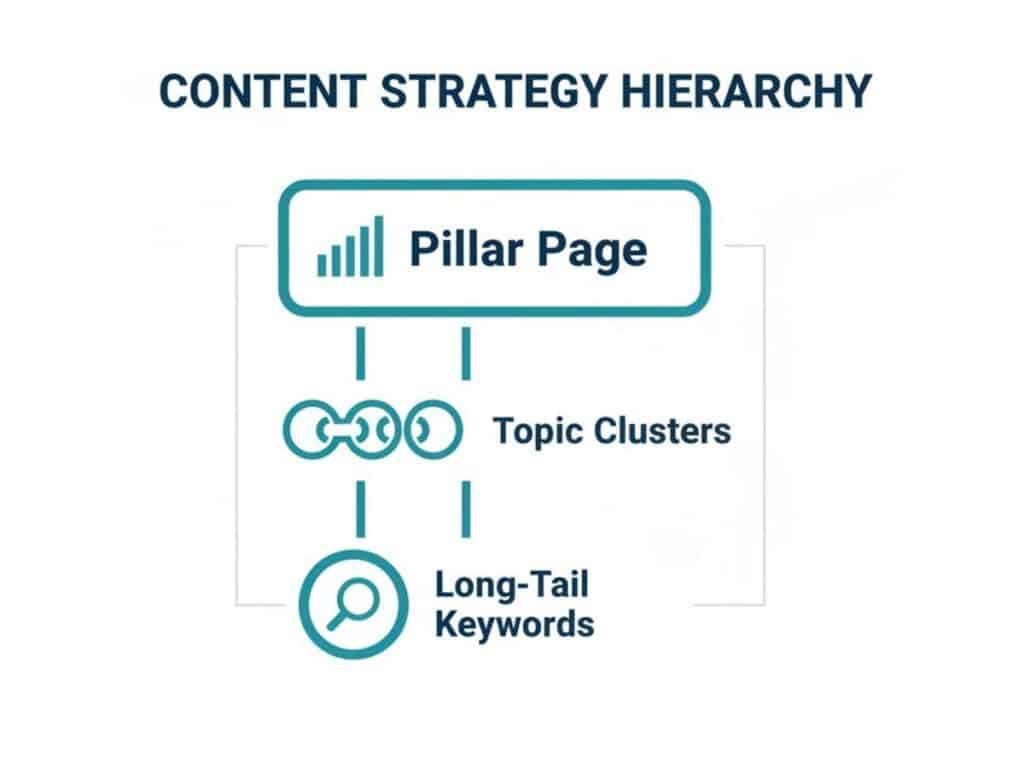
This structure ensures every article you publish works together, building your site’s credibility on a specific subject from the ground up.
How Long Does It Take to Rank?
Ranking timelines are never set in stone, but the beauty of targeting low-competition keywords is the speed. You can often see content hit the first page of Google within three to six months.
That’s a significant improvement over the year or more it can take to even make a dent for a high-difficulty term. Of course, factors like your site’s existing authority, the quality of your content, and your backlink profile will always play a major role in how quickly you climb the ranks.
Ready to stop guessing and start ranking? The expert team at Galant Studios builds data-driven SEO strategies that uncover the high-intent, low-competition keywords your business needs to grow. Visit us online to see how we can elevate your online presence.