Keyword research is the art and science of getting inside your customer’s head. It’s the process of figuring out the exact words and phrases your ideal audience is typing into Google when they’re looking for solutions—the very solutions you provide. This isn’t just a technical SEO task; it’s about turning your website from a passive digital brochure into a powerhouse that actively attracts qualified, ready-to-buy leads.
Why Keyword Research Is Your Growth Blueprint
Many businesses treat keyword research as a simple SEO chore to check off a list. That’s a mistake. In reality, it’s the strategic backbone of your entire marketing plan. Think of it as the most honest form of market research available. When you know exactly what people are searching for, you get a direct, unfiltered look into their biggest challenges, their urgent needs, and, most importantly, their intent to buy. This insight allows you to stop guessing and start creating content that genuinely connects, builds trust, and ultimately drives sales.
The effect of a solid keyword strategy can be massive. To fully grasp its power, it helps to understand the bigger picture of What Is Search Engine Optimization (SEO). If SEO is the engine that drives your online presence, then keywords are the high-octane fuel that makes it run. A smart strategy ensures you’re not just getting random clicks, but attracting the right kind of visitors—the ones who are already looking for exactly what you offer.
The Financial Impact of a Keyword Strategy
It’s easy to get lost in the numbers and see keyword research as a game of chasing high traffic volume. The real value, however, is how it directly fuels your business growth. When you target the right keywords, you align your business’s message with what a user actually wants, which has a dramatic and positive effect on your conversion rates.
Imagine a small, local artisan bakery. Instead of trying to rank for a massive, highly competitive term like “bakery,” they decided to get specific. They focused their efforts on a long-tail keyword: “sourdough bread workshop for beginners.”
This one strategic shift accomplished several amazing things for them:
- They sidestepped their much larger, national competitors by focusing on a specific, profitable niche.
- They attracted an audience with incredibly high purchase intent—people actively searching to spend money on a class.
- Their class bookings shot up, generating a clear, measurable return on their content investment.
This practical example highlights a fundamental truth: great keyword selection puts you directly in front of customers at the very moment they’re ready to make a decision.
Keyword research bridges the gap between what your customers are looking for and what your business offers. It is the most direct way to understand market demand and position your products or services as the ideal solution.
This direct line to customer demand is precisely why organic search is such a powerful channel. According to a study by BrightEdge, organic search drives over 53% of all website traffic globally. That means your keyword strategy directly influences more than half of your potential online audience. Better still, a well-executed SEO strategy, built on the back of smart keyword research, can deliver a return on investment (ROI) as high as 748%. Numbers like that show just how much insightful keyword targeting can drive real, measurable business growth.
Decoding Keyword Metrics for Business Strategy
When you start digging into keyword research, you’ll encounter a lot of different metrics. It’s crucial to understand what these numbers mean not just for SEO, but for your overall business strategy. Each metric tells a part of the story about your potential customers and the market landscape.
| Metric | What It Measures | Why It Matters for Business |
|---|---|---|
| Search Volume | The average number of times a keyword is searched per month. | Indicates the size of the potential market and the brand awareness opportunity for a given topic. |
| Keyword Difficulty | An estimate of how hard it is to rank on the first page of Google for a keyword. | Helps you assess the competitive landscape and decide where to invest your resources for the best ROI. |
| Cost Per Click (CPC) | The average amount advertisers pay for a single click on an ad for that keyword. | A high CPC often signals strong commercial intent, meaning searchers are closer to making a purchase. |
| Search Intent | The “why” behind a search query (e.g., to learn, to find, to compare, or to buy). | Aligning your content with user intent is crucial for attracting qualified leads and improving conversion rates. |
| Traffic Potential | The total estimated monthly organic traffic you could get from ranking #1 for a keyword. | Provides a more realistic picture of potential clicks than search volume alone, as pages rank for many related terms. |
Understanding these metrics empowers you to move beyond simply picking popular keywords. It allows you to build a sophisticated strategy that targets profitable niches, attracts high-intent customers, and ultimately grows your bottom line.
Finding Your Initial Seed Keywords

Every powerful keyword strategy starts with a simple, foundational step: brainstorming a list of seed keywords. These are the broad, essential terms that define your business and what you offer. Think of them as the roots from which your entire keyword tree will eventually grow.
The most common pitfall here is brainstorming from an internal perspective, using company jargon and brand-heavy language. But the real goal isn’t to list what you call your products; it’s to uncover the exact words your customers use when they’re looking for a solution. This is a subtle but critical mindset shift from “what do we sell?” to “what problem are they trying to solve?”
Think Like Your Customer
To unearth truly effective seed keywords, you need to step into your customer’s shoes. The best way to do this isn’t by guessing, but by tapping into the places where they are already telling you what they need, in their own words.
Customer Support Tickets: Your support desk is an absolute goldmine. Sift through tickets and look for recurring questions and pain points. Are people constantly asking “how do I integrate with…” or “is there a way to automate…”? Those phrases are your keyword starting points.
Sales Call Transcripts: Listen to how potential customers describe their challenges during sales calls. A prospect for a project management tool probably isn’t searching for “synergistic workflow optimization software.” They’re more likely to complain about “keeping track of team tasks,” a far more specific and valuable seed term.
Online Forums and Communities: Dive into platforms like Reddit, Quora, or niche industry forums. These communities give you unfiltered access to how real people discuss their problems. You’ll find the exact terminology they use, completely free of corporate spin.
When you ground your seed list in real customer language from the very beginning, you build a foundation based on actual user intent. This makes every subsequent step of your research more effective. For a deeper dive into this initial phase, our guide on how to choose SEO keywords is an excellent resource.
Analyzing Your Competition
Another incredibly practical approach is to see what’s already working for your competitors. Identify their top-performing pages—the ones pulling in significant traffic and ranking well. Then, work backward to figure out the core topics and primary keywords those pages are targeting.
The point here isn’t to just copy your competitors’ keywords. Use their success as a diagnostic tool. It shows you which topics and terms have already been proven to resonate with the audience you both share.
This kind of analysis can reveal gaps in their strategy or opportunities where you can create something far more comprehensive. It also serves as a great reality check. If your top competitors are ranking for a term on your brainstormed list, it’s a strong sign you’re on the right track.
Choosing the Right Keyword Research Tools

With a solid list of seed keywords, you’ve laid the groundwork. Now it’s time to bring in the heavy hitters—the keyword research tools that will expand your list and back your ideas with cold, hard data. This is the crucial step where brainstorming meets strategy, turning your initial thoughts into a measurable, actionable plan.
The market for these tools is booming for a reason: businesses are realizing just how vital this data is for spotting trends and gaining a competitive edge. In fact, according to a report from Coherent Market Insights, the global keyword research tools market is projected to grow significantly, reaching $1.6 billion by 2030.
Finding the right tool in such a crowded space can feel daunting, but it’s worth the effort. A good platform can take a single seed keyword and help you spin it into an entire content strategy, giving you the confidence to make decisions based on data, not just a gut feeling.
Differentiating Between Free and Paid Platforms
The right tool for you really comes down to your budget and the scale of your SEO ambitions. There are great options on both sides of the paywall, and the most effective strategies often use a mix of both.
- Free Tools (e.g., Google Keyword Planner): Perfect if you’re just starting out or working with a tight budget. They give you the basics, like search volume estimates and related ideas, straight from the source. They aren’t as granular as paid options, but they’re fantastic for a quick reality check on your initial concepts.
- Paid Suites (e.g., Ahrefs, Semrush): This is where you get into deep-dive analytics. These platforms offer more precise search volume, sophisticated competition metrics, and powerful features for analyzing search results. For any serious SEO campaign, an investment in one of these tools is almost always essential.
Don’t fall into the trap of thinking more expensive automatically means better. The “best” tool is the one that gives you the data you need in a format you can understand and act on. For many small businesses, a robust free tool is more than enough to get moving.
Remember, the point isn’t just to hoard a massive spreadsheet of keywords. The goal is to find the right keywords—ones that strike the perfect balance between search volume, realistic competition, and direct relevance to your business goals.
For instance, a broad seed keyword like “project management” is a starting point, not a destination. A quality tool helps you splinter that massive topic into hundreds of specific, long-tail keywords that people are actually searching for, uncovering opportunities you’d never find otherwise.
Expanding Your Seed List into Actionable Opportunities
Let’s stick with that “project management” example. If you run a software company, plugging that term into a research tool will instantly reveal the different ways your potential customers think and search.
You’ll see the list expand into distinct categories of intent:
- Informational Queries: “what is a Gantt chart”
- Commercial Queries: “best project management software for small teams”
- Navigational Queries: “Asana login”
- Transactional Queries: “Kanban board software pricing”
This is where the magic happens. You might uncover that a specific phrase like “Gantt chart software for construction” gets around 500 searches a month and has surprisingly low competition. That’s a golden opportunity—a high-intent keyword just waiting for a targeted blog post or landing page.
This process is also your secret weapon for finding chinks in your competitors’ armor. A thorough competitor analysis within digital marketing can show you what they’re ranking for but haven’t fully optimized. That’s your opening. By systematically expanding your list and analyzing the data, you’re no longer guessing; you’re building a data-driven content strategy with a clear path to success.
Decoding Search Intent for Better Content

A raw list of keywords is just data. The real magic happens when you understand the human motivation behind those words. This is called search intent—the “why” behind every query—and it’s what transforms a simple spreadsheet into a roadmap for creating content that genuinely connects with your audience and solves their problems.
If you get this part wrong, you’ll see it in your metrics. High bounce rates and low rankings are the classic symptoms of a mismatch between your content and what the user actually wants. Google’s entire business model is built on user satisfaction, and its algorithms have become incredibly good at figuring out what people are looking for. When you align your content with intent, you’re working with Google, not against it.
The Four Primary Types of Search Intent
To get this right, you first need to understand the fundamental categories of intent. Think of them as different stages in a user’s journey, each one calling for a completely different type of content.
Informational Intent: The user is hunting for information. These queries often look like questions: “how to,” “what is,” or “why.” Someone searching for “how to tie running shoes” wants a tutorial, not a sales pitch for new laces.
Navigational Intent: The user knows exactly where they want to go and is just using the search engine as a shortcut. Think “Facebook login” or “IRS tax forms.” The destination is already decided.
Commercial Intent: Here, the user is in research mode, getting ready to make a purchase. They’re comparing products and looking for expert opinions. You’ll see keywords like “best,” “review,” “top,” or “comparison,” such as in a search for “best running shoes for flat feet.”
Transactional Intent: This is the finish line. The user is ready to pull out their wallet and buy something. Their queries are direct and often include words like “buy,” “price,” “discount,” or a specific product name like “Nike Air Zoom Pegasus 41 price.”
A recent analysis found that informational searches make up the vast majority of all queries. This underscores why a well-rounded B2B content marketing strategy must address every stage of the funnel, not just the final sale.
How to Analyze the SERP for Clues
So, how do you figure out the intent for your keywords? Simple: ask Google. The search engine results page (SERP) is your cheat sheet. It shows you exactly what kind of content Google has already determined is the best fit for a given query.
Go ahead and search for one of your target keywords. For example, if you search for “best noise-cancelling headphones,” the results will be a mix of product listicles from tech review sites, in-depth comparison articles, and e-commerce category pages. That’s a clear signal of commercial intent.
Now, try “how to clean headphones.” You’ll see a completely different landscape: video tutorials, blog posts with step-by-step instructions, and articles from manufacturers’ help centers. That’s informational intent in its purest form.
Analyzing the SERP is like getting a direct answer key from Google. It shows you the content formats, angles, and types of pages that are already winning for your target keyword. Your job is to create something even better.
Once you have a firm grasp on search intent, you’re in a much better position to build a content strategy that doesn’t just attract visitors, but actually guides them toward becoming customers. In modern SEO, focusing on user satisfaction isn’t just a good idea—it’s everything.
Building Your Keyword-Driven Content Roadmap
You’ve gathered a rich set of keywords and decoded user intent. But a raw list won’t move the needle. It’s time to translate those insights into an actionable content plan that aligns seamlessly with your broader business goals.
Prioritization is the linchpin. Some keywords can deliver quick wins, while others are long-term strategic plays. By systematically scoring your keywords, you ensure your resources flow to areas with the highest potential return—rather than chasing overly competitive or irrelevant phrases.
A Framework For Keyword Prioritization
To bring order to your research, assess each keyword against three core metrics. This helps you find the sweet spot where Search Volume, Keyword Difficulty, and Business Relevance all converge.
- Search Volume: Estimates the potential audience size for a keyword.
- Keyword Difficulty: A 1–100 score indicating how tough it is to rank.
- Business Relevance: A 1–5 rating of how closely a term ties to your offerings (5 being a perfect match).
Before moving on, capture your findings in a simple comparison table. Below is a practical template you can adapt to fit your sector and scoring system.
A Practical Keyword Prioritization Matrix
Use this sample matrix to score and prioritize keywords based on the metrics that matter most to your business and SEO efforts.
| Keyword | Monthly Search Volume | Keyword Difficulty (1-100) | Business Relevance (1-5) | Priority Score |
|---|---|---|---|---|
| Project Management Software | 12,000 | 45 | 5 | 4.5 |
| Agile Project Management | 7,500 | 55 | 4 | 3.9 |
| Gantt Chart For Beginners | 3,200 | 30 | 3 | 3.0 |
Use this matrix to filter out low-value terms and home in on keywords that deliver both traffic potential and business impact. You can even tweak the weight of each metric to reflect your unique priorities.
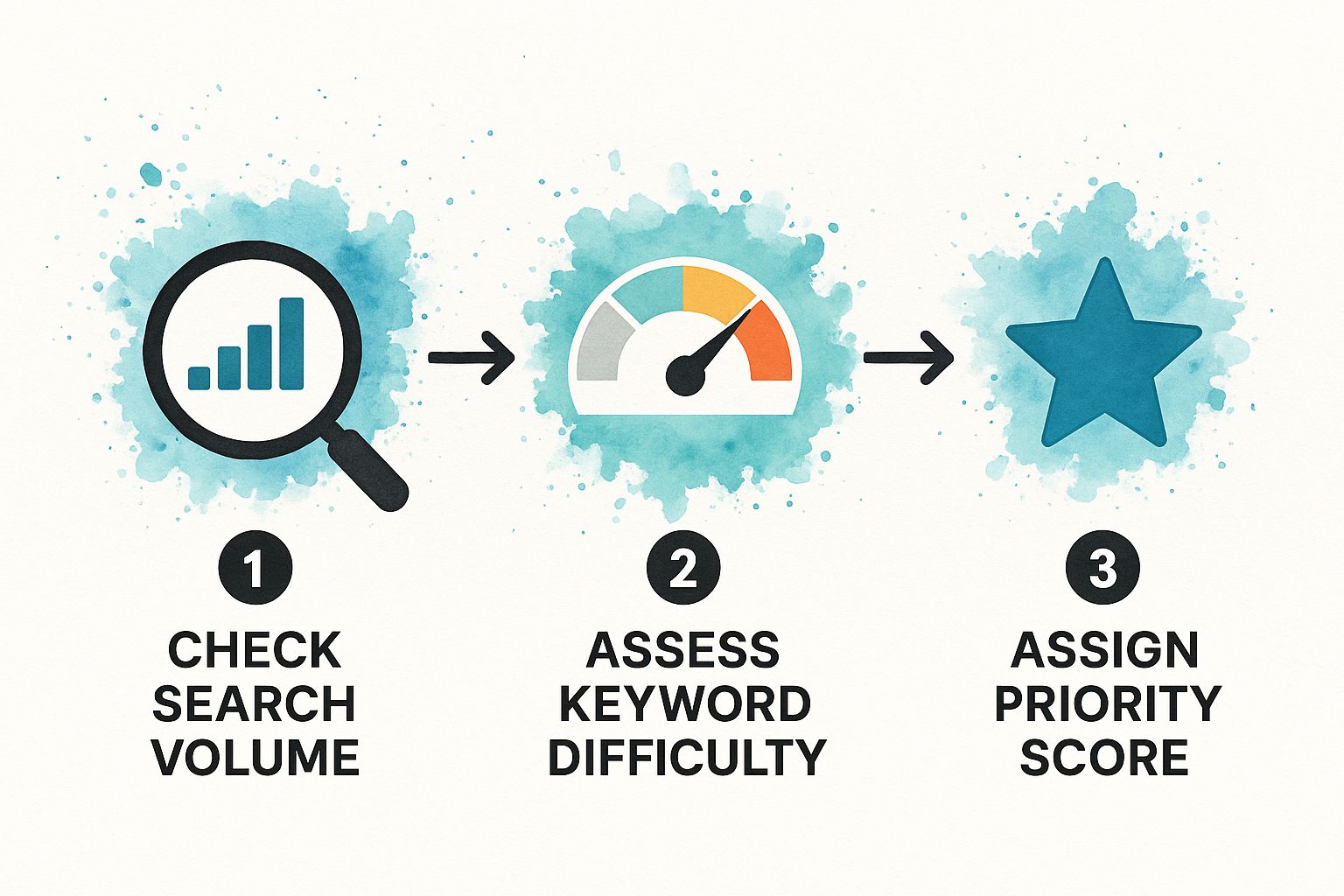
With your scoring in place, the “quick wins” rise to the top—those keywords with solid volume, manageable difficulty, and clear relevance to your core offerings.
From Keywords To Topic Clusters
Once your list is ranked, the next step is to group related terms into topic clusters, each anchored by a central “pillar” page. This powerful approach organizes your content, showcases deep expertise, and signals to search engines that you are an authority on the subject.
By organizing content into topic clusters, you build topical authority. This not only helps individual pages rank but also lifts the visibility of all related content, creating a powerful network effect that strengthens your entire SEO presence.
For example, a company selling project management software might build a comprehensive pillar page on “Project Management Methodologies.” From there, they would create cluster articles on specific subtopics like “What Is a Gantt Chart,” “Kanban Boards for Marketing Agencies,” and “Agile Project Management Benefits.” Each of these articles would dive deep into a niche subtopic, all while linking back to the main pillar page.
Mapping these clusters onto a content calendar transforms a messy spreadsheet into a strategic roadmap. Every article has a purpose, deadlines are clear, and your team remains focused on the keywords that truly drive business growth.
Common Questions About Keyword Research
Even with the best plan, you’re bound to run into a few questions as you dig into keyword research. It’s just part of the process. Getting clear on these common sticking points can help you move forward with confidence and turn all that data into a real, actionable content plan.
Let’s walk through the questions we hear most often.
How Often Should I Do Keyword Research?
Think of keyword research as an ongoing discipline, not a one-and-done project. It’s a cycle.
A full, top-to-bottom audit of your entire keyword strategy is something you should tackle about once a year. This gives you a chance to step back, re-evaluate your core business topics, and make sure you’re still aligned with any big-picture shifts in your market.
On a more regular basis, you should conduct fresh, topic-specific research every single time you create a new piece of content. And at the very least, you should be checking in on your keyword rankings quarterly. This is how you spot new trends and react before your competitors do. If you’re in a particularly fast-moving industry, like e-commerce or tech, you might need to check in even more frequently.
What Is The Difference Between Short-Tail and Long-Tail Keywords?
Getting this distinction right is foundational to a smart keyword strategy.
Short-tail keywords are those broad, simple searches, usually just one or two words long. Think “running shoes.” They get a massive amount of search volume, but the competition is incredibly fierce, and it’s often hard to know what the searcher actually wants.
Long-tail keywords, on the other hand, are much more specific phrases of three or more words, like “best trail running shoes for flat feet.” The search volume is lower, but so is the competition.
The real magic of long-tail keywords is that they signal much clearer, stronger intent. Someone searching for a very specific type of shoe is miles closer to buying than the person who just types “shoes.” A truly effective SEO strategy has to balance both.
Can I Do Keyword Research For Free?
Yes, you absolutely can. While premium paid tools offer a firehose of data and sophisticated competitive analysis, you can build an incredibly solid foundation using nothing but free resources. It’s the perfect way to get started, especially if you’re working with a tight budget.
A few powerful free options include:
- Google Keyword Planner: Gives you search volume estimates and new keyword ideas straight from the source.
- Google Trends: Helps you see how a keyword’s popularity has changed over time, which is great for spotting seasonal or emerging topics.
- Manual SERP Analysis: Don’t underestimate this one. Simply searching your term and looking at the “People Also Ask” boxes and “Related searches” at the bottom of the page gives you a treasure trove of real-world insights into what people are actually looking for.
How Do I Know If a Keyword Is Too Competitive?
Most keyword tools will give you some kind of “Keyword Difficulty” or “Competition” score, usually on a scale of 1-100. If your website is relatively new or doesn’t have a lot of authority yet, a good rule of thumb is to focus on keywords on the lower end of that scale, perhaps below 40.
But don’t just trust the tool. Always do a quick manual check. Google the keyword yourself. Is the first page completely dominated by household names like Wikipedia, major news outlets, or government sites? If so, it’s going to be an uphill battle.
What you’re looking for are SERPs where you see smaller blogs, niche business sites, or forums cracking the top 10. That’s your signal that there’s an opening for you to do the same with superior content.
Ready to turn your keyword research into real results? Galant Studios specializes in expert SEO services that drive traffic and grow your business. Let’s build your strategy together.